Weather Instruments
Bridge weather instruments — anemometer, barometer, thermometer and hygrometer — feed the wind speed and direction display IMO requires on the bridge, and their readings back the routing decisions a master makes long before a forecast confirms them.
What to check on a Weather Instruments.
1 models from Victron Energy in Weather Instruments. Below: the full model list.
What sets bridge weather instruments apart
Weather instruments are the ship's own local sensors, distinct from the forecasts and warnings received over NAVTEX or satellite weather services. A barometer trend over the last three hours often gives an officer of the watch earlier warning of a developing system than the next scheduled forecast broadcast, and a true wind reading corrected for the ship's own heading and speed is something no shore forecast can substitute for when planning cargo operations or a course alteration.
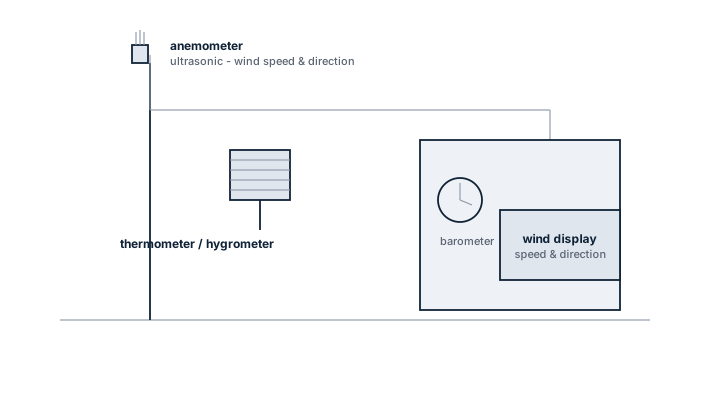
Legend
- anemometer ultrasonic - wind speed & direction
- wind display speed & direction
- thermometer / hygrometer
- barometer
Main components
Anemometer
A rotating-cup or ultrasonic sensor mounted clear of the ship's structure, typically on the monkey island, feeding apparent wind speed and direction to a bridge display that calculates true wind by removing the vessel's own course and speed vector.
Barometer
An aneroid or digital pressure sensor, read regularly and logged so the trend, not just the instantaneous value, is available to the watch officer.
Read the full guide
Thermometer
Air temperature and, separately, sea temperature sensors; sea temperature also feeds engine room cooling water planning and, on some trades, cargo temperature management.
Hygrometer
Measures relative humidity, used together with air and sea temperature to judge fog risk and, on some cargoes, condensation (ship's sweat) risk in holds.
Selection and sizing
Selection turns on mounting location and integration rather than a performance spec war: the anemometer needs a position clear of funnel and superstructure turbulence to give a representative reading, and the whole set benefits from feeding a common bridge display or the ship's INS rather than standing as isolated dial instruments nobody logs consistently. Redundant sensors matter less here than reliable calibration and a location free of airflow disturbance.
Regulations and class
SOLAS Chapter V requires ships to have on board, or to have access to, means of measuring and displaying wind speed and direction, together with means of measuring and recording atmospheric pressure, air and sea temperature — the goal is that a bridge team always has current local weather data available, whether from dedicated instruments or an integrated bridge system. Class notations for enhanced bridge equipment may specify calibration intervals and accuracy tolerances beyond the SOLAS minimum.
Typical faults
- Anemometer sited in turbulent airflow — readings are consistently biased and the crew learns to distrust the display, defeating its purpose.
- Barometer never logged consistently — the pressure trend that gives early warning of a developing system is lost even though the instantaneous reading is available.
- Iced or fouled anemometer cups — stops rotating in freezing spray without an obvious fault indication on the bridge display.
- Uncalibrated humidity sensor — leads to missed condensation risk warnings in holds carrying moisture-sensitive cargo.
What to look for in a supplier
- Sensor housings rated for the vessel's mast-head or monkey-island exposure, including salt spray and, on some trades, icing.
- Integration compatibility with the existing bridge display or INS, rather than a standalone dial nobody references.
- A stated calibration interval and an accessible way for crew to verify readings against a known reference.
- Documented accuracy figures for wind speed, pressure and temperature, not only a working range.
Log the barometer reading at fixed intervals even when nothing looks unusual — the three-hour pressure trend is often the first hint of deteriorating weather, well before any forecast update arrives.
Models in this type.
The best-documented model of each manufacturer first, then the next — 1 of 1 models in Weather Instruments. Every row links to full specifications, documents and service notes.
Manufacturers.
All 16 manufacturers with models of Weather Instruments. Names with a manufacturer page open it; the others open a search across the full library.
All manufacturersAlso in Navigation & Bridge Equipment.
The other equipment types in this category.
One request. A person reads it and replies by e-mail.
Tell us the manufacturer, the model and what you need — a part, a service call, a second opinion. A person reads every request and replies by e-mail.
No details at hand? A photo of the rating plate or the part is enough — simply attach it to the request.
Three things people ask first.
Is Weather Instruments data free?
Yes. Every model page, every guide and every datasheet for this type is readable without an account. An account adds saved searches and requests, nothing is taken away.
My model is missing — what now?
Send us the nameplate. We identify it by hand, add it to the library, and if you need a part or a service, the request is already on our desk.
Can you source a Weather Instruments part?
Yes. Tell us the manufacturer, the model and what you need — a person reads every request and replies by e-mail.