What to check on a Navigation Instruments.
Every other item in this category is a sensor that reports something the bridge team cannot otherwise judge by eye: depth, speed over the water, an audit trail after an incident, whether the watchkeeper is still alert. The instruments in this group are different. They report heading, rudder position and rate of turn, which a competent officer could estimate roughly by watching the wake and the compass card, but not with the precision or the redundancy that steering and collision avoidance actually need. A gyrocompass and a magnetic compass answer…
What sets this group apart
Every other item in this category is a sensor that reports something the bridge team cannot otherwise judge by eye: depth, speed over the water, an audit trail after an incident, whether the watchkeeper is still alert. The instruments in this group are different. They report heading, rudder position and rate of turn, which a competent officer could estimate roughly by watching the wake and the compass card, but not with the precision or the redundancy that steering and collision avoidance actually need. A gyrocompass and a magnetic compass answer the same question - which way is the bow pointing - by two completely different physical principles, and that duplication is the point, not an accident of procurement.
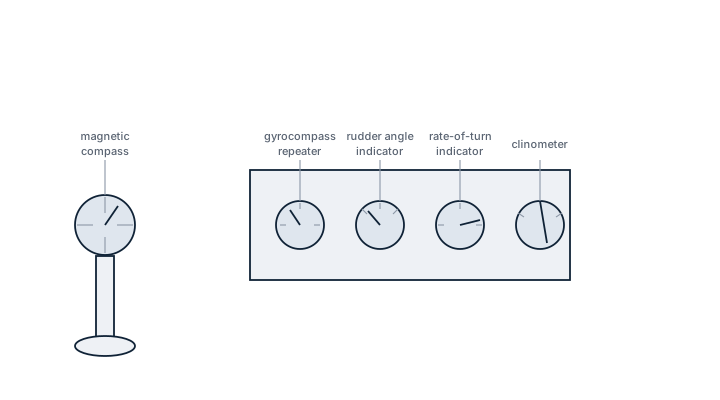
Main components
Magnetic compass
The standard or steering magnetic compass remains mandatory on SOLAS vessels regardless of how much electronic equipment is fitted, because it needs no electrical power and cannot be spoofed or lost to a blackout. It sits on the centreline, away from ferrous structure and electrical cabling, and its deviation card is only valid until the next swing - any change to nearby equipment, cargo, or even a new VHF aerial can shift the deviation enough to matter.
Gyrocompass
A gyrocompass finds true north mechanically or, on modern fibre-optic and ring-laser units, without a spinning mass at all, and feeds a repeater system to radar, ECDIS, autopilot and the VDR. Settling time after a cold start is typically several hours for a spinning-mass unit, which is why it is left running continuously rather than switched off in port.
Rudder angle indicator
This repeats the actual rudder position taken from the steering gear transmitter, not the helm order, so a mismatch between the two is one of the fastest ways to catch a steering gear fault before it becomes a steering failure.
Rate-of-turn indicator
Derived from the gyrocompass or a dedicated rate sensor, this shows how fast the heading is changing in degrees per minute, which matters far more than heading alone when conning in confined water or executing a collision avoidance turn.
Clinometer
A simple pendulum or electronic inclinometer showing list and roll angle, read routinely after loading and watched closely in heavy weather or during a stability incident.
Selection and sizing
These instruments are chosen less on capacity and more on class and accuracy. Gyrocompass heading accuracy is normally specified to within about half a degree at rated latitude, and the unit must be rated to keep working at the ship's maximum operating latitude - some spinning-mass gyros lose accuracy or stop tracking reliably at high latitudes, which matters for vessels trading into polar routes. Magnetic compass card diameter and binnacle type are set largely by class society and flag rules for the vessel's tonnage. Rudder angle and rate-of-turn indicators are matched to the steering gear transmitter type already fitted, so retrofits usually follow the existing steering gear maker rather than an independent choice.
Regulations and class
SOLAS Chapter V sets the baseline: a magnetic compass is required on essentially all seagoing ships, and a gyrocompass with heading repeaters is mandatory above a tonnage threshold set by the convention. A rudder angle indicator is required wherever remote steering control is fitted. Class societies additionally require periodic compass adjustment and a documented deviation card, checked at each annual survey and after any event likely to affect deviation, such as major structural or electrical work near the compass.
Typical faults
- Compass deviation drift - caused by new equipment or cargo near the binnacle; leads to a heading error the watchkeeper may not notice until a position fix disagrees with dead reckoning.
- Gyrocompass settling error - caused by restarting the gyro shortly before departure instead of hours in advance; leads to a heading offset that propagates into radar, ECDIS and autopilot simultaneously.
- Rudder angle transmitter fault - caused by a worn or corroded synchro or a broken feedback linkage; leads to the indicator showing a rudder angle that does not match the helm order, masking a real steering gear problem.
- Rate-of-turn signal noise - caused by a failing gyro repeater or loose wiring; leads to erratic turn indication that can prompt an unnecessary correction from the officer of the watch.
What to look for in a supplier
- Type approval certificates matching the flag state and the intended trading area, including polar-capable gyro models if relevant.
- Compatibility of repeater signal formats with the existing radar, ECDIS and autopilot rather than a proprietary interface that needs extra conversion hardware.
- Availability of spare synchros and transmitters for the rudder angle and rate-of-turn systems, which are the parts that actually fail in service.
- A service network able to carry out compass adjustment and deviation card issue at the ports the vessel actually calls.
When the gyro and magnetic compass disagree by more than the known deviation, trust neither blindly - cross-check against a GPS course over ground and find out which one moved before altering course on the strength of either.