Echosounder/Speedlog
An echo sounder times the return of an acoustic pulse off the seabed to report depth under the transducer, while a speed log reports speed through the water or over the ground using an entirely different sensing principle; grouping them here reflects that both feed the same bridge system, not that they share hardware.
Read more — Echosounder/Speedlog explained ▾
What sets this pairing apart
An echo sounder and a speed log are grouped as one line item in the spares catalogue because they occupy the same slot in the navigation suite and are often bought, tested and replaced together, not because they work the same way. The echo sounder is an active sonar: it fires a short pulse from a hull-mounted transducer, times the return from the seabed, and converts the interval to depth using an assumed speed of sound in water. The speed log measures motion, not distance to a surface, and depending on the technology fitted it may reference the seabed (bottom track), the water mass (water track) or the ground via satellite correction. Confusing the two during troubleshooting wastes time: a log fault never shows up as a blank depth display and vice versa.

Main components
Echo sounder
The transmitter/receiver unit generates the pulse and amplifies the return echo; a hull transducer, usually a magnetostrictive or piezoelectric type mounted in a sea chest, converts electrical energy to sound and back; a display or repeater shows depth in metres or fathoms and typically drives an alarm relay for shallow water.
Speed log
Electromagnetic (EM) logs use a small sensor flush with the hull that measures the voltage induced by seawater flow past a magnetic field, giving speed through water only. Doppler logs transmit acoustic beams angled forward and aft and measure the frequency shift of the return; in shallow water they can bottom-track for speed over ground, and in deep water they fall back to water-track mode. Correlation logs, less common today, cross-correlate two seabed echoes separated in time to derive speed over ground directly.
Selection and sizing
For the echo sounder, the working range, typically 0.5-200 m for coastal work and deeper for offshore units, and transducer beam angle decide how close to a sloping seabed the reading stays reliable; a narrow beam gives a sharper first-return but is more sensitive to trim and roll. For the speed log, the deciding question is whether the operation needs speed over ground close to berths and locks (Doppler with bottom track) or a simple, robust through-water reference for passage planning (EM log). Interface requirements matter as much as sensor accuracy: both units normally output NMEA 0183 or NMEA 2000 sentences to the integrated bridge system, VDR and ECDIS, and the sentence format has to match what the receiving equipment expects.
Regulations and class
SOLAS Chapter V requires ships to carry a device to indicate speed and distance, and a means of ascertaining depth of water, on ships of the sizes specified in the same chapter; the echo sounder and speed log satisfy these two separate carriage requirements. Both are treated as navigational aids subject to annual survey of the navigation equipment fit, and their outputs are logged by the VDR where one is fitted, so an unrepaired fault on either unit becomes visible in the recorded data during a port state control inspection.
Typical faults
| Fault | Cause | Consequence |
|---|---|---|
| Intermittent or lost depth reading | Air bubbles or marine growth over the transducer face, often after dry-docking without proper transducer protection | False shallow-water alarms or complete loss of depth indication in confined waters |
| Speed log reads zero at anchor but drifts under way | EM sensor electrode fouling or a failed zero-set calibration | Incorrect distance-run figures feeding the noon report and passage plan |
| Doppler log loses bottom track offshore | Water depth exceeds the bottom-tracking range of the transducer | Automatic fallback to water-track mode; not a fault if documented, but confuses new watchkeepers |
| NMEA data not reaching ECDIS | Wiring or baud-rate mismatch after a repeater or multiplexer change | Loss of automatic speed/depth input, forcing manual entry and increasing watchkeeper workload |
What to look for in a supplier
- Type approval certificate matching the flag state and the specific transducer model, not just the display unit
- Availability of the original transducer footprint and sea chest fitting, since a different hole pattern means a dry-dock job
- Documented compatibility with the ship's existing NMEA sentence set and multiplexer
- Calibration service or at least a documented calibration procedure the crew can perform without a service engineer
Before condemning a log as faulty, check the shaft speed and rudder angle first — a genuinely broken log is rare, a fouled EM sensor or a misread water-track mode in shallow water is common.
3 manufacturers · 3 models
Furuno Electric (Japan)
1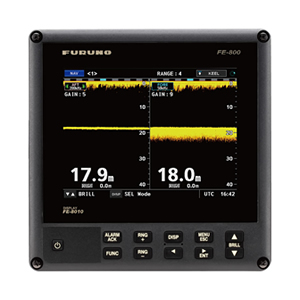
- FE-800 Echosounder
- DS-80 Speed Log
- Transducer fouling from marine growth
- Transducer cable damage
- Display unit failure
- Speed log calibration drift
- Air bubble interference in shallow water
JRC (Japan)
1- JFE-680
- JLN-652
- Transducer fouling
- Speed log calibration drift
- Display issues
Kongsberg Maritime
1- EA600 Navigation
- EM2040 Multibeam
- Transducer fouling
- Electronics overheating
- Network communication errors
- Transducer window delamination