What to check on a Access Control System.
The underlying technology — card or fob readers, door controllers, a central management server — is the same hardware used in a shore office building, but the operating environment is not. A shipboard system has to survive vibration, salt air, power interruptions during blackouts, and a crew list that changes at every port, while still producing an auditable record that satisfies an ISPS port state control inspection. The system exists to enforce the ship security plan's restricted areas — bridge, engine room, steering gear, CO2 room, crew accommodation — not…
What sets a shipboard access control system apart from a shoreside office system
The underlying technology — card or fob readers, door controllers, a central management server — is the same hardware used in a shore office building, but the operating environment is not. A shipboard system has to survive vibration, salt air, power interruptions during blackouts, and a crew list that changes at every port, while still producing an auditable record that satisfies an ISPS port state control inspection. The system exists to enforce the ship security plan's restricted areas — bridge, engine room, steering gear, CO2 room, crew accommodation — not as a general convenience feature, and that purpose shapes what counts as acceptable performance from it.
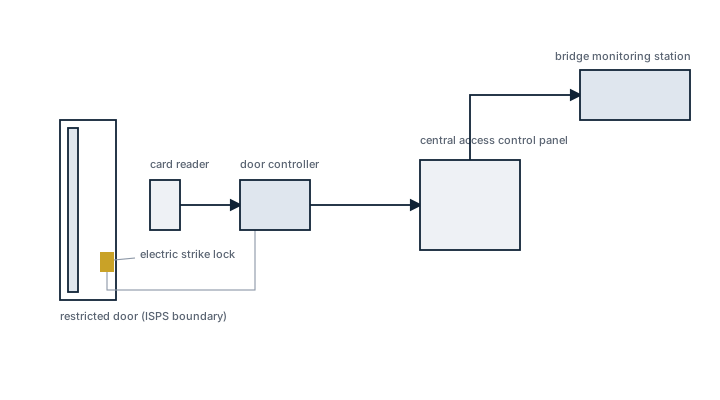
Main components
Credential readers
Card, fob, PIN keypad, or biometric readers mounted at each controlled door, identifying the person requesting entry.
Door controllers
Local units that decide, based on the credential and the current access schedule, whether to release the electric strike or maglock, and that log the event even if the network to the central server is temporarily down.
Central management server
Holds the crew and visitor database, access group assignments, and the audit log, usually with a backup or replicated database given how important the log is after a security incident.
Electric strikes / maglocks and fail-safe wiring
The physical locking hardware, wired so that fire and emergency egress requirements override access control on escape routes — a door must fail open on fire alarm activation even if it is normally access-controlled.
Sizing and selection
- Number of controlled doors against the ship's actual restricted areas defined in the ship security plan, not every door on board.
- Credential type suited to the crew turnover pattern — cards are simple to reissue, biometrics avoid card sharing but need enrolment time.
- Network resilience, since a door controller that cannot make its own decision during a network or power interruption defeats the purpose during exactly the kind of incident it exists for.
- Integration with the crew list and manning system so leavers are removed promptly rather than left with live credentials.
Regulations and class
The ISPS Code requires ships to control access to the vessel and to restricted areas identified in the ship security plan, and an electronic access control system is one accepted way of meeting that requirement, though not the only one. Port state control checks that restricted areas are actually controlled and that the log or watch record can show who had access, more than it checks the brand or model of the hardware. Class notations for security systems exist but are typically optional rather than mandatory.
Typical faults
| Fault | Consequence |
|---|---|
| Crew credentials not deactivated after signing off | Departed crew retain physical access, undermining the audit log's value in an investigation |
| Door controller battery backup depleted | Controller loses its access list during a blackout and either locks out everyone or fails open, defeating the control |
| Maglock wired without fire alarm override | Escape route stays locked during a fire, a life safety failure disguised as a security feature |
| Reader corroded from weather deck exposure without a rated enclosure | Intermittent failures train crew to prop the door open, which removes the control entirely |
What to look for in a supplier
- Confirmed fail-safe wiring on every door on an escape route, verified against the ship's fire control plan, not taken on trust.
- Marine-rated enclosures for readers on weather decks or in engine spaces.
- Local decision-making at the door controller so the system degrades gracefully, not to a fully locked or fully open state, during a network outage.
- Straightforward crew onboarding and offboarding workflow matched to how often the ship actually changes crew.
Check the fire override wiring on every access-controlled door personally rather than trusting the installation drawing — a maglock that fails to unlock on fire alarm activation is a life-safety defect, not a minor security detail.