What to check on a VDR/S-VDR.
Where an echo sounder or speed log feeds live data to the officer of the watch, a voyage data recorder does the opposite: it is not there to help anyone navigate, it exists to reconstruct what happened after the fact. It continuously records bridge audio, VHF communications, radar image, AIS, heading, speed, rudder and engine order data, and GPS position in a rolling buffer, normally covering the last 12 hours, held inside a fixed protective capsule built to survive fire, impact and deep submersion. The simplified voyage data recorder (S-VDR)…
What sets the VDR apart from other bridge instruments
Where an echo sounder or speed log feeds live data to the officer of the watch, a voyage data recorder does the opposite: it is not there to help anyone navigate, it exists to reconstruct what happened after the fact. It continuously records bridge audio, VHF communications, radar image, AIS, heading, speed, rudder and engine order data, and GPS position in a rolling buffer, normally covering the last 12 hours, held inside a fixed protective capsule built to survive fire, impact and deep submersion. The simplified voyage data recorder (S-VDR), fitted on older or smaller cargo ships instead of a full VDR, records a reduced data set - typically position, heading, speed, radar and bridge audio - but not the full range of engine and control data a full VDR captures.
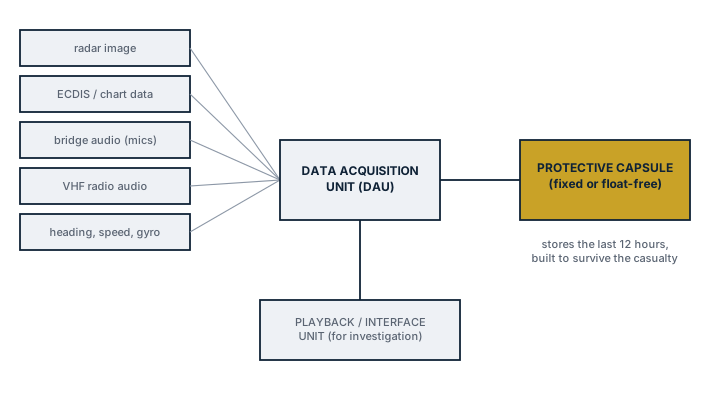
Main components
Data acquisition unit
Collects and time-stamps inputs from bridge sensors, communication equipment and at least one microphone covering bridge conversation, then compresses and multiplexes them into the recording stream.
Protective storage capsule
A fixed capsule, built to withstand fire exposure, a defined shock load, and sustained deep-ocean pressure, so the data survives even where the vessel does not. Float-free capsules exist but are less common on cargo ships than on passenger ships.
Recording medium and playback
Data is written to solid-state memory inside the capsule; retrieval requires specialist playback software supplied by the manufacturer, which investigators and the company's own auditors use to extract and review a voyage.
Selection and sizing
There is no power or capacity sizing in the propulsion-equipment sense - the choice is mainly about data channels and interface compatibility:
- Number and type of sensor interfaces matching the bridge equipment actually fitted (radar, ECDIS, AIS, gyro, speed log, echo sounder)
- Full VDR versus S-VDR data set, driven by the vessel's SOLAS category and construction date rather than by choice
- Capsule type - fixed only, or fixed plus float-free, depending on ship type
- Recording duration and playback software licensing terms, which affect how easily the company can conduct its own reviews
Regulations and class
SOLAS Chapter V requires VDR or S-VDR carriage depending on ship type, tonnage and build date, with cargo ships constructed before 2002 typically permitted the simplified S-VDR standard. Annual performance testing by an approved service provider is mandatory, checking that all required data channels are actually being captured and are recoverable, not just that the unit is powered up. Flag state and class both expect the annual test certificate to be current and kept on board.
Typical faults
| Fault | Cause | Consequence |
|---|---|---|
| Missing audio channel | Failed or disconnected bridge microphone, unnoticed between annual tests | Incomplete record if an incident occurs, annual test failure |
| Sensor channel dropout | Interface cabling fault or sensor replaced without reconfiguring the VDR input | Gaps in recorded navigation data, compliance finding at survey |
| Capsule beacon failure | Battery expired on the locating beacon | Capsule harder to locate if the vessel is lost, PSC deficiency |
| Playback failure at review | Outdated or missing playback software licence when data is needed | Delay in accident investigation or internal review |
What to look for in a supplier
- Confirmed compatibility with the specific radar, ECDIS and AIS models already on board
- Annual testing and service coverage in the vessel's actual trading ports, not just the home region
- Playback software provided or accessible without a lengthy licence request each time
- Spare capsule beacon and microphone stock, since these are the parts that fail quietly
Check the annual VDR performance test certificate at every survey preparation - a unit that has been silently missing one data channel for months is a compliance and investigation risk nobody notices until it is needed.