What to check on a Magnetic Compass.
A gyrocompass seeks true north through a spinning mechanism and needs power to do it; lose power and it runs down. A magnetic compass needs nothing but the Earth's field and a free-swinging card, which is exactly why SOLAS keeps it as the mandatory independent backup: it works through a blackout that would silence every powered heading reference on the bridge. The tradeoff is that a magnetic compass does not read true north on its own. It reads magnetic north distorted by the ship's own steel structure and electrical equipment…
What Sets a Magnetic Compass Apart
A gyrocompass seeks true north through a spinning mechanism and needs power to do it; lose power and it runs down. A magnetic compass needs nothing but the Earth's field and a free-swinging card, which is exactly why SOLAS keeps it as the mandatory independent backup: it works through a blackout that would silence every powered heading reference on the bridge. The tradeoff is that a magnetic compass does not read true north on its own. It reads magnetic north distorted by the ship's own steel structure and electrical equipment, an error called deviation, and that error changes with heading, cargo, and anything new installed near the binnacle. A gyrocompass has its own errors, mainly related to speed and latitude, but they are predictable by formula. Deviation is specific to each individual ship and has to be measured, not calculated.
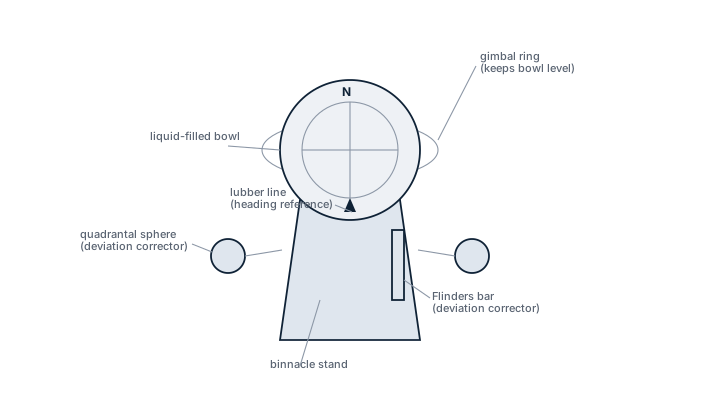
Main Components
Compass Bowl and Card
A liquid-filled bowl houses the card, with magnets attached beneath it, gimbal-mounted so it stays level as the ship rolls and pitches.
Binnacle
The housing around the bowl carries the correcting magnets, Flinders bar for correcting vertical soft iron effects, and quadrantal spheres for correcting soft iron in the horizontal plane, along with a heeling magnet for list-induced error.
Azimuth Ring
A bearing ring fitted around the bowl lets the watchkeeper take a compass bearing of a landmark or celestial body for position fixing or deviation checks.
Compass Light
Illuminates the card for night reading; it must be positioned and shielded so it does not itself introduce any magnetic influence near the bowl.
Selection and Sizing
Bowl diameter is chosen against the vessel's class and applicable flag requirement. The bowl liquid has to suit the ship's operating temperature range, since a liquid too viscous in cold conditions makes the card sluggish, and one too thin in heat lets it oscillate. The correcting magnet range fitted has to be sufficient for the deviation the ship's own structure and equipment actually generates, and the compass has to be sited clear of the safe distance tables published for nearby electronics, speakers and other magnetic sources.
Regulations and Class
SOLAS chapter V requires ships to carry a magnetic compass, or another heading reference independent of any power supply, as a backup to powered systems. Deviation must be checked periodically by swinging the compass, with the resulting deviation card posted at the steering position. A certified compass adjuster is normally required after any major structural change, new electrical or electronic installation near the binnacle, or degaussing work, since any of these can shift the deviation curve away from what is posted.
Typical Faults
- Bubble in the bowl liquid - from a seal failure or temperature-driven expansion, making the card sluggish or prone to oscillating instead of settling.
- Uncorrected deviation after new equipment nearby - the most dangerous fault of all, because the compass keeps giving a confident reading that is silently wrong.
- Sticky gimbal bearings - the compass lags during turns and takes too long to settle on the new heading.
- Discoloured or cracked bowl glass - hard to read at night and a sign moisture may already be getting into the bowl.
- Shifted or missing correcting magnets - the deviation curve drifts away from the posted deviation card without any obvious external sign.
What to Look For in a Supplier or Adjuster
- A certified compass adjuster available to swing the compass after installation, refit, or any major nearby electrical change.
- Bowl liquid rated for the ship's actual operating temperature range, not a generic default.
- Deviation card documentation in the format the flag state expects.
- A replacement bowl that matches the existing binnacle, avoiding a full binnacle replacement when only the bowl has failed.
- Installation advice that respects the safe distance tables for any newly fitted electronics on the bridge.
An outdated deviation card is worse than an obviously broken compass, because the watchkeeper trusts a number that is already wrong. Swing the compass after any structural or electrical change near the binnacle, not only on the class-mandated interval.