"> AIS - Equipment Database

AIS

medium 10 models total

AIS broadcasts a ship's identity, position, course and speed over VHF at short intervals, so nearby traffic and shore stations can see it independent of radar detection, which is why it works as well in a crowded anchorage as it does in open water at night.

Read more — AIS explained

What Sets AIS Apart from Radar and Radio

Radar detects a target by reflection and tells the watchkeeper where something is, but not what it is or where it is heading with any certainty until it has been tracked for a while. AIS is different: each fitted ship transmits its own identity, position from GPS, course, speed and voyage details directly, so any other AIS-equipped ship or shore station receives accurate data the moment the signal is picked up, without needing line of sight the way radar does or reliance on someone answering a VHF call. The trade-off is that AIS only shows what other stations choose, or are required, to transmit; a target with its AIS switched off or a small craft under the carriage threshold remains invisible on the AIS display even though it may show clearly on radar.
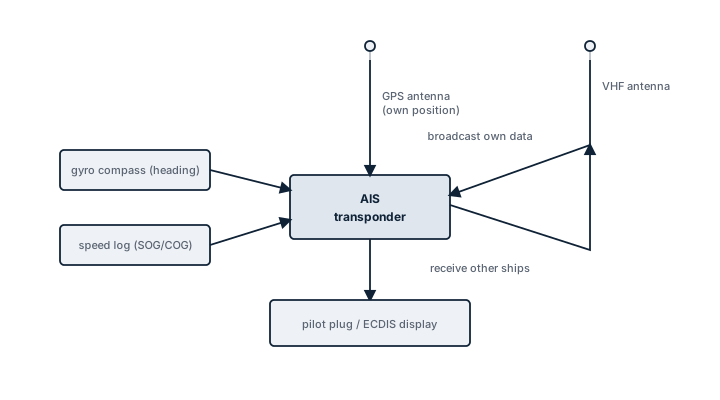
AIS transponder signal flow
Block diagram of an AIS transponder showing its position and heading inputs, VHF broadcast and receive path, and the display output.

Main Components

Transponder Class A

SOLAS-mandated ships carry a Class A unit, transmitting at higher power and shorter reporting intervals than the Class B units fitted on smaller leisure or fishing vessels, with priority access to the VHF data channels.

GPS Position Input

AIS relies on an internal or ship's GPS receiver for position and timing; a degraded or lost GPS fix propagates directly into every AIS target that receives the ship's transmission, an easily overlooked failure mode.

VHF Data Link Transceiver

Two dedicated marine VHF channels carry AIS traffic using a time-division scheme so multiple ships can transmit without constant collision of messages, each unit self-organising its transmission slot.

Minimum Keyboard Display or Integration

A basic AIS unit has its own minimum display for entering voyage data and viewing targets, though on most ships AIS data is overlaid onto the radar or ECDIS display rather than read from its own separate screen.

Selection and Sizing

There is no sizing calculation as with a pump or valve; the relevant decision is Class A versus Class B for vessels below the mandatory carriage threshold, and whether the installation integrates with VDR, ECDIS and radar or stands alone. Antenna placement matters more than most crews expect, since a poorly sited VHF antenna with significant mast or superstructure shadowing genuinely reduces range and reliability.

Regulations and Class

  • SOLAS Chapter V, Regulation 19 requires AIS on all ships of 300 gross tonnage and above engaged on international voyages, all cargo ships of 500 gross tonnage and above on any voyage, and all passenger ships regardless of size.
  • The equipment must meet IMO performance standards for AIS and be type-approved; static data such as ship name, call sign and IMO number must be kept accurate and updated after any change.
  • AIS data feeds the ship's Voyage Data Recorder where fitted, and inaccurate or missing AIS data has been a factor examined in collision investigations.

Typical Faults

FaultConsequence
GPS antenna cable or connector corrodedPosition transmitted to other ships drifts or freezes, misleading nearby traffic
Static data entered incorrectly after a name change or charterShip displays under the wrong identity to VTS and other vessels
VHF antenna or coax degradedReduced transmission range, ship effectively invisible on AIS to traffic beyond a shortened range
Navigation status left on a stale setting, such as anchored while under wayOther ships' collision avoidance assessment of the vessel's intentions is wrong

What to Look for in a Supplier

  • Type approval certificate for the current IMO AIS performance standard and confirmation the firmware is not an outdated revision.
  • Clean integration with the ship's existing ECDIS, radar and VDR without a proprietary interface that locks out future equipment changes.
  • Antenna and cable specification suited to the ship's actual mast height and VHF routing, not a generic short run assumption.

Check and correct the voyage data and navigation status fields yourself at watch handover; an AIS unit left showing the wrong destination or status for days is a small thing that looks bad the moment a VTS operator or investigator checks the record.

10 manufacturers · 10 models

AMEC

1
Camino-108 AIS
Class A / 12.5 W · Navigation Data / Sensor · Class A AIS transponder
Class
A
Power output
12.5 W
IMO Approved
ja
Common Failures & Inspection Points
  • Display resolution
  • GPS accuracy
  • Service availability in Europe
Service: Asian manufacturer. Growing presence in budget Class A market.
Spare Parts: AMEC: Ersatzteile per Hersteller-Netzwerk. Lead time: 1-4 Wochen. Backup-Systeme an Bord pflichtgemäß.
Strengths
  • IMO‑approved Class A compliance meets mandatory SOLAS requirements
  • Very low power consumption (≈12.5 W) reduces onboard energy load
  • Competitive price point for budget‑focused operators
  • Simple plug‑and‑play installation with standard NMEA output
  • Compact unit suitable for limited bridge space
Weaknesses
  • Reported issues with display resolution on the built‑in screen
  • GPS accuracy sometimes below expected maritime standards
  • Limited after‑sales support and spare‑part availability in Europe
  • No documented redundancy (single‑receiver architecture)
  • Firmware updates may be slower compared with larger OEMs
Typical Vessels: Container shipBulk carrierTankerGeneral cargo vesselOffshore supply vesselPassenger ferry
Certifications: IMO Type Approval
Decision Guide: Choose if: you need a cost‑effective Class A AIS that meets SOLAS, have limited bridge space and power budget, and operate primarily in regions where AMEC service centres are present. Avoid if: high‑precision GPS is critical, you require rapid European technical support, or you prefer a system with proven redundancy and advanced display capabilities.
Use Cases: The Camino-108 is typically installed on the bridge of merchant vessels to provide real‑time identification and collision‑avoidance data to other ships and shore stations. It integrates with ECDIS/NMEA networks for traffic monitoring in busy sea lanes, port approaches and offshore operations where compliance with AIS regulations is mandatory.

em-trak

1
em-trak A100 AIS
A100 AIS
Class A / 12.5 W · Navigation Data / Sensor · Class A AIS transponder
Class
A
Power output
12.5 W
IMO Approved
ja
Common Failures & Inspection Points
  • Compact antenna limitations
  • Limited display
  • Service network
Service: Budget Class A. Popular for smaller commercial vessels.
Spare Parts: em-trak: Ersatzteile per Hersteller-Netzwerk. Lead time: 1-4 Wochen. Backup-Systeme an Bord pflichtgemäß.
Strengths
  • Budget‑friendly price for a full Class A solution
  • Low power consumption (12.5 W) suitable for small vessels
  • Compact unit fits limited bridge space
  • IMO‑approved performance meets regulatory requirements
  • Easy integration with standard NMEA‑0183 bridge displays
Weaknesses
  • Small antenna limits effective range compared with larger AIS sets
  • Limited built‑in display; requires external monitor for full functionality
  • Service and support network may be sparse in some regions
  • No advanced features such as AIS‑VTS, satellite AIS or dual‑frequency operation
Typical Vessels: Coastal cargo vesselWorkboat / utility vesselSmall offshore supply shipFishing vesselInland river barges
Certifications: IMO Performance Standard (Class A)
Decision Guide: Choose if: you need a cost‑effective Class A AIS for a small commercial vessel, have limited bridge space and can accommodate a compact antenna. Avoid if: you require long‑range coverage, advanced AIS services, or operate in regions where em‑trak service support is unavailable.
Use Cases: Commonly installed on small to medium coastal traders, workboats and fishing fleets that must meet Class A AIS regulations but have tight budget or space constraints. The unit is typically paired with an external bridge display or integrated into existing navigation suites.

Kongsberg

1
Kongsberg AISM AIS
AISM AIS
Class A / 12.5 W · Navigation Data / Sensor · Class A AIS
Class
A
Power output
12.5 W
IMO Approved
ja
Common Failures & Inspection Points
  • Integration dependency on K-Bridge
  • Standalone mode limitations
  • Configuration complexity
Service: Part of Kongsberg integrated bridge. Can operate standalone.
Spare Parts: Kongsberg: Ersatzteile per Hersteller-Netzwerk. Lead time: 1-4 Wochen. Backup-Systeme an Bord pflichtgemäß.
Strengths
  • Full integration with Kongsberg K‑Bridge bridge suite for seamless data exchange
  • IMO type‑approved Class A performance meeting SOLAS requirements
  • Low power consumption (12.5 W) suitable for energy‑constrained installations
  • Supports both integrated and standalone operation, offering flexibility
  • Proven reliability on large commercial vessels
Weaknesses
  • Standalone mode offers reduced functionality compared with full K‑Bridge integration
  • Configuration can be complex and may require specialist support
  • Dependence on K‑Bridge for advanced features limits use on non‑Kongsberg bridges
  • Higher acquisition cost than basic, generic AIS units
Typical Vessels: TankerContainer shipBulk carrierCruise linerOffshore supply vesselGeneral cargo vessel
Certifications: IMO Type Approval (Class A)
Decision Guide: Choose if you already operate a Kongsberg K‑Bridge system or need a highly reliable, IMO‑approved Class A AIS with low power draw. Avoid if you require a simple plug‑and‑play AIS for non‑Kongsberg bridges or have limited technical support for complex configuration.
Use Cases: Deployed on large merchant and offshore vessels as part of an integrated bridge system to provide continuous AIS broadcast, receive ship‑to‑ship traffic information, and feed data to VTS and collision‑avoidance applications.

McMurdo

1
SmartFind AIS
Class A / 12.5 W · Navigation Data / Sensor · Integrated AIS/LRIT transceiver
Class
A
Power output
12.5 W
IMO Approved
ja
Common Failures & Inspection Points
  • LRIT connectivity issues
  • Power supply sensitivity
  • GPS antenna aging
Service: Combined AIS + LRIT reduces bridge equipment count.
Spare Parts: McMurdo: Ersatzteile per Hersteller-Netzwerk. Lead time: 1-4 Wochen. Backup-Systeme an Bord pflichtgemäß.
Strengths
  • Class A AIS compliance with IMO approval
  • Combines AIS and LRIT, reducing the number of bridge installations
  • Low power consumption (≈12.5 W)
  • Compact, single‑point installation simplifies cabling
  • Suitable for vessels that must meet both AIS and LRIT reporting
Weaknesses
  • Reported LRIT connectivity reliability issues
  • Sensitive to unstable power supply conditions
  • GPS antenna may age faster than the unit itself, affecting performance
  • Limited redundancy compared with separate AIS and LRIT units
Typical Vessels: TankerContainer shipBulk carrierPassenger vesselOffshore support vessel
Certifications: IMO Type Approval
Decision Guide: Choose if you need to minimise bridge equipment count and have a modest power budget, especially on new builds or retrofits where combined AIS/LRIT is acceptable. Avoid if your operation cannot tolerate occasional LRIT link failures, requires high‑redundancy reporting, or has known power quality issues.
Use Cases: Deployed on merchant vessels subject to the International Maritime Organisation's LRIT requirement, providing continuous AIS position broadcasting while simultaneously fulfilling mandatory LRIT reporting from a single device on the bridge.

Saab

1
Saab R5 Supreme AIS
R5 Supreme AIS
Class A / 12.5 W · Navigation Data / Sensor · Class A AIS transponder
Class
A
Power output
12.5 W
IMO Approved
ja
Common Failures & Inspection Points
  • Expensive replacement parts
  • Software license expiry
  • Ethernet interface issues
Service: Used on advanced bridges. High-performance target tracking.
Spare Parts: Saab: Ersatzteile per Hersteller-Netzwerk. Lead time: 1-4 Wochen. Backup-Systeme an Bord pflichtgemäß.
Strengths
  • Class A compliance (IMO approved) for full VTS functionality
  • Low power consumption (12.5 W)
  • High‑resolution target tracking suited to busy traffic areas
  • Designed for integration with Saab R5 bridge displays and other bridge systems
  • Robust marine‑grade construction
Weaknesses
  • Replacement parts are expensive
  • Software license must be renewed periodically, adding operating cost
  • Reported Ethernet interface reliability issues in some installations
  • Higher upfront cost compared with basic AIS units
Typical Vessels: Container shipCrude oil tankerLNG carrierCruise linerOffshore supply vesselLarge passenger ferry
Certifications: IMO AIS Class A
Decision Guide: Choose if you need a Class A AIS with high‑performance tracking and tight integration into a Saab bridge suite, and can accommodate higher capital and licensing costs. Avoid if budget constraints dominate or if you prefer a simpler, lower‑cost AIS without recurring software fees.
Use Cases: Typically installed on vessels equipped with advanced integrated bridge systems—e.g., cruise ships, large tankers, container carriers, and offshore support vessels—where precise traffic monitoring and compliance with stringent AIS regulations are critical.

Sailor (Cobham)

1
6280 AIS
Class A / 12.5 W · Navigation Data / Sensor · Class A AIS transponder
Class
A
Power output
12.5 W
IMO Approved
ja
Common Failures & Inspection Points
  • VHF antenna sharing issues
  • DSC interference
  • Power supply sensitivity
Service: Sailor-branded AIS. Good integration with Sailor VHF.
Spare Parts: Sailor (Cobham): Ersatzteile per Hersteller-Netzwerk. Lead time: 1-4 Wochen. Backup-Systeme an Bord pflichtgemäß.
Strengths
  • Seamless integration with Sailor VHF units simplifies installation and configuration
  • Low power consumption (12.5 W) reduces load on the vessel's electrical system
  • IMO type‑approved for SOLAS compliance, ensuring regulatory acceptance
  • Compact design suitable for limited bridge space
  • Proven reliability on a wide range of commercial vessels
Weaknesses
  • Requires a dedicated AIS antenna; sharing with VHF can cause performance loss
  • Known DSC interference when the same VHF channel is used for both services
  • Sensitive to power‑supply voltage fluctuations, necessitating stable conditioning
  • Limited on‑board GNSS capability – often relies on external GPS input
Typical Vessels: TankerContainer shipBulk carrierPassenger vesselOffshore supply vesselLarge fishing vessel
Certifications: IMO Type Approval (SOLAS)
Decision Guide: Choose if you already operate Sailor VHF radios and need a low‑power, IMO‑approved Class A AIS that integrates directly with existing bridge equipment. Avoid if antenna space is constrained or the vessel experiences frequent DSC interference, or if a highly robust power supply conditioning system is not available.
Use Cases: Commonly installed on commercial cargo and passenger ships to meet SOLAS AIS requirements, provide real‑time traffic awareness for collision avoidance, and feed position data to fleet monitoring systems and port authorities.

SRT

1
SRT AIS Class A
AIS Class A
Class A / 12.5 W · Navigation Data / Sensor · VHF AIS transceiver
Class
A
Power output
12.5 W
IMO Approved
ja
Common Failures & Inspection Points
  • Limited service network
  • Display resolution
  • Antenna connector corrosion
Service: Budget-friendly Class A option. Good for smaller commercial vessels.
Spare Parts: SRT: Ersatzteile per Hersteller-Netzwerk. Lead time: 1-4 Wochen. Backup-Systeme an Bord pflichtgemäß.
Strengths
  • Meets full Class A AIS performance specifications
  • Low power consumption (12.5 W)
  • IMO approved – compliant with SOLAS/AIS regulations
  • Cost‑effective option for smaller commercial vessels
  • Compact installation footprint
Weaknesses
  • Limited global service and support network
  • Display resolution lower than premium bridge units
  • Antenna connector prone to corrosion in salty environments
  • May lack advanced integration features (e.g., full NMEA 2000 bridge networking)
  • Durability not proven on high‑stress, long‑haul vessels
Typical Vessels: Feeder container shipCoastal bulk carrierRegional tankerOffshore supply vesselSmall passenger ferry
Certifications: IMO AIS Class A approval
Decision Guide: Choose if: you need a compliant Class A AIS on a small‑to‑mid size commercial ship and budget or space constraints are primary; the unit’s low power draw and compact design fit well. Avoid if: extensive after‑sales support, high‑resolution bridge displays, or operation in highly corrosive environments are critical – other manufacturers offer more robust service networks and corrosion‑resistant hardware.
Use Cases: Installed on the bridge of coastal cargo vessels, regional ferries and offshore supply ships to provide real‑time vessel tracking, collision avoidance and AIS data exchange with shore stations and nearby traffic. Often paired with basic ECDIS or radar overlays where advanced display features are not required.

Transas

1
Transas T-100/T-200 AIS
T-100/T-200 AIS
Class A / 12.5 W · Navigation Data / Sensor · Class A AIS transponder
Class
A
Power output
12.5 W
IMO Approved
ja
Common Failures & Inspection Points
  • Transas to Wärtsilä transition
  • Software support
  • Hardware aging
Service: Part of Transas bridge suite. Wärtsilä continues support.
Spare Parts: Transas: Ersatzteile per Hersteller-Netzwerk. Lead time: 1-4 Wochen. Backup-Systeme an Bord pflichtgemäß.
Strengths
  • IMO‑approved Class A performance meeting SOLAS requirements
  • Low power consumption (12.5 W) for continuous operation
  • Seamless integration with Transas/Wärtsilä bridge displays and navigation software
  • Proven reliability on a wide range of large commercial vessels
  • Continued support from Wärtsilä after the Transas acquisition
Weaknesses
  • Hardware aging – units installed before 2015 may require refurbishment
  • Transition issues reported when migrating from legacy Transas software to Wärtsilä platforms
  • Limited availability of newer AIS VDE (VHF Data Exchange) features compared with latest competitors
  • Software support depends on Wärtsilä service contracts, which can be costly in remote regions
Typical Vessels: TankerContainer shipBulk carrierPassenger vesselOffshore supply vessel
Certifications: IMO Performance Standard (SOLAS) Class A
Decision Guide: Choose if you need a proven, IMO‑approved Class A AIS that integrates directly with an existing Transas/Wärtsilä bridge suite and you value low power draw. Avoid if you require the latest VDE capabilities, want brand‑new hardware without aging components, or operate in regions where Wärtsilä support contracts are impractical.
Use Cases: Installed on large merchant ships to satisfy SOLAS AIS requirements, provide real‑time vessel identification and traffic information on bridge consoles, and support collision avoidance systems during long ocean voyages.

Vesper Marine

1
Vesper Marine WatchMate AIS
WatchMate AIS
Class B / 2 W · Navigation Data / Sensor · Class B AIS transceiver
Class
B
Power output
2 W
Common Failures & Inspection Points
  • Class B power limitations
  • Target capacity
  • WiFi module issues
Service: Class B — not SOLAS. Good for recreational and small commercial.
Spare Parts: Vesper Marine: Ersatzteile per Hersteller-Netzwerk. Lead time: 1-4 Wochen. Backup-Systeme an Bord pflichtgemäß.
Strengths
  • Very low power draw (≈2 W), extending battery life on small vessels
  • Compact and easy to install on recreational or small commercial boats
  • Provides mandatory AIS broadcast for non‑SOLAS compliance
  • Integrated Wi‑Fi output enables simple connection to bridge displays or mobile apps
Weaknesses
  • Limited transmission range and target capacity compared with Class A units
  • Power output restrictions can reduce performance in high‑traffic areas
  • Reported reliability issues with the built‑in Wi‑Fi module
  • Not SOLAS approved, therefore unsuitable for large commercial ships
Typical Vessels: Recreational yachtsFishing vesselsCoastal workboatsPilot boatsSmall offshore support craft
Decision Guide: Choose if: the vessel is under SOLAS thresholds (e.g., <24 m), you need a cost‑effective AIS solution with minimal power draw, and Wi‑Fi data export is valuable. Avoid if: you require Class A performance, operate in dense traffic zones where higher target capacity is critical, or must meet SOLAS/USCG mandatory AIS standards for larger commercial ships.
Use Cases: WatchMate AIS is typically installed on pleasure craft cruising coastal waters, small charter boats, coastal fisheries and other workboats that need basic AIS compliance without the expense or power demand of a Class A system. It is also used where bridge integration via Wi‑Fi to tablets or laptops simplifies navigation monitoring.

Weatherdock

1
Weatherdock easyAIS
easyAIS
Class B / 2 W · Navigation Data / Sensor · Class B AIS transceiver
Class
B
Power output
2 W
Common Failures & Inspection Points
  • Limited range Class B
  • USB interface issues
  • Antenna quality
Service: German-made Class B. Good for inland and coastal use.
Spare Parts: Weatherdock: Ersatzteile per Hersteller-Netzwerk. Lead time: 1-4 Wochen. Backup-Systeme an Bord pflichtgemäß.
Strengths
  • Low power consumption (≈2 W) suitable for battery‑operated installations
  • Plug‑and‑play USB connection simplifies integration with bridge computers or tablets
  • Compact, lightweight design ideal for small workboats and inland vessels
  • German engineering offers reliable build quality at a modest price point
Weaknesses
  • Class B range (typically ≤10 NM) is limited compared to Class A units
  • Reported occasional USB interface stability issues under harsh vibration
  • Standard antenna may be less robust for high‑wind or offshore environments
  • No built‑in VHF voice channel; requires separate radio for full communication
Typical Vessels: Inland cargo bargesCoastal workboatsFishing vesselsPleasure yachtsSmall passenger ferries
Decision Guide: Choose if: you need a cost‑effective, easy‑install AIS for Class B compliance on inland or short‑range coastal vessels and have limited power budget. Avoid if: the vessel operates in offshore/high‑traffic areas where Class A range is required, or you need a rugged antenna system for severe weather.
Use Cases: Deployed on river barges navigating congested waterways, coastal patrol boats operating near ports, and recreational yachts that must meet AIS carriage regulations without adding significant weight or power draw.