What to check on a Autopilot.
An autopilot is a closed-loop control system: it reads heading from the gyrocompass or magnetic compass, compares it to the ordered course, and sends a correcting signal to the steering gear through the rudder actuator, continuously and automatically. More capable units add track control, holding the ship to a plotted route from the ECDIS or GPS rather than a single fixed heading, adjusting automatically for cross-track error and, on some systems, for set and drift. It replaces hand-steering, not the requirement for a lookout or for someone monitoring that the…
What an autopilot actually does
An autopilot is a closed-loop control system: it reads heading from the gyrocompass or magnetic compass, compares it to the ordered course, and sends a correcting signal to the steering gear through the rudder actuator, continuously and automatically. More capable units add track control, holding the ship to a plotted route from the ECDIS or GPS rather than a single fixed heading, adjusting automatically for cross-track error and, on some systems, for set and drift. It replaces hand-steering, not the requirement for a lookout or for someone monitoring that the system is actually doing what was ordered.
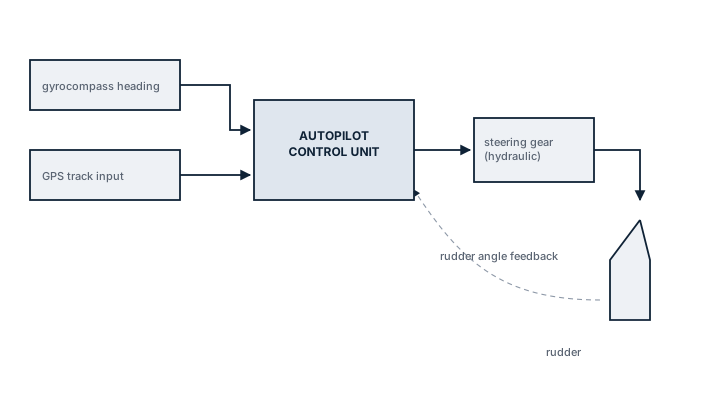
Main components
Control unit and heading sensor input
Takes heading from the gyrocompass and, on track control systems, position from GPS, calculating the rudder command needed to correct any deviation according to tuned gain and counter-rudder settings.
Adaptive tuning
Sea state, loading condition and speed all change how the ship responds to rudder, so autopilots include adjustable gain, weather and rudder limit settings the officer tunes for conditions: too aggressive a setting causes constant rudder hunting, too soft lets the ship wander off course.
Steering gear interface
Sends the corrective signal to the steering gear's control system, which is a separate certified system in its own right; the autopilot commands it but does not replace the steering gear's own power units or manual override capability.
Alarm and monitoring functions
Off-course alarms, heading sensor failure alarms and, on track control systems, cross-track deviation alarms that alert the watchkeeper before an error becomes a navigational hazard.
Selection points
Match the autopilot's capability to the ship's steering gear and operating profile: simple heading-hold suits vessels that steer set courses for long stretches, while track control with automatic waypoint following suits ships running repetitive routes or restricted-water passages where continuous manual correction against a plotted track adds workload without adding safety. Interface compatibility with the ship's existing gyrocompass, GPS and ECDIS is a hard requirement, not an option.
Regulations and class
IMO Performance Standard MSC.64(67) Annex 3 sets the technical requirements for automatic steering aids, including heading-keeping accuracy and alarm functions, and SOLAS Ch. V requires ships to be capable of taking manual control immediately at any time. Vessels with powered steering gear are required to carry heading and/or track control systems meeting the standard, verified at survey alongside the steering gear itself.
Typical faults
- Gain or counter-rudder settings left unadjusted after a change in loading condition or sea state, causing excessive rudder activity and fuel waste, or sluggish course-keeping
- Heading sensor drift not cross-checked against the standard compass, so the autopilot holds a heading that is subtly wrong
- Track control followed without monitoring cross-track error, so deviation builds silently until the alarm threshold is finally crossed
- Manual changeover drill neglected, causing delay in regaining hand steering during an emergency
What to look for in a supplier
- Type approval to MSC.64(67) documented for the specific model
- Confirmed interface compatibility with the ship's existing gyrocompass, GPS and ECDIS
- Clear, fast manual changeover procedure built into the control unit design
- Adaptive tuning range suited to the vessel's actual loading and sea state variation
Practice the manual changeover from autopilot to hand steering as a drill, not just a switch position: the one time it matters is usually the moment least convenient to discover the changeover is slow or confusing.