"> Signal Lamp / Aldis Lamp - Equipment Database

Signal Lamp / Aldis Lamp

medium 4 models total

An Aldis lamp is the one piece of SOLAS-required bridge equipment that needs no power beyond a hand trigger and no software at all — a focused beam and a shutter, unchanged in principle for a century.

Read more — Signal Lamp / Aldis Lamp explained

What sets a signal lamp apart

Almost everything else on a modern bridge depends on electronics, satellites or at least a functioning power bus. A signal lamp, still commonly called an Aldis lamp after its early-20th-century design, is the deliberate exception: a focused beam of light switched on and off by a trigger to send Morse code, readable by eye at several miles with no receiving equipment needed on the other end beyond a lookout. It survives on the bridge not out of nostalgia but because it is the one visual signalling method that works when radios are silenced, jammed, or simply not fitted on the vessel being signalled — small craft, naval vessels under certain conditions, or another ship confirming identity visually during close-quarters situations.
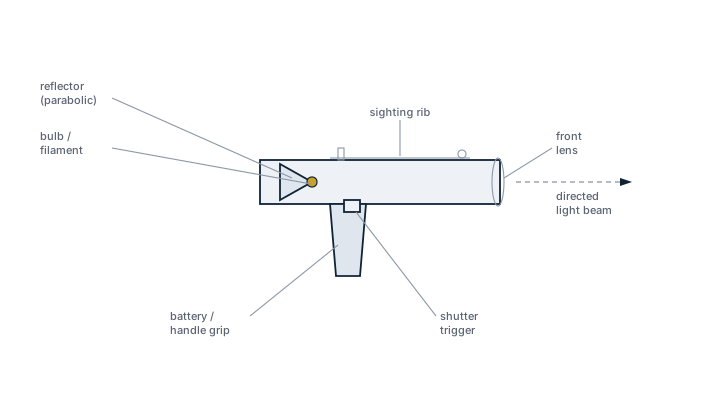
Signal lamp (Aldis lamp), side view
Side cross-section of a handheld signal lamp showing the parabolic reflector and bulb, the front lens, the sighting rib for aiming, the shutter trigger and the battery handle grip.

Main components

Lamp head and lens

A high-intensity bulb or, on modern units, an LED array behind a focusing lens that concentrates the beam into a narrow, bright cone rather than the wide spread of a searchlight, which is what makes the flashes readable as distinct Morse characters at distance.

Trigger mechanism

A pistol-grip trigger that operates a shutter or directly switches the lamp circuit, letting the operator key Morse code by hand with the same feel regardless of how the beam itself is produced.

Power supply

Battery-powered handheld units are standard for portability to the bridge wings; some vessels retain a fixed, ship-power lamp on the monkey island for longer signalling sessions where battery endurance would be a limitation.

Sighting device

A simple sight or scope aligned with the beam axis so the operator can aim the lamp precisely at a distant receiving vessel rather than sweeping the beam across the horizon.

Regulations and class

SOLAS Chapter V requires ships to carry a daylight signalling lamp not dependent solely on the ship's main power supply, as part of the mandatory navigational equipment carriage requirements. The lamp does not need type approval in the way GMDSS equipment does, but it must be operational and its battery condition maintained, and it is a standard item checked during flag state and port state control inspections of bridge equipment. Officers are still required to demonstrate basic Morse code proficiency during certification, which keeps the lamp a functioning piece of equipment rather than a certificate-only fixture.

Typical faults

  • Battery left uncharged or corroded terminals — the most common finding at port state control, since the lamp is used rarely enough to be forgotten between drills.
  • Lens cracked or fogged with condensation, scattering the beam and making Morse characters unreadable at any useful range.
  • Trigger mechanism stiff or sticking from lack of use, producing ragged, unreadable dots and dashes even when the lamp itself works.
  • LED retrofit units with a beam angle too wide for the lens housing, reducing effective signalling range compared with the original bulb design.

What to look for in a supplier

  • A beam intensity and focus rating suited to the ranges the vessel actually needs, not just a bright light.
  • Battery or power options matched to how the lamp will actually be stowed and used — handheld on the bridge wing versus fixed on the monkey island.
  • Robust housing, since this is deck equipment that sits in a bracket exposed to weather between the rare occasions it is used.

Test the lamp and its battery at every navigation equipment check, not only before drills — it is the backup for the day every other method of signalling has failed.

4 manufacturers · 4 models

Breitling

1
Breitling Aldis-type Signal Lamp
Aldis-type Signal Lamp
Halogen · Navigation Data / Sensor · incandescent Aldis signal lamp
Type
Signal Lamp
Solas required
ja
Common Failures & Inspection Points
  • Bulb burnout
  • Lens scratching
  • Handle grip wear
Service: Basic Aldis lamp. Being replaced by LED versions.
Spare Parts: Breitling: Ersatzteile per Hersteller-Netzwerk. Lead time: 1-4 Wochen. Backup-Systeme an Bord pflichtgemäß.
Strengths
  • Simple mechanical design – easy to operate and maintain with minimal electronics
  • Low initial cost compared with modern LED units
  • Runs on standard shipboard batteries; no complex power conversion needed
  • Meets SOLAS mandatory visual signaling requirement out‑of‑the‑box
Weaknesses
  • Frequent bulb burnout – requires regular spare‑bulb inventory
  • Manual operation can be labor‑intensive during prolonged signalling
  • Limited luminous range and beam intensity versus contemporary LED lamps
  • Handle grip wear and lens scratching reduce performance over time
Typical Vessels: Passenger shipsTankersContainer vesselsBulk carriersOffshore supply vesselsCoastal ferries
Decision Guide: Choose if: the vessel needs a low‑cost, battery‑operated visual backup that complies with SOLAS and you already have an incandescent lamp infrastructure. Avoid if: you prioritize minimal maintenance, longer signalling range, or want automated LED signalling with reduced crew workload.
Use Cases: Used for night‑time Morse‑code communication between ships, ship‑to‑shore signaling in fog or radio‑denied environments, training exercises, and as the required SOLAS visual distress/communication device on board.

Colorlight

1
Colorlight CL Series
CL Series
Xenon/LED · Navigation Data / Sensor · LED signal lamp
Type
Signal Lamp
Solas required
ja
Common Failures & Inspection Points
  • Trigger mechanism wear
  • Bulb burnout during extended use
  • Battery contact corrosion
Service: SOLAS-required. Crew must be trained in Morse code.
Spare Parts: Colorlight: Ersatzteile per Hersteller-Netzwerk. Lead time: 1-4 Wochen. Backup-Systeme an Bord pflichtgemäß.
Strengths
  • SOLAS‑compliant with built‑in battery backup for operation during power loss
  • Low power consumption and long LED life reduces maintenance intervals
  • Automatic Morse‑code generator simplifies crew training and use
  • Rugged, weather‑sealed housing suitable for harsh marine environments
  • Instant on/off trigger with adjustable flash intensity
Weaknesses
  • Higher upfront cost compared with older incandescent Aldis lamps
  • LED output may be lower range than some high‑intensity xenon models in very poor visibility
  • Battery performance degrades over time and requires periodic testing/replacement
  • Limited to white light; no multi‑color signaling options
  • Mechanical trigger can wear if used excessively without regular inspection
Typical Vessels: Passenger shipsTankersContainer vesselsBulk carriersOffshore supply vesselsFerries
Certifications: SOLASIMO Type ApprovalUSCG Type Approval
Decision Guide: Choose if you need a low‑maintenance, SOLAS‑compliant visual signaling lamp with reliable battery backup and automatic Morse code capability. Avoid if budget constraints prohibit the higher initial cost or if your operation requires maximum range in extreme fog where high‑intensity xenon lamps are preferred.
Use Cases: Deployed on bridge wings for night‑time ship‑to‑ship communication, harbor maneuvering signals, emergency distress alerts, and compliance drills requiring Morse code signaling under SOLAS regulations.

DEBEG/Elbit

1
Aldis Lamp
Halogen/LED · Navigation Data / Sensor · manual Morse light
Type
Aldis Lamp
Solas required
ja
Common Failures & Inspection Points
  • Bulb replacement
  • Trigger switch failure
  • Handle grip deterioration
Service: Traditional Aldis lamp. LED versions now available.
Spare Parts: DEBEG/Elbit: Ersatzteile per Hersteller-Netzwerk. Lead time: 1-4 Wochen. Backup-Systeme an Bord pflichtgemäß.
Strengths
  • Meets mandatory SOLAS visual signalling requirement
  • Robust marine‑grade housing resistant to corrosion and impact
  • Interchangeable lamp module – incandescent or LED versions available
  • Low power consumption especially with the LED retrofit
  • Simple manual operation without reliance on electronic systems
Weaknesses
  • Limited range (typically 2–3 nautical miles) compared with modern AIS VHF solutions
  • Mechanical wear on trigger switch and handle grip over time
  • Bulb/LED module replacement required periodically
  • No automatic signalling – operator must be trained in Morse code
Typical Vessels: Passenger shipsTankersContainer vesselsBulk carriersOffshore supply vesselsCoastal and inland craft
Decision Guide: Choose if you need a proven, SOLAS‑compliant visual signalling device that works independently of electronic systems and can be retrofitted with LED for lower power use. Avoid if you require long‑range automated communication or want to eliminate manual Morse operation.
Use Cases: Deployed on the bridge as a backup visual signalling tool during radio failure, in foggy conditions, or when silent communication is required; also used for compliance drills and training of deck crew in Morse code.

Francis Searchlights

1
Francis Searchlights FH Signal Lamp
FH Signal Lamp
Halogen/LED · Navigation Data / Sensor · Aldis signal lamp
Type
Signal Lamp
Solas required
ja
Common Failures & Inspection Points
  • Trigger fatigue
  • Bulb alignment
  • Battery contact corrosion
Service: SOLAS-required. Francis also makes searchlights.
Spare Parts: Francis Searchlights: Ersatzteile per Hersteller-Netzwerk. Lead time: 1-4 Wochen. Backup-Systeme an Bord pflichtgemäß.
Strengths
  • Meets mandatory SOLAS signaling requirements out of the box
  • Robust marine‑grade housing resistant to corrosion and impact
  • Battery powered, providing redundancy when main power is unavailable
  • Simple manual operation requires no complex electronics or software
  • Long‑range visual signal capability in clear weather conditions
Weaknesses
  • Trigger mechanism can develop fatigue, reducing reliability over time
  • Bulb alignment is critical; misalignment degrades signal visibility
  • Battery contacts are prone to corrosion in humid marine environments
  • Manual operation may be slower than modern automated LED signaling units
  • Limited visual range compared with newer high‑intensity LED lanterns
Typical Vessels: TankersContainer shipsBulk carriersPassenger vesselsTugboatsOffshore supply vessels
Certifications: SOLAS
Decision Guide: Choose if: you need a proven, SOLAS‑compliant visual signaling device with simple manual operation and robust construction for vessels that may lose main power. Avoid if: you prefer fully automated, low‑maintenance LED systems or require the longest possible signal range in adverse weather.
Use Cases: The FH Signal Lamp is typically installed on bridge wings or dedicated signal stations of merchant ships to provide night-time Morse code or flag‑style signaling during port entry, distress situations, or when radio communication is compromised.