What to check on a GMDSS MF/HF Radio.
MF/HF distress and safety radiotelephony and NBDP (narrow-band direct printing, the GMDSS successor to telex) is the communication layer required once a vessel operates in Sea Area A3 or A4. In A3, Inmarsat satellite coverage is available and is normally used for routine traffic, with MF/HF DSC providing a second, independent distress alerting path that does not depend on a satellite. In A4, the polar regions above roughly 70 degrees latitude, no geostationary satellite has line of sight, so MF/HF becomes the primary, not the backup, distress and safety system…
What sets MF/HF radio apart
MF/HF distress and safety radiotelephony and NBDP (narrow-band direct printing, the GMDSS successor to telex) is the communication layer required once a vessel operates in Sea Area A3 or A4. In A3, Inmarsat satellite coverage is available and is normally used for routine traffic, with MF/HF DSC providing a second, independent distress alerting path that does not depend on a satellite. In A4, the polar regions above roughly 70 degrees latitude, no geostationary satellite has line of sight, so MF/HF becomes the primary, not the backup, distress and safety system. This is the key distinction from VHF DSC, which only covers Sea Area A1 close to shore, and from Inmarsat terminals, which fail entirely once a ship sails into A4 waters.
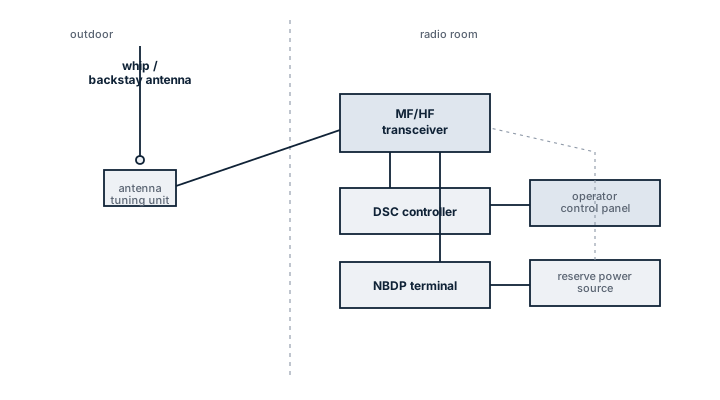
Main components
MF/HF transceiver
Covers the 1.6 to 27.5 MHz range across MF and HF bands, giving distress and routine coverage from a few hundred to several thousand nautical miles depending on band and ionospheric conditions.
DSC controller
Sends and receives Digital Selective Calling alerts on the dedicated distress and calling frequencies, including 2187.5 kHz on MF plus HF distress frequencies, automating what used to be a manual Morse distress call.
NBDP terminal
Handles narrow-band direct printing traffic, the modern replacement for radiotelex, used for routine and safety message exchange with coast stations and other vessels fitted with the same system.
Automatic antenna tuner
Matches the transmitter to the whip or backstay antenna across the whole frequency range; a defective tuner is the most common single-point cause of a set that receives but cannot transmit.
Reserve power source
A dedicated battery supply, independent of the ship's main and emergency source, sized to power the set for the SOLAS-required minimum endurance.
Selection / Sizing
| Parameter | What it drives |
|---|---|
| Intended sea area (A3 vs A4) | A4 operation makes MF/HF the primary system and drives redundancy requirements |
| Antenna run length and geometry | Affects tuner range and achievable transmit efficiency, especially on smaller vessels |
| Reserve power endurance | Sized against SOLAS minimum hours, not just battery amp-hours on paper |
Regulations / Class
SOLAS Chapter IV sets the GMDSS carriage requirements: vessels certified for Sea Area A3 must carry either an Inmarsat ship earth station or MF/HF DSC as the satellite backup, while vessels certified for A4 must carry MF/HF DSC and NBDP regardless of any satellite fit, since satellite coverage cannot be guaranteed there. Equipment must be type-approved and included on the ship's Cargo Ship Safety Radio Certificate, with annual survey of the reserve power source and DSC self-test function.
Typical faults
- Antenna tuner corrosion at the deck feed-through — set transmits weakly or not at all, though the receiver still works, so the fault is easy to miss until a distress test.
- Reserve battery never load-tested — shows full voltage on an open-circuit check but collapses the moment the transmitter keys up.
- DSC MMSI programmed incorrectly after a flag or name change — distress alerts identify the wrong vessel.
- NBDP software left on an outdated coast station frequency list — routine traffic simply fails to connect and is blamed on propagation.
What to look for in a supplier
- Type approval covering both DSC and NBDP modes, not DSC alone.
- Documented reserve power calculation matched to your vessel's actual radio installation, not a generic figure.
- Service network able to reach the ship for the annual radio survey wherever it trades, since this equipment cannot simply be posted for repair.
Before entering A4 waters, actually key up on HF and get a response from a coast station — a set that passes its self-test can still fail to raise anyone once the ionosphere is not cooperating, and that is not something the self-test checks.