What to check on a VSAT Terminal.
VSAT gives a ship broadband bandwidth, megabits rather than kilobits per second, by using a much larger stabilised antenna aimed at a geostationary Ku-band or Ka-band satellite, instead of the small omnidirectional antenna an L-band system like Fleet Broadband uses. The trade-off is size, power draw and cost: a VSAT dome sits prominently on the superstructure, needs a stabilised mount to keep the beam on the satellite through the vessel's motion, and depends on coverage from a specific satellite operator's beam pattern, which is why many installations carry an L-band…
What sets this type apart
VSAT gives a ship broadband bandwidth, megabits rather than kilobits per second, by using a much larger stabilised antenna aimed at a geostationary Ku-band or Ka-band satellite, instead of the small omnidirectional antenna an L-band system like Fleet Broadband uses. The trade-off is size, power draw and cost: a VSAT dome sits prominently on the superstructure, needs a stabilised mount to keep the beam on the satellite through the vessel's motion, and depends on coverage from a specific satellite operator's beam pattern, which is why many installations carry an L-band terminal as backup for the gaps between beams or when VSAT service drops.
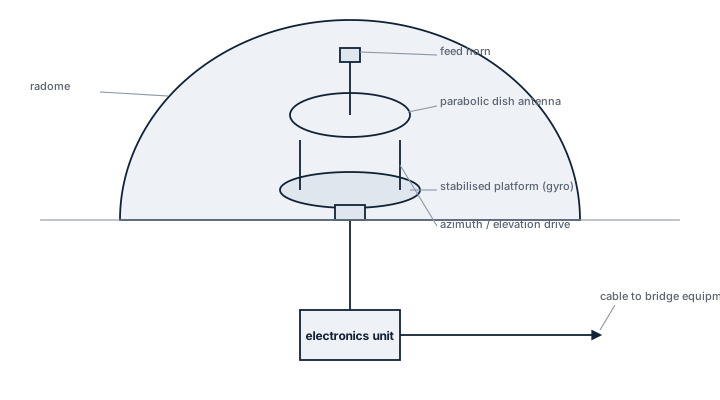
Main components
Antenna and radome
A parabolic dish, commonly 60 cm to well over a metre depending on required throughput, inside a radome that protects it from weather while remaining transparent to the satellite signal.
Stabilisation platform
A gyro-stabilised mount that continuously repositions the dish to compensate for roll, pitch and yaw, keeping it pointed at the satellite within a fraction of a degree.
Below-decks unit (BDU)
Houses the modem, RF electronics and network interface, converting satellite signal to the ship's onboard network and back.
Antenna control unit
Manages beam switching when the vessel crosses between satellite coverage areas, a process that on Ku-band VSAT is often automatic but requires the network operator's coverage map to be current.
Selection and sizing
Dish size and terminal bandwidth plan are chosen against the trading routes the vessel actually runs, since Ku-band and Ka-band coverage is not uniform globally and some routes cross gaps between satellite beams. Ka-band offers higher throughput per dollar of airtime in covered areas but has historically had thinner blue-water coverage than established Ku-band networks, so route coverage checking against the specific operator's footprint matters more than the headline bandwidth figure. Power consumption and deck space for the radome also factor into fitting the terminal on an existing vessel.
Regulations and class
VSAT installation does not carry a SOLAS carriage requirement the way GMDSS equipment does, since it typically serves crew welfare, operational data and business communication rather than distress and safety functions. Where the terminal shares infrastructure with GMDSS or navigation systems, class and flag administration rules on electromagnetic compatibility and independent power supply for safety equipment still apply, and the radome and mount must meet the vessel's structural and stability approval for topside weight and windage.
Typical faults
- Loss of satellite lock in heavy weather -- stabilisation platform cannot fully compensate for extreme roll; the consequence is connectivity dropouts exactly when crew and operations may need communication most.
- Radome damage from weather or ice -- physical damage to the protective dome; the consequence is signal degradation or water ingress into the antenna assembly.
- Beam switching failure at coverage boundaries -- outdated coverage maps or a fault in the antenna control unit; the consequence is a service gap that looks like a satellite outage but is actually a configuration issue.
- BDU or modem failure -- electronics failure below decks; the consequence is total loss of VSAT service even though the antenna itself is undamaged.
What to look for in a supplier
- Coverage maps and beam plans that actually match the vessel's trading routes, checked route by route rather than accepting a global coverage claim.
- Stabilisation performance specified for the sea states the vessel realistically encounters, not calm-water figures.
- Service level agreement covering both airtime and hardware support, since a BDU fault at sea needs a clear escalation path.
- Interoperability with the vessel's existing L-band backup terminal for automatic failover during VSAT gaps.
Check the satellite operator's current beam coverage against the vessel's actual voyage plan before departure on an unfamiliar route -- a dropped connection mid-ocean is more often a coverage gap than an equipment fault, and knowing the difference saves a wasted troubleshooting session.