Iridium Terminal
Iridium's low Earth orbit constellation gives pole-to-pole coverage that geostationary VSAT cannot reach, which is why an Iridium terminal stays fitted on vessels trading in high latitudes even where a broadband VSAT dome is also installed.
Read more — Iridium Terminal explained ▾
What this type is
An Iridium terminal is a satellite communication unit that links to the Iridium constellation of low Earth orbit satellites rather than a single geostationary satellite. Because the satellites orbit close to the earth and cover the poles, an Iridium terminal keeps a signal in latitudes where GEO-based VSAT systems lose coverage entirely. The trade-off is bandwidth: classic Iridium voice and short-burst data is measured in kilobits, and even Iridium Certus broadband tops out well below a VSAT Ku- or Ka-band link. Vessels use Iridium as the resilient backup channel and for GMDSS, not as the primary internet pipe.
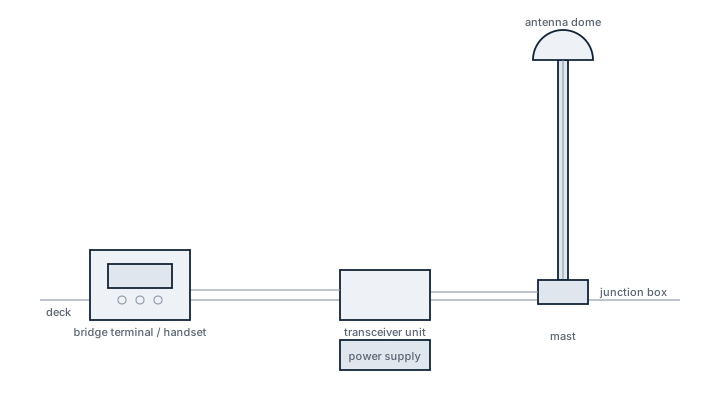
Main components
- Antenna/transceiver dome — a compact omnidirectional unit, far smaller than a VSAT dish, mounted with clear sky view fore and aft.
- Below-decks transceiver unit — handles call setup, data session management, and interfaces to the bridge network or SSAS/LRIT terminal.
- Subscriber Identity Module — an Iridium SIM tied to the airtime contract, similar in principle to a mobile SIM.
- Power supply and UPS backup — Iridium terminals used for GMDSS distress alerting must stay powered from the emergency source.
Selection and sizing
The deciding factor is not power but service class. A basic voice/SBD (Short Burst Data) unit suits SSAS reporting, crew calling and low-volume telemetry. Iridium Certus terminals step up to broadband speeds sufficient for email, weather routing files and some remote monitoring, at higher airtime cost. Fit is also driven by whether the terminal must serve a regulatory function.
| Service class | Typical use |
|---|---|
| Voice / SBD | Crew calls, SSAS, low-rate telemetry |
| Iridium Certus 100/200 | Email, weather files, light monitoring |
| Iridium Certus 700 | Broadband data, video, larger file transfer |
Regulations and class
Iridium is recognised under the GMDSS as an approved mobile satellite service alongside Inmarsat, so an Iridium terminal can fulfil the ship's GMDSS distress and safety communication requirement under SOLAS Chapter IV where fitted and type-approved for that purpose. Where used for the Ship Security Alert System, the terminal must meet the covert-alert requirements of SOLAS Chapter XI-2, including no on-board indication that an alert has been sent. Type approval and correct installation documentation are checked at survey.
Typical faults
- Antenna cable or connector corrosion at the mast — intermittent loss of registration that is hard to diagnose from below decks.
- SIM or airtime contract lapse — unit reports no service despite hardware being fully functional.
- Firmware mismatch after a partial software update — data sessions drop while voice still works, or vice versa.
- UPS battery degraded — terminal loses power exactly when the main supply fails, defeating its purpose as a backup channel.
What to look for in a supplier
- Type approval certificate matching the specific GMDSS or SSAS role the terminal will perform.
- Confirmed compatibility with the airtime provider's activation process before installation, not after.
- Documented antenna cable run and connector spec for the actual mast height and exposure.
- Service support that covers both the hardware and the airtime account — the two are often sold by different parties.
Test the Iridium link on its own, with the VSAT dome powered down, at least once a voyage — a terminal that has silently been riding on the VSAT connection for months will fail exactly when the VSAT does.
4 manufacturers · 8 models
Iridium
5- Antenna, feeder or casing damage reduces communication or locating performance and may cause self-test faults
- Battery, emergency-power or power-supply deterioration causes resets, low-voltage alarms or failure to operate
- Water ingress or corrosion causes intermittent operation, damaged connectors or internal faults
- Configuration, registration or identity errors cause incorrect vessel or beacon information
- Internal transceiver, display or control faults cause failed self-tests, missing communications or unavailable emergency functions
- Worldwide coverage including polar regions – no reliance on terrestrial networks
- Compact antenna system; can be installed on most vessel superstructures
- Integrated with GMDSS/bridge equipment for automated distress signalling
- Low power consumption and reliable in harsh marine environments
- Provides a dedicated safety‑critical backup channel separate from primary broadband links
- Very limited bandwidth (≈88 kbps) – unsuitable for video or large data transfers
- Antenna must have an unobstructed view of the sky; placement is critical on crowded decks
- Handset and terminal firmware quality issues reported in some installations
- Higher cost per megabyte compared with higher‑tier satellite services
- Voice quality can be affected by rain fade despite L‑band resilience
- Antenna, feeder or casing damage reduces communication or locating performance and may cause self-test faults
- Battery, emergency-power or power-supply deterioration causes resets, low-voltage alarms or failure to operate
- Water ingress or corrosion causes intermittent operation, damaged connectors or internal faults
- Configuration, registration or identity errors cause incorrect vessel or beacon information
- Internal transceiver, display or control faults cause failed self-tests, missing communications or unavailable emergency functions
- True worldwide coverage – no reliance on regional GEO constellations
- Integrated voice (3 simultaneous lines) and data in a single compact unit
- Low power consumption compared with higher‑throughput terminals
- Simple installation; fits standard maritime antenna mounts
- Limited bandwidth (176 kbps max) unsuitable for high‑volume applications
- Performance degrades if the antenna is partially obstructed or mis‑aligned
- Voice quality can suffer during network congestion periods
- Reported firmware bugs may require periodic updates

- Antenna, feeder or casing damage reduces communication or locating performance and may cause self-test faults
- Battery, emergency-power or power-supply deterioration causes resets, low-voltage alarms or failure to operate
- Water ingress or corrosion causes intermittent operation, damaged connectors or internal faults
- Configuration, registration or identity errors cause incorrect vessel or beacon information
- Internal transceiver, display or control faults cause failed self-tests, missing communications or unavailable emergency functions
- Global coverage including polar regions – no dead zones
- Minimal rain fade thanks to L‑band frequency
- Highest Certus tier (700) delivers up to 704 kbps, suitable for most operational data needs
- Compact antenna compared with Ka/Ku VSAT systems and can serve as a reliable backup link
- Integrated with Iridium GMDSS certification for distress communications
- Higher per‑megabyte airtime cost than GEO VSAT services
- Antenna size larger than handheld terminals; installation may require deck space
- Maximum throughput (704 kbps) is lower than modern Ka/Ku VSAT solutions, limiting high‑bandwidth applications
- Latency (~1–2 s) higher than GEO but acceptable for most maritime data
- Antenna, feeder or casing damage reduces communication or locating performance and may cause self-test faults
- Battery, emergency-power or power-supply deterioration causes resets, low-voltage alarms or failure to operate
- Water ingress or corrosion causes intermittent operation, damaged connectors or internal faults
- Configuration, registration or identity errors cause incorrect vessel or beacon information
- Internal transceiver, display or control faults cause failed self-tests, missing communications or unavailable emergency functions
- Compact and lightweight – can be carried or mounted in limited space
- Global coverage independent of terrestrial networks
- Simple plug‑and‑play setup with Wi‑Fi hotspot for crew devices
- Low power draw suitable for vessels with modest electrical capacity
- Future‑proof Certus service offering higher‑efficiency protocols
- Maximum data rate limited to ~88 kbps – unsuitable for high‑bandwidth applications
- Battery runtime is short and may require frequent recharging or external power
- Wi‑Fi hotspot range is modest; crew must stay close to the unit
- Antenna performance highly dependent on placement and clear sky view
- No built‑in redundancy for antenna loss – a separate backup antenna is needed

- Antenna, feeder or casing damage reduces communication or locating performance and may cause self-test faults
- Battery, emergency-power or power-supply deterioration causes resets, low-voltage alarms or failure to operate
- Water ingress or corrosion causes intermittent operation, damaged connectors or internal faults
- Configuration, registration or identity errors cause incorrect vessel or beacon information
- Internal transceiver, display or control faults cause failed self-tests, missing communications or unavailable emergency functions
- Global coverage – works from pole to pole without terrestrial infrastructure
- Ruggedized (IP68) housing suitable for harsh marine environments
- Integrated GPS and SOS button for emergency positioning and distress alerts
- Standalone, portable backup that can be used on any bridge without installation
- Battery life sufficient for several hours of talk time in emergencies
- Very limited data rates (max ~2.4 kbps), unsuitable for bandwidth‑intensive applications
- High per‑minute voice cost compared with VHF or other satellite services
- Voice quality can degrade under adverse weather or low elevation angles
- Battery is not hot‑swappable; replacement requires device shutdown
- Handset size and weight are larger than typical consumer smartphones
Lars Thrane
1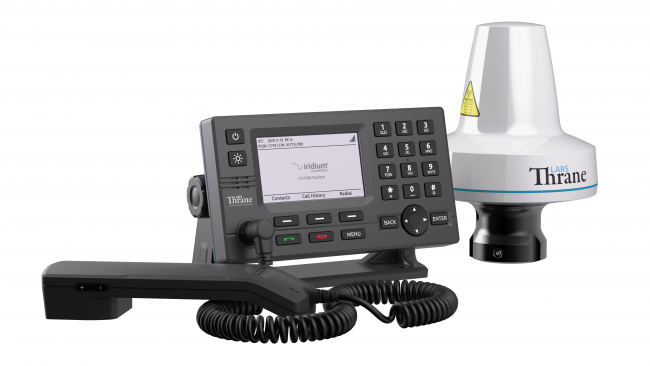
- Antenna, feeder or casing damage reduces communication or locating performance and may cause self-test faults
- Battery, emergency-power or power-supply deterioration causes resets, low-voltage alarms or failure to operate
- Water ingress or corrosion causes intermittent operation, damaged connectors or internal faults
- Configuration, registration or identity errors cause incorrect vessel or beacon information
- Internal transceiver, display or control faults cause failed self-tests, missing communications or unavailable emergency functions
- Compact, space‑saving design suitable for vessels with limited bridge space
- Global coverage via the Iridium constellation – no reliance on terrestrial networks
- Supports Iridium Certus service up to 700 kbps, enabling real‑time monitoring and low‑bandwidth video
- Integrated antenna system simplifies installation compared with separate antenna kits
- GMDSS certification still pending – may not meet mandatory distress communication requirements on some flags
- Antenna cable routing can be problematic if not planned carefully during installation
- Firmware updates have been reported as cumbersome and may require shipyard downtime
- Maximum data rate (700 kbps) is lower than competing Ka‑band satellite terminals for high‑volume traffic
Sailor / Cobham
1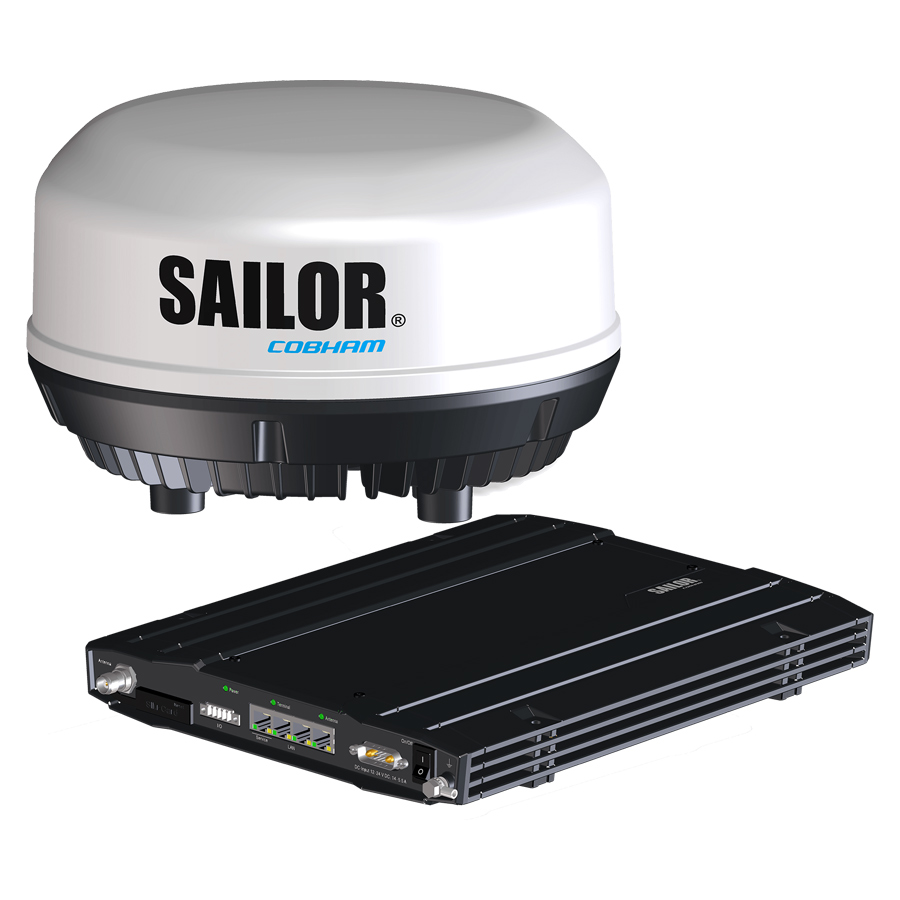
- Antenna, feeder or casing damage reduces communication or locating performance and may cause self-test faults
- Battery, emergency-power or power-supply deterioration causes resets, low-voltage alarms or failure to operate
- Water ingress or corrosion causes intermittent operation, damaged connectors or internal faults
- Configuration, registration or identity errors cause incorrect vessel or beacon information
- Internal transceiver, display or control faults cause failed self-tests, missing communications or unavailable emergency functions
- Broadband speeds up to 700 kbps for high‑capacity data and voice services
- Compact, marine‑rated hardware designed for bridge integration
- Global Iridium coverage eliminates dead zones in remote areas
- Future‑proof with pending GMDSS certification for compliance
- Seamless interface with Sailor’s existing bridge communication suite
- Known integration challenges with legacy Sailor GMDSS equipment
- Antenna placement can be restrictive on vessels with limited deck space
- Operating costs are higher than narrow‑band satellite services due to airtime rates
- GMDSS approval still pending, limiting use where certification is mandatory
- Limited data rate compared to newer LEO constellations (e.g., Starlink) for very high‑throughput needs
Thales
1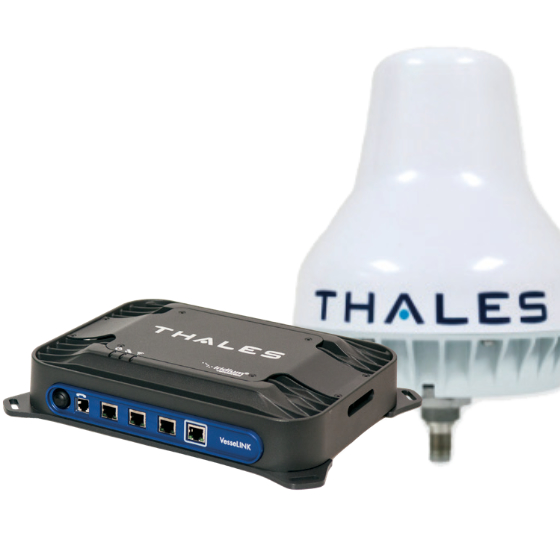
- Antenna, feeder or casing damage reduces communication or locating performance and may cause self-test faults
- Battery, emergency-power or power-supply deterioration causes resets, low-voltage alarms or failure to operate
- Water ingress or corrosion causes intermittent operation, damaged connectors or internal faults
- Configuration, registration or identity errors cause incorrect vessel or beacon information
- Internal transceiver, display or control faults cause failed self-tests, missing communications or unavailable emergency functions
- True worldwide coverage including polar regions thanks to the Iridium constellation
- Marine‑rated housing and corrosion‑resistant components for harsh sea environments
- Integrated with bridge equipment, enabling seamless navigation data exchange
- Compact footprint suitable for vessels with limited deck space
- Supports up to 704 kbps data rate on Certus service
- Antenna pedestal motor is prone to wear and may require periodic overhaul
- Initial configuration can be complex, often needing specialist support
- Firmware updates are mandatory to access newer Certus‑700 features
- Limited bandwidth compared with Ka‑band VSAT solutions for high‑throughput needs
- Higher latency typical of L‑band satellite links