What to check on a Rate of Turn Indicator.
A compass tells you what heading the ship is on. A rate of turn indicator (ROTI) tells you how fast that heading is changing, displayed in degrees per minute, updated continuously rather than read off a slowly swinging card. That distinction matters most in restricted waters and pilotage, where an officer needs to know whether a turn is developing too fast, too slow, or has stopped altogether, well before the compass heading itself has moved enough to show it. The instrument does not replace the compass; it works alongside it…
What sets a rate of turn indicator apart
A compass tells you what heading the ship is on. A rate of turn indicator (ROTI) tells you how fast that heading is changing, displayed in degrees per minute, updated continuously rather than read off a slowly swinging card. That distinction matters most in restricted waters and pilotage, where an officer needs to know whether a turn is developing too fast, too slow, or has stopped altogether, well before the compass heading itself has moved enough to show it. The instrument does not replace the compass; it works alongside it, usually as a needle or bar-graph display mounted directly in the helmsman's and officer's line of sight.
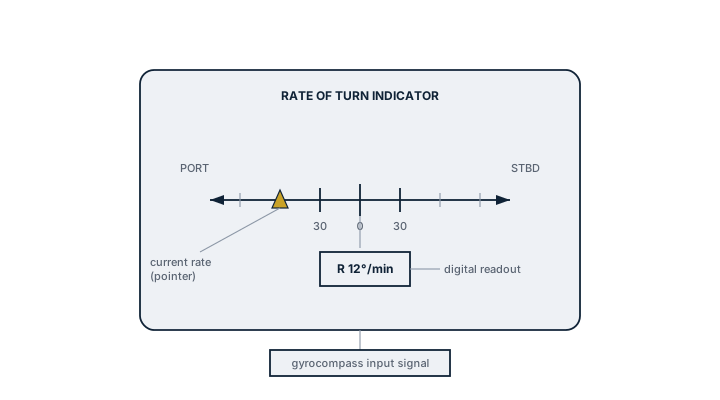
Main components
Sensor
Most modern installations derive rate of turn from the ship's gyrocompass or inertial sensor rather than a dedicated turn sensor, differentiating heading change over time. Standalone ROTI units use a fibre-optic or piezoelectric rate gyro package independent of the main gyrocompass.
Signal processing unit
Filters the raw rate signal to smooth out short-period yaw from waves and steering corrections, so the display shows the underlying turn trend rather than every small oscillation.
Display
A dial or bar display calibrated in degrees per minute, typically scaled to around 30, 60 or higher depending on the vessel type, with a clear zero position for steady heading. Repeaters are commonly fitted at the conning position and on the bridge wings.
Interface to other bridge systems
Rate of turn data feeds the integrated bridge system, ECDIS and, on vessels fitted with track control, the autopilot's turn radius calculations, so a fault in the ROTI sensor can propagate into other displays if the interface is not properly isolated.
Selection and sizing
- Full-scale range matched to the vessel type: a large tanker rarely turns faster than 10 to 20 degrees per minute, while a smaller, more manoeuvrable ship needs a wider scale to stay useful in harbour manoeuvres.
- Standalone sensor versus derived signal from the gyrocompass — standalone units give redundancy if the gyro fails, at the cost of an extra sensor to maintain.
- Response time and damping settings, balancing a display that reacts fast enough to be useful against one so twitchy it is unreadable in a seaway.
Regulations and class
SOLAS Chapter V requires a rate of turn indicator on vessels of 50,000 gross tonnage and above, and flag states or class societies extend the requirement to smaller vessels on some routes and vessel types. Where fitted, the ROTI must meet IMO performance standards for rate of turn indicators, and periodic testing against the gyrocompass reading is normally included in bridge equipment survey.
Typical faults
- Sensor drift over time causing a steady heading to show a small false turn rate — corrected by recalibration against the gyrocompass, not ignored as noise.
- Damping set too aggressively, hiding the early stage of an unintended turn until it has already developed.
- Loss of signal from the gyrocompass on derived-signal units, which takes out the ROTI along with the heading reference at the worst possible moment.
- Display backlight or repeater failure on the bridge wing, leaving the conning officer without a reading during a pilotage turn.
What to look for in a supplier
- Compliance certification against the applicable IMO performance standard, with the type approval documentation available for the flag state.
- Clean integration with the existing gyrocompass or inertial sensor rather than a bolt-on unit that adds another single point of failure.
- Repeater options for bridge wings and the pilotage conning position, since the main console display is often not where it is needed most.
Cross-check the ROTI against the compass heading change by the clock during handover — a sensor that has drifted quietly still looks perfectly normal on its own display.