"> Navtex Receiver - Equipment Database

Navtex Receiver

medium 40 models total

A Navtex receiver automatically prints or displays maritime safety information broadcast on 518 kHz in English and 490 kHz in the national language, filtering messages by station and subject so the bridge only sees relevant warnings without anyone standing a radio watch.

Read more — Navtex Receiver explained

What Makes a Navtex Receiver Different

A Navtex receiver is a dedicated, narrow-purpose radio receiver that automatically demodulates and prints or displays text broadcasts of maritime safety information, navigational warnings, weather forecasts and warnings, search and rescue information, and ice reports, without requiring a radio operator to tune in or transcribe anything. It listens continuously on 518 kHz for the international English-language broadcast and, where fitted, on 490 kHz for the national-language service, and it filters incoming messages by originating station and by subject code so the bridge team only sees information relevant to the ship's area and interests. That automatic, unattended reception is what distinguishes Navtex from a general MF/HF radio, VHF set, or satellite communication terminal, none of which are built to filter and log safety broadcasts on their own.
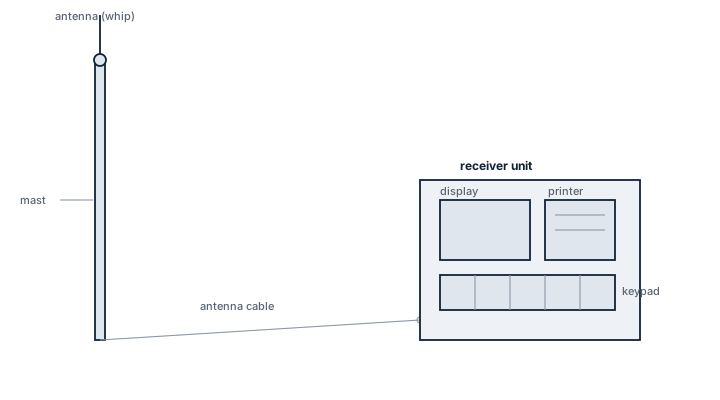
Navtex receiver, shipboard arrangement
A Navtex whip antenna on the mast connected by cable to the bridge receiver unit, which shows messages on its display, prints them out and is operated from its keypad.

Main Components

Receiver and demodulator

Tuned to 518 kHz and 490 kHz, demodulating the narrow-band direct-printing (NBDP) signal used for Navtex broadcasts.

Antenna

A dedicated whip or wire antenna for the MF band, separate from the ship's main MF/HF communication antenna, since Navtex must keep receiving even while other MF equipment transmits.

Message processor and filter

Decodes the four-character message header, station identifier, subject category such as A for navigational warning or B for weather warning, and message number, and suppresses messages the operator has selected as not relevant or already received.

Display or printer

Older units use a thermal printer producing a paper log; most modern installations use an integrated display with message storage and export, though many ships still keep the printer for a hard-copy record.

Selection and Sizing

  • Coverage of both 518 kHz and 490 kHz where the ship trades in waters broadcasting a national-language service
  • Message storage capacity and the ability to export or interface with the ship's electronic chart system
  • Reliable subject-category filtering, since a receiver that cannot filter buries navigational warnings in low-priority traffic
  • Integration with the bridge alarm system so an urgent message triggers an audible alert rather than sitting unread on a display

Regulations and Class

SOLAS Chapter IV requires Navtex reception as part of the Global Maritime Distress and Safety System (GMDSS) for ships trading in sea areas A1 through A3 where Navtex coverage exists, as an alternative or supplement to satellite-based safety information reception. The receiver must carry type approval to the relevant GMDSS performance standard, and its function is checked at survey along with the rest of the GMDSS installation. Certain subject categories, navigational and weather warnings, categories A and B, cannot be deselected by the operator, since SOLAS treats them as always required.

Typical Faults

FaultCauseConsequence
Missed messagesWrong station selection for the trading area, or mandatory categories accidentally deselectedBridge team unaware of navigational or weather warnings in effect
Weak or noisy receptionCorroded antenna connection, poor antenna grounding, nearby electrical interferenceGarbled or dropped messages, gaps in the safety information log
Printer paper or ribbon exhausted unnoticedNo spare consumables kept, low-supply alarm not checkedLoss of hard-copy record even though reception continues
Duplicate or repeated messages flooding the logMessage deduplication or station filtering misconfiguredImportant new warnings harder to spot among repeats

What to Look for in a Supplier

  • Current GMDSS type approval valid for the flag state and trading areas the ship operates in
  • Dual-frequency, 518/490 kHz, capability where the trading pattern requires the national-language service
  • A filtering interface the bridge team can actually configure correctly, not one requiring factory support for routine changes
  • Spares availability for the antenna, printer consumables and processor unit

Check the station and category selection after every change of trading area; a Navtex set faithfully filtering out the wrong region's warnings gives a false sense of being covered.

20 manufacturers · 40 models

Furuno

11
NX-700A Nav38 unverified
Dual channel
ja
IMO Compliant
ja
NX-700B Nav38 unverified
Dual channel
ja
IMO Compliant
ja
NX-300 Nav38 unverified
Dual channel
ja
IMO Compliant
ja
NX-700C unverified
NX-800 unverified
NX-300 Navtex Receiver unverified
Frequencies khz
490/518/4209.5
IMO Compliant
ja
Printer
nein
Display
ja
NX-700A Navtex Receiver unverified
Frequencies khz
490/518/4209.5
IMO Compliant
ja
NX-700B Navtex Receiver unverified
Frequencies khz
490/518/4209.5
IMO Compliant
ja
Color display
ja
FAX-30 Weather Fax unverified
Type
weather_fax
Frequency range
1.6-22.1 MHz
FAX-408 Weather Fax unverified
Type
weather_fax
Frequency range
1.6-22.1 MHz
NAVpilot-711C Autopilot unverified
Type
autopilot
IMO Compliant
ja

JRC

5
JRC NCR-333A
NCR-333A
518/490 kHz · Navigation Data / Sensor · Navtex receiver
Frequencies
518/490 kHz
Printer
ja
Gmdss approved
ja
Common Failures & Inspection Points
  • Printer thermal head wear
  • Message duplication
  • Power supply issues
Service: JRC Navtex. Reliable unit. Thermal head replacement ~5 years.
Spare Parts: JRC: Ersatzteile per Hersteller-Netzwerk. Lead time: 1-4 Wochen. Backup-Systeme an Bord pflichtgemäß.
Strengths
  • GMDSS approved and SOLAS compliant out‑of‑the‑box
  • Built‑in thermal printer for hard‑copy records
  • Simple installation with standard bridge power supply
  • Proven reliability on a wide range of commercial vessels
Weaknesses
  • Thermal print head wears after ~5 years, requiring replacement
  • Occasional message duplication reported in harsh EMI environments
  • Limited to 518/490 kHz – no support for additional Navtex bands
  • No integrated AIS or satellite communication functions
Typical Vessels: Bulk CarrierTankerContainer ShipGeneral Cargo VesselPassenger Ferry
Certifications: IMO SOLASUSCG Type ApprovalGMDSS Approved
Decision Guide: Choose if you need a dedicated, GMDSS‑compliant Navtex receiver with an on‑board printer and proven reliability for standard safety information bands. Avoid if your vessel requires multi‑band Navtex coverage, integrated AIS/SATCOM functionality, or minimal long‑term maintenance of the print head.
Use Cases: Installed on bridge consoles of merchant ships to receive NAVTEX safety broadcasts (weather warnings, navigational alerts, distress messages) and produce a hard copy log for compliance audits and crew briefing.
NCR-333 Navtex Receiver unverified
Frequencies khz
490/518/4209.5
IMO Compliant
ja
NCR-333A Navtex Receiver unverified
Frequencies khz
490/518/4209.5
IMO Compliant
ja
Dual channel
ja
JAX-9B Weather Fax unverified
Type
weather_fax
Frequency range
1.6-22.1 MHz
JAN-9102 Autopilot unverified
Type
autopilot
IMO Compliant
ja

ICS Electronics

4
NAV7 Plus unverified
NAV8 unverified
NAV-5 Navtex Receiver unverified
Frequencies khz
490/518
IMO Compliant
ja
WX-1 Weather Fax unverified
Type
weather_fax
Frequency range
1.6-22.1 MHz

Haihua

2
HNR-5000 unverified
HNR-6000 unverified

McMurdo

2
McMurdo Navtex
Navtex
518/490 kHz · Navigation Data / Sensor · Navtex receiver
Frequencies
518/490 kHz
Gmdss approved
ja
Common Failures & Inspection Points
  • Memory management
  • Antenna tuning
  • Power supply sensitivity
Service: McMurdo Navtex. Part of GMDSS product range.
Spare Parts: McMurdo: Ersatzteile per Hersteller-Netzwerk. Lead time: 1-4 Wochen. Backup-Systeme an Bord pflichtgemäß.
Strengths
  • Fully GMDSS approved with USCG type approval, ensuring regulatory compliance
  • Simple, rugged marine‑grade housing suitable for harsh bridge environments
  • Low power consumption compared with many newer digital units
  • Clear alphanumeric display and audible alarm for urgent messages
  • Straightforward installation – compatible with standard 1 m whip antennas
Weaknesses
  • Reported memory‑management bugs can cause occasional loss of stored messages
  • Antenna tuning is critical; performance degrades if the antenna is not precisely matched to 518/490 kHz
  • Sensitive to power‑supply voltage fluctuations, leading to occasional resets
  • Limited integration options – no built‑in AIS or NMEA 2000 output
  • User interface lacks modern touchscreen features found on newer competitors
Typical Vessels: Bulk CarrierTankerContainer ShipOffshore Support VesselPassenger Ferry
Certifications: USCG Type ApprovalIMO GMDSS ComplianceDNV Class Approved
Decision Guide: Choose if you need a proven, low‑cost Navtex receiver that meets all GMDSS requirements and can be installed on vessels with standard antenna setups. Avoid if your vessel requires tight integration with AIS/NMEA networks, high reliability under unstable power conditions, or a modern touchscreen interface.
Use Cases: Installed on the bridge of merchant ships to receive coastal safety broadcasts, weather warnings, and navigational alerts in both international waters (518 kHz) and national zones (490 kHz). Commonly paired with a GMDSS console for continuous monitoring of Maritime Safety Information.
Navtex Pro II unverified
Frequencies khz
490/518/4209.5
IMO Compliant
ja

Simrad

2
NX40 Navtex Receiver unverified
Frequencies khz
490/518
IMO Compliant
ja
AP70 Autopilot unverified
Type
autopilot
IMO Compliant
ja

Alphatron

1
AlphaPilot Autopilot unverified
Type
autopilot
IMO Compliant
ja

IEC Telecom

1
IEC Telecom Navtex NR-100
Navtex NR-100
518/490 kHz · Navigation Data / Sensor · Navtex receiver
Frequencies
518/490 kHz
Printer
ja
Gmdss approved
ja
Common Failures & Inspection Points
  • Printer mechanism issues
  • Antenna interference
  • Display contrast
Service: Budget Navtex. Simple and functional.
Spare Parts: IEC Telecom: Ersatzteile per Hersteller-Netzwerk. Lead time: 1-4 Wochen. Backup-Systeme an Bord pflichtgemäß.
Strengths
  • Dual‑frequency coverage (518 kHz & 490 kHz) for worldwide Navtex service
  • Built‑in printer provides a hard copy record of safety messages
  • Simple, rugged design suitable for low‑maintenance installations
  • GMDSS approved, meeting basic regulatory requirements for most vessels
  • Cost‑effective solution for vessels with limited budget
Weaknesses
  • Printer mechanism reported to be prone to jamming or ink issues
  • Antenna interference can affect reception in high‑electromagnetic environments
  • Display contrast may be low, reducing readability in bright daylight
  • Limited advanced features (e.g., no LCD backlight, no integrated AIS)
  • Support and spare parts availability may be less robust than major brands
Typical Vessels: Coastal cargo vesselsTugboatsSupply & support shipsFishing vesselsSmall passenger ferries
Decision Guide: Choose if you need a basic, GMDSS‑compliant Navtex receiver with printing capability at a low purchase price and can tolerate occasional printer or display quirks. Avoid if your operation demands high reliability, advanced user interface features, or extensive after‑sales support.
Use Cases: The NR-100 is commonly installed on small to medium commercial vessels operating in coastal waters where receipt of Maritime Safety Information (MSI) is mandatory but budget constraints limit investment in higher‑end equipment. It provides a straightforward way to meet GMDSS requirements while keeping installation and maintenance simple.

JRC (Japan Radio Co)

1
NCR-333 Nav38 unverified
Dual channel
ja
IMO Compliant
ja

Kongsberg

1
K-Pilot Autopilot unverified
Type
autopilot
IMO Compliant
ja

NASA Marine

1
Clipper Navtex
518 kHz · Navigation Data / Sensor · single-frequency Navtex receiver
Frequencies
518 kHz
Common Failures & Inspection Points
  • Single frequency only
  • Small display
  • Limited message storage
Service: Budget option. 518 kHz only — no 490 kHz national language.
Spare Parts: NASA Marine: Ersatzteile per Hersteller-Netzwerk. Lead time: 1-4 Wochen. Backup-Systeme an Bord pflichtgemäß.
Strengths
  • Low acquisition cost – suitable for vessels with limited budgets
  • Simple installation and operation due to single‑frequency design
  • Compact unit fits easily into small bridge consoles
  • Provides continuous monitoring of the mandatory 518 kHz international channel
Weaknesses
  • Only receives on 518 kHz – cannot receive national language broadcasts on 490 kHz
  • Small display limits readability, especially in bright conditions
  • Limited internal message storage requires frequent clearing
  • Lacks advanced features such as AIS integration or multi‑frequency capability
Typical Vessels: Coastal fishing vesselsTugs and workboatsTraining shipsSmall offshore supply craftRecreational yachts (when compliance is required)
Decision Guide: Choose if you need an inexpensive, easy‑to‑install Navtex that only requires the international 518 kHz channel and space on board is limited. Avoid if your operations depend on national language broadcasts (490 kHz), require larger message archives, or need integrated bridge systems with multi‑frequency support.
Use Cases: Typically installed on small to medium coastal vessels where regulatory compliance for the 518 kHz distress frequency is mandatory but budget constraints preclude more feature‑rich receivers. Commonly found on workboats, training platforms, and modest offshore supply units that operate primarily in international waters.

Navis

1
NP-3000 Autopilot unverified
Type
autopilot
IMO Compliant
ja

Praxis

1
ProSteer Autopilot unverified
Type
autopilot
IMO Compliant
ja

Raytheon Anschuetz

1
NautoSteer Autopilot unverified
Type
autopilot
IMO Compliant
ja

Sailor

1
Sailor 6391 Navtex unverified
Frequencies khz
490/518/4209.5
IMO Compliant
ja

Sailor (Cobham)

1
Sailor (Cobham) 6390 Navtex
6390 Navtex
518/490/4209.5 kHz · Navigation Data / Sensor · NAVTEX MF/HF receiver
Frequencies
518/490/4209.5 kHz
Gmdss approved
ja
Common Failures & Inspection Points
  • Integration issues with Sailor console
  • Antenna compatibility
  • Message storage full
Service: Triple-frequency including 4209.5 kHz international Navtex.
Spare Parts: Sailor (Cobham): Ersatzteile per Hersteller-Netzwerk. Lead time: 1-4 Wochen. Backup-Systeme an Bord pflichtgemäß.
Strengths
  • Triple‑frequency coverage (518/490/4209.5 kHz) for worldwide NAVTEX service
  • GMDSS approved, meeting SOLAS requirements
  • Simple plug‑and‑play installation with minimal wiring
  • Low power consumption suitable for all vessel sizes
  • Proven reliability in harsh marine environments
Weaknesses
  • Known integration issues with newer Sailor bridge consoles
  • Antenna compatibility limited to specific MF/HF types
  • Message storage can become full quickly, requiring manual purge
  • No modern digital interfaces (e.g., NMEA 2000 or Ethernet)
  • Older hardware may be harder to obtain spare parts for
Typical Vessels: Bulk CarrierContainer ShipTankerPassenger VesselOffshore Supply Vessel
Certifications: GMDSS Approved
Decision Guide: Choose if: you operate a vessel that already uses Sailor bridge equipment, need reliable triple‑frequency NAVTEX reception, and prefer a simple, low‑power solution. Avoid if: you require integrated AIS/VDES data, modern network interfaces, or seamless compatibility with the latest Sailor consoles.
Use Cases: Deployed on commercial cargo ships, tankers and passenger vessels to receive safety broadcasts, weather warnings and navigational alerts in compliance with SOLAS GMDSS obligations, especially where a straightforward MF/HF receiver is preferred over multi‑function units.

SAMYUNG

1
SNX-300 Navtex
518/490 kHz · Navigation Data / Sensor · Navtex receiver
Frequencies
518/490 kHz
Gmdss approved
ja
Common Failures & Inspection Points
  • Limited service network
  • Display quality
  • Antenna sensitivity
Service: Budget Navtex option. Popular on Korean-built vessels.
Spare Parts: SAMYUNG: Ersatzteile per Hersteller-Netzwerk. Lead time: 1-4 Wochen. Backup-Systeme an Bord pflichtgemäß.
Strengths
  • Low acquisition cost compared with most Western brands
  • GMDSS approved for mandatory safety communications
  • Dual‑frequency operation (518/490 kHz) covers both global and regional broadcasts
  • Simple plug‑and‑play installation, suited to vessels with limited bridge space
  • Widely used on Korean‑built ships, so spare parts are often stocked locally
Weaknesses
  • Limited after‑sales service network outside Korea
  • Display quality reported as dim or low‑resolution
  • Antenna sensitivity can be marginal, requiring careful mounting
  • Basic feature set – no integrated AIS or multi‑channel logging
  • Reliability concerns on long voyages in harsh sea states
Typical Vessels: Bulk CarrierContainer ShipTankerGeneral Cargo VesselOffshore Supply Vessel
Certifications: GMDSS Type Approval
Decision Guide: Choose if: you need a cost‑effective Navtex solution, the vessel is Korean‑built or operates in regions where Samsung support is available, and only basic safety message reception is required. Avoid if: high reliability, extensive service coverage, advanced display or integrated bridge systems are essential.
Use Cases: Commonly installed on small to medium sized merchant ships operating under GMDSS requirements, especially Korean‑flagged or Korea‑built vessels where budget constraints dominate and a straightforward Navtex receiver is sufficient for receiving safety broadcasts.

Samyung

1
SNX-300 Navtex Receiver unverified
Frequencies khz
490/518/4209.5
IMO Compliant
ja

Sperry Marine

1
NAVIPILOT 4000 unverified
Type
autopilot
IMO Compliant
ja

Tokyo Keiki

1
PR-9000 Autopilot unverified
Type
autopilot
IMO Compliant
ja