Navigation Lights
COLREG navigation lights are graded by visibility range, not brightness in isolation — a masthead light on a 60m vessel must show for 5 nautical miles, and swapping in an LED fixture without checking its rated range against the vessel's length is a common way to fail this requirement.
Read more — Navigation Lights explained ▾
What this type is
Navigation lights are the fixed lights a vessel must show under the International Regulations for Preventing Collisions at Sea (COLREG) so that other vessels can judge its type, size, aspect and direction of travel at night or in restricted visibility. Each light — masthead, sidelights, sternlight, all-round, not-under-command, towing — has a defined arc of visibility in degrees and a minimum visibility range in nautical miles set by the vessel's length, not by a single fixed standard across all ships.
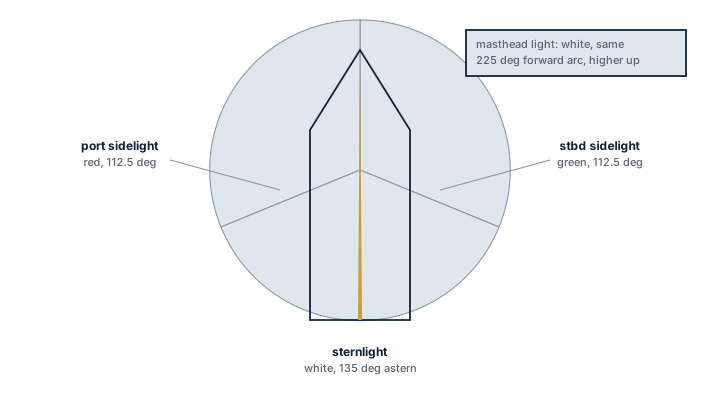
Main components
- Masthead light — white, forward arc of 225°, mounted on the centreline; larger vessels carry a second, higher masthead light aft of and higher than the forward one.
- Sidelights — red (port) and green (starboard), each covering 112.5° from dead ahead to abaft the beam.
- Sternlight — white, covering the 135° arc astern not covered by the sidelights.
- All-round light — visible over the full 360°, used for anchor lights, not-under-command signals, and on smaller craft that combine functions.
- Signal lights for special status — towing lights, not-under-command (two red all-round), restricted-in-ability-to-manoeuvre (red-white-red), fishing vessel lights, and similar COLREG-defined combinations.
Selection and sizing
| Vessel length | Masthead light range | Sidelight/sternlight range |
|---|---|---|
| Under 12m | 2 nm | 1 nm |
| 12-20m | 3 nm | 2 nm |
| 20-50m | 5 nm | 2 nm |
| 50m and over | 6 nm | 3 nm |
An LED retrofit must be selected against these COLREG Rule 22 ranges for the vessel's actual length, and the fixture's type approval certificate should state the range it meets, not just its power draw or lumen output.
Regulations and class
COLREG Rules 20 through 31 set the technical requirements for colour, arc and range; Annex I sets the detailed positioning and screening rules that stop one light's arc bleeding into a neighbouring sector. Fixtures must carry type approval evidencing compliance with these ranges and arcs, and class/flag surveys check the lights are the approved type, correctly positioned, and that the required indicator or alarm for light failure at the bridge is functioning.
Typical faults
- LED fixture swapped in without checking rated range — the light works but does not meet the visibility distance for the vessel's length.
- Screen or baffle damaged or missing, letting a sidelight's arc bleed across the bow and create a false aspect to an approaching vessel.
- Bridge failure-indicator lamp burnt out, so a navigation light outage goes unnoticed until reported from another vessel.
- Corrosion at the lamp housing seal admitting water, causing intermittent failure that is hard to reproduce during daytime testing.
What to look for in a supplier
- Type approval certificate stating the exact COLREG range and arc met, for the specific fixture model.
- Housing rated for the mounting location's vibration and weather exposure, not a generic marine rating.
- Compatibility with the existing bridge indicator/alarm panel wiring.
- LED driver quality — cheap drivers are a common early-failure point, not the LED itself.
Check navigation lights against their rated range at commissioning, not just for on/off state — a light that is lit but under-range is a COLREG deficiency that a night-time port state inspection will not accept.

8 manufacturers · 8 models
DHR
1- Bulb replacement (incandescent)
- Gasket seal aging
- Mounting bolt corrosion
- COLREG‑approved design ensures regulatory compliance worldwide
- LED version offers long service life and low maintenance compared with incandescent units
- Rugged housing with sealed gasket resists saltwater ingress on European‑built ships
- Standard mounting pattern fits most new‑build bridge decks and masts
- Wide acceptance in the European market gives easy access to spare parts
- Initial cost higher than basic generic incandescent lights
- Retrofit on older vessels may require modification of existing brackets or wiring
- Gasket seals can age and need periodic inspection/replacement
- Mounting bolts are prone to corrosion if non‑stainless hardware is used
- LED heat dissipation must be managed in confined installations
Glamox
1
- LED driver in harsh environments
- Signal light controller issues
- Connector corrosion
- COLREG‑approved lighting with integrated colour sectors
- Low power consumption when fitted with LEDs
- Robust offshore‑rated housings resistant to salt spray and vibration
- Modular design allows easy replacement of LED modules or drivers
- Wide product range covering both navigation and signal functions
- LED driver can be sensitive to extreme temperature cycles in harsh environments
- Connector corrosion reported on older installations if not periodically inspected
- Higher initial cost compared with basic incandescent units
- Spare parts may have longer lead times for remote offshore depots
- Signal light controller firmware updates sometimes required to maintain compatibility
Hella Marine
1
- LED driver failure
- Lens UV degradation
- Mounting bracket corrosion
- Very long service life (≈50,000 h) reduces replacement intervals
- Low power consumption compared with traditional incandescent lamps
- Instant full‑brightness output for immediate compliance
- Meets COLREG requirements and is USCG type‑approved
- Compact, lightweight design simplifies installation
- LED driver modules have a known failure mode requiring periodic testing
- Polycarbonate lenses can suffer UV‑induced yellowing over many years
- Mounting brackets are prone to corrosion in highly saline environments if not maintained
- Higher upfront purchase cost than conventional halogen units
Lopolight
1
- Higher cost than traditional
- Module connector corrosion
- Color consistency between modules
- Very low power consumption compared with incandescent or halogen units
- Long service life (30,000+ hours) reducing maintenance intervals
- Modular construction allows individual LED modules to be swapped without removing the whole fixture
- High luminous intensity and colour stability meeting COLREG requirements
- Compact size and lightweight mounting options
- Higher initial purchase price than traditional halogen/nav‑light units
- Connector corrosion reported in harsh marine atmospheres if not regularly inspected
- Potential colour‑balance variation between modules from different production batches
- Requires compatible voltage supply; retro‑fits may need wiring adjustments
Orga
1- Helideck-specific requirements
- LED module replacement
- Salt spray corrosion
- Low power consumption compared with traditional incandescent lamps
- Long service life (typically >50,000 hours) reducing maintenance intervals
- COLREG and USCG approved, ensuring regulatory compliance
- Robust housing designed for marine environments and salt‑spray exposure
- Compact design suitable for integration on helidecks and obstruction points
- Higher upfront capital cost than conventional halogen units
- LED module replacement can require specialised tools or dealer service
- Reported susceptibility to corrosion if seals are compromised in extreme salt‑spray conditions
- Limited retro‑fit flexibility on older vessels with non‑standard mounting provisions
Perko
1
- Incandescent bulb replacement
- Chrome plating pitting
- Lens cracking
- COLREG‑approved design ensures regulatory compliance
- LED option offers low power consumption and long service life
- Robust stainless‑steel housing with proven durability
- Interchangeable incandescent bulbs simplify on‑board replacement
- Widely used in commercial fleets, so spare parts are readily available
- Chrome plating can pit over time, requiring periodic inspection
- Lens material may crack under impact or thermal stress
- Incandescent models have higher energy use and shorter bulb life
- Initial cost of LED units is higher than traditional lamps
- Limited to Perko’s product line – fewer colour‑temperature options
Tideland Signal
1
- AtoN regulatory compliance
- Solar power system aging
- Lens fouling
- Very low power consumption, enabling long autonomous operation on solar panels
- LED life typically >50,000 hours, reducing replacement intervals
- Meets or exceeds AtoN luminous intensity requirements for most categories
- Robust sealed housing with high corrosion resistance (IP68/70)
- Straight‑forward retrofit onto existing lantern fixtures
- Solar panel performance degrades over time, shortening autonomy if not replaced
- Lens fouling in harsh marine environments can diminish output and requires regular cleaning
- Older firmware may not satisfy the latest IMO/DNV updates without upgrade
- Limited color options (generally white, red, green only)
- Higher upfront cost compared with traditional incandescent lanterns
Tranberg
1
- ATEX certification maintenance
- High cost
- Heavy construction
- ATEX certification available for hazardous atmospheres on gas carriers
- Dual light source options (LED and incandescent) for redundancy
- Full compliance with COLREG requirements
- High‑intensity output for long‑range visibility
- Robust, marine‑grade construction
- Higher purchase price than standard navigation lights
- Relatively heavy mounting hardware
- ATEX certification requires periodic maintenance and documentation
- Limited to vessels that can accommodate the extra weight and cost