Signal Lamp / Aldis Lamp
An Aldis lamp is the one piece of SOLAS-required bridge equipment that needs no power beyond a hand trigger and no software at all — a focused beam and a shutter, unchanged in principle for a century.
What to check on a Signal Lamp / Aldis Lamp.
1 models from Sealite in Signal Lamp / Aldis Lamp. Below: the full model list.
What sets a signal lamp apart
Almost everything else on a modern bridge depends on electronics, satellites or at least a functioning power bus. A signal lamp, still commonly called an Aldis lamp after its early-20th-century design, is the deliberate exception: a focused beam of light switched on and off by a trigger to send Morse code, readable by eye at several miles with no receiving equipment needed on the other end beyond a lookout. It survives on the bridge not out of nostalgia but because it is the one visual signalling method that works when radios are silenced, jammed, or simply not fitted on the vessel being signalled — small craft, naval vessels under certain conditions, or another ship confirming identity visually during close-quarters situations.
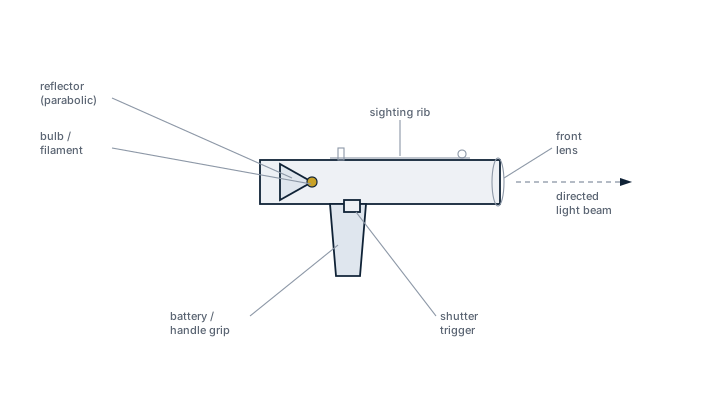
Legend
- sighting rib
- reflector (parabolic)
- bulb / filament
- front lens
- directed light beam
- shutter trigger
- battery / handle grip
Main components
Lamp head and lens
A high-intensity bulb or, on modern units, an LED array behind a focusing lens that concentrates the beam into a narrow, bright cone rather than the wide spread of a searchlight, which is what makes the flashes readable as distinct Morse characters at distance.
Trigger mechanism
A pistol-grip trigger that operates a shutter or directly switches the lamp circuit, letting the operator key Morse code by hand with the same feel regardless of how the beam itself is produced.
Read the full guide
Power supply
Battery-powered handheld units are standard for portability to the bridge wings; some vessels retain a fixed, ship-power lamp on the monkey island for longer signalling sessions where battery endurance would be a limitation.
Sighting device
A simple sight or scope aligned with the beam axis so the operator can aim the lamp precisely at a distant receiving vessel rather than sweeping the beam across the horizon.
Regulations and class
SOLAS Chapter V requires ships to carry a daylight signalling lamp not dependent solely on the ship's main power supply, as part of the mandatory navigational equipment carriage requirements. The lamp does not need type approval in the way GMDSS equipment does, but it must be operational and its battery condition maintained, and it is a standard item checked during flag state and port state control inspections of bridge equipment. Officers are still required to demonstrate basic Morse code proficiency during certification, which keeps the lamp a functioning piece of equipment rather than a certificate-only fixture.
Typical faults
- Battery left uncharged or corroded terminals — the most common finding at port state control, since the lamp is used rarely enough to be forgotten between drills.
- Lens cracked or fogged with condensation, scattering the beam and making Morse characters unreadable at any useful range.
- Trigger mechanism stiff or sticking from lack of use, producing ragged, unreadable dots and dashes even when the lamp itself works.
- LED retrofit units with a beam angle too wide for the lens housing, reducing effective signalling range compared with the original bulb design.
What to look for in a supplier
- A beam intensity and focus rating suited to the ranges the vessel actually needs, not just a bright light.
- Battery or power options matched to how the lamp will actually be stowed and used — handheld on the bridge wing versus fixed on the monkey island.
- Robust housing, since this is deck equipment that sits in a bracket exposed to weather between the rare occasions it is used.
Test the lamp and its battery at every navigation equipment check, not only before drills — it is the backup for the day every other method of signalling has failed.
Models in this type.
The best-documented model of each manufacturer first, then the next — 1 of 1 models in Signal Lamp / Aldis Lamp. Every row links to full specifications, documents and service notes.
Manufacturers.
All 14 manufacturers with models of Signal Lamp / Aldis Lamp. Names with a manufacturer page open it; the others open a search across the full library.
All manufacturers in the libraryAlso in Navigation & Bridge Equipment.
The other equipment types in this category.
Write to us about this model — the answer comes by e-mail.
Name the make and the model and what the job is: a spare, a service call, a second opinion on a data sheet. We answer by e-mail.
No details at hand? A photo of the rating plate or the part is enough — simply attach it to the request.
Questions that come up with this equipment.
Is Signal Lamp / Aldis Lamp data free?
Yes. Every model page, every guide and every datasheet for this type is readable without an account. An account adds saved searches and requests, nothing is taken away.
My model is missing — what now?
Send us the nameplate. We identify it by hand, add it to the library, and if you need a part or a service, the request is already on our desk.
Can you source a Signal Lamp / Aldis Lamp part?
Yes. Tell us the manufacturer, the model and what you need — a person reads every request and replies by e-mail.