Weather Station / Anemometer
The ship's anemometer gives relative wind speed and direction as measured at the masthead, and the bridge system must convert that to true wind using the vessel's own speed and heading before it means anything for manoeuvring, cargo operations, or reporting.
What to check on a Weather Station / Anemometer.
2 models from DEIF in Weather Station / Anemometer. Below: the full model list.
What sets the weather station apart
Within bridge instrumentation, most sensors such as the log, echo sounder and gyro report something the ship itself is doing. The anemometer reports the environment, and specifically it reports relative wind: what the sensor actually feels, which is the vector sum of the true wind and the wind created by the ship's own movement through the air. Converting relative wind to true wind and direction requires combining the anemometer reading with the vessel's speed and heading, a calculation the bridge system performs continuously and displays or feeds to other systems such as dynamic positioning or cargo operations software.
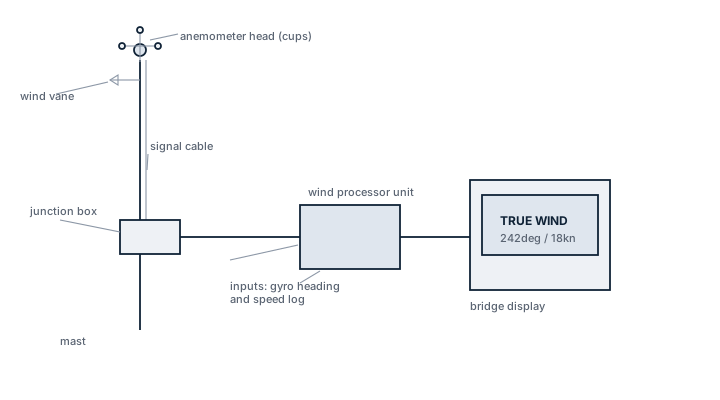
Legend
- anemometer head (cups)
- wind vane
- signal cable
- wind processor unit
- junction box
- TRUE WIND 242deg / 18kn
- inputs: gyro heading and speed log
- mast
- bridge display
Main components
Sensor head
Two designs dominate: the traditional cup-and-vane mechanical anemometer with moving parts, and the ultrasonic anemometer, which measures wind by timing ultrasonic pulses between fixed transducers and has no moving parts to wear or ice up as readily.
Mast mounting and exposure
Mounted at the masthead or another position clear of superstructure turbulence; poor exposure, too close to the funnel or stack gas, introduces errors that no amount of sensor accuracy can correct.
Read the full guide
Processing unit
Converts relative to true wind using heading and speed input from the gyro and log, and outputs the result to the bridge display and, via the ship's data bus, to other systems that consume wind data.
Heating element
Fitted to the sensor head on vessels operating in cold climates to prevent icing, which otherwise stops a mechanical anemometer dead and gives a false zero reading.
Selection and sizing
- Sensor type: ultrasonic units cost more but avoid the moving-part wear and icing sensitivity of cup-and-vane designs, which matters more on cold-climate or heavy-weather routes.
- Output interface compatible with the bridge system and any downstream consumer such as dynamic positioning or the loading computer.
- Wind speed measurement range appropriate to the vessel's operating envelope, since severe-weather readings are often the ones that matter most operationally.
- Mounting position surveyed for clean airflow before installation, not decided by convenience of cable routing.
Regulations and class
SOLAS Ch. V does not mandate an anemometer for every ship type, but it is required on certain vessel types and standard fit on most seagoing ships as part of the navigation equipment outfit; class societies specify it in their equipment lists for particular notations. Where fitted, it is subject to the general requirement that navigation equipment be maintained in proper working order, and interfacing to other mandatory systems such as a voyage data recorder can bring it under those systems' own performance standards.
Typical faults
| Fault | Cause | Consequence |
|---|---|---|
| Frozen or seized cups or vane | Icing without an active heater, or a heater failed unnoticed | False zero or fixed reading, silently wrong wind data feeding into other systems |
| Systematic direction offset | Sensor head mounted out of alignment with the ship's fore-and-aft line | Consistent directional error that looks plausible but is wrong |
| Turbulence-corrupted readings | Sensor sited too close to funnel or superstructure airflow disturbance | Erratic or biased readings, particularly at certain relative wind angles |
| Loss of true wind calculation | Loss of heading or speed input feeding the processing unit | Relative wind still shown but true wind conversion fails silently or defaults incorrectly |
What to look for in a supplier
- Documented accuracy figures for both speed and direction, and stated behaviour in icing conditions if a heated version is chosen.
- Interface standards confirmed compatible with the existing bridge integration before ordering.
- Manufacturer guidance on mounting position and minimum clearance from turbulence sources.
- Spare sensor head availability, since replacing the whole mast-mounted unit is a significant job better done with a spare in hand.
Always read wind data with the true/relative distinction in mind; a bridge team quoting relative wind speed as if it were true wind during a manoeuvring discussion is a recurring and avoidable source of confusion.
Models in this type.
The best-documented model of each manufacturer first, then the next — 2 of 2 models in Weather Station / Anemometer. Every row links to full specifications, documents and service notes.
Manufacturers.
All 40 manufacturers with models of Weather Station / Anemometer. Names with a manufacturer page open it; the others open a search across the full library.
All manufacturers in the libraryShow all 40 manufacturers
Also in Navigation & Bridge Equipment.
The other equipment types in this category.
Write to us about this model — the answer comes by e-mail.
Name the make and the model and what the job is: a spare, a service call, a second opinion on a data sheet. We answer by e-mail.
No details at hand? A photo of the rating plate or the part is enough — simply attach it to the request.
Questions that come up with this equipment.
Is Weather Station / Anemometer data free?
Yes. Every model page, every guide and every datasheet for this type is readable without an account. An account adds saved searches and requests, nothing is taken away.
My model is missing — what now?
Send us the nameplate. We identify it by hand, add it to the library, and if you need a part or a service, the request is already on our desk.
Can you source a Weather Station / Anemometer part?
Yes. Tell us the manufacturer, the model and what you need — a person reads every request and replies by e-mail.