AIS
AIS broadcasts a ship's identity, position, course and speed over VHF at short intervals, so nearby traffic and shore stations can see it independent of radar detection, which is why it works as well in a crowded anchorage as it does in open water at night.
What to check on an AIS.
19 models from SAILOR / Thrane & Thrane in AIS. Below: the full model list.
What Sets AIS Apart from Radar and Radio
Radar detects a target by reflection and tells the watchkeeper where something is, but not what it is or where it is heading with any certainty until it has been tracked for a while. AIS is different: each fitted ship transmits its own identity, position from GPS, course, speed and voyage details directly, so any other AIS-equipped ship or shore station receives accurate data the moment the signal is picked up, without needing line of sight the way radar does or reliance on someone answering a VHF call. The trade-off is that AIS only shows what other stations choose, or are required, to transmit; a target with its AIS switched off or a small craft under the carriage threshold remains invisible on the AIS display even though it may show clearly on radar.
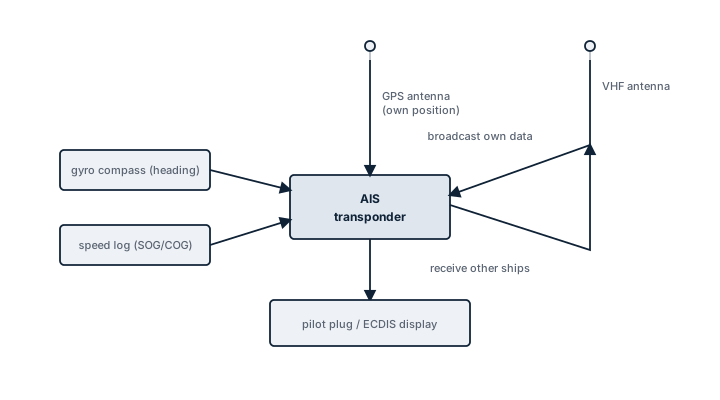
Legend
- GPS antenna (own position)
- VHF antenna
- gyro compass (heading)
- broadcast own data
- AIS transponder
- speed log (SOG/COG)
- receive other ships
- pilot plug / ECDIS display
Main Components
Transponder Class A
SOLAS-mandated ships carry a Class A unit, transmitting at higher power and shorter reporting intervals than the Class B units fitted on smaller leisure or fishing vessels, with priority access to the VHF data channels.
GPS Position Input
AIS relies on an internal or ship's GPS receiver for position and timing; a degraded or lost GPS fix propagates directly into every AIS target that receives the ship's transmission, an easily overlooked failure mode.
Read the full guide
VHF Data Link Transceiver
Two dedicated marine VHF channels carry AIS traffic using a time-division scheme so multiple ships can transmit without constant collision of messages, each unit self-organising its transmission slot.
Minimum Keyboard Display or Integration
A basic AIS unit has its own minimum display for entering voyage data and viewing targets, though on most ships AIS data is overlaid onto the radar or ECDIS display rather than read from its own separate screen.
Selection and Sizing
There is no sizing calculation as with a pump or valve; the relevant decision is Class A versus Class B for vessels below the mandatory carriage threshold, and whether the installation integrates with VDR, ECDIS and radar or stands alone. Antenna placement matters more than most crews expect, since a poorly sited VHF antenna with significant mast or superstructure shadowing genuinely reduces range and reliability.
Regulations and Class
- SOLAS Chapter V, Regulation 19 requires AIS on all ships of 300 gross tonnage and above engaged on international voyages, all cargo ships of 500 gross tonnage and above on any voyage, and all passenger ships regardless of size.
- The equipment must meet IMO performance standards for AIS and be type-approved; static data such as ship name, call sign and IMO number must be kept accurate and updated after any change.
- AIS data feeds the ship's Voyage Data Recorder where fitted, and inaccurate or missing AIS data has been a factor examined in collision investigations.
Typical Faults
| Fault | Consequence |
|---|---|
| GPS antenna cable or connector corroded | Position transmitted to other ships drifts or freezes, misleading nearby traffic |
| Static data entered incorrectly after a name change or charter | Ship displays under the wrong identity to VTS and other vessels |
| VHF antenna or coax degraded | Reduced transmission range, ship effectively invisible on AIS to traffic beyond a shortened range |
| Navigation status left on a stale setting, such as anchored while under way | Other ships' collision avoidance assessment of the vessel's intentions is wrong |
What to Look for in a Supplier
- Type approval certificate for the current IMO AIS performance standard and confirmation the firmware is not an outdated revision.
- Clean integration with the ship's existing ECDIS, radar and VDR without a proprietary interface that locks out future equipment changes.
- Antenna and cable specification suited to the ship's actual mast height and VHF routing, not a generic short run assumption.
Check and correct the voyage data and navigation status fields yourself at watch handover; an AIS unit left showing the wrong destination or status for days is a small thing that looks bad the moment a VTS operator or investigator checks the record.
Models in this type.
The best-documented model of each manufacturer first, then the next — 19 of 19 models in AIS. Every row links to full specifications, documents and service notes.
Manufacturers.
All 54 manufacturers with models of AIS. Names with a manufacturer page open it; the others open a search across the full library.
All manufacturersAlso in Navigation & Bridge Equipment.
The other equipment types in this category.
One request. A person reads it and replies by e-mail.
Tell us the manufacturer, the model and what you need — a part, a service call, a second opinion. A person reads every request and replies by e-mail.
No details at hand? A photo of the rating plate or the part is enough — simply attach it to the request.
Three things people ask first.
Is AIS data free?
Yes. Every model page, every guide and every datasheet for this type is readable without an account. An account adds saved searches and requests, nothing is taken away.
My model is missing — what now?
Send us the nameplate. We identify it by hand, add it to the library, and if you need a part or a service, the request is already on our desk.
Can you source a AIS part?
Yes. Tell us the manufacturer, the model and what you need — a person reads every request and replies by e-mail.