What to check on a Navtex Receiver.
5 models from SAILOR / Thrane & Thrane in Navtex Receiver. Below: the full model list.
What Makes a Navtex Receiver Different
A Navtex receiver is a dedicated, narrow-purpose radio receiver that automatically demodulates and prints or displays text broadcasts of maritime safety information, navigational warnings, weather forecasts and warnings, search and rescue information, and ice reports, without requiring a radio operator to tune in or transcribe anything. It listens continuously on 518 kHz for the international English-language broadcast and, where fitted, on 490 kHz for the national-language service, and it filters incoming messages by originating station and by subject code so the bridge team only sees information relevant to the ship's area and interests. That automatic, unattended reception is what distinguishes Navtex from a general MF/HF radio, VHF set, or satellite communication terminal, none of which are built to filter and log safety broadcasts on their own.
Read the full guide
Main Components
Receiver and demodulator
Tuned to 518 kHz and 490 kHz, demodulating the narrow-band direct-printing (NBDP) signal used for Navtex broadcasts.
Antenna
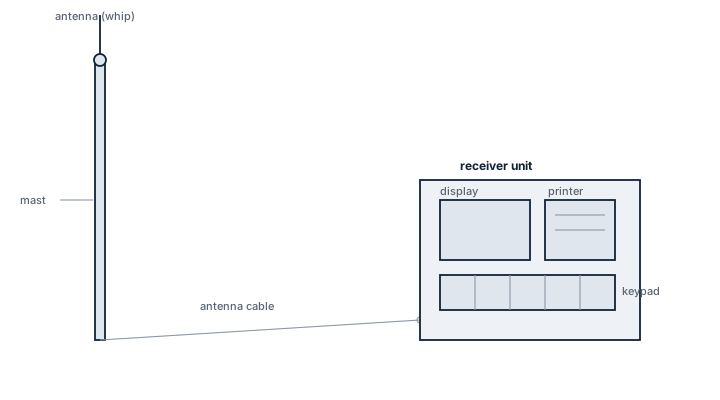
A dedicated whip or wire antenna for the MF band, separate from the ship's main MF/HF communication antenna, since Navtex must keep receiving even while other MF equipment transmits.
Message processor and filter
Decodes the four-character message header, station identifier, subject category such as A for navigational warning or B for weather warning, and message number, and suppresses messages the operator has selected as not relevant or already received.
Display or printer
Older units use a thermal printer producing a paper log; most modern installations use an integrated display with message storage and export, though many ships still keep the printer for a hard-copy record.
Selection and Sizing
- Coverage of both 518 kHz and 490 kHz where the ship trades in waters broadcasting a national-language service
- Message storage capacity and the ability to export or interface with the ship's electronic chart system
- Reliable subject-category filtering, since a receiver that cannot filter buries navigational warnings in low-priority traffic
- Integration with the bridge alarm system so an urgent message triggers an audible alert rather than sitting unread on a display
Regulations and Class
SOLAS Chapter IV requires Navtex reception as part of the Global Maritime Distress and Safety System (GMDSS) for ships trading in sea areas A1 through A3 where Navtex coverage exists, as an alternative or supplement to satellite-based safety information reception. The receiver must carry type approval to the relevant GMDSS performance standard, and its function is checked at survey along with the rest of the GMDSS installation. Certain subject categories, navigational and weather warnings, categories A and B, cannot be deselected by the operator, since SOLAS treats them as always required.
Typical Faults
| Fault | Cause | Consequence |
|---|---|---|
| Missed messages | Wrong station selection for the trading area, or mandatory categories accidentally deselected | Bridge team unaware of navigational or weather warnings in effect |
| Weak or noisy reception | Corroded antenna connection, poor antenna grounding, nearby electrical interference | Garbled or dropped messages, gaps in the safety information log |
| Printer paper or ribbon exhausted unnoticed | No spare consumables kept, low-supply alarm not checked | Loss of hard-copy record even though reception continues |
| Duplicate or repeated messages flooding the log | Message deduplication or station filtering misconfigured | Important new warnings harder to spot among repeats |
What to Look for in a Supplier
- Current GMDSS type approval valid for the flag state and trading areas the ship operates in
- Dual-frequency, 518/490 kHz, capability where the trading pattern requires the national-language service
- A filtering interface the bridge team can actually configure correctly, not one requiring factory support for routine changes
- Spares availability for the antenna, printer consumables and processor unit
Check the station and category selection after every change of trading area; a Navtex set faithfully filtering out the wrong region's warnings gives a false sense of being covered.