What to check on an AIS Transponder (Class A).
1 models from global in AIS Transponder (Class A). Below: the full model list.
What Makes a Class A AIS Transponder Different
A Class A AIS transponder transmits automatically and continuously, position, course, speed, heading, rate of turn and voyage data, using dedicated VHF channels, without needing anyone to key a call. Reporting intervals shorten automatically as speed or manoeuvring status changes, from as long as three minutes at anchor down to about two seconds when a ship is turning at speed. That automatic, high-frequency, mandatory-carriage behaviour is what separates Class A from Class B, the lower-power, lower-priority transponder fitted to smaller commercial and leisure craft, which transmits less often and yields channel access to Class A traffic. Class A is the SOLAS-mandated type; Class B is never an acceptable substitute for a vessel required to carry AIS.
Read the full guide
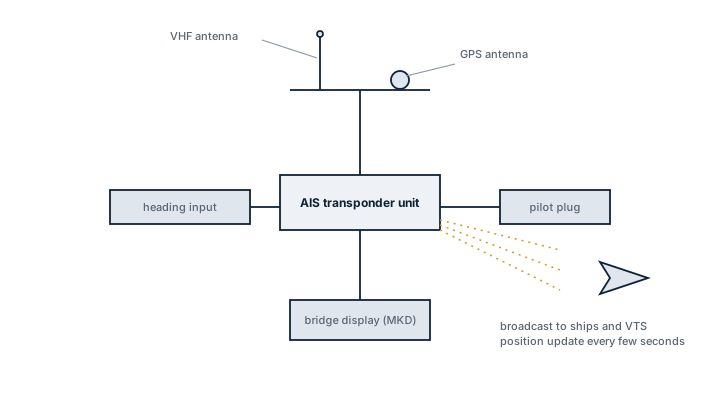
Main Components
VHF transceiver
Transmits and receives on the two internationally designated AIS VHF channels, switching automatically between them and monitoring for regional channel changes broadcast by shore authorities.
GNSS receiver
An internal or externally fed GPS/GNSS position source providing the position, course and speed data transmitted in each report; accuracy here directly affects the reliability of every ship relying on that data for collision avoidance.
Minimum keyboard and display (MKD)
The bridge unit used to enter voyage-related data, destination, ETA, cargo category, number of persons on board, and to view received traffic; many ships instead interface AIS data into the ECDIS or radar and use the MKD only as backup.
Pilot plug
A standardized connector giving a pilot's portable navigation unit direct access to the ship's AIS and other sensor data on boarding.
Sensor interfaces
Inputs from the gyrocompass, rate-of-turn indicator and speed log feed additional fields into the AIS broadcast beyond what GNSS alone provides.
Selection and Sizing
- Type approval matching the flag state's accepted equipment list, since AIS is SOLAS-mandated and not a discretionary fit-out choice
- Integration options with the ship's ECDIS, radar and VDR, since AIS data is now expected to overlay directly on the primary navigation displays
- Pilot plug provision and location, positioned for practical access when a pilot boards
- Long-range AIS capability where trading patterns or company policy call for satellite-relayed position reporting beyond VHF range
Regulations and Class
SOLAS Chapter V requires AIS Class A carriage on all ships of 300 gross tonnage and above engaged on international voyages, cargo ships of 500 gross tonnage and above not engaged on international voyages, and all passenger ships regardless of size. The transponder must remain in operation at all times except where its operation might compromise the safety or security of the ship, a decision the master documents in the log. Static data such as ship name, call sign, IMO number and dimensions, and voyage data such as destination, ETA and draught, must be kept current, since inaccurate AIS data undermines the collision-avoidance purpose of the whole system for every vessel receiving it.
Typical Faults
| Fault | Cause | Consequence |
|---|---|---|
| Incorrect or stale voyage data | Destination, ETA or draught not updated after departure or cargo change | Other vessels and VTS act on wrong information, undermines traffic management |
| Position jumps or freezes on other ships' displays | GNSS signal loss or degraded antenna reception | Loss of reliable collision-avoidance data at the worst possible time |
| Transponder switched off without justification | Crew silencing AIS believing it aids security or avoids attention | SOLAS non-compliance, Port State Control deficiency, real collision risk to other traffic |
| Static data errors such as wrong MMSI, ship type or dimensions | Incorrect programming at installation, never corrected afterward | Persistent identification confusion across every vessel and VTS that receives the signal |
What to Look for in a Supplier
- Current type approval matching the flag state's accepted list and the applicable IMO performance standard
- Straightforward integration with the ship's existing ECDIS, radar and VDR rather than a standalone display nobody actually uses
- GNSS antenna placement guidance suited to the vessel's superstructure, since shadowing degrades position quality
- Support for correcting static and voyage data quickly, since errors here are a compliance issue as much as a technical one
Check static and voyage data every time cargo, destination or draught changes; an AIS transponder broadcasting confidently wrong information is arguably worse than one that is silent, because everyone else trusts it.