Oily Water Separator (15 ppm)
The 15 ppm oily water separator is the standard bilge-cleaning unit fitted to meet the global MARPOL discharge limit; its defining feature is not the separator alone but the certified 15 ppm bilge alarm and automatic stopping device wired into it.
Read more — Oily Water Separator (15 ppm) explained ▾
What sets the 15 ppm type apart
Every ship generating oily bilge water needs some means of cleaning it before overboard discharge, but the term "15 ppm separator" refers specifically to a unit type-approved against the IMO discharge standard of 15 parts per million oil content, tested and certified under MEPC.107(49) (or the earlier MEPC.60(33) for older units still in service). What distinguishes this type is the combination of a mechanical treatment stage with a certified 15 ppm bilge alarm and automatic stopping device: the separator alone only removes oil, the complete system also monitors the outlet continuously and shuts discharge to the bilge holding tank the moment the reading rises toward the limit. A separator without a certified monitor and shutdown fitted is not a compliant 15 ppm unit, whatever its treatment performance on paper.

Main components
Gravity / coalescing separation stage
Bilge water enters a first chamber where free oil rises by gravity, then passes through a coalescing stage of plates or a filter/coalescer pack that merges small oil droplets into larger ones that can also rise out.
Fine filter or second-stage polisher
Many designs add a second treatment stage, often a replaceable cartridge filter, membrane or coalescer, to bring the outlet reliably below 15 ppm even with emulsified oil that gravity alone cannot separate.
15 ppm bilge alarm and monitor
An oil content meter, sampling the treated water continuously, wired to sound an alarm and automatically stop overboard discharge (diverting flow back to the bilge holding tank) if the reading approaches 15 ppm. This unit carries its own separate type approval certificate.
Sludge and waste oil handling
Separated oil drains to a sludge tank; the separator's own performance depends on this tank not being allowed to back up into the unit.
Selection and sizing
| Parameter | Typical basis |
|---|---|
| Rated capacity | sized to the vessel's expected bilge water generation rate, commonly 0.5 - 10 m3/h |
| Inlet oil content design basis | up to several thousand ppm depending on approval class |
| Outlet requirement | 15 ppm continuous, monitored |
| Materials | bronze, stainless or coated steel wetted parts for seawater/bilge service life |
Undersizing against actual bilge generation is a common yard mistake; a unit rated for the design flow rarely copes once engine room leakage exceeds the original estimate.
Regulations and class
Governed by MARPOL Annex I, Regulation 14, which requires ships to discharge oily mixtures only through equipment meeting the 15 ppm standard, with special area restrictions (Antarctic area: no discharge at all) layered on top. The equipment and its alarm/monitor both need individual type approval certificates referencing the applicable MEPC resolution, and both are checked at survey together with the associated Oil Record Book entries and IOPP Certificate. Class surveyors check the automatic stopping function actually operates, not just that the alarm sounds.
Typical faults
- Coalescer fouling - sludge and detergent residue block the coalescing media, and treated output quality drops even though the pump still runs normally.
- Monitor calibration drift - an uncalibrated oil content meter reads falsely low, allowing out-of-spec water overboard undetected until the next survey catches it.
- Emulsified oil bypass - detergents or cleaning chemicals in the bilge break oil into an emulsion that gravity separation cannot remove, overloading the polishing stage.
- Sludge tank back-pressure - a full sludge tank prevents separated oil from draining away, and it re-mixes into the treated stream.
What to look for in a supplier
- Type approval certificate for the complete system, separator and monitor together, matching the resolution actually in force for the ship's flag and build date.
- Spare parts and calibration service availability for the specific oil content monitor model, since these need periodic recalibration to stay certified.
- Documented performance at realistic inlet oil concentrations, not only the clean-water test condition.
A 15 ppm unit that passes its annual survey with clean test water can still fail in service the moment someone runs degreaser through the bilges - emulsified oil is the real test of a separator, not the paperwork test.
66 manufacturers · 577 models
Alfa Laval
54 ✓ 1 verified
- Separation-stage, bowl, coalescer or filter fouling reduces treatment efficiency and causes poor outlet quality or alarms
- Monitor, sensor or sampling-line contamination causes unstable readings or unnecessary recirculation and trips
- Seal, gasket or bowl-sealing faults cause leakage or loss of correct separation conditions
- Feed-pump, drive or bearing faults cause unstable flow, vibration, abnormal noise or shutdown
- Incorrect temperature, flow, interface or chemical condition causes poor separation despite apparently normal machinery
- Achieves ≤15 ppm oil discharge, complying with MARPOL Annex I
- Compact footprint suitable for space‑constrained installations
- Low power consumption compared with traditional gravity separators
- Automated Clean‑In‑Place (CIP) cycle reduces manual maintenance
- Integrated oil‑content sensor provides real‑time compliance monitoring
- Membrane fouling requires regular chemical cleaning cycles
- Sensitive to high solids or particulate loads; may need upstream filtration
- CIP system complexity can lead to downtime if malfunctioning
- Higher upfront cost than simple gravity OWS units
- Limited flow capacity (≈2.5 m³/h) may be insufficient for large‑scale bilge streams
- Durchsatz (PureBilge 2515)
- 2.500 l/h
- Durchsatz (PureBilge 5015)
- 5.000 l/h
- Separator-drehzahl
- 8.000 rpm
- Ölgehalt Ausgabe (typisch)
- <5 ppm (MARPOL-Limit: 15 ppm)
- Filtermedium
- Vorwärmefilter + Koalescenteinsätze
- Prozessregler
- EPC 60/70 (computergestützt, mit Cybersecurity)
- PureBilge 2515 (2500 l/h, 15ppm)
- PureBilge 5015 (5000 l/h, 15ppm)
- PureBilge Compact 0605 (600 l/h, 5ppm)
- Area: 15ppm-Ölgehalt-Monitor (Optical Cell) Verschmutzung/KalibrierungCheck: Visual: Check optical cell for fouling; Function test via high-oil simulation (monthly); Calibration by authorized manufacturer agent every 12 months or before IOPP renewal survey (MEPC.107(49) § 4.2.11 requirement)
- Area: Coalescer inserts (filter/coalescer) blockage, wear or degradationCheck: Routine inspection: Weekly check filter/coalescer elements for wear, clogging or damage; Replace upon blockage or visible wear (planned maintenance). Internal inspection: Clear separator chamber and inspect coalescer inserts for aging
- Area: Three-way valve (changeover valve) position and functionCheck: Daily: Check all valve positions; Monthly: Test three-way valve under simulated high-oil condition to confirm diversion to slop tank; Check for leakage at flange connections; Actuation without delay or abnormal noise
- Area: Process controller (EPC 60/70) alarms, data logging and sensor functionsCheck: Weekly: Check all sensors (temperature, pressure, speed) for functionality; Monthly: Check data logging device and review log data; Quarterly: Test all alarms and sensor outputs (document with protocol); Annually: Verify sensor calibration
- Area: Piping and flange connections: Leakage and corrosionCheck: Daily: Visually inspect all pipes and valve connections for oil film, droplet formation or corrosion (especially hot water/drain areas); Weekly: Check flanges for reduction in clamping force or leakage under load; Immediately repair if signs of corrosion or leakage appear
- Area: Heater (if electrical) and preheating to setpoint temperatureCheck: Daily: Check outlet temperature of preheated bilge water (typical: 50-70°C, manufacturer-specific); Weekly: Inspect heating element surface for deposits, wear or charring; Monthly: Calibrate thermostats and temperature sensors; If setpoint temperature is not reached, check thermocouple or controller
Type-universal inspection/maintenance points for oily water separator (Alfa Laval, Mega-Schwarm 2026-06). Per-model specs not auto-filled.
- Durchsatz (PureBilge 2515)
- 2.500 l/h
- Durchsatz (PureBilge 5015)
- 5.000 l/h
- Separator-drehzahl
- 8.000 rpm
- Ölgehalt Ausgabe (typisch)
- <5 ppm (MARPOL-Limit: 15 ppm)
- Filtermedium
- Vorwärmefilter + Koalescenteinsätze
- Prozessregler
- EPC 60/70 (computergestützt, mit Cybersecurity)
- PureBilge 2515 (2500 l/h, 15ppm)
- PureBilge 5015 (5000 l/h, 15ppm)
- PureBilge Compact 0605 (600 l/h, 5ppm)
- Area: 15ppm-Ölgehalt-Monitor (Optical Cell) Verschmutzung/KalibrierungCheck: Visual: Check optical cell for fouling; Function test via high-oil simulation (monthly); Calibration by authorized manufacturer agent every 12 months or before IOPP renewal survey (MEPC.107(49) § 4.2.11 requirement)
- Area: Coalescer inserts (filter/coalescer) blockage, wear or degradationCheck: Routine inspection: Weekly check filter/coalescer elements for wear, clogging or damage; Replace upon blockage or visible wear (planned maintenance). Internal inspection: Clear separator chamber and inspect coalescer inserts for aging
- Area: Three-way valve (changeover valve) position and functionCheck: Daily: Check all valve positions; Monthly: Test three-way valve under simulated high-oil condition to confirm diversion to slop tank; Check for leakage at flange connections; Actuation without delay or abnormal noise
- Area: Process controller (EPC 60/70) alarms, data logging and sensor functionsCheck: Weekly: Check all sensors (temperature, pressure, speed) for functionality; Monthly: Check data logging device and review log data; Quarterly: Test all alarms and sensor outputs (document with protocol); Annually: Verify sensor calibration
- Area: Piping and flange connections: Leakage and corrosionCheck: Daily: Visually inspect all pipes and valve connections for oil film, droplet formation or corrosion (especially hot water/drain areas); Weekly: Check flanges for reduction in clamping force or leakage under load; Immediately repair if signs of corrosion or leakage appear
- Area: Heater (if electrical) and preheating to setpoint temperatureCheck: Daily: Check outlet temperature of preheated bilge water (typical: 50-70°C, manufacturer-specific); Weekly: Inspect heating element surface for deposits, wear or charring; Monthly: Calibrate thermostats and temperature sensors; If setpoint temperature is not reached, check thermocouple or controller
Type-universal inspection/maintenance points for oily water separator (Alfa Laval, Mega-Schwarm 2026-06). Per-model specs not auto-filled.

- Durchsatz (PureBilge 2515)
- 2.500 l/h
- Durchsatz (PureBilge 5015)
- 5.000 l/h
- Separator-drehzahl
- 8.000 rpm
- Ölgehalt Ausgabe (typisch)
- <5 ppm (MARPOL-Limit: 15 ppm)
- Filtermedium
- Vorwärmefilter + Koalescenteinsätze
- Prozessregler
- EPC 60/70 (computergestützt, mit Cybersecurity)
- PureBilge 2515 (2500 l/h, 15ppm)
- PureBilge 5015 (5000 l/h, 15ppm)
- PureBilge Compact 0605 (600 l/h, 5ppm)
- Area: 15ppm-Ölgehalt-Monitor (Optical Cell) Verschmutzung/KalibrierungCheck: Visual: Check optical cell for fouling; Function test via high-oil simulation (monthly); Calibration by authorized manufacturer agent every 12 months or before IOPP renewal survey (MEPC.107(49) § 4.2.11 requirement)
- Area: Coalescer inserts (filter/coalescer) blockage, wear or degradationCheck: Routine inspection: Weekly check filter/coalescer elements for wear, clogging or damage; Replace upon blockage or visible wear (planned maintenance). Internal inspection: Clear separator chamber and inspect coalescer inserts for aging
- Area: Three-way valve (changeover valve) position and functionCheck: Daily: Check all valve positions; Monthly: Test three-way valve under simulated high-oil condition to confirm diversion to slop tank; Check for leakage at flange connections; Actuation without delay or abnormal noise
- Area: Process controller (EPC 60/70) alarms, data logging and sensor functionsCheck: Weekly: Check all sensors (temperature, pressure, speed) for functionality; Monthly: Check data logging device and review log data; Quarterly: Test all alarms and sensor outputs (document with protocol); Annually: Verify sensor calibration
- Area: Piping and flange connections: Leakage and corrosionCheck: Daily: Visually inspect all pipes and valve connections for oil film, droplet formation or corrosion (especially hot water/drain areas); Weekly: Check flanges for reduction in clamping force or leakage under load; Immediately repair if signs of corrosion or leakage appear
- Area: Heater (if electrical) and preheating to setpoint temperatureCheck: Daily: Check outlet temperature of preheated bilge water (typical: 50-70°C, manufacturer-specific); Weekly: Inspect heating element surface for deposits, wear or charring; Monthly: Calibrate thermostats and temperature sensors; If setpoint temperature is not reached, check thermocouple or controller
Type-universal inspection/maintenance points for oily water separator (Alfa Laval, Mega-Schwarm 2026-06). Per-model specs not auto-filled.
- Durchsatz (PureBilge 2515)
- 2.500 l/h
- Durchsatz (PureBilge 5015)
- 5.000 l/h
- Separator-drehzahl
- 8.000 rpm
- Ölgehalt Ausgabe (typisch)
- <5 ppm (MARPOL-Limit: 15 ppm)
- Filtermedium
- Vorwärmefilter + Koalescenteinsätze
- Prozessregler
- EPC 60/70 (computergestützt, mit Cybersecurity)
- PureBilge 2515 (2500 l/h, 15ppm)
- PureBilge 5015 (5000 l/h, 15ppm)
- PureBilge Compact 0605 (600 l/h, 5ppm)
- Area: 15ppm-Ölgehalt-Monitor (Optical Cell) Verschmutzung/KalibrierungCheck: Visual: Check optical cell for fouling; Function test via high-oil simulation (monthly); Calibration by authorized manufacturer agent every 12 months or before IOPP renewal survey (MEPC.107(49) § 4.2.11 requirement)
- Area: Coalescer inserts (filter/coalescer) blockage, wear or degradationCheck: Routine inspection: Weekly check filter/coalescer elements for wear, clogging or damage; Replace upon blockage or visible wear (planned maintenance). Internal inspection: Clear separator chamber and inspect coalescer inserts for aging
- Area: Three-way valve (changeover valve) position and functionCheck: Daily: Check all valve positions; Monthly: Test three-way valve under simulated high-oil condition to confirm diversion to slop tank; Check for leakage at flange connections; Actuation without delay or abnormal noise
- Area: Process controller (EPC 60/70) alarms, data logging and sensor functionsCheck: Weekly: Check all sensors (temperature, pressure, speed) for functionality; Monthly: Check data logging device and review log data; Quarterly: Test all alarms and sensor outputs (document with protocol); Annually: Verify sensor calibration
- Area: Piping and flange connections: Leakage and corrosionCheck: Daily: Visually inspect all pipes and valve connections for oil film, droplet formation or corrosion (especially hot water/drain areas); Weekly: Check flanges for reduction in clamping force or leakage under load; Immediately repair if signs of corrosion or leakage appear
- Area: Heater (if electrical) and preheating to setpoint temperatureCheck: Daily: Check outlet temperature of preheated bilge water (typical: 50-70°C, manufacturer-specific); Weekly: Inspect heating element surface for deposits, wear or charring; Monthly: Calibrate thermostats and temperature sensors; If setpoint temperature is not reached, check thermocouple or controller
Type-universal inspection/maintenance points for oily water separator (Alfa Laval, Mega-Schwarm 2026-06). Per-model specs not auto-filled.
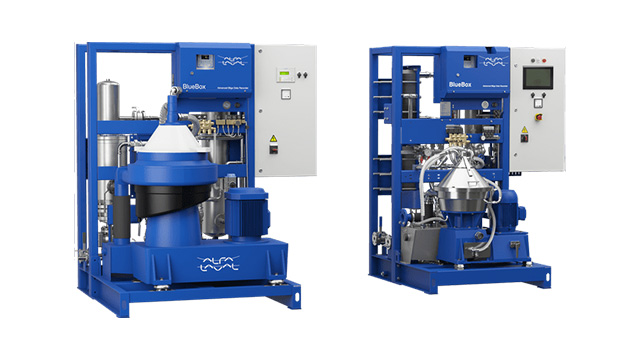
- Durchsatz (PureBilge 2515)
- 2.500 l/h
- Durchsatz (PureBilge 5015)
- 5.000 l/h
- Separator-drehzahl
- 8.000 rpm
- Ölgehalt Ausgabe (typisch)
- <5 ppm (MARPOL-Limit: 15 ppm)
- Filtermedium
- Vorwärmefilter + Koalescenteinsätze
- Prozessregler
- EPC 60/70 (computergestützt, mit Cybersecurity)
- PureBilge 2515 (2500 l/h, 15ppm)
- PureBilge 5015 (5000 l/h, 15ppm)
- PureBilge Compact 0605 (600 l/h, 5ppm)
- Area: 15ppm-Ölgehalt-Monitor (Optical Cell) Verschmutzung/KalibrierungCheck: Visual: Check optical cell for fouling; Function test via high-oil simulation (monthly); Calibration by authorized manufacturer agent every 12 months or before IOPP renewal survey (MEPC.107(49) § 4.2.11 requirement)
- Area: Coalescer inserts (filter/coalescer) blockage, wear or degradationCheck: Routine inspection: Weekly check filter/coalescer elements for wear, clogging or damage; Replace upon blockage or visible wear (planned maintenance). Internal inspection: Clear separator chamber and inspect coalescer inserts for aging
- Area: Three-way valve (changeover valve) position and functionCheck: Daily: Check all valve positions; Monthly: Test three-way valve under simulated high-oil condition to confirm diversion to slop tank; Check for leakage at flange connections; Actuation without delay or abnormal noise
- Area: Process controller (EPC 60/70) alarms, data logging and sensor functionsCheck: Weekly: Check all sensors (temperature, pressure, speed) for functionality; Monthly: Check data logging device and review log data; Quarterly: Test all alarms and sensor outputs (document with protocol); Annually: Verify sensor calibration
- Area: Piping and flange connections: Leakage and corrosionCheck: Daily: Visually inspect all pipes and valve connections for oil film, droplet formation or corrosion (especially hot water/drain areas); Weekly: Check flanges for reduction in clamping force or leakage under load; Immediately repair if signs of corrosion or leakage appear
- Area: Heater (if electrical) and preheating to setpoint temperatureCheck: Daily: Check outlet temperature of preheated bilge water (typical: 50-70°C, manufacturer-specific); Weekly: Inspect heating element surface for deposits, wear or charring; Monthly: Calibrate thermostats and temperature sensors; If setpoint temperature is not reached, check thermocouple or controller
Type-universal inspection/maintenance points for oily water separator (Alfa Laval, Mega-Schwarm 2026-06). Per-model specs not auto-filled.
- Durchsatz (PureBilge 2515)
- 2.500 l/h
- Durchsatz (PureBilge 5015)
- 5.000 l/h
- Separator-drehzahl
- 8.000 rpm
- Ölgehalt Ausgabe (typisch)
- <5 ppm (MARPOL-Limit: 15 ppm)
- Filtermedium
- Vorwärmefilter + Koalescenteinsätze
- Prozessregler
- EPC 60/70 (computergestützt, mit Cybersecurity)
- PureBilge 2515 (2500 l/h, 15ppm)
- PureBilge 5015 (5000 l/h, 15ppm)
- PureBilge Compact 0605 (600 l/h, 5ppm)
- Area: 15ppm-Ölgehalt-Monitor (Optical Cell) Verschmutzung/KalibrierungCheck: Visual: Check optical cell for fouling; Function test via high-oil simulation (monthly); Calibration by authorized manufacturer agent every 12 months or before IOPP renewal survey (MEPC.107(49) § 4.2.11 requirement)
- Area: Coalescer inserts (filter/coalescer) blockage, wear or degradationCheck: Routine inspection: Weekly check filter/coalescer elements for wear, clogging or damage; Replace upon blockage or visible wear (planned maintenance). Internal inspection: Clear separator chamber and inspect coalescer inserts for aging
- Area: Three-way valve (changeover valve) position and functionCheck: Daily: Check all valve positions; Monthly: Test three-way valve under simulated high-oil condition to confirm diversion to slop tank; Check for leakage at flange connections; Actuation without delay or abnormal noise
- Area: Process controller (EPC 60/70) alarms, data logging and sensor functionsCheck: Weekly: Check all sensors (temperature, pressure, speed) for functionality; Monthly: Check data logging device and review log data; Quarterly: Test all alarms and sensor outputs (document with protocol); Annually: Verify sensor calibration
- Area: Piping and flange connections: Leakage and corrosionCheck: Daily: Visually inspect all pipes and valve connections for oil film, droplet formation or corrosion (especially hot water/drain areas); Weekly: Check flanges for reduction in clamping force or leakage under load; Immediately repair if signs of corrosion or leakage appear
- Area: Heater (if electrical) and preheating to setpoint temperatureCheck: Daily: Check outlet temperature of preheated bilge water (typical: 50-70°C, manufacturer-specific); Weekly: Inspect heating element surface for deposits, wear or charring; Monthly: Calibrate thermostats and temperature sensors; If setpoint temperature is not reached, check thermocouple or controller
Type-universal inspection/maintenance points for oily water separator (Alfa Laval, Mega-Schwarm 2026-06). Per-model specs not auto-filled.
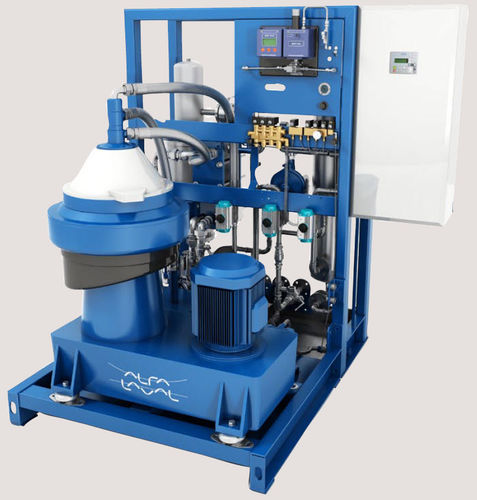
- Durchsatz (PureBilge 2515)
- 2.500 l/h
- Durchsatz (PureBilge 5015)
- 5.000 l/h
- Separator-drehzahl
- 8.000 rpm
- Ölgehalt Ausgabe (typisch)
- <5 ppm (MARPOL-Limit: 15 ppm)
- Filtermedium
- Vorwärmefilter + Koalescenteinsätze
- Prozessregler
- EPC 60/70 (computergestützt, mit Cybersecurity)
- PureBilge 2515 (2500 l/h, 15ppm)
- PureBilge 5015 (5000 l/h, 15ppm)
- PureBilge Compact 0605 (600 l/h, 5ppm)
- Area: 15ppm-Ölgehalt-Monitor (Optical Cell) Verschmutzung/KalibrierungCheck: Visual: Check optical cell for fouling; Function test via high-oil simulation (monthly); Calibration by authorized manufacturer agent every 12 months or before IOPP renewal survey (MEPC.107(49) § 4.2.11 requirement)
- Area: Coalescer inserts (filter/coalescer) blockage, wear or degradationCheck: Routine inspection: Weekly check filter/coalescer elements for wear, clogging or damage; Replace upon blockage or visible wear (planned maintenance). Internal inspection: Clear separator chamber and inspect coalescer inserts for aging
- Area: Three-way valve (changeover valve) position and functionCheck: Daily: Check all valve positions; Monthly: Test three-way valve under simulated high-oil condition to confirm diversion to slop tank; Check for leakage at flange connections; Actuation without delay or abnormal noise
- Area: Process controller (EPC 60/70) alarms, data logging and sensor functionsCheck: Weekly: Check all sensors (temperature, pressure, speed) for functionality; Monthly: Check data logging device and review log data; Quarterly: Test all alarms and sensor outputs (document with protocol); Annually: Verify sensor calibration
- Area: Piping and flange connections: Leakage and corrosionCheck: Daily: Visually inspect all pipes and valve connections for oil film, droplet formation or corrosion (especially hot water/drain areas); Weekly: Check flanges for reduction in clamping force or leakage under load; Immediately repair if signs of corrosion or leakage appear
- Area: Heater (if electrical) and preheating to setpoint temperatureCheck: Daily: Check outlet temperature of preheated bilge water (typical: 50-70°C, manufacturer-specific); Weekly: Inspect heating element surface for deposits, wear or charring; Monthly: Calibrate thermostats and temperature sensors; If setpoint temperature is not reached, check thermocouple or controller
Type-universal inspection/maintenance points for oily water separator (Alfa Laval, Mega-Schwarm 2026-06). Per-model specs not auto-filled.
- Durchsatz (PureBilge 2515)
- 2.500 l/h
- Durchsatz (PureBilge 5015)
- 5.000 l/h
- Separator-drehzahl
- 8.000 rpm
- Ölgehalt Ausgabe (typisch)
- <5 ppm (MARPOL-Limit: 15 ppm)
- Filtermedium
- Vorwärmefilter + Koalescenteinsätze
- Prozessregler
- EPC 60/70 (computergestützt, mit Cybersecurity)
- PureBilge 2515 (2500 l/h, 15ppm)
- PureBilge 5015 (5000 l/h, 15ppm)
- PureBilge Compact 0605 (600 l/h, 5ppm)
- Area: 15ppm-Ölgehalt-Monitor (Optical Cell) Verschmutzung/KalibrierungCheck: Visual: Check optical cell for fouling; Function test via high-oil simulation (monthly); Calibration by authorized manufacturer agent every 12 months or before IOPP renewal survey (MEPC.107(49) § 4.2.11 requirement)
- Area: Coalescer inserts (filter/coalescer) blockage, wear or degradationCheck: Routine inspection: Weekly check filter/coalescer elements for wear, clogging or damage; Replace upon blockage or visible wear (planned maintenance). Internal inspection: Clear separator chamber and inspect coalescer inserts for aging
- Area: Three-way valve (changeover valve) position and functionCheck: Daily: Check all valve positions; Monthly: Test three-way valve under simulated high-oil condition to confirm diversion to slop tank; Check for leakage at flange connections; Actuation without delay or abnormal noise
- Area: Process controller (EPC 60/70) alarms, data logging and sensor functionsCheck: Weekly: Check all sensors (temperature, pressure, speed) for functionality; Monthly: Check data logging device and review log data; Quarterly: Test all alarms and sensor outputs (document with protocol); Annually: Verify sensor calibration
- Area: Piping and flange connections: Leakage and corrosionCheck: Daily: Visually inspect all pipes and valve connections for oil film, droplet formation or corrosion (especially hot water/drain areas); Weekly: Check flanges for reduction in clamping force or leakage under load; Immediately repair if signs of corrosion or leakage appear
- Area: Heater (if electrical) and preheating to setpoint temperatureCheck: Daily: Check outlet temperature of preheated bilge water (typical: 50-70°C, manufacturer-specific); Weekly: Inspect heating element surface for deposits, wear or charring; Monthly: Calibrate thermostats and temperature sensors; If setpoint temperature is not reached, check thermocouple or controller
Type-universal inspection/maintenance points for oily water separator (Alfa Laval, Mega-Schwarm 2026-06). Per-model specs not auto-filled.
- Durchsatz (PureBilge 2515)
- 2.500 l/h
- Durchsatz (PureBilge 5015)
- 5.000 l/h
- Separator-drehzahl
- 8.000 rpm
- Ölgehalt Ausgabe (typisch)
- <5 ppm (MARPOL-Limit: 15 ppm)
- Filtermedium
- Vorwärmefilter + Koalescenteinsätze
- Prozessregler
- EPC 60/70 (computergestützt, mit Cybersecurity)
- PureBilge 2515 (2500 l/h, 15ppm)
- PureBilge 5015 (5000 l/h, 15ppm)
- PureBilge Compact 0605 (600 l/h, 5ppm)
- Area: 15ppm-Ölgehalt-Monitor (Optical Cell) Verschmutzung/KalibrierungCheck: Visual: Check optical cell for fouling; Function test via high-oil simulation (monthly); Calibration by authorized manufacturer agent every 12 months or before IOPP renewal survey (MEPC.107(49) § 4.2.11 requirement)
- Area: Coalescer inserts (filter/coalescer) blockage, wear or degradationCheck: Routine inspection: Weekly check filter/coalescer elements for wear, clogging or damage; Replace upon blockage or visible wear (planned maintenance). Internal inspection: Clear separator chamber and inspect coalescer inserts for aging
- Area: Three-way valve (changeover valve) position and functionCheck: Daily: Check all valve positions; Monthly: Test three-way valve under simulated high-oil condition to confirm diversion to slop tank; Check for leakage at flange connections; Actuation without delay or abnormal noise
- Area: Process controller (EPC 60/70) alarms, data logging and sensor functionsCheck: Weekly: Check all sensors (temperature, pressure, speed) for functionality; Monthly: Check data logging device and review log data; Quarterly: Test all alarms and sensor outputs (document with protocol); Annually: Verify sensor calibration
- Area: Piping and flange connections: Leakage and corrosionCheck: Daily: Visually inspect all pipes and valve connections for oil film, droplet formation or corrosion (especially hot water/drain areas); Weekly: Check flanges for reduction in clamping force or leakage under load; Immediately repair if signs of corrosion or leakage appear
- Area: Heater (if electrical) and preheating to setpoint temperatureCheck: Daily: Check outlet temperature of preheated bilge water (typical: 50-70°C, manufacturer-specific); Weekly: Inspect heating element surface for deposits, wear or charring; Monthly: Calibrate thermostats and temperature sensors; If setpoint temperature is not reached, check thermocouple or controller
Type-universal inspection/maintenance points for oily water separator (Alfa Laval, Mega-Schwarm 2026-06). Per-model specs not auto-filled.
- Durchsatz (PureBilge 2515)
- 2.500 l/h
- Durchsatz (PureBilge 5015)
- 5.000 l/h
- Separator-drehzahl
- 8.000 rpm
- Ölgehalt Ausgabe (typisch)
- <5 ppm (MARPOL-Limit: 15 ppm)
- Filtermedium
- Vorwärmefilter + Koalescenteinsätze
- Prozessregler
- EPC 60/70 (computergestützt, mit Cybersecurity)
- PureBilge 2515 (2500 l/h, 15ppm)
- PureBilge 5015 (5000 l/h, 15ppm)
- PureBilge Compact 0605 (600 l/h, 5ppm)
- Area: 15ppm-Ölgehalt-Monitor (Optical Cell) Verschmutzung/KalibrierungCheck: Visual: Check optical cell for fouling; Function test via high-oil simulation (monthly); Calibration by authorized manufacturer agent every 12 months or before IOPP renewal survey (MEPC.107(49) § 4.2.11 requirement)
- Area: Coalescer inserts (filter/coalescer) blockage, wear or degradationCheck: Routine inspection: Weekly check filter/coalescer elements for wear, clogging or damage; Replace upon blockage or visible wear (planned maintenance). Internal inspection: Clear separator chamber and inspect coalescer inserts for aging
- Area: Three-way valve (changeover valve) position and functionCheck: Daily: Check all valve positions; Monthly: Test three-way valve under simulated high-oil condition to confirm diversion to slop tank; Check for leakage at flange connections; Actuation without delay or abnormal noise
- Area: Process controller (EPC 60/70) alarms, data logging and sensor functionsCheck: Weekly: Check all sensors (temperature, pressure, speed) for functionality; Monthly: Check data logging device and review log data; Quarterly: Test all alarms and sensor outputs (document with protocol); Annually: Verify sensor calibration
- Area: Piping and flange connections: Leakage and corrosionCheck: Daily: Visually inspect all pipes and valve connections for oil film, droplet formation or corrosion (especially hot water/drain areas); Weekly: Check flanges for reduction in clamping force or leakage under load; Immediately repair if signs of corrosion or leakage appear
- Area: Heater (if electrical) and preheating to setpoint temperatureCheck: Daily: Check outlet temperature of preheated bilge water (typical: 50-70°C, manufacturer-specific); Weekly: Inspect heating element surface for deposits, wear or charring; Monthly: Calibrate thermostats and temperature sensors; If setpoint temperature is not reached, check thermocouple or controller
Type-universal inspection/maintenance points for oily water separator (Alfa Laval, Mega-Schwarm 2026-06). Per-model specs not auto-filled.
- Durchsatz (PureBilge 2515)
- 2.500 l/h
- Durchsatz (PureBilge 5015)
- 5.000 l/h
- Separator-drehzahl
- 8.000 rpm
- Ölgehalt Ausgabe (typisch)
- <5 ppm (MARPOL-Limit: 15 ppm)
- Filtermedium
- Vorwärmefilter + Koalescenteinsätze
- Prozessregler
- EPC 60/70 (computergestützt, mit Cybersecurity)
- PureBilge 2515 (2500 l/h, 15ppm)
- PureBilge 5015 (5000 l/h, 15ppm)
- PureBilge Compact 0605 (600 l/h, 5ppm)
- Area: 15ppm-Ölgehalt-Monitor (Optical Cell) Verschmutzung/KalibrierungCheck: Visual: Check optical cell for fouling; Function test via high-oil simulation (monthly); Calibration by authorized manufacturer agent every 12 months or before IOPP renewal survey (MEPC.107(49) § 4.2.11 requirement)
- Area: Coalescer inserts (filter/coalescer) blockage, wear or degradationCheck: Routine inspection: Weekly check filter/coalescer elements for wear, clogging or damage; Replace upon blockage or visible wear (planned maintenance). Internal inspection: Clear separator chamber and inspect coalescer inserts for aging
- Area: Three-way valve (changeover valve) position and functionCheck: Daily: Check all valve positions; Monthly: Test three-way valve under simulated high-oil condition to confirm diversion to slop tank; Check for leakage at flange connections; Actuation without delay or abnormal noise
- Area: Process controller (EPC 60/70) alarms, data logging and sensor functionsCheck: Weekly: Check all sensors (temperature, pressure, speed) for functionality; Monthly: Check data logging device and review log data; Quarterly: Test all alarms and sensor outputs (document with protocol); Annually: Verify sensor calibration
- Area: Piping and flange connections: Leakage and corrosionCheck: Daily: Visually inspect all pipes and valve connections for oil film, droplet formation or corrosion (especially hot water/drain areas); Weekly: Check flanges for reduction in clamping force or leakage under load; Immediately repair if signs of corrosion or leakage appear
- Area: Heater (if electrical) and preheating to setpoint temperatureCheck: Daily: Check outlet temperature of preheated bilge water (typical: 50-70°C, manufacturer-specific); Weekly: Inspect heating element surface for deposits, wear or charring; Monthly: Calibrate thermostats and temperature sensors; If setpoint temperature is not reached, check thermocouple or controller
Type-universal inspection/maintenance points for oily water separator (Alfa Laval, Mega-Schwarm 2026-06). Per-model specs not auto-filled.
- Durchsatz (PureBilge 2515)
- 2.500 l/h
- Durchsatz (PureBilge 5015)
- 5.000 l/h
- Separator-drehzahl
- 8.000 rpm
- Ölgehalt Ausgabe (typisch)
- <5 ppm (MARPOL-Limit: 15 ppm)
- Filtermedium
- Vorwärmefilter + Koalescenteinsätze
- Prozessregler
- EPC 60/70 (computergestützt, mit Cybersecurity)
- PureBilge 2515 (2500 l/h, 15ppm)
- PureBilge 5015 (5000 l/h, 15ppm)
- PureBilge Compact 0605 (600 l/h, 5ppm)
- Area: 15ppm-Ölgehalt-Monitor (Optical Cell) Verschmutzung/KalibrierungCheck: Visual: Check optical cell for fouling; Function test via high-oil simulation (monthly); Calibration by authorized manufacturer agent every 12 months or before IOPP renewal survey (MEPC.107(49) § 4.2.11 requirement)
- Area: Coalescer inserts (filter/coalescer) blockage, wear or degradationCheck: Routine inspection: Weekly check filter/coalescer elements for wear, clogging or damage; Replace upon blockage or visible wear (planned maintenance). Internal inspection: Clear separator chamber and inspect coalescer inserts for aging
- Area: Three-way valve (changeover valve) position and functionCheck: Daily: Check all valve positions; Monthly: Test three-way valve under simulated high-oil condition to confirm diversion to slop tank; Check for leakage at flange connections; Actuation without delay or abnormal noise
- Area: Process controller (EPC 60/70) alarms, data logging and sensor functionsCheck: Weekly: Check all sensors (temperature, pressure, speed) for functionality; Monthly: Check data logging device and review log data; Quarterly: Test all alarms and sensor outputs (document with protocol); Annually: Verify sensor calibration
- Area: Piping and flange connections: Leakage and corrosionCheck: Daily: Visually inspect all pipes and valve connections for oil film, droplet formation or corrosion (especially hot water/drain areas); Weekly: Check flanges for reduction in clamping force or leakage under load; Immediately repair if signs of corrosion or leakage appear
- Area: Heater (if electrical) and preheating to setpoint temperatureCheck: Daily: Check outlet temperature of preheated bilge water (typical: 50-70°C, manufacturer-specific); Weekly: Inspect heating element surface for deposits, wear or charring; Monthly: Calibrate thermostats and temperature sensors; If setpoint temperature is not reached, check thermocouple or controller
Type-universal inspection/maintenance points for oily water separator (Alfa Laval, Mega-Schwarm 2026-06). Per-model specs not auto-filled.
- Durchsatz (PureBilge 2515)
- 2.500 l/h
- Durchsatz (PureBilge 5015)
- 5.000 l/h
- Separator-drehzahl
- 8.000 rpm
- Ölgehalt Ausgabe (typisch)
- <5 ppm (MARPOL-Limit: 15 ppm)
- Filtermedium
- Vorwärmefilter + Koalescenteinsätze
- Prozessregler
- EPC 60/70 (computergestützt, mit Cybersecurity)
- PureBilge 2515 (2500 l/h, 15ppm)
- PureBilge 5015 (5000 l/h, 15ppm)
- PureBilge Compact 0605 (600 l/h, 5ppm)
- Area: 15ppm-Ölgehalt-Monitor (Optical Cell) Verschmutzung/KalibrierungCheck: Visual: Check optical cell for fouling; Function test via high-oil simulation (monthly); Calibration by authorized manufacturer agent every 12 months or before IOPP renewal survey (MEPC.107(49) § 4.2.11 requirement)
- Area: Coalescer inserts (filter/coalescer) blockage, wear or degradationCheck: Routine inspection: Weekly check filter/coalescer elements for wear, clogging or damage; Replace upon blockage or visible wear (planned maintenance). Internal inspection: Clear separator chamber and inspect coalescer inserts for aging
- Area: Three-way valve (changeover valve) position and functionCheck: Daily: Check all valve positions; Monthly: Test three-way valve under simulated high-oil condition to confirm diversion to slop tank; Check for leakage at flange connections; Actuation without delay or abnormal noise
- Area: Process controller (EPC 60/70) alarms, data logging and sensor functionsCheck: Weekly: Check all sensors (temperature, pressure, speed) for functionality; Monthly: Check data logging device and review log data; Quarterly: Test all alarms and sensor outputs (document with protocol); Annually: Verify sensor calibration
- Area: Piping and flange connections: Leakage and corrosionCheck: Daily: Visually inspect all pipes and valve connections for oil film, droplet formation or corrosion (especially hot water/drain areas); Weekly: Check flanges for reduction in clamping force or leakage under load; Immediately repair if signs of corrosion or leakage appear
- Area: Heater (if electrical) and preheating to setpoint temperatureCheck: Daily: Check outlet temperature of preheated bilge water (typical: 50-70°C, manufacturer-specific); Weekly: Inspect heating element surface for deposits, wear or charring; Monthly: Calibrate thermostats and temperature sensors; If setpoint temperature is not reached, check thermocouple or controller
Type-universal inspection/maintenance points for oily water separator (Alfa Laval, Mega-Schwarm 2026-06). Per-model specs not auto-filled.
- Durchsatz (PureBilge 2515)
- 2.500 l/h
- Durchsatz (PureBilge 5015)
- 5.000 l/h
- Separator-drehzahl
- 8.000 rpm
- Ölgehalt Ausgabe (typisch)
- <5 ppm (MARPOL-Limit: 15 ppm)
- Filtermedium
- Vorwärmefilter + Koalescenteinsätze
- Prozessregler
- EPC 60/70 (computergestützt, mit Cybersecurity)
- PureBilge 2515 (2500 l/h, 15ppm)
- PureBilge 5015 (5000 l/h, 15ppm)
- PureBilge Compact 0605 (600 l/h, 5ppm)
- Area: 15ppm-Ölgehalt-Monitor (Optical Cell) Verschmutzung/KalibrierungCheck: Visual: Check optical cell for fouling; Function test via high-oil simulation (monthly); Calibration by authorized manufacturer agent every 12 months or before IOPP renewal survey (MEPC.107(49) § 4.2.11 requirement)
- Area: Coalescer inserts (filter/coalescer) blockage, wear or degradationCheck: Routine inspection: Weekly check filter/coalescer elements for wear, clogging or damage; Replace upon blockage or visible wear (planned maintenance). Internal inspection: Clear separator chamber and inspect coalescer inserts for aging
- Area: Three-way valve (changeover valve) position and functionCheck: Daily: Check all valve positions; Monthly: Test three-way valve under simulated high-oil condition to confirm diversion to slop tank; Check for leakage at flange connections; Actuation without delay or abnormal noise
- Area: Process controller (EPC 60/70) alarms, data logging and sensor functionsCheck: Weekly: Check all sensors (temperature, pressure, speed) for functionality; Monthly: Check data logging device and review log data; Quarterly: Test all alarms and sensor outputs (document with protocol); Annually: Verify sensor calibration
- Area: Piping and flange connections: Leakage and corrosionCheck: Daily: Visually inspect all pipes and valve connections for oil film, droplet formation or corrosion (especially hot water/drain areas); Weekly: Check flanges for reduction in clamping force or leakage under load; Immediately repair if signs of corrosion or leakage appear
- Area: Heater (if electrical) and preheating to setpoint temperatureCheck: Daily: Check outlet temperature of preheated bilge water (typical: 50-70°C, manufacturer-specific); Weekly: Inspect heating element surface for deposits, wear or charring; Monthly: Calibrate thermostats and temperature sensors; If setpoint temperature is not reached, check thermocouple or controller
Type-universal inspection/maintenance points for oily water separator (Alfa Laval, Mega-Schwarm 2026-06). Per-model specs not auto-filled.
- Durchsatz (PureBilge 2515)
- 2.500 l/h
- Durchsatz (PureBilge 5015)
- 5.000 l/h
- Separator-drehzahl
- 8.000 rpm
- Ölgehalt Ausgabe (typisch)
- <5 ppm (MARPOL-Limit: 15 ppm)
- Filtermedium
- Vorwärmefilter + Koalescenteinsätze
- Prozessregler
- EPC 60/70 (computergestützt, mit Cybersecurity)
- PureBilge 2515 (2500 l/h, 15ppm)
- PureBilge 5015 (5000 l/h, 15ppm)
- PureBilge Compact 0605 (600 l/h, 5ppm)
- Area: 15ppm-Ölgehalt-Monitor (Optical Cell) Verschmutzung/KalibrierungCheck: Visual: Check optical cell for fouling; Function test via high-oil simulation (monthly); Calibration by authorized manufacturer agent every 12 months or before IOPP renewal survey (MEPC.107(49) § 4.2.11 requirement)
- Area: Coalescer inserts (filter/coalescer) blockage, wear or degradationCheck: Routine inspection: Weekly check filter/coalescer elements for wear, clogging or damage; Replace upon blockage or visible wear (planned maintenance). Internal inspection: Clear separator chamber and inspect coalescer inserts for aging
- Area: Three-way valve (changeover valve) position and functionCheck: Daily: Check all valve positions; Monthly: Test three-way valve under simulated high-oil condition to confirm diversion to slop tank; Check for leakage at flange connections; Actuation without delay or abnormal noise
- Area: Process controller (EPC 60/70) alarms, data logging and sensor functionsCheck: Weekly: Check all sensors (temperature, pressure, speed) for functionality; Monthly: Check data logging device and review log data; Quarterly: Test all alarms and sensor outputs (document with protocol); Annually: Verify sensor calibration
- Area: Piping and flange connections: Leakage and corrosionCheck: Daily: Visually inspect all pipes and valve connections for oil film, droplet formation or corrosion (especially hot water/drain areas); Weekly: Check flanges for reduction in clamping force or leakage under load; Immediately repair if signs of corrosion or leakage appear
- Area: Heater (if electrical) and preheating to setpoint temperatureCheck: Daily: Check outlet temperature of preheated bilge water (typical: 50-70°C, manufacturer-specific); Weekly: Inspect heating element surface for deposits, wear or charring; Monthly: Calibrate thermostats and temperature sensors; If setpoint temperature is not reached, check thermocouple or controller
Type-universal inspection/maintenance points for oily water separator (Alfa Laval, Mega-Schwarm 2026-06). Per-model specs not auto-filled.
- Durchsatz (PureBilge 2515)
- 2.500 l/h
- Durchsatz (PureBilge 5015)
- 5.000 l/h
- Separator-drehzahl
- 8.000 rpm
- Ölgehalt Ausgabe (typisch)
- <5 ppm (MARPOL-Limit: 15 ppm)
- Filtermedium
- Vorwärmefilter + Koalescenteinsätze
- Prozessregler
- EPC 60/70 (computergestützt, mit Cybersecurity)
- PureBilge 2515 (2500 l/h, 15ppm)
- PureBilge 5015 (5000 l/h, 15ppm)
- PureBilge Compact 0605 (600 l/h, 5ppm)
- Area: 15ppm-Ölgehalt-Monitor (Optical Cell) Verschmutzung/KalibrierungCheck: Visual: Check optical cell for fouling; Function test via high-oil simulation (monthly); Calibration by authorized manufacturer agent every 12 months or before IOPP renewal survey (MEPC.107(49) § 4.2.11 requirement)
- Area: Coalescer inserts (filter/coalescer) blockage, wear or degradationCheck: Routine inspection: Weekly check filter/coalescer elements for wear, clogging or damage; Replace upon blockage or visible wear (planned maintenance). Internal inspection: Clear separator chamber and inspect coalescer inserts for aging
- Area: Three-way valve (changeover valve) position and functionCheck: Daily: Check all valve positions; Monthly: Test three-way valve under simulated high-oil condition to confirm diversion to slop tank; Check for leakage at flange connections; Actuation without delay or abnormal noise
- Area: Process controller (EPC 60/70) alarms, data logging and sensor functionsCheck: Weekly: Check all sensors (temperature, pressure, speed) for functionality; Monthly: Check data logging device and review log data; Quarterly: Test all alarms and sensor outputs (document with protocol); Annually: Verify sensor calibration
- Area: Piping and flange connections: Leakage and corrosionCheck: Daily: Visually inspect all pipes and valve connections for oil film, droplet formation or corrosion (especially hot water/drain areas); Weekly: Check flanges for reduction in clamping force or leakage under load; Immediately repair if signs of corrosion or leakage appear
- Area: Heater (if electrical) and preheating to setpoint temperatureCheck: Daily: Check outlet temperature of preheated bilge water (typical: 50-70°C, manufacturer-specific); Weekly: Inspect heating element surface for deposits, wear or charring; Monthly: Calibrate thermostats and temperature sensors; If setpoint temperature is not reached, check thermocouple or controller
Type-universal inspection/maintenance points for oily water separator (Alfa Laval, Mega-Schwarm 2026-06). Per-model specs not auto-filled.
- Area: Sampling point integrity and representativenessCheck: Verify sampling point is in vertical section of effluent piping near OWS outlet, with adequate pressure (≥0.2 bar) and flow rate (≥3 l/min). Check piping is sealed, inspect for tampering or bypass valves. Verify sample line has no isolation points.
- Area: 15ppm bilge alarm accuracy and response timeCheck: Test alarm calibration within ±5 ppm accuracy. Verify response time ≤5 seconds for alarm activation. Test automatic overboard discharge valve closure within ≤20 seconds total. Check alarm has audible/visual indication. Verify alarm stores operational data (date, time, status) for minimum 18 months.
- Area: Coalescer and filter element condition and replacementCheck: Inspect coalescer for blockage, degradation, or sediment accumulation. Check filter elements for fouling or clogging (service life typically 1-2 years). Verify replacement schedule compliance. Inspect internal seals and gaskets for integrity. Check heater elements (if equipped) for corrosion or scaling.
- Area: Oil content monitor (OCM) calibration and functionalityCheck: Verify OCM calibration by manufacturer or authorized agent within 5-year intervals. Test with clean water supply to measuring cell. Confirm sensor precision for oil content regulation. Check OCM display/recording function. Test bypass activation when oil content <threshold. Confirm cell replacement after 5 years of service.
- Area: Separator tank condition, sludge, and sediment accumulationCheck: Inspect separation chambers for cleanliness, oil residue, and water level sensors. Check for sludge or emulsion buildup at tank bottom. Verify automatic sludge/oil discharge valve operation. Test level sensors and transfer solenoid valves. Confirm oil recovery system functioning and recovered oil properly disposed.
Typ-universelle Inspektionspunkte fuer Oily Water Separator (15ppm) (verifiziert, 2026-06).
- Area: Sampling point integrity and representativenessCheck: Verify sampling point is in vertical section of effluent piping near OWS outlet, with adequate pressure (≥0.2 bar) and flow rate (≥3 l/min). Check piping is sealed, inspect for tampering or bypass valves. Verify sample line has no isolation points.
- Area: 15ppm bilge alarm accuracy and response timeCheck: Test alarm calibration within ±5 ppm accuracy. Verify response time ≤5 seconds for alarm activation. Test automatic overboard discharge valve closure within ≤20 seconds total. Check alarm has audible/visual indication. Verify alarm stores operational data (date, time, status) for minimum 18 months.
- Area: Coalescer and filter element condition and replacementCheck: Inspect coalescer for blockage, degradation, or sediment accumulation. Check filter elements for fouling or clogging (service life typically 1-2 years). Verify replacement schedule compliance. Inspect internal seals and gaskets for integrity. Check heater elements (if equipped) for corrosion or scaling.
- Area: Oil content monitor (OCM) calibration and functionalityCheck: Verify OCM calibration by manufacturer or authorized agent within 5-year intervals. Test with clean water supply to measuring cell. Confirm sensor precision for oil content regulation. Check OCM display/recording function. Test bypass activation when oil content <threshold. Confirm cell replacement after 5 years of service.
- Area: Separator tank condition, sludge, and sediment accumulationCheck: Inspect separation chambers for cleanliness, oil residue, and water level sensors. Check for sludge or emulsion buildup at tank bottom. Verify automatic sludge/oil discharge valve operation. Test level sensors and transfer solenoid valves. Confirm oil recovery system functioning and recovered oil properly disposed.
Typ-universelle Inspektionspunkte fuer Oily Water Separator (15ppm) (verifiziert, 2026-06).
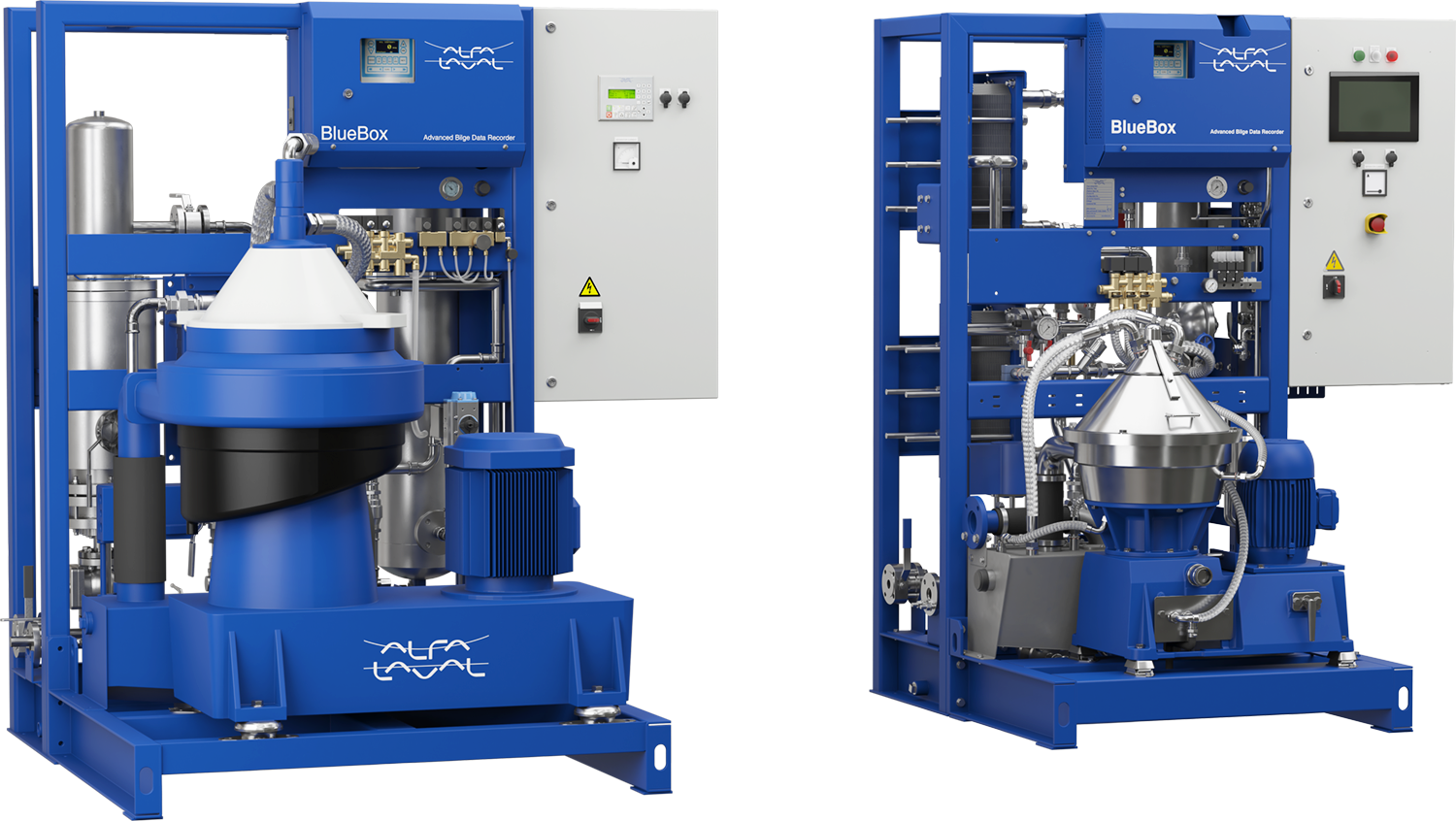
- Area: Check oil content monitor (15 ppm bilge alarm) for calibration and correct function per IMO MEPC.107(49) — sample temperatures up to 70 °C, zero-to-40 ppm rangeCheck: Check oil content monitor (15 ppm bilge alarm) for calibration and correct function per IMO MEPC.107(49) — sample temperatures up to 70 °C, zero-to-40 ppm range
- Area: Inspect and clean the disc stack / centrifuge bowl; remove sludge and oil accumulation on a scheduled basisCheck: Inspect and clean the disc stack / centrifuge bowl; remove sludge and oil accumulation on a scheduled basis
- Area: Verify feed pump operation, suction strainer condition, and inlet filter — clear blockages that reduce throughput or cause cavitationCheck: Verify feed pump operation, suction strainer condition, and inlet filter — clear blockages that reduce throughput or cause cavitation
- Area: Check heating element / steam coil for proper bilge water pre-heating (typically to 60–70 °C) to aid separation efficiencyCheck: Check heating element / steam coil for proper bilge water pre-heating (typically to 60–70 °C) to aid separation efficiency
- Area: Inspect all seals, gaskets, and O-rings in the separator bowl and pipework for leaks or wearCheck: Inspect all seals, gaskets, and O-rings in the separator bowl and pipework for leaks or wear
- Area: Test automatic discharge valves (clean-water outlet and dirty-side recirculation) for correct switching at the set ppm thresholdCheck: Test automatic discharge valves (clean-water outlet and dirty-side recirculation) for correct switching at the set ppm threshold
- Area: Review Oil Record Book entries and alarm/event log from the control unit (EPC 70 or equivalent) to confirm MARPOL compliance records are completeCheck: Review Oil Record Book entries and alarm/event log from the control unit (EPC 70 or equivalent) to confirm MARPOL compliance records are complete
- Area: Inspect sludge holding tank level, sludge discharge pump, and associated pipework; verify sludge is transferred to a certified reception facility and not bypassCheck: Inspect sludge holding tank level, sludge discharge pump, and associated pipework; verify sludge is transferred to a certified reception facility and not bypassed
Typ-universelle Inspektionspunkte fuer Oily Water Separator (verifiziert, 2026-06).
- PureBilge 0.5
- PureBilge 1.0
- PureBilge 2.5
- PureBilge 5.0
- 0.5
- 5.0
- 2
- 8
- Durchsatz (PureBilge 2515)
- 2.500 l/h
- Durchsatz (PureBilge 5015)
- 5.000 l/h
- Separator-drehzahl
- 8.000 rpm
- Ölgehalt Ausgabe (typisch)
- <5 ppm (MARPOL-Limit: 15 ppm)
- Filtermedium
- Vorwärmefilter + Koalescenteinsätze
- Prozessregler
- EPC 60/70 (computergestützt, mit Cybersecurity)
- PureBilge 2515 (2500 l/h, 15ppm)
- PureBilge 5015 (5000 l/h, 15ppm)
- PureBilge Compact 0605 (600 l/h, 5ppm)
- Area: 15ppm-Ölgehalt-Monitor (Optical Cell) Verschmutzung/KalibrierungCheck: Visual: Check optical cell for fouling; Function test via high-oil simulation (monthly); Calibration by authorized manufacturer agent every 12 months or before IOPP renewal survey (MEPC.107(49) § 4.2.11 requirement)
- Area: Coalescer inserts (filter/coalescer) blockage, wear or degradationCheck: Routine inspection: Weekly check filter/coalescer elements for wear, clogging or damage; Replace upon blockage or visible wear (planned maintenance). Internal inspection: Clear separator chamber and inspect coalescer inserts for aging
- Area: Three-way valve (changeover valve) position and functionCheck: Daily: Check all valve positions; Monthly: Test three-way valve under simulated high-oil condition to confirm diversion to slop tank; Check for leakage at flange connections; Actuation without delay or abnormal noise
- Area: Process controller (EPC 60/70) alarms, data logging and sensor functionsCheck: Weekly: Check all sensors (temperature, pressure, speed) for functionality; Monthly: Check data logging device and review log data; Quarterly: Test all alarms and sensor outputs (document with protocol); Annually: Verify sensor calibration
- Area: Piping and flange connections: Leakage and corrosionCheck: Daily: Visually inspect all pipes and valve connections for oil film, droplet formation or corrosion (especially hot water/drain areas); Weekly: Check flanges for reduction in clamping force or leakage under load; Immediately repair if signs of corrosion or leakage appear
- Area: Heater (if electrical) and preheating to setpoint temperatureCheck: Daily: Check outlet temperature of preheated bilge water (typical: 50-70°C, manufacturer-specific); Weekly: Inspect heating element surface for deposits, wear or charring; Monthly: Calibrate thermostats and temperature sensors; If setpoint temperature is not reached, check thermocouple or controller
Type-universal inspection/maintenance points for oily water separator (Alfa Laval, Mega-Schwarm 2026-06). Per-model specs not auto-filled.
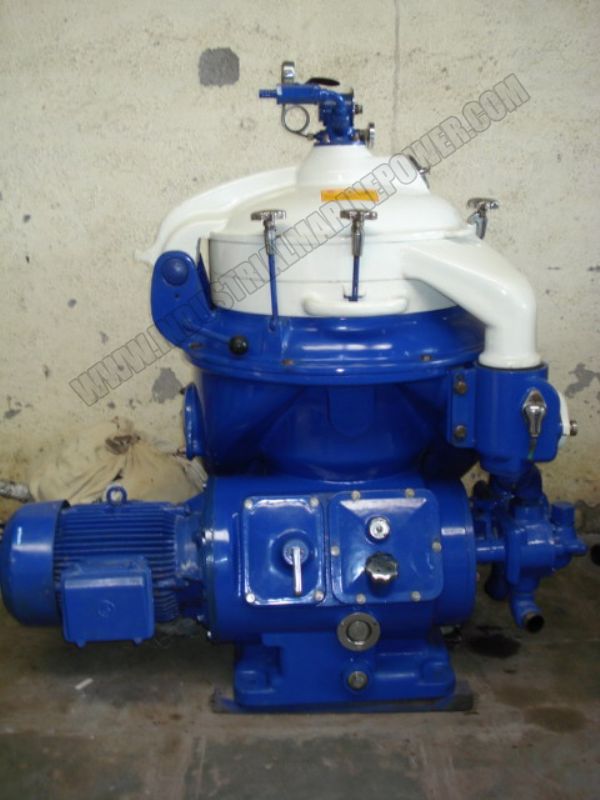
- MAPX 207
- MAPX 309
- 0.5
- 5.0
- 5.5
- 15
- Durchsatz (PureBilge 2515)
- 2.500 l/h
- Durchsatz (PureBilge 5015)
- 5.000 l/h
- Separator-drehzahl
- 8.000 rpm
- Ölgehalt Ausgabe (typisch)
- <5 ppm (MARPOL-Limit: 15 ppm)
- Filtermedium
- Vorwärmefilter + Koalescenteinsätze
- Prozessregler
- EPC 60/70 (computergestützt, mit Cybersecurity)
- PureBilge 2515 (2500 l/h, 15ppm)
- PureBilge 5015 (5000 l/h, 15ppm)
- PureBilge Compact 0605 (600 l/h, 5ppm)
- Area: 15ppm-Ölgehalt-Monitor (Optical Cell) Verschmutzung/KalibrierungCheck: Visual: Check optical cell for fouling; Function test via high-oil simulation (monthly); Calibration by authorized manufacturer agent every 12 months or before IOPP renewal survey (MEPC.107(49) § 4.2.11 requirement)
- Area: Coalescer inserts (filter/coalescer) blockage, wear or degradationCheck: Routine inspection: Weekly check filter/coalescer elements for wear, clogging or damage; Replace upon blockage or visible wear (planned maintenance). Internal inspection: Clear separator chamber and inspect coalescer inserts for aging
- Area: Three-way valve (changeover valve) position and functionCheck: Daily: Check all valve positions; Monthly: Test three-way valve under simulated high-oil condition to confirm diversion to slop tank; Check for leakage at flange connections; Actuation without delay or abnormal noise
- Area: Process controller (EPC 60/70) alarms, data logging and sensor functionsCheck: Weekly: Check all sensors (temperature, pressure, speed) for functionality; Monthly: Check data logging device and review log data; Quarterly: Test all alarms and sensor outputs (document with protocol); Annually: Verify sensor calibration
- Area: Piping and flange connections: Leakage and corrosionCheck: Daily: Visually inspect all pipes and valve connections for oil film, droplet formation or corrosion (especially hot water/drain areas); Weekly: Check flanges for reduction in clamping force or leakage under load; Immediately repair if signs of corrosion or leakage appear
- Area: Heater (if electrical) and preheating to setpoint temperatureCheck: Daily: Check outlet temperature of preheated bilge water (typical: 50-70°C, manufacturer-specific); Weekly: Inspect heating element surface for deposits, wear or charring; Monthly: Calibrate thermostats and temperature sensors; If setpoint temperature is not reached, check thermocouple or controller
Type-universal inspection/maintenance points for oily water separator (Alfa Laval, Mega-Schwarm 2026-06). Per-model specs not auto-filled.
- Insufficient wash-water flow caused by pump faults, blocked strainers or restricted piping produces deteriorating scrubbing performance and process alarms
- Fouled or damaged spray and distribution components cause uneven gas cleaning, abnormal temperatures or unstable emission readings
- Failed pH, turbidity, flow, pressure or emission-monitoring instrumentation causes implausible values, compliance alarms or loss of automatic control
- Deposits, corrosion or erosion in the scrubber, drains and associated piping cause leakage, restriction or increasing exhaust backpressure
- Control-valve, actuator, dosing or automation faults prevent correct routing or conditioning of wash water and can force the system out of compliant operating mode
- Insufficient wash-water flow caused by pump faults, blocked strainers or restricted piping produces deteriorating scrubbing performance and process alarms
- Fouled or damaged spray and distribution components cause uneven gas cleaning, abnormal temperatures or unstable emission readings
- Failed pH, turbidity, flow, pressure or emission-monitoring instrumentation causes implausible values, compliance alarms or loss of automatic control
- Deposits, corrosion or erosion in the scrubber, drains and associated piping cause leakage, restriction or increasing exhaust backpressure
- Control-valve, actuator, dosing or automation faults prevent correct routing or conditioning of wash water and can force the system out of compliant operating mode

- Insufficient wash-water flow caused by pump faults, blocked strainers or restricted piping produces deteriorating scrubbing performance and process alarms
- Fouled or damaged spray and distribution components cause uneven gas cleaning, abnormal temperatures or unstable emission readings
- Failed pH, turbidity, flow, pressure or emission-monitoring instrumentation causes implausible values, compliance alarms or loss of automatic control
- Deposits, corrosion or erosion in the scrubber, drains and associated piping cause leakage, restriction or increasing exhaust backpressure
- Control-valve, actuator, dosing or automation faults prevent correct routing or conditioning of wash water and can force the system out of compliant operating mode
- Insufficient wash-water flow caused by pump faults, blocked strainers or restricted piping produces deteriorating scrubbing performance and process alarms
- Fouled or damaged spray and distribution components cause uneven gas cleaning, abnormal temperatures or unstable emission readings
- Failed pH, turbidity, flow, pressure or emission-monitoring instrumentation causes implausible values, compliance alarms or loss of automatic control
- Deposits, corrosion or erosion in the scrubber, drains and associated piping cause leakage, restriction or increasing exhaust backpressure
- Control-valve, actuator, dosing or automation faults prevent correct routing or conditioning of wash water and can force the system out of compliant operating mode
- Insufficient wash-water flow caused by pump faults, blocked strainers or restricted piping produces deteriorating scrubbing performance and process alarms
- Fouled or damaged spray and distribution components cause uneven gas cleaning, abnormal temperatures or unstable emission readings
- Failed pH, turbidity, flow, pressure or emission-monitoring instrumentation causes implausible values, compliance alarms or loss of automatic control
- Deposits, corrosion or erosion in the scrubber, drains and associated piping cause leakage, restriction or increasing exhaust backpressure
- Control-valve, actuator, dosing or automation faults prevent correct routing or conditioning of wash water and can force the system out of compliant operating mode
- Insufficient wash-water flow caused by pump faults, blocked strainers or restricted piping produces deteriorating scrubbing performance and process alarms
- Fouled or damaged spray and distribution components cause uneven gas cleaning, abnormal temperatures or unstable emission readings
- Failed pH, turbidity, flow, pressure or emission-monitoring instrumentation causes implausible values, compliance alarms or loss of automatic control
- Deposits, corrosion or erosion in the scrubber, drains and associated piping cause leakage, restriction or increasing exhaust backpressure
- Control-valve, actuator, dosing or automation faults prevent correct routing or conditioning of wash water and can force the system out of compliant operating mode
- Insufficient wash-water flow caused by pump faults, blocked strainers or restricted piping produces deteriorating scrubbing performance and process alarms
- Fouled or damaged spray and distribution components cause uneven gas cleaning, abnormal temperatures or unstable emission readings
- Failed pH, turbidity, flow, pressure or emission-monitoring instrumentation causes implausible values, compliance alarms or loss of automatic control
- Deposits, corrosion or erosion in the scrubber, drains and associated piping cause leakage, restriction or increasing exhaust backpressure
- Control-valve, actuator, dosing or automation faults prevent correct routing or conditioning of wash water and can force the system out of compliant operating mode
- Insufficient wash-water flow caused by pump faults, blocked strainers or restricted piping produces deteriorating scrubbing performance and process alarms
- Fouled or damaged spray and distribution components cause uneven gas cleaning, abnormal temperatures or unstable emission readings
- Failed pH, turbidity, flow, pressure or emission-monitoring instrumentation causes implausible values, compliance alarms or loss of automatic control
- Deposits, corrosion or erosion in the scrubber, drains and associated piping cause leakage, restriction or increasing exhaust backpressure
- Control-valve, actuator, dosing or automation faults prevent correct routing or conditioning of wash water and can force the system out of compliant operating mode
- Insufficient wash-water flow caused by pump faults, blocked strainers or restricted piping produces deteriorating scrubbing performance and process alarms
- Fouled or damaged spray and distribution components cause uneven gas cleaning, abnormal temperatures or unstable emission readings
- Failed pH, turbidity, flow, pressure or emission-monitoring instrumentation causes implausible values, compliance alarms or loss of automatic control
- Deposits, corrosion or erosion in the scrubber, drains and associated piping cause leakage, restriction or increasing exhaust backpressure
- Control-valve, actuator, dosing or automation faults prevent correct routing or conditioning of wash water and can force the system out of compliant operating mode
- Insufficient wash-water flow caused by pump faults, blocked strainers or restricted piping produces deteriorating scrubbing performance and process alarms
- Fouled or damaged spray and distribution components cause uneven gas cleaning, abnormal temperatures or unstable emission readings
- Failed pH, turbidity, flow, pressure or emission-monitoring instrumentation causes implausible values, compliance alarms or loss of automatic control
- Deposits, corrosion or erosion in the scrubber, drains and associated piping cause leakage, restriction or increasing exhaust backpressure
- Control-valve, actuator, dosing or automation faults prevent correct routing or conditioning of wash water and can force the system out of compliant operating mode
- Insufficient wash-water flow caused by pump faults, blocked strainers or restricted piping produces deteriorating scrubbing performance and process alarms
- Fouled or damaged spray and distribution components cause uneven gas cleaning, abnormal temperatures or unstable emission readings
- Failed pH, turbidity, flow, pressure or emission-monitoring instrumentation causes implausible values, compliance alarms or loss of automatic control
- Deposits, corrosion or erosion in the scrubber, drains and associated piping cause leakage, restriction or increasing exhaust backpressure
- Control-valve, actuator, dosing or automation faults prevent correct routing or conditioning of wash water and can force the system out of compliant operating mode
- Insufficient wash-water flow caused by pump faults, blocked strainers or restricted piping produces deteriorating scrubbing performance and process alarms
- Fouled or damaged spray and distribution components cause uneven gas cleaning, abnormal temperatures or unstable emission readings
- Failed pH, turbidity, flow, pressure or emission-monitoring instrumentation causes implausible values, compliance alarms or loss of automatic control
- Deposits, corrosion or erosion in the scrubber, drains and associated piping cause leakage, restriction or increasing exhaust backpressure
- Control-valve, actuator, dosing or automation faults prevent correct routing or conditioning of wash water and can force the system out of compliant operating mode
- Insufficient wash-water flow caused by pump faults, blocked strainers or restricted piping produces deteriorating scrubbing performance and process alarms
- Fouled or damaged spray and distribution components cause uneven gas cleaning, abnormal temperatures or unstable emission readings
- Failed pH, turbidity, flow, pressure or emission-monitoring instrumentation causes implausible values, compliance alarms or loss of automatic control
- Deposits, corrosion or erosion in the scrubber, drains and associated piping cause leakage, restriction or increasing exhaust backpressure
- Control-valve, actuator, dosing or automation faults prevent correct routing or conditioning of wash water and can force the system out of compliant operating mode
- Insufficient wash-water flow caused by pump faults, blocked strainers or restricted piping produces deteriorating scrubbing performance and process alarms
- Fouled or damaged spray and distribution components cause uneven gas cleaning, abnormal temperatures or unstable emission readings
- Failed pH, turbidity, flow, pressure or emission-monitoring instrumentation causes implausible values, compliance alarms or loss of automatic control
- Deposits, corrosion or erosion in the scrubber, drains and associated piping cause leakage, restriction or increasing exhaust backpressure
- Control-valve, actuator, dosing or automation faults prevent correct routing or conditioning of wash water and can force the system out of compliant operating mode
- Insufficient wash-water flow caused by pump faults, blocked strainers or restricted piping produces deteriorating scrubbing performance and process alarms
- Fouled or damaged spray and distribution components cause uneven gas cleaning, abnormal temperatures or unstable emission readings
- Failed pH, turbidity, flow, pressure or emission-monitoring instrumentation causes implausible values, compliance alarms or loss of automatic control
- Deposits, corrosion or erosion in the scrubber, drains and associated piping cause leakage, restriction or increasing exhaust backpressure
- Control-valve, actuator, dosing or automation faults prevent correct routing or conditioning of wash water and can force the system out of compliant operating mode
- Insufficient wash-water flow caused by pump faults, blocked strainers or restricted piping produces deteriorating scrubbing performance and process alarms
- Fouled or damaged spray and distribution components cause uneven gas cleaning, abnormal temperatures or unstable emission readings
- Failed pH, turbidity, flow, pressure or emission-monitoring instrumentation causes implausible values, compliance alarms or loss of automatic control
- Deposits, corrosion or erosion in the scrubber, drains and associated piping cause leakage, restriction or increasing exhaust backpressure
- Control-valve, actuator, dosing or automation faults prevent correct routing or conditioning of wash water and can force the system out of compliant operating mode
- Insufficient wash-water flow caused by pump faults, blocked strainers or restricted piping produces deteriorating scrubbing performance and process alarms
- Fouled or damaged spray and distribution components cause uneven gas cleaning, abnormal temperatures or unstable emission readings
- Failed pH, turbidity, flow, pressure or emission-monitoring instrumentation causes implausible values, compliance alarms or loss of automatic control
- Deposits, corrosion or erosion in the scrubber, drains and associated piping cause leakage, restriction or increasing exhaust backpressure
- Control-valve, actuator, dosing or automation faults prevent correct routing or conditioning of wash water and can force the system out of compliant operating mode
- Insufficient wash-water flow caused by pump faults, blocked strainers or restricted piping produces deteriorating scrubbing performance and process alarms
- Fouled or damaged spray and distribution components cause uneven gas cleaning, abnormal temperatures or unstable emission readings
- Failed pH, turbidity, flow, pressure or emission-monitoring instrumentation causes implausible values, compliance alarms or loss of automatic control
- Deposits, corrosion or erosion in the scrubber, drains and associated piping cause leakage, restriction or increasing exhaust backpressure
- Control-valve, actuator, dosing or automation faults prevent correct routing or conditioning of wash water and can force the system out of compliant operating mode
- Insufficient wash-water flow caused by pump faults, blocked strainers or restricted piping produces deteriorating scrubbing performance and process alarms
- Fouled or damaged spray and distribution components cause uneven gas cleaning, abnormal temperatures or unstable emission readings
- Failed pH, turbidity, flow, pressure or emission-monitoring instrumentation causes implausible values, compliance alarms or loss of automatic control
- Deposits, corrosion or erosion in the scrubber, drains and associated piping cause leakage, restriction or increasing exhaust backpressure
- Control-valve, actuator, dosing or automation faults prevent correct routing or conditioning of wash water and can force the system out of compliant operating mode
- Insufficient wash-water flow caused by pump faults, blocked strainers or restricted piping produces deteriorating scrubbing performance and process alarms
- Fouled or damaged spray and distribution components cause uneven gas cleaning, abnormal temperatures or unstable emission readings
- Failed pH, turbidity, flow, pressure or emission-monitoring instrumentation causes implausible values, compliance alarms or loss of automatic control
- Deposits, corrosion or erosion in the scrubber, drains and associated piping cause leakage, restriction or increasing exhaust backpressure
- Control-valve, actuator, dosing or automation faults prevent correct routing or conditioning of wash water and can force the system out of compliant operating mode
- Insufficient wash-water flow caused by pump faults, blocked strainers or restricted piping produces deteriorating scrubbing performance and process alarms
- Fouled or damaged spray and distribution components cause uneven gas cleaning, abnormal temperatures or unstable emission readings
- Failed pH, turbidity, flow, pressure or emission-monitoring instrumentation causes implausible values, compliance alarms or loss of automatic control
- Deposits, corrosion or erosion in the scrubber, drains and associated piping cause leakage, restriction or increasing exhaust backpressure
- Control-valve, actuator, dosing or automation faults prevent correct routing or conditioning of wash water and can force the system out of compliant operating mode
- Insufficient wash-water flow caused by pump faults, blocked strainers or restricted piping produces deteriorating scrubbing performance and process alarms
- Fouled or damaged spray and distribution components cause uneven gas cleaning, abnormal temperatures or unstable emission readings
- Failed pH, turbidity, flow, pressure or emission-monitoring instrumentation causes implausible values, compliance alarms or loss of automatic control
- Deposits, corrosion or erosion in the scrubber, drains and associated piping cause leakage, restriction or increasing exhaust backpressure
- Control-valve, actuator, dosing or automation faults prevent correct routing or conditioning of wash water and can force the system out of compliant operating mode
- Insufficient wash-water flow caused by pump faults, blocked strainers or restricted piping produces deteriorating scrubbing performance and process alarms
- Fouled or damaged spray and distribution components cause uneven gas cleaning, abnormal temperatures or unstable emission readings
- Failed pH, turbidity, flow, pressure or emission-monitoring instrumentation causes implausible values, compliance alarms or loss of automatic control
- Deposits, corrosion or erosion in the scrubber, drains and associated piping cause leakage, restriction or increasing exhaust backpressure
- Control-valve, actuator, dosing or automation faults prevent correct routing or conditioning of wash water and can force the system out of compliant operating mode
- Insufficient wash-water flow caused by pump faults, blocked strainers or restricted piping produces deteriorating scrubbing performance and process alarms
- Fouled or damaged spray and distribution components cause uneven gas cleaning, abnormal temperatures or unstable emission readings
- Failed pH, turbidity, flow, pressure or emission-monitoring instrumentation causes implausible values, compliance alarms or loss of automatic control
- Deposits, corrosion or erosion in the scrubber, drains and associated piping cause leakage, restriction or increasing exhaust backpressure
- Control-valve, actuator, dosing or automation faults prevent correct routing or conditioning of wash water and can force the system out of compliant operating mode
- Insufficient wash-water flow caused by pump faults, blocked strainers or restricted piping produces deteriorating scrubbing performance and process alarms
- Fouled or damaged spray and distribution components cause uneven gas cleaning, abnormal temperatures or unstable emission readings
- Failed pH, turbidity, flow, pressure or emission-monitoring instrumentation causes implausible values, compliance alarms or loss of automatic control
- Deposits, corrosion or erosion in the scrubber, drains and associated piping cause leakage, restriction or increasing exhaust backpressure
- Control-valve, actuator, dosing or automation faults prevent correct routing or conditioning of wash water and can force the system out of compliant operating mode
- Insufficient wash-water flow caused by pump faults, blocked strainers or restricted piping produces deteriorating scrubbing performance and process alarms
- Fouled or damaged spray and distribution components cause uneven gas cleaning, abnormal temperatures or unstable emission readings
- Failed pH, turbidity, flow, pressure or emission-monitoring instrumentation causes implausible values, compliance alarms or loss of automatic control
- Deposits, corrosion or erosion in the scrubber, drains and associated piping cause leakage, restriction or increasing exhaust backpressure
- Control-valve, actuator, dosing or automation faults prevent correct routing or conditioning of wash water and can force the system out of compliant operating mode
- Insufficient wash-water flow caused by pump faults, blocked strainers or restricted piping produces deteriorating scrubbing performance and process alarms
- Fouled or damaged spray and distribution components cause uneven gas cleaning, abnormal temperatures or unstable emission readings
- Failed pH, turbidity, flow, pressure or emission-monitoring instrumentation causes implausible values, compliance alarms or loss of automatic control
- Deposits, corrosion or erosion in the scrubber, drains and associated piping cause leakage, restriction or increasing exhaust backpressure
- Control-valve, actuator, dosing or automation faults prevent correct routing or conditioning of wash water and can force the system out of compliant operating mode
- Insufficient wash-water flow caused by pump faults, blocked strainers or restricted piping produces deteriorating scrubbing performance and process alarms
- Fouled or damaged spray and distribution components cause uneven gas cleaning, abnormal temperatures or unstable emission readings
- Failed pH, turbidity, flow, pressure or emission-monitoring instrumentation causes implausible values, compliance alarms or loss of automatic control
- Deposits, corrosion or erosion in the scrubber, drains and associated piping cause leakage, restriction or increasing exhaust backpressure
- Control-valve, actuator, dosing or automation faults prevent correct routing or conditioning of wash water and can force the system out of compliant operating mode
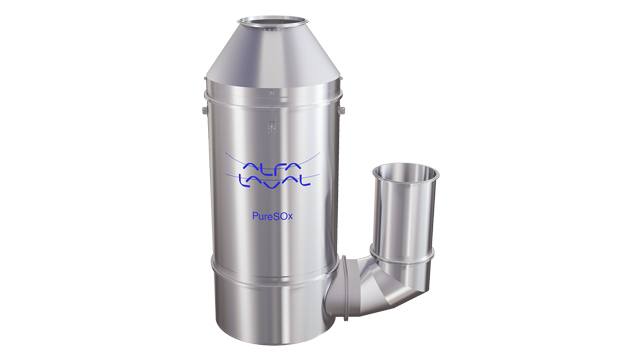
- Insufficient wash-water flow caused by pump faults, blocked strainers or restricted piping produces deteriorating scrubbing performance and process alarms
- Fouled or damaged spray and distribution components cause uneven gas cleaning, abnormal temperatures or unstable emission readings
- Failed pH, turbidity, flow, pressure or emission-monitoring instrumentation causes implausible values, compliance alarms or loss of automatic control
- Deposits, corrosion or erosion in the scrubber, drains and associated piping cause leakage, restriction or increasing exhaust backpressure
- Control-valve, actuator, dosing or automation faults prevent correct routing or conditioning of wash water and can force the system out of compliant operating mode
- Insufficient wash-water flow caused by pump faults, blocked strainers or restricted piping produces deteriorating scrubbing performance and process alarms
- Fouled or damaged spray and distribution components cause uneven gas cleaning, abnormal temperatures or unstable emission readings
- Failed pH, turbidity, flow, pressure or emission-monitoring instrumentation causes implausible values, compliance alarms or loss of automatic control
- Deposits, corrosion or erosion in the scrubber, drains and associated piping cause leakage, restriction or increasing exhaust backpressure
- Control-valve, actuator, dosing or automation faults prevent correct routing or conditioning of wash water and can force the system out of compliant operating mode
- Insufficient wash-water flow caused by pump faults, blocked strainers or restricted piping produces deteriorating scrubbing performance and process alarms
- Fouled or damaged spray and distribution components cause uneven gas cleaning, abnormal temperatures or unstable emission readings
- Failed pH, turbidity, flow, pressure or emission-monitoring instrumentation causes implausible values, compliance alarms or loss of automatic control
- Deposits, corrosion or erosion in the scrubber, drains and associated piping cause leakage, restriction or increasing exhaust backpressure
- Control-valve, actuator, dosing or automation faults prevent correct routing or conditioning of wash water and can force the system out of compliant operating mode
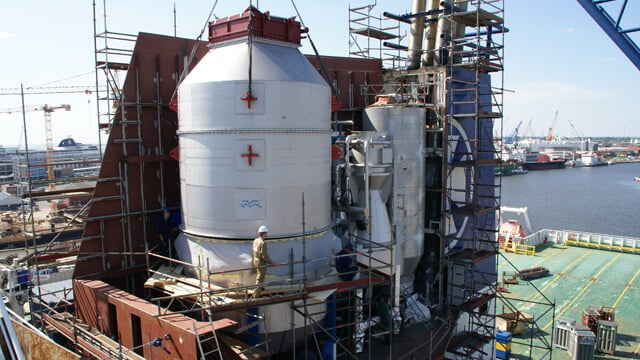
- Insufficient wash-water flow caused by pump faults, blocked strainers or restricted piping produces deteriorating scrubbing performance and process alarms
- Fouled or damaged spray and distribution components cause uneven gas cleaning, abnormal temperatures or unstable emission readings
- Failed pH, turbidity, flow, pressure or emission-monitoring instrumentation causes implausible values, compliance alarms or loss of automatic control
- Deposits, corrosion or erosion in the scrubber, drains and associated piping cause leakage, restriction or increasing exhaust backpressure
- Control-valve, actuator, dosing or automation faults prevent correct routing or conditioning of wash water and can force the system out of compliant operating mode
Victor Marine
49 ✓ 2 verified- Separation-element fouling caused by sludge, detergents or excessive oil loading, resulting in poor separation and repeated high-oil-content alarms
- Oil-content monitor contamination or calibration drift caused by dirty sample lines or sensor fouling, resulting in unstable or implausible readings
- Automatic recirculation or discharge-valve failure caused by actuator, solenoid or control faults, resulting in inability to route off-specification water correctly
- Feed-pump or suction problems caused by blockage, air ingress or pump wear, resulting in unstable flow and poor separator performance
- Internal leakage or bypassing caused by damaged seals, incorrect assembly or unauthorized piping changes, resulting in non-compliant operation or abnormal sample results
- Coalescer, filter or separation-stage fouling reduces separation efficiency and causes rising oil-content readings or automatic recirculation
- Oil-content monitor contamination, blocked sampling lines or calibration drift produces unstable readings, alarms or discharge shutdown
- Diverting-valve, solenoid or actuator faults prevent correct recirculation and cause sequence alarms
- Feed-pump seal wear or suction-side air ingress causes unstable flow, poor treatment performance or visible leakage
- Detergents or stable emulsions in bilge water overload the separation process and cause persistently high oil-content readings
- Coalescer, filter or separation-stage fouling reduces separation efficiency and causes rising oil-content readings or automatic recirculation
- Oil-content monitor contamination, blocked sampling lines or calibration drift produces unstable readings, alarms or discharge shutdown
- Diverting-valve, solenoid or actuator faults prevent correct recirculation and cause sequence alarms
- Feed-pump seal wear or suction-side air ingress causes unstable flow, poor treatment performance or visible leakage
- Detergents or stable emulsions in bilge water overload the separation process and cause persistently high oil-content readings
- Separation-element fouling caused by sludge, detergents or excessive oil loading, resulting in poor separation and repeated high-oil-content alarms
- Oil-content monitor contamination or calibration drift caused by dirty sample lines or sensor fouling, resulting in unstable or implausible readings
- Automatic recirculation or discharge-valve failure caused by actuator, solenoid or control faults, resulting in inability to route off-specification water correctly
- Feed-pump or suction problems caused by blockage, air ingress or pump wear, resulting in unstable flow and poor separator performance
- Internal leakage or bypassing caused by damaged seals, incorrect assembly or unauthorized piping changes, resulting in non-compliant operation or abnormal sample results
- Coalescer, filter or separation-stage fouling reduces separation efficiency and causes rising oil-content readings or automatic recirculation
- Oil-content monitor contamination, blocked sampling lines or calibration drift produces unstable readings, alarms or discharge shutdown
- Diverting-valve, solenoid or actuator faults prevent correct recirculation and cause sequence alarms
- Feed-pump seal wear or suction-side air ingress causes unstable flow, poor treatment performance or visible leakage
- Detergents or stable emulsions in bilge water overload the separation process and cause persistently high oil-content readings
- Coalescer, filter or separation-stage fouling reduces separation efficiency and causes rising oil-content readings or automatic recirculation
- Oil-content monitor contamination, blocked sampling lines or calibration drift produces unstable readings, alarms or discharge shutdown
- Diverting-valve, solenoid or actuator faults prevent correct recirculation and cause sequence alarms
- Feed-pump seal wear or suction-side air ingress causes unstable flow, poor treatment performance or visible leakage
- Detergents or stable emulsions in bilge water overload the separation process and cause persistently high oil-content readings
- Separation-element fouling caused by sludge, detergents or excessive oil loading, resulting in poor separation and repeated high-oil-content alarms
- Oil-content monitor contamination or calibration drift caused by dirty sample lines or sensor fouling, resulting in unstable or implausible readings
- Automatic recirculation or discharge-valve failure caused by actuator, solenoid or control faults, resulting in inability to route off-specification water correctly
- Feed-pump or suction problems caused by blockage, air ingress or pump wear, resulting in unstable flow and poor separator performance
- Internal leakage or bypassing caused by damaged seals, incorrect assembly or unauthorized piping changes, resulting in non-compliant operation or abnormal sample results
- Coalescer, filter or separation-stage fouling reduces separation efficiency and causes rising oil-content readings or automatic recirculation
- Oil-content monitor contamination, blocked sampling lines or calibration drift produces unstable readings, alarms or discharge shutdown
- Diverting-valve, solenoid or actuator faults prevent correct recirculation and cause sequence alarms
- Feed-pump seal wear or suction-side air ingress causes unstable flow, poor treatment performance or visible leakage
- Detergents or stable emulsions in bilge water overload the separation process and cause persistently high oil-content readings
- Coalescer, filter or separation-stage fouling reduces separation efficiency and causes rising oil-content readings or automatic recirculation
- Oil-content monitor contamination, blocked sampling lines or calibration drift produces unstable readings, alarms or discharge shutdown
- Diverting-valve, solenoid or actuator faults prevent correct recirculation and cause sequence alarms
- Feed-pump seal wear or suction-side air ingress causes unstable flow, poor treatment performance or visible leakage
- Detergents or stable emulsions in bilge water overload the separation process and cause persistently high oil-content readings
- Separation-element fouling caused by sludge, detergents or excessive oil loading, resulting in poor separation and repeated high-oil-content alarms
- Oil-content monitor contamination or calibration drift caused by dirty sample lines or sensor fouling, resulting in unstable or implausible readings
- Automatic recirculation or discharge-valve failure caused by actuator, solenoid or control faults, resulting in inability to route off-specification water correctly
- Feed-pump or suction problems caused by blockage, air ingress or pump wear, resulting in unstable flow and poor separator performance
- Internal leakage or bypassing caused by damaged seals, incorrect assembly or unauthorized piping changes, resulting in non-compliant operation or abnormal sample results
- Coalescer, filter or separation-stage fouling reduces separation efficiency and causes rising oil-content readings or automatic recirculation
- Oil-content monitor contamination, blocked sampling lines or calibration drift produces unstable readings, alarms or discharge shutdown
- Diverting-valve, solenoid or actuator faults prevent correct recirculation and cause sequence alarms
- Feed-pump seal wear or suction-side air ingress causes unstable flow, poor treatment performance or visible leakage
- Detergents or stable emulsions in bilge water overload the separation process and cause persistently high oil-content readings
- Coalescer, filter or separation-stage fouling reduces separation efficiency and causes rising oil-content readings or automatic recirculation
- Oil-content monitor contamination, blocked sampling lines or calibration drift produces unstable readings, alarms or discharge shutdown
- Diverting-valve, solenoid or actuator faults prevent correct recirculation and cause sequence alarms
- Feed-pump seal wear or suction-side air ingress causes unstable flow, poor treatment performance or visible leakage
- Detergents or stable emulsions in bilge water overload the separation process and cause persistently high oil-content readings
- Separation-element fouling caused by sludge, detergents or excessive oil loading, resulting in poor separation and repeated high-oil-content alarms
- Oil-content monitor contamination or calibration drift caused by dirty sample lines or sensor fouling, resulting in unstable or implausible readings
- Automatic recirculation or discharge-valve failure caused by actuator, solenoid or control faults, resulting in inability to route off-specification water correctly
- Feed-pump or suction problems caused by blockage, air ingress or pump wear, resulting in unstable flow and poor separator performance
- Internal leakage or bypassing caused by damaged seals, incorrect assembly or unauthorized piping changes, resulting in non-compliant operation or abnormal sample results
- Coalescer, filter or separation-stage fouling reduces separation efficiency and causes rising oil-content readings or automatic recirculation
- Oil-content monitor contamination, blocked sampling lines or calibration drift produces unstable readings, alarms or discharge shutdown
- Diverting-valve, solenoid or actuator faults prevent correct recirculation and cause sequence alarms
- Feed-pump seal wear or suction-side air ingress causes unstable flow, poor treatment performance or visible leakage
- Detergents or stable emulsions in bilge water overload the separation process and cause persistently high oil-content readings
- Coalescer, filter or separation-stage fouling reduces separation efficiency and causes rising oil-content readings or automatic recirculation
- Oil-content monitor contamination, blocked sampling lines or calibration drift produces unstable readings, alarms or discharge shutdown
- Diverting-valve, solenoid or actuator faults prevent correct recirculation and cause sequence alarms
- Feed-pump seal wear or suction-side air ingress causes unstable flow, poor treatment performance or visible leakage
- Detergents or stable emulsions in bilge water overload the separation process and cause persistently high oil-content readings
- Separation-element fouling caused by sludge, detergents or excessive oil loading, resulting in poor separation and repeated high-oil-content alarms
- Oil-content monitor contamination or calibration drift caused by dirty sample lines or sensor fouling, resulting in unstable or implausible readings
- Automatic recirculation or discharge-valve failure caused by actuator, solenoid or control faults, resulting in inability to route off-specification water correctly
- Feed-pump or suction problems caused by blockage, air ingress or pump wear, resulting in unstable flow and poor separator performance
- Internal leakage or bypassing caused by damaged seals, incorrect assembly or unauthorized piping changes, resulting in non-compliant operation or abnormal sample results
- Coalescer, filter or separation-stage fouling reduces separation efficiency and causes rising oil-content readings or automatic recirculation
- Oil-content monitor contamination, blocked sampling lines or calibration drift produces unstable readings, alarms or discharge shutdown
- Diverting-valve, solenoid or actuator faults prevent correct recirculation and cause sequence alarms
- Feed-pump seal wear or suction-side air ingress causes unstable flow, poor treatment performance or visible leakage
- Detergents or stable emulsions in bilge water overload the separation process and cause persistently high oil-content readings
- Coalescer, filter or separation-stage fouling reduces separation efficiency and causes rising oil-content readings or automatic recirculation
- Oil-content monitor contamination, blocked sampling lines or calibration drift produces unstable readings, alarms or discharge shutdown
- Diverting-valve, solenoid or actuator faults prevent correct recirculation and cause sequence alarms
- Feed-pump seal wear or suction-side air ingress causes unstable flow, poor treatment performance or visible leakage
- Detergents or stable emulsions in bilge water overload the separation process and cause persistently high oil-content readings
- Separation-element fouling caused by sludge, detergents or excessive oil loading, resulting in poor separation and repeated high-oil-content alarms
- Oil-content monitor contamination or calibration drift caused by dirty sample lines or sensor fouling, resulting in unstable or implausible readings
- Automatic recirculation or discharge-valve failure caused by actuator, solenoid or control faults, resulting in inability to route off-specification water correctly
- Feed-pump or suction problems caused by blockage, air ingress or pump wear, resulting in unstable flow and poor separator performance
- Internal leakage or bypassing caused by damaged seals, incorrect assembly or unauthorized piping changes, resulting in non-compliant operation or abnormal sample results
- Coalescer, filter or separation-stage fouling reduces separation efficiency and causes rising oil-content readings or automatic recirculation
- Oil-content monitor contamination, blocked sampling lines or calibration drift produces unstable readings, alarms or discharge shutdown
- Diverting-valve, solenoid or actuator faults prevent correct recirculation and cause sequence alarms
- Feed-pump seal wear or suction-side air ingress causes unstable flow, poor treatment performance or visible leakage
- Detergents or stable emulsions in bilge water overload the separation process and cause persistently high oil-content readings
- Coalescer, filter or separation-stage fouling reduces separation efficiency and causes rising oil-content readings or automatic recirculation
- Oil-content monitor contamination, blocked sampling lines or calibration drift produces unstable readings, alarms or discharge shutdown
- Diverting-valve, solenoid or actuator faults prevent correct recirculation and cause sequence alarms
- Feed-pump seal wear or suction-side air ingress causes unstable flow, poor treatment performance or visible leakage
- Detergents or stable emulsions in bilge water overload the separation process and cause persistently high oil-content readings
- Separation-element fouling caused by sludge, detergents or excessive oil loading, resulting in poor separation and repeated high-oil-content alarms
- Oil-content monitor contamination or calibration drift caused by dirty sample lines or sensor fouling, resulting in unstable or implausible readings
- Automatic recirculation or discharge-valve failure caused by actuator, solenoid or control faults, resulting in inability to route off-specification water correctly
- Feed-pump or suction problems caused by blockage, air ingress or pump wear, resulting in unstable flow and poor separator performance
- Internal leakage or bypassing caused by damaged seals, incorrect assembly or unauthorized piping changes, resulting in non-compliant operation or abnormal sample results
- Coalescer, filter or separation-stage fouling reduces separation efficiency and causes rising oil-content readings or automatic recirculation
- Oil-content monitor contamination, blocked sampling lines or calibration drift produces unstable readings, alarms or discharge shutdown
- Diverting-valve, solenoid or actuator faults prevent correct recirculation and cause sequence alarms
- Feed-pump seal wear or suction-side air ingress causes unstable flow, poor treatment performance or visible leakage
- Detergents or stable emulsions in bilge water overload the separation process and cause persistently high oil-content readings
- Coalescer, filter or separation-stage fouling reduces separation efficiency and causes rising oil-content readings or automatic recirculation
- Oil-content monitor contamination, blocked sampling lines or calibration drift produces unstable readings, alarms or discharge shutdown
- Diverting-valve, solenoid or actuator faults prevent correct recirculation and cause sequence alarms
- Feed-pump seal wear or suction-side air ingress causes unstable flow, poor treatment performance or visible leakage
- Detergents or stable emulsions in bilge water overload the separation process and cause persistently high oil-content readings
- Separation-element fouling caused by sludge, detergents or excessive oil loading, resulting in poor separation and repeated high-oil-content alarms
- Oil-content monitor contamination or calibration drift caused by dirty sample lines or sensor fouling, resulting in unstable or implausible readings
- Automatic recirculation or discharge-valve failure caused by actuator, solenoid or control faults, resulting in inability to route off-specification water correctly
- Feed-pump or suction problems caused by blockage, air ingress or pump wear, resulting in unstable flow and poor separator performance
- Internal leakage or bypassing caused by damaged seals, incorrect assembly or unauthorized piping changes, resulting in non-compliant operation or abnormal sample results
- Coalescer, filter or separation-stage fouling reduces separation efficiency and causes rising oil-content readings or automatic recirculation
- Oil-content monitor contamination, blocked sampling lines or calibration drift produces unstable readings, alarms or discharge shutdown
- Diverting-valve, solenoid or actuator faults prevent correct recirculation and cause sequence alarms
- Feed-pump seal wear or suction-side air ingress causes unstable flow, poor treatment performance or visible leakage
- Detergents or stable emulsions in bilge water overload the separation process and cause persistently high oil-content readings
- Coalescer, filter or separation-stage fouling reduces separation efficiency and causes rising oil-content readings or automatic recirculation
- Oil-content monitor contamination, blocked sampling lines or calibration drift produces unstable readings, alarms or discharge shutdown
- Diverting-valve, solenoid or actuator faults prevent correct recirculation and cause sequence alarms
- Feed-pump seal wear or suction-side air ingress causes unstable flow, poor treatment performance or visible leakage
- Detergents or stable emulsions in bilge water overload the separation process and cause persistently high oil-content readings
- Separation-element fouling caused by sludge, detergents or excessive oil loading, resulting in poor separation and repeated high-oil-content alarms
- Oil-content monitor contamination or calibration drift caused by dirty sample lines or sensor fouling, resulting in unstable or implausible readings
- Automatic recirculation or discharge-valve failure caused by actuator, solenoid or control faults, resulting in inability to route off-specification water correctly
- Feed-pump or suction problems caused by blockage, air ingress or pump wear, resulting in unstable flow and poor separator performance
- Internal leakage or bypassing caused by damaged seals, incorrect assembly or unauthorized piping changes, resulting in non-compliant operation or abnormal sample results
- Coalescer, filter or separation-stage fouling reduces separation efficiency and causes rising oil-content readings or automatic recirculation
- Oil-content monitor contamination, blocked sampling lines or calibration drift produces unstable readings, alarms or discharge shutdown
- Diverting-valve, solenoid or actuator faults prevent correct recirculation and cause sequence alarms
- Feed-pump seal wear or suction-side air ingress causes unstable flow, poor treatment performance or visible leakage
- Detergents or stable emulsions in bilge water overload the separation process and cause persistently high oil-content readings
- Coalescer, filter or separation-stage fouling reduces separation efficiency and causes rising oil-content readings or automatic recirculation
- Oil-content monitor contamination, blocked sampling lines or calibration drift produces unstable readings, alarms or discharge shutdown
- Diverting-valve, solenoid or actuator faults prevent correct recirculation and cause sequence alarms
- Feed-pump seal wear or suction-side air ingress causes unstable flow, poor treatment performance or visible leakage
- Detergents or stable emulsions in bilge water overload the separation process and cause persistently high oil-content readings
- Separation-element fouling caused by sludge, detergents or excessive oil loading, resulting in poor separation and repeated high-oil-content alarms
- Oil-content monitor contamination or calibration drift caused by dirty sample lines or sensor fouling, resulting in unstable or implausible readings
- Automatic recirculation or discharge-valve failure caused by actuator, solenoid or control faults, resulting in inability to route off-specification water correctly
- Feed-pump or suction problems caused by blockage, air ingress or pump wear, resulting in unstable flow and poor separator performance
- Internal leakage or bypassing caused by damaged seals, incorrect assembly or unauthorized piping changes, resulting in non-compliant operation or abnormal sample results
- Coalescer, filter or separation-stage fouling reduces separation efficiency and causes rising oil-content readings or automatic recirculation
- Oil-content monitor contamination, blocked sampling lines or calibration drift produces unstable readings, alarms or discharge shutdown
- Diverting-valve, solenoid or actuator faults prevent correct recirculation and cause sequence alarms
- Feed-pump seal wear or suction-side air ingress causes unstable flow, poor treatment performance or visible leakage
- Detergents or stable emulsions in bilge water overload the separation process and cause persistently high oil-content readings
- Coalescer, filter or separation-stage fouling reduces separation efficiency and causes rising oil-content readings or automatic recirculation
- Oil-content monitor contamination, blocked sampling lines or calibration drift produces unstable readings, alarms or discharge shutdown
- Diverting-valve, solenoid or actuator faults prevent correct recirculation and cause sequence alarms
- Feed-pump seal wear or suction-side air ingress causes unstable flow, poor treatment performance or visible leakage
- Detergents or stable emulsions in bilge water overload the separation process and cause persistently high oil-content readings
- Separation-element fouling caused by sludge, detergents or excessive oil loading, resulting in poor separation and repeated high-oil-content alarms
- Oil-content monitor contamination or calibration drift caused by dirty sample lines or sensor fouling, resulting in unstable or implausible readings
- Automatic recirculation or discharge-valve failure caused by actuator, solenoid or control faults, resulting in inability to route off-specification water correctly
- Feed-pump or suction problems caused by blockage, air ingress or pump wear, resulting in unstable flow and poor separator performance
- Internal leakage or bypassing caused by damaged seals, incorrect assembly or unauthorized piping changes, resulting in non-compliant operation or abnormal sample results
- Coalescer, filter or separation-stage fouling reduces separation efficiency and causes rising oil-content readings or automatic recirculation
- Oil-content monitor contamination, blocked sampling lines or calibration drift produces unstable readings, alarms or discharge shutdown
- Diverting-valve, solenoid or actuator faults prevent correct recirculation and cause sequence alarms
- Feed-pump seal wear or suction-side air ingress causes unstable flow, poor treatment performance or visible leakage
- Detergents or stable emulsions in bilge water overload the separation process and cause persistently high oil-content readings
- Coalescer, filter or separation-stage fouling reduces separation efficiency and causes rising oil-content readings or automatic recirculation
- Oil-content monitor contamination, blocked sampling lines or calibration drift produces unstable readings, alarms or discharge shutdown
- Diverting-valve, solenoid or actuator faults prevent correct recirculation and cause sequence alarms
- Feed-pump seal wear or suction-side air ingress causes unstable flow, poor treatment performance or visible leakage
- Detergents or stable emulsions in bilge water overload the separation process and cause persistently high oil-content readings
- Separation-element fouling caused by sludge, detergents or excessive oil loading, resulting in poor separation and repeated high-oil-content alarms
- Oil-content monitor contamination or calibration drift caused by dirty sample lines or sensor fouling, resulting in unstable or implausible readings
- Automatic recirculation or discharge-valve failure caused by actuator, solenoid or control faults, resulting in inability to route off-specification water correctly
- Feed-pump or suction problems caused by blockage, air ingress or pump wear, resulting in unstable flow and poor separator performance
- Internal leakage or bypassing caused by damaged seals, incorrect assembly or unauthorized piping changes, resulting in non-compliant operation or abnormal sample results
- Coalescer, filter or separation-stage fouling reduces separation efficiency and causes rising oil-content readings or automatic recirculation
- Oil-content monitor contamination, blocked sampling lines or calibration drift produces unstable readings, alarms or discharge shutdown
- Diverting-valve, solenoid or actuator faults prevent correct recirculation and cause sequence alarms
- Feed-pump seal wear or suction-side air ingress causes unstable flow, poor treatment performance or visible leakage
- Detergents or stable emulsions in bilge water overload the separation process and cause persistently high oil-content readings
- Coalescer, filter or separation-stage fouling reduces separation efficiency and causes rising oil-content readings or automatic recirculation
- Oil-content monitor contamination, blocked sampling lines or calibration drift produces unstable readings, alarms or discharge shutdown
- Diverting-valve, solenoid or actuator faults prevent correct recirculation and cause sequence alarms
- Feed-pump seal wear or suction-side air ingress causes unstable flow, poor treatment performance or visible leakage
- Detergents or stable emulsions in bilge water overload the separation process and cause persistently high oil-content readings
- Separation-element fouling caused by sludge, detergents or excessive oil loading, resulting in poor separation and repeated high-oil-content alarms
- Oil-content monitor contamination or calibration drift caused by dirty sample lines or sensor fouling, resulting in unstable or implausible readings
- Automatic recirculation or discharge-valve failure caused by actuator, solenoid or control faults, resulting in inability to route off-specification water correctly
- Feed-pump or suction problems caused by blockage, air ingress or pump wear, resulting in unstable flow and poor separator performance
- Internal leakage or bypassing caused by damaged seals, incorrect assembly or unauthorized piping changes, resulting in non-compliant operation or abnormal sample results
- Coalescer, filter or separation-stage fouling reduces separation efficiency and causes rising oil-content readings or automatic recirculation
- Oil-content monitor contamination, blocked sampling lines or calibration drift produces unstable readings, alarms or discharge shutdown
- Diverting-valve, solenoid or actuator faults prevent correct recirculation and cause sequence alarms
- Feed-pump seal wear or suction-side air ingress causes unstable flow, poor treatment performance or visible leakage
- Detergents or stable emulsions in bilge water overload the separation process and cause persistently high oil-content readings
- Coalescer, filter or separation-stage fouling reduces separation efficiency and causes rising oil-content readings or automatic recirculation
- Oil-content monitor contamination, blocked sampling lines or calibration drift produces unstable readings, alarms or discharge shutdown
- Diverting-valve, solenoid or actuator faults prevent correct recirculation and cause sequence alarms
- Feed-pump seal wear or suction-side air ingress causes unstable flow, poor treatment performance or visible leakage
- Detergents or stable emulsions in bilge water overload the separation process and cause persistently high oil-content readings
- Separation-element fouling caused by sludge, detergents or excessive oil loading, resulting in poor separation and repeated high-oil-content alarms
- Oil-content monitor contamination or calibration drift caused by dirty sample lines or sensor fouling, resulting in unstable or implausible readings
- Automatic recirculation or discharge-valve failure caused by actuator, solenoid or control faults, resulting in inability to route off-specification water correctly
- Feed-pump or suction problems caused by blockage, air ingress or pump wear, resulting in unstable flow and poor separator performance
- Internal leakage or bypassing caused by damaged seals, incorrect assembly or unauthorized piping changes, resulting in non-compliant operation or abnormal sample results
- Coalescer, filter or separation-stage fouling reduces separation efficiency and causes rising oil-content readings or automatic recirculation
- Oil-content monitor contamination, blocked sampling lines or calibration drift produces unstable readings, alarms or discharge shutdown
- Diverting-valve, solenoid or actuator faults prevent correct recirculation and cause sequence alarms
- Feed-pump seal wear or suction-side air ingress causes unstable flow, poor treatment performance or visible leakage
- Detergents or stable emulsions in bilge water overload the separation process and cause persistently high oil-content readings
- Coalescer, filter or separation-stage fouling reduces separation efficiency and causes rising oil-content readings or automatic recirculation
- Oil-content monitor contamination, blocked sampling lines or calibration drift produces unstable readings, alarms or discharge shutdown
- Diverting-valve, solenoid or actuator faults prevent correct recirculation and cause sequence alarms
- Feed-pump seal wear or suction-side air ingress causes unstable flow, poor treatment performance or visible leakage
- Detergents or stable emulsions in bilge water overload the separation process and cause persistently high oil-content readings
- Area: Sampling point integrity and representativenessCheck: Verify sampling point is in vertical section of effluent piping near OWS outlet, with adequate pressure (≥0.2 bar) and flow rate (≥3 l/min). Check piping is sealed, inspect for tampering or bypass valves. Verify sample line has no isolation points.
- Area: 15ppm bilge alarm accuracy and response timeCheck: Test alarm calibration within ±5 ppm accuracy. Verify response time ≤5 seconds for alarm activation. Test automatic overboard discharge valve closure within ≤20 seconds total. Check alarm has audible/visual indication. Verify alarm stores operational data (date, time, status) for minimum 18 months.
- Area: Coalescer and filter element condition and replacementCheck: Inspect coalescer for blockage, degradation, or sediment accumulation. Check filter elements for fouling or clogging (service life typically 1-2 years). Verify replacement schedule compliance. Inspect internal seals and gaskets for integrity. Check heater elements (if equipped) for corrosion or scaling.
- Area: Oil content monitor (OCM) calibration and functionalityCheck: Verify OCM calibration by manufacturer or authorized agent within 5-year intervals. Test with clean water supply to measuring cell. Confirm sensor precision for oil content regulation. Check OCM display/recording function. Test bypass activation when oil content <threshold. Confirm cell replacement after 5 years of service.
- Area: Separator tank condition, sludge, and sediment accumulationCheck: Inspect separation chambers for cleanliness, oil residue, and water level sensors. Check for sludge or emulsion buildup at tank bottom. Verify automatic sludge/oil discharge valve operation. Test level sensors and transfer solenoid valves. Confirm oil recovery system functioning and recovered oil properly disposed.
Typ-universelle Inspektionspunkte fuer Oily Water Separator (15ppm) (verifiziert, 2026-06).
- Area: Sampling point integrity and representativenessCheck: Verify sampling point is in vertical section of effluent piping near OWS outlet, with adequate pressure (≥0.2 bar) and flow rate (≥3 l/min). Check piping is sealed, inspect for tampering or bypass valves. Verify sample line has no isolation points.
- Area: 15ppm bilge alarm accuracy and response timeCheck: Test alarm calibration within ±5 ppm accuracy. Verify response time ≤5 seconds for alarm activation. Test automatic overboard discharge valve closure within ≤20 seconds total. Check alarm has audible/visual indication. Verify alarm stores operational data (date, time, status) for minimum 18 months.
- Area: Coalescer and filter element condition and replacementCheck: Inspect coalescer for blockage, degradation, or sediment accumulation. Check filter elements for fouling or clogging (service life typically 1-2 years). Verify replacement schedule compliance. Inspect internal seals and gaskets for integrity. Check heater elements (if equipped) for corrosion or scaling.
- Area: Oil content monitor (OCM) calibration and functionalityCheck: Verify OCM calibration by manufacturer or authorized agent within 5-year intervals. Test with clean water supply to measuring cell. Confirm sensor precision for oil content regulation. Check OCM display/recording function. Test bypass activation when oil content <threshold. Confirm cell replacement after 5 years of service.
- Area: Separator tank condition, sludge, and sediment accumulationCheck: Inspect separation chambers for cleanliness, oil residue, and water level sensors. Check for sludge or emulsion buildup at tank bottom. Verify automatic sludge/oil discharge valve operation. Test level sensors and transfer solenoid valves. Confirm oil recovery system functioning and recovered oil properly disposed.
Typ-universelle Inspektionspunkte fuer Oily Water Separator (15ppm) (verifiziert, 2026-06).
- Area: Verify oil content monitor (OCM) calibration and 15 ppm alarm/shutoff function before each voyage as required by MARPOL Annex ICheck: Verify oil content monitor (OCM) calibration and 15 ppm alarm/shutoff function before each voyage as required by MARPOL Annex I
- Area: Inspect and replace Adsorption Granular Media (AGM) / coalescing filter elements at manufacturer-specified intervals or when differential pressure exceeds limitCheck: Inspect and replace Adsorption Granular Media (AGM) / coalescing filter elements at manufacturer-specified intervals or when differential pressure exceeds limit
- Area: Check bilge pump suction strainer / Y-strainer (1 mm mesh) for blockage and clean as requiredCheck: Check bilge pump suction strainer / Y-strainer (1 mm mesh) for blockage and clean as required
- Area: Inspect all solenoid-operated overboard discharge and return-to-bilge valves for correct actuation and no leakageCheck: Inspect all solenoid-operated overboard discharge and return-to-bilge valves for correct actuation and no leakage
- Area: Test automatic overboard discharge shutoff: confirm system closes discharge valve and opens bilge return when OCM reads >15 ppmCheck: Test automatic overboard discharge shutoff: confirm system closes discharge valve and opens bilge return when OCM reads >15 ppm
- Area: Check bilge float switch (IP68 submersible type) for correct operation, cable integrity, and absence of debris around slosh shieldCheck: Check bilge float switch (IP68 submersible type) for correct operation, cable integrity, and absence of debris around slosh shield
- Area: Inspect separator vessel, pipework, and connections for corrosion, fouling, and tightness; verify pressure relief valve conditionCheck: Inspect separator vessel, pipework, and connections for corrosion, fouling, and tightness; verify pressure relief valve condition
- Area: Confirm Oil Record Book entries are complete and that ORB Part I (machinery spaces) is up to date per MARPOL requirementsCheck: Confirm Oil Record Book entries are complete and that ORB Part I (machinery spaces) is up to date per MARPOL requirements
Typ-universelle Inspektionspunkte fuer Oily Water Separator (verifiziert, 2026-06).
- Area: Verify oil content monitor (OCM) calibration and 15 ppm alarm/shutoff function before each voyage as required by MARPOL Annex ICheck: Verify oil content monitor (OCM) calibration and 15 ppm alarm/shutoff function before each voyage as required by MARPOL Annex I
- Area: Inspect and replace Adsorption Granular Media (AGM) / coalescing filter elements at manufacturer-specified intervals or when differential pressure exceeds limitCheck: Inspect and replace Adsorption Granular Media (AGM) / coalescing filter elements at manufacturer-specified intervals or when differential pressure exceeds limit
- Area: Check bilge pump suction strainer / Y-strainer (1 mm mesh) for blockage and clean as requiredCheck: Check bilge pump suction strainer / Y-strainer (1 mm mesh) for blockage and clean as required
- Area: Inspect all solenoid-operated overboard discharge and return-to-bilge valves for correct actuation and no leakageCheck: Inspect all solenoid-operated overboard discharge and return-to-bilge valves for correct actuation and no leakage
- Area: Test automatic overboard discharge shutoff: confirm system closes discharge valve and opens bilge return when OCM reads >15 ppmCheck: Test automatic overboard discharge shutoff: confirm system closes discharge valve and opens bilge return when OCM reads >15 ppm
- Area: Check bilge float switch (IP68 submersible type) for correct operation, cable integrity, and absence of debris around slosh shieldCheck: Check bilge float switch (IP68 submersible type) for correct operation, cable integrity, and absence of debris around slosh shield
- Area: Inspect separator vessel, pipework, and connections for corrosion, fouling, and tightness; verify pressure relief valve conditionCheck: Inspect separator vessel, pipework, and connections for corrosion, fouling, and tightness; verify pressure relief valve condition
- Area: Confirm Oil Record Book entries are complete and that ORB Part I (machinery spaces) is up to date per MARPOL requirementsCheck: Confirm Oil Record Book entries are complete and that ORB Part I (machinery spaces) is up to date per MARPOL requirements
Typ-universelle Inspektionspunkte fuer Oily Water Separator (verifiziert, 2026-06).
Jowa
27 ✓ 5 verified- Area: Inspection of oil content in discharge water: check whether the 15-ppm bilge alarm responds correctly and the overboard shut-off valve upon alarm exceedingCheck: Inspection of oil content in discharge water: check whether the 15-ppm bilge alarm responds correctly and the overboard shut-off valve upon alarm exceeding reliably closes
- Area: Filter and coalescence elements: regular visual inspection and replacement of filter cartridges/media according to manufacturer's specification (operating hours or intervalCheck: Filter and coalescence elements: regular visual inspection and replacement of filter cartridges/media according to manufacturer's specification (operating hours or interval)
- Area: Pumps and valves: leak test, function of the automatic three-way valves (overboard valve, recirculation valve) and sludge discharge inspectionCheck: Pumps and valves: leak test, function of the automatic three-way valves (overboard valve, recirculation valve) and sludge discharge inspection
- Area: Instrumentation and sensors: calibration and functional test of the oil content sensor (OCM/OMD) as well as pressure gauges and temperature sensorsCheck: Instrumentation and sensors: calibration and functional test of the oil content sensor (OCM/OMD) as well as pressure gauges and temperature sensors
- Area: Compressed air supply: test for adequate and dry instrument air pressure (setpoint 4–6 bar) for pneumatic actuatorsCheck: Compressed air supply: test for adequate and dry instrument air pressure (setpoint 4–6 bar) for pneumatic actuators
- Area: Vessels and lines: visual inspection for corrosion, leaks and damage; inspection of AISI-316L stainless steel vessels for signs of pittingCheck: Vessels and lines: visual inspection for corrosion, leaks and damage; inspection of AISI-316L stainless steel vessels for signs of pitting or crevice corrosion
- Area: ORB entry (Oil Record Book): ensure that all bilge water transfers and alarm events are correctly and completely documented in the Oil Record BookCheck: ORB entry (Oil Record Book): ensure that all bilge water transfers and alarm events are correctly and completely documented in the Oil Record Book (MARPOL Annex I)
- Area: Classification certificate and type approval: validity of the IMO MEPC 107(49) type approval and recognized class certificates (DNV, CCS, USCG, KR, RMRS)Check: Classification certificate and type approval: validity of the IMO MEPC 107(49) type approval and recognized class certificates (DNV, CCS, USCG, KR, RMRS) check and renew if necessary
Typ-universelle Inspektionspunkte fuer Oily Water Separator (verifiziert, 2026-06).
- Area: Inspection of oil content in discharge water: check whether the 15-ppm bilge alarm responds correctly and the overboard shut-off valve upon alarm exceedingCheck: Inspection of oil content in discharge water: check whether the 15-ppm bilge alarm responds correctly and the overboard shut-off valve upon alarm exceeding reliably closes
- Area: Filter and coalescence elements: regular visual inspection and replacement of filter cartridges/media according to manufacturer's specification (operating hours or intervalCheck: Filter and coalescence elements: regular visual inspection and replacement of filter cartridges/media according to manufacturer's specification (operating hours or interval)
- Area: Pumps and valves: leak test, function of the automatic three-way valves (overboard valve, recirculation valve) and sludge discharge inspectionCheck: Pumps and valves: leak test, function of the automatic three-way valves (overboard valve, recirculation valve) and sludge discharge inspection
- Area: Instrumentation and sensors: calibration and functional test of the oil content sensor (OCM/OMD) as well as pressure gauges and temperature sensorsCheck: Instrumentation and sensors: calibration and functional test of the oil content sensor (OCM/OMD) as well as pressure gauges and temperature sensors
- Area: Compressed air supply: test for adequate and dry instrument air pressure (setpoint 4–6 bar) for pneumatic actuatorsCheck: Compressed air supply: test for adequate and dry instrument air pressure (setpoint 4–6 bar) for pneumatic actuators
- Area: Vessels and lines: visual inspection for corrosion, leaks and damage; inspection of AISI-316L stainless steel vessels for signs of pittingCheck: Vessels and lines: visual inspection for corrosion, leaks and damage; inspection of AISI-316L stainless steel vessels for signs of pitting or crevice corrosion
- Area: ORB entry (Oil Record Book): ensure that all bilge water transfers and alarm events are correctly and completely documented in the Oil Record BookCheck: ORB entry (Oil Record Book): ensure that all bilge water transfers and alarm events are correctly and completely documented in the Oil Record Book (MARPOL Annex I)
- Area: Classification certificate and type approval: validity of the IMO MEPC 107(49) type approval and recognized class certificates (DNV, CCS, USCG, KR, RMRS)Check: Classification certificate and type approval: validity of the IMO MEPC 107(49) type approval and recognized class certificates (DNV, CCS, USCG, KR, RMRS) check and renew if necessary
Typ-universelle Inspektionspunkte fuer Oily Water Separator (verifiziert, 2026-06).
- Area: Inspection of oil content in discharge water: check whether the 15-ppm bilge alarm responds correctly and the overboard shut-off valve upon alarm exceedingCheck: Inspection of oil content in discharge water: check whether the 15-ppm bilge alarm responds correctly and the overboard shut-off valve upon alarm exceeding reliably closes
- Area: Filter and coalescence elements: regular visual inspection and replacement of filter cartridges/media according to manufacturer's specification (operating hours or intervalCheck: Filter and coalescence elements: regular visual inspection and replacement of filter cartridges/media according to manufacturer's specification (operating hours or interval)
- Area: Pumps and valves: leak test, function of the automatic three-way valves (overboard valve, recirculation valve) and sludge discharge inspectionCheck: Pumps and valves: leak test, function of the automatic three-way valves (overboard valve, recirculation valve) and sludge discharge inspection
- Area: Instrumentation and sensors: calibration and functional test of the oil content sensor (OCM/OMD) as well as pressure gauges and temperature sensorsCheck: Instrumentation and sensors: calibration and functional test of the oil content sensor (OCM/OMD) as well as pressure gauges and temperature sensors
- Area: Compressed air supply: test for adequate and dry instrument air pressure (setpoint 4–6 bar) for pneumatic actuatorsCheck: Compressed air supply: test for adequate and dry instrument air pressure (setpoint 4–6 bar) for pneumatic actuators
- Area: Vessels and lines: visual inspection for corrosion, leaks and damage; inspection of AISI-316L stainless steel vessels for signs of pittingCheck: Vessels and lines: visual inspection for corrosion, leaks and damage; inspection of AISI-316L stainless steel vessels for signs of pitting or crevice corrosion
- Area: ORB entry (Oil Record Book): ensure that all bilge water transfers and alarm events are correctly and completely documented in the Oil Record BookCheck: ORB entry (Oil Record Book): ensure that all bilge water transfers and alarm events are correctly and completely documented in the Oil Record Book (MARPOL Annex I)
- Area: Classification certificate and type approval: validity of the IMO MEPC 107(49) type approval and recognized class certificates (DNV, CCS, USCG, KR, RMRS)Check: Classification certificate and type approval: validity of the IMO MEPC 107(49) type approval and recognized class certificates (DNV, CCS, USCG, KR, RMRS) check and renew if necessary
Typ-universelle Inspektionspunkte fuer Oily Water Separator (verifiziert, 2026-06).
- Area: Inspection of oil content in discharge water: check whether the 15-ppm bilge alarm responds correctly and the overboard shut-off valve upon alarm exceedingCheck: Inspection of oil content in discharge water: check whether the 15-ppm bilge alarm responds correctly and the overboard shut-off valve upon alarm exceeding reliably closes
- Area: Filter and coalescence elements: regular visual inspection and replacement of filter cartridges/media according to manufacturer's specification (operating hours or intervalCheck: Filter and coalescence elements: regular visual inspection and replacement of filter cartridges/media according to manufacturer's specification (operating hours or interval)
- Area: Pumps and valves: leak test, function of the automatic three-way valves (overboard valve, recirculation valve) and sludge discharge inspectionCheck: Pumps and valves: leak test, function of the automatic three-way valves (overboard valve, recirculation valve) and sludge discharge inspection
- Area: Instrumentation and sensors: calibration and functional test of the oil content sensor (OCM/OMD) as well as pressure gauges and temperature sensorsCheck: Instrumentation and sensors: calibration and functional test of the oil content sensor (OCM/OMD) as well as pressure gauges and temperature sensors
- Area: Compressed air supply: test for adequate and dry instrument air pressure (setpoint 4–6 bar) for pneumatic actuatorsCheck: Compressed air supply: test for adequate and dry instrument air pressure (setpoint 4–6 bar) for pneumatic actuators
- Area: Vessels and lines: visual inspection for corrosion, leaks and damage; inspection of AISI-316L stainless steel vessels for signs of pittingCheck: Vessels and lines: visual inspection for corrosion, leaks and damage; inspection of AISI-316L stainless steel vessels for signs of pitting or crevice corrosion
- Area: ORB entry (Oil Record Book): ensure that all bilge water transfers and alarm events are correctly and completely documented in the Oil Record BookCheck: ORB entry (Oil Record Book): ensure that all bilge water transfers and alarm events are correctly and completely documented in the Oil Record Book (MARPOL Annex I)
- Area: Classification certificate and type approval: validity of the IMO MEPC 107(49) type approval and recognized class certificates (DNV, CCS, USCG, KR, RMRS)Check: Classification certificate and type approval: validity of the IMO MEPC 107(49) type approval and recognized class certificates (DNV, CCS, USCG, KR, RMRS) check and renew if necessary
Typ-universelle Inspektionspunkte fuer Oily Water Separator (verifiziert, 2026-06).
- Area: Inspection of oil content in discharge water: check whether the 15-ppm bilge alarm responds correctly and the overboard shut-off valve upon alarm exceedingCheck: Inspection of oil content in discharge water: check whether the 15-ppm bilge alarm responds correctly and the overboard shut-off valve upon alarm exceeding reliably closes
- Area: Filter and coalescence elements: regular visual inspection and replacement of filter cartridges/media according to manufacturer's specification (operating hours or intervalCheck: Filter and coalescence elements: regular visual inspection and replacement of filter cartridges/media according to manufacturer's specification (operating hours or interval)
- Area: Pumps and valves: leak test, function of the automatic three-way valves (overboard valve, recirculation valve) and sludge discharge inspectionCheck: Pumps and valves: leak test, function of the automatic three-way valves (overboard valve, recirculation valve) and sludge discharge inspection
- Area: Instrumentation and sensors: calibration and functional test of the oil content sensor (OCM/OMD) as well as pressure gauges and temperature sensorsCheck: Instrumentation and sensors: calibration and functional test of the oil content sensor (OCM/OMD) as well as pressure gauges and temperature sensors
- Area: Compressed air supply: test for adequate and dry instrument air pressure (setpoint 4–6 bar) for pneumatic actuatorsCheck: Compressed air supply: test for adequate and dry instrument air pressure (setpoint 4–6 bar) for pneumatic actuators
- Area: Vessels and lines: visual inspection for corrosion, leaks and damage; inspection of AISI-316L stainless steel vessels for signs of pittingCheck: Vessels and lines: visual inspection for corrosion, leaks and damage; inspection of AISI-316L stainless steel vessels for signs of pitting or crevice corrosion
- Area: ORB entry (Oil Record Book): ensure that all bilge water transfers and alarm events are correctly and completely documented in the Oil Record BookCheck: ORB entry (Oil Record Book): ensure that all bilge water transfers and alarm events are correctly and completely documented in the Oil Record Book (MARPOL Annex I)
- Area: Classification certificate and type approval: validity of the IMO MEPC 107(49) type approval and recognized class certificates (DNV, CCS, USCG, KR, RMRS)Check: Classification certificate and type approval: validity of the IMO MEPC 107(49) type approval and recognized class certificates (DNV, CCS, USCG, KR, RMRS) check and renew if necessary
Typ-universelle Inspektionspunkte fuer Oily Water Separator (verifiziert, 2026-06).
- Coalescer, filter or separation-stage fouling reduces treatment efficiency and causes rising oil-content readings or discharge recirculation
- Oil-content monitor contamination or calibration drift causes implausible readings, alarms or automatic discharge shutdown
- Solenoid, diverting-valve or actuator failure prevents correct recirculation and may trigger an alarm or stop discharge
- Feed-pump seal wear or air ingress causes unstable flow, poor separation or visible leakage
- Improper detergent or emulsified bilge-water loading overwhelms the separation process and causes persistently high oil-content readings
- Poor separation caused by excessive oil, detergents or stable emulsions, noticed as high oil-content readings or frequent recirculation
- Coalescer/filter fouling caused by sludge and solids, noticed as high differential pressure and reduced throughput
- Oil-content-monitor drift or contamination caused by dirty sample cell or sensor faults, noticed as implausible readings or failed checks
- Automatic stop/recirculation valve fault caused by actuator or control problems, noticed as incorrect valve position during high-oil alarm
- Feed-pump or suction fault caused by blockage, air ingress or wear, noticed as low or unstable treatment flow
- Unauthorized or incorrect valve lineup caused by human error or tampering, noticed from bypass evidence, broken seals or piping inconsistency
- Poor separation caused by excessive oil, detergents or stable emulsions, noticed as high oil-content readings or frequent recirculation
- Coalescer/filter fouling caused by sludge and solids, noticed as high differential pressure and reduced throughput
- Oil-content-monitor drift or contamination caused by dirty sample cell or sensor faults, noticed as implausible readings or failed checks
- Automatic stop/recirculation valve fault caused by actuator or control problems, noticed as incorrect valve position during high-oil alarm
- Feed-pump or suction fault caused by blockage, air ingress or wear, noticed as low or unstable treatment flow
- Unauthorized or incorrect valve lineup caused by human error or tampering, noticed from bypass evidence, broken seals or piping inconsistency
- Coalescer, filter or separation-stage fouling reduces treatment efficiency and causes rising oil-content readings or discharge recirculation
- Oil-content monitor contamination or calibration drift causes implausible readings, alarms or automatic discharge shutdown
- Solenoid, diverting-valve or actuator failure prevents correct recirculation and may trigger an alarm or stop discharge
- Feed-pump seal wear or air ingress causes unstable flow, poor separation or visible leakage
- Improper detergent or emulsified bilge-water loading overwhelms the separation process and causes persistently high oil-content readings
- Poor separation caused by excessive oil, detergents or stable emulsions, noticed as high oil-content readings or frequent recirculation
- Coalescer/filter fouling caused by sludge and solids, noticed as high differential pressure and reduced throughput
- Oil-content-monitor drift or contamination caused by dirty sample cell or sensor faults, noticed as implausible readings or failed checks
- Automatic stop/recirculation valve fault caused by actuator or control problems, noticed as incorrect valve position during high-oil alarm
- Feed-pump or suction fault caused by blockage, air ingress or wear, noticed as low or unstable treatment flow
- Unauthorized or incorrect valve lineup caused by human error or tampering, noticed from bypass evidence, broken seals or piping inconsistency
- Poor separation caused by excessive oil, detergents or stable emulsions, noticed as high oil-content readings or frequent recirculation
- Coalescer/filter fouling caused by sludge and solids, noticed as high differential pressure and reduced throughput
- Oil-content-monitor drift or contamination caused by dirty sample cell or sensor faults, noticed as implausible readings or failed checks
- Automatic stop/recirculation valve fault caused by actuator or control problems, noticed as incorrect valve position during high-oil alarm
- Feed-pump or suction fault caused by blockage, air ingress or wear, noticed as low or unstable treatment flow
- Unauthorized or incorrect valve lineup caused by human error or tampering, noticed from bypass evidence, broken seals or piping inconsistency
- Coalescer, filter or separation-stage fouling reduces treatment efficiency and causes rising oil-content readings or discharge recirculation
- Oil-content monitor contamination or calibration drift causes implausible readings, alarms or automatic discharge shutdown
- Solenoid, diverting-valve or actuator failure prevents correct recirculation and may trigger an alarm or stop discharge
- Feed-pump seal wear or air ingress causes unstable flow, poor separation or visible leakage
- Improper detergent or emulsified bilge-water loading overwhelms the separation process and causes persistently high oil-content readings
- Poor separation caused by excessive oil, detergents or stable emulsions, noticed as high oil-content readings or frequent recirculation
- Coalescer/filter fouling caused by sludge and solids, noticed as high differential pressure and reduced throughput
- Oil-content-monitor drift or contamination caused by dirty sample cell or sensor faults, noticed as implausible readings or failed checks
- Automatic stop/recirculation valve fault caused by actuator or control problems, noticed as incorrect valve position during high-oil alarm
- Feed-pump or suction fault caused by blockage, air ingress or wear, noticed as low or unstable treatment flow
- Unauthorized or incorrect valve lineup caused by human error or tampering, noticed from bypass evidence, broken seals or piping inconsistency
- Poor separation caused by excessive oil, detergents or stable emulsions, noticed as high oil-content readings or frequent recirculation
- Coalescer/filter fouling caused by sludge and solids, noticed as high differential pressure and reduced throughput
- Oil-content-monitor drift or contamination caused by dirty sample cell or sensor faults, noticed as implausible readings or failed checks
- Automatic stop/recirculation valve fault caused by actuator or control problems, noticed as incorrect valve position during high-oil alarm
- Feed-pump or suction fault caused by blockage, air ingress or wear, noticed as low or unstable treatment flow
- Unauthorized or incorrect valve lineup caused by human error or tampering, noticed from bypass evidence, broken seals or piping inconsistency
- Coalescer, filter or separation-stage fouling reduces treatment efficiency and causes rising oil-content readings or discharge recirculation
- Oil-content monitor contamination or calibration drift causes implausible readings, alarms or automatic discharge shutdown
- Solenoid, diverting-valve or actuator failure prevents correct recirculation and may trigger an alarm or stop discharge
- Feed-pump seal wear or air ingress causes unstable flow, poor separation or visible leakage
- Improper detergent or emulsified bilge-water loading overwhelms the separation process and causes persistently high oil-content readings
- Poor separation caused by excessive oil, detergents or stable emulsions, noticed as high oil-content readings or frequent recirculation
- Coalescer/filter fouling caused by sludge and solids, noticed as high differential pressure and reduced throughput
- Oil-content-monitor drift or contamination caused by dirty sample cell or sensor faults, noticed as implausible readings or failed checks
- Automatic stop/recirculation valve fault caused by actuator or control problems, noticed as incorrect valve position during high-oil alarm
- Feed-pump or suction fault caused by blockage, air ingress or wear, noticed as low or unstable treatment flow
- Unauthorized or incorrect valve lineup caused by human error or tampering, noticed from bypass evidence, broken seals or piping inconsistency
- Poor separation caused by excessive oil, detergents or stable emulsions, noticed as high oil-content readings or frequent recirculation
- Coalescer/filter fouling caused by sludge and solids, noticed as high differential pressure and reduced throughput
- Oil-content-monitor drift or contamination caused by dirty sample cell or sensor faults, noticed as implausible readings or failed checks
- Automatic stop/recirculation valve fault caused by actuator or control problems, noticed as incorrect valve position during high-oil alarm
- Feed-pump or suction fault caused by blockage, air ingress or wear, noticed as low or unstable treatment flow
- Unauthorized or incorrect valve lineup caused by human error or tampering, noticed from bypass evidence, broken seals or piping inconsistency
- Coalescer, filter or separation-stage fouling reduces treatment efficiency and causes rising oil-content readings or discharge recirculation
- Oil-content monitor contamination or calibration drift causes implausible readings, alarms or automatic discharge shutdown
- Solenoid, diverting-valve or actuator failure prevents correct recirculation and may trigger an alarm or stop discharge
- Feed-pump seal wear or air ingress causes unstable flow, poor separation or visible leakage
- Improper detergent or emulsified bilge-water loading overwhelms the separation process and causes persistently high oil-content readings
- Poor separation caused by excessive oil, detergents or stable emulsions, noticed as high oil-content readings or frequent recirculation
- Coalescer/filter fouling caused by sludge and solids, noticed as high differential pressure and reduced throughput
- Oil-content-monitor drift or contamination caused by dirty sample cell or sensor faults, noticed as implausible readings or failed checks
- Automatic stop/recirculation valve fault caused by actuator or control problems, noticed as incorrect valve position during high-oil alarm
- Feed-pump or suction fault caused by blockage, air ingress or wear, noticed as low or unstable treatment flow
- Unauthorized or incorrect valve lineup caused by human error or tampering, noticed from bypass evidence, broken seals or piping inconsistency
- Poor separation caused by excessive oil, detergents or stable emulsions, noticed as high oil-content readings or frequent recirculation
- Coalescer/filter fouling caused by sludge and solids, noticed as high differential pressure and reduced throughput
- Oil-content-monitor drift or contamination caused by dirty sample cell or sensor faults, noticed as implausible readings or failed checks
- Automatic stop/recirculation valve fault caused by actuator or control problems, noticed as incorrect valve position during high-oil alarm
- Feed-pump or suction fault caused by blockage, air ingress or wear, noticed as low or unstable treatment flow
- Unauthorized or incorrect valve lineup caused by human error or tampering, noticed from bypass evidence, broken seals or piping inconsistency
- Coalescer, filter or separation-stage fouling reduces treatment efficiency and causes rising oil-content readings or discharge recirculation
- Oil-content monitor contamination or calibration drift causes implausible readings, alarms or automatic discharge shutdown
- Solenoid, diverting-valve or actuator failure prevents correct recirculation and may trigger an alarm or stop discharge
- Feed-pump seal wear or air ingress causes unstable flow, poor separation or visible leakage
- Improper detergent or emulsified bilge-water loading overwhelms the separation process and causes persistently high oil-content readings
- Poor separation caused by excessive oil, detergents or stable emulsions, noticed as high oil-content readings or frequent recirculation
- Coalescer/filter fouling caused by sludge and solids, noticed as high differential pressure and reduced throughput
- Oil-content-monitor drift or contamination caused by dirty sample cell or sensor faults, noticed as implausible readings or failed checks
- Automatic stop/recirculation valve fault caused by actuator or control problems, noticed as incorrect valve position during high-oil alarm
- Feed-pump or suction fault caused by blockage, air ingress or wear, noticed as low or unstable treatment flow
- Unauthorized or incorrect valve lineup caused by human error or tampering, noticed from bypass evidence, broken seals or piping inconsistency
- Poor separation caused by excessive oil, detergents or stable emulsions, noticed as high oil-content readings or frequent recirculation
- Coalescer/filter fouling caused by sludge and solids, noticed as high differential pressure and reduced throughput
- Oil-content-monitor drift or contamination caused by dirty sample cell or sensor faults, noticed as implausible readings or failed checks
- Automatic stop/recirculation valve fault caused by actuator or control problems, noticed as incorrect valve position during high-oil alarm
- Feed-pump or suction fault caused by blockage, air ingress or wear, noticed as low or unstable treatment flow
- Unauthorized or incorrect valve lineup caused by human error or tampering, noticed from bypass evidence, broken seals or piping inconsistency
- Coalescer, filter or separation-stage fouling reduces treatment efficiency and causes rising oil-content readings or discharge recirculation
- Oil-content monitor contamination or calibration drift causes implausible readings, alarms or automatic discharge shutdown
- Solenoid, diverting-valve or actuator failure prevents correct recirculation and may trigger an alarm or stop discharge
- Feed-pump seal wear or air ingress causes unstable flow, poor separation or visible leakage
- Improper detergent or emulsified bilge-water loading overwhelms the separation process and causes persistently high oil-content readings
- Poor separation caused by excessive oil, detergents or stable emulsions, noticed as high oil-content readings or frequent recirculation
- Coalescer/filter fouling caused by sludge and solids, noticed as high differential pressure and reduced throughput
- Oil-content-monitor drift or contamination caused by dirty sample cell or sensor faults, noticed as implausible readings or failed checks
- Automatic stop/recirculation valve fault caused by actuator or control problems, noticed as incorrect valve position during high-oil alarm
- Feed-pump or suction fault caused by blockage, air ingress or wear, noticed as low or unstable treatment flow
- Unauthorized or incorrect valve lineup caused by human error or tampering, noticed from bypass evidence, broken seals or piping inconsistency
- Poor separation caused by excessive oil, detergents or stable emulsions, noticed as high oil-content readings or frequent recirculation
- Coalescer/filter fouling caused by sludge and solids, noticed as high differential pressure and reduced throughput
- Oil-content-monitor drift or contamination caused by dirty sample cell or sensor faults, noticed as implausible readings or failed checks
- Automatic stop/recirculation valve fault caused by actuator or control problems, noticed as incorrect valve position during high-oil alarm
- Feed-pump or suction fault caused by blockage, air ingress or wear, noticed as low or unstable treatment flow
- Unauthorized or incorrect valve lineup caused by human error or tampering, noticed from bypass evidence, broken seals or piping inconsistency
Marinfloc
19 ✓ 6 verified- Poor separation caused by excessive oil, detergents or stable emulsions, noticed as high oil-content readings or frequent recirculation
- Coalescer/filter fouling caused by sludge and solids, noticed as high differential pressure and reduced throughput
- Oil-content-monitor drift or contamination caused by dirty sample cell or sensor faults, noticed as implausible readings or failed checks
- Automatic stop/recirculation valve fault caused by actuator or control problems, noticed as incorrect valve position during high-oil alarm
- Feed-pump or suction fault caused by blockage, air ingress or wear, noticed as low or unstable treatment flow
- Unauthorized or incorrect valve lineup caused by human error or tampering, noticed from bypass evidence, broken seals or piping inconsistency
- Poor separation caused by excessive oil, detergents or stable emulsions, noticed as high oil-content readings or frequent recirculation
- Coalescer/filter fouling caused by sludge and solids, noticed as high differential pressure and reduced throughput
- Oil-content-monitor drift or contamination caused by dirty sample cell or sensor faults, noticed as implausible readings or failed checks
- Automatic stop/recirculation valve fault caused by actuator or control problems, noticed as incorrect valve position during high-oil alarm
- Feed-pump or suction fault caused by blockage, air ingress or wear, noticed as low or unstable treatment flow
- Unauthorized or incorrect valve lineup caused by human error or tampering, noticed from bypass evidence, broken seals or piping inconsistency
- Poor separation caused by excessive oil, detergents or stable emulsions, noticed as high oil-content readings or frequent recirculation
- Coalescer/filter fouling caused by sludge and solids, noticed as high differential pressure and reduced throughput
- Oil-content-monitor drift or contamination caused by dirty sample cell or sensor faults, noticed as implausible readings or failed checks
- Automatic stop/recirculation valve fault caused by actuator or control problems, noticed as incorrect valve position during high-oil alarm
- Feed-pump or suction fault caused by blockage, air ingress or wear, noticed as low or unstable treatment flow
- Unauthorized or incorrect valve lineup caused by human error or tampering, noticed from bypass evidence, broken seals or piping inconsistency
- Poor separation caused by excessive oil, detergents or stable emulsions, noticed as high oil-content readings or frequent recirculation
- Coalescer/filter fouling caused by sludge and solids, noticed as high differential pressure and reduced throughput
- Oil-content-monitor drift or contamination caused by dirty sample cell or sensor faults, noticed as implausible readings or failed checks
- Automatic stop/recirculation valve fault caused by actuator or control problems, noticed as incorrect valve position during high-oil alarm
- Feed-pump or suction fault caused by blockage, air ingress or wear, noticed as low or unstable treatment flow
- Unauthorized or incorrect valve lineup caused by human error or tampering, noticed from bypass evidence, broken seals or piping inconsistency
- Poor separation caused by excessive oil, detergents or stable emulsions, noticed as high oil-content readings or frequent recirculation
- Coalescer/filter fouling caused by sludge and solids, noticed as high differential pressure and reduced throughput
- Oil-content-monitor drift or contamination caused by dirty sample cell or sensor faults, noticed as implausible readings or failed checks
- Automatic stop/recirculation valve fault caused by actuator or control problems, noticed as incorrect valve position during high-oil alarm
- Feed-pump or suction fault caused by blockage, air ingress or wear, noticed as low or unstable treatment flow
- Unauthorized or incorrect valve lineup caused by human error or tampering, noticed from bypass evidence, broken seals or piping inconsistency
- Poor separation caused by excessive oil, detergents or stable emulsions, noticed as high oil-content readings or frequent recirculation
- Coalescer/filter fouling caused by sludge and solids, noticed as high differential pressure and reduced throughput
- Oil-content-monitor drift or contamination caused by dirty sample cell or sensor faults, noticed as implausible readings or failed checks
- Automatic stop/recirculation valve fault caused by actuator or control problems, noticed as incorrect valve position during high-oil alarm
- Feed-pump or suction fault caused by blockage, air ingress or wear, noticed as low or unstable treatment flow
- Unauthorized or incorrect valve lineup caused by human error or tampering, noticed from bypass evidence, broken seals or piping inconsistency
- Poor separation caused by excessive oil, detergents or stable emulsions, noticed as high oil-content readings or frequent recirculation
- Coalescer/filter fouling caused by sludge and solids, noticed as high differential pressure and reduced throughput
- Oil-content-monitor drift or contamination caused by dirty sample cell or sensor faults, noticed as implausible readings or failed checks
- Automatic stop/recirculation valve fault caused by actuator or control problems, noticed as incorrect valve position during high-oil alarm
- Feed-pump or suction fault caused by blockage, air ingress or wear, noticed as low or unstable treatment flow
- Unauthorized or incorrect valve lineup caused by human error or tampering, noticed from bypass evidence, broken seals or piping inconsistency
- Poor separation caused by excessive oil, detergents or stable emulsions, noticed as high oil-content readings or frequent recirculation
- Coalescer/filter fouling caused by sludge and solids, noticed as high differential pressure and reduced throughput
- Oil-content-monitor drift or contamination caused by dirty sample cell or sensor faults, noticed as implausible readings or failed checks
- Automatic stop/recirculation valve fault caused by actuator or control problems, noticed as incorrect valve position during high-oil alarm
- Feed-pump or suction fault caused by blockage, air ingress or wear, noticed as low or unstable treatment flow
- Unauthorized or incorrect valve lineup caused by human error or tampering, noticed from bypass evidence, broken seals or piping inconsistency
- Poor separation caused by excessive oil, detergents or stable emulsions, noticed as high oil-content readings or frequent recirculation
- Coalescer/filter fouling caused by sludge and solids, noticed as high differential pressure and reduced throughput
- Oil-content-monitor drift or contamination caused by dirty sample cell or sensor faults, noticed as implausible readings or failed checks
- Automatic stop/recirculation valve fault caused by actuator or control problems, noticed as incorrect valve position during high-oil alarm
- Feed-pump or suction fault caused by blockage, air ingress or wear, noticed as low or unstable treatment flow
- Unauthorized or incorrect valve lineup caused by human error or tampering, noticed from bypass evidence, broken seals or piping inconsistency
- Poor separation caused by excessive oil, detergents or stable emulsions, noticed as high oil-content readings or frequent recirculation
- Coalescer/filter fouling caused by sludge and solids, noticed as high differential pressure and reduced throughput
- Oil-content-monitor drift or contamination caused by dirty sample cell or sensor faults, noticed as implausible readings or failed checks
- Automatic stop/recirculation valve fault caused by actuator or control problems, noticed as incorrect valve position during high-oil alarm
- Feed-pump or suction fault caused by blockage, air ingress or wear, noticed as low or unstable treatment flow
- Unauthorized or incorrect valve lineup caused by human error or tampering, noticed from bypass evidence, broken seals or piping inconsistency
- Poor separation caused by excessive oil, detergents or stable emulsions, noticed as high oil-content readings or frequent recirculation
- Coalescer/filter fouling caused by sludge and solids, noticed as high differential pressure and reduced throughput
- Oil-content-monitor drift or contamination caused by dirty sample cell or sensor faults, noticed as implausible readings or failed checks
- Automatic stop/recirculation valve fault caused by actuator or control problems, noticed as incorrect valve position during high-oil alarm
- Feed-pump or suction fault caused by blockage, air ingress or wear, noticed as low or unstable treatment flow
- Unauthorized or incorrect valve lineup caused by human error or tampering, noticed from bypass evidence, broken seals or piping inconsistency
- Coalescer, filter, or separation-stage fouling from sludge and solids raises pressure drop, reduces throughput, or causes poor separation
- Oil-content monitor contamination, calibration drift, or sampling-line blockage causes unstable readings, alarms, or diversion despite apparently clean water
- Valve, solenoid, or automatic stopping-device faults from sticking, air failure, or electrical problems prevent correct recirculation or overboard control
- Feed-pump wear, air ingress, or suction blockage causes low flow, loss of prime, cavitation, or inability to process the bilge tank
- Excessive emulsified oil, detergents, chemicals, or unsuitable bilge composition overwhelms separation performance and results in persistently high oil-content readings
- Area: Sampling point integrity and representativenessCheck: Verify sampling point is in vertical section of effluent piping near OWS outlet, with adequate pressure (≥0.2 bar) and flow rate (≥3 l/min). Check piping is sealed, inspect for tampering or bypass valves. Verify sample line has no isolation points.
- Area: 15ppm bilge alarm accuracy and response timeCheck: Test alarm calibration within ±5 ppm accuracy. Verify response time ≤5 seconds for alarm activation. Test automatic overboard discharge valve closure within ≤20 seconds total. Check alarm has audible/visual indication. Verify alarm stores operational data (date, time, status) for minimum 18 months.
- Area: Coalescer and filter element condition and replacementCheck: Inspect coalescer for blockage, degradation, or sediment accumulation. Check filter elements for fouling or clogging (service life typically 1-2 years). Verify replacement schedule compliance. Inspect internal seals and gaskets for integrity. Check heater elements (if equipped) for corrosion or scaling.
- Area: Oil content monitor (OCM) calibration and functionalityCheck: Verify OCM calibration by manufacturer or authorized agent within 5-year intervals. Test with clean water supply to measuring cell. Confirm sensor precision for oil content regulation. Check OCM display/recording function. Test bypass activation when oil content <threshold. Confirm cell replacement after 5 years of service.
- Area: Separator tank condition, sludge, and sediment accumulationCheck: Inspect separation chambers for cleanliness, oil residue, and water level sensors. Check for sludge or emulsion buildup at tank bottom. Verify automatic sludge/oil discharge valve operation. Test level sensors and transfer solenoid valves. Confirm oil recovery system functioning and recovered oil properly disposed.
Typ-universelle Inspektionspunkte fuer Oily Water Separator (15ppm) (verifiziert, 2026-06).
- Area: Verify Oil Content Meter (OCM / 15 ppm bilge alarm) calibration and function test using the manufacturer-approved test solution (e.g. Marinfloc WBS function tesCheck: Verify Oil Content Meter (OCM / 15 ppm bilge alarm) calibration and function test using the manufacturer-approved test solution (e.g. Marinfloc WBS function test solution) at intervals required by class.
- Area: Inspect and replace filter cartridges (coalescence and polishing filters) according to service bulletin intervals or when differential pressure exceeds the specCheck: Inspect and replace filter cartridges (coalescence and polishing filters) according to service bulletin intervals or when differential pressure exceeds the specified limit; check for wrong filter material as per SB 17.
- Area: Check dosing pump hoses, flocculant chemical levels, and chemical dosing system operation; verify approved chemicals are in use per the manufacturer's approvedCheck: Check dosing pump hoses, flocculant chemical levels, and chemical dosing system operation; verify approved chemicals are in use per the manufacturer's approved chemical list.
- Area: Inspect all tank internals (oil descaler, flocculation tank, flotation tank) for corrosion, scaling, and sludge build-up; flush and clean as required — especialCheck: Inspect all tank internals (oil descaler, flocculation tank, flotation tank) for corrosion, scaling, and sludge build-up; flush and clean as required — especially critical in high-chloride or high-temperature bilge water conditions (SB 01, SB 12, SB 24).
- Area: Verify the three-way overboard/recirculation valve operation and confirm correct sampling point arrangement and recirculation facility per SB 23 and MARPOL requCheck: Verify the three-way overboard/recirculation valve operation and confirm correct sampling point arrangement and recirculation facility per SB 23 and MARPOL requirements.
- Area: Check the compressed air supply system (pressure, moisture, oil-free quality) used for dissolved air flotation; inspect air distributor non-return valves as perCheck: Check the compressed air supply system (pressure, moisture, oil-free quality) used for dissolved air flotation; inspect air distributor non-return valves as per SB 14 and settings for backflush timing per SB 13.
- Area: Review the Oil Record Book entries, WhiteBox / discharge monitoring unit logs, and confirm the 15 ppm alarm activates the automatic stop-and-recirculate functioCheck: Review the Oil Record Book entries, WhiteBox / discharge monitoring unit logs, and confirm the 15 ppm alarm activates the automatic stop-and-recirculate function before any overboard valve opens.
- Area: Inspect all pump seals, piping connections, and magnetic flow meter installation for leaks or air ingress that could affect flow measurement accuracy (SB 18); tCheck: Inspect all pump seals, piping connections, and magnetic flow meter installation for leaks or air ingress that could affect flow measurement accuracy (SB 18); test automatic oil-sensing and oil-release valve to sludge tank.
Typ-universelle Inspektionspunkte fuer Oily Water Separator (verifiziert, 2026-06).
- Area: Verify Oil Content Meter (OCM / 15 ppm bilge alarm) calibration and function test using the manufacturer-approved test solution (e.g. Marinfloc WBS function tesCheck: Verify Oil Content Meter (OCM / 15 ppm bilge alarm) calibration and function test using the manufacturer-approved test solution (e.g. Marinfloc WBS function test solution) at intervals required by class.
- Area: Inspect and replace filter cartridges (coalescence and polishing filters) according to service bulletin intervals or when differential pressure exceeds the specCheck: Inspect and replace filter cartridges (coalescence and polishing filters) according to service bulletin intervals or when differential pressure exceeds the specified limit; check for wrong filter material as per SB 17.
- Area: Check dosing pump hoses, flocculant chemical levels, and chemical dosing system operation; verify approved chemicals are in use per the manufacturer's approvedCheck: Check dosing pump hoses, flocculant chemical levels, and chemical dosing system operation; verify approved chemicals are in use per the manufacturer's approved chemical list.
- Area: Inspect all tank internals (oil descaler, flocculation tank, flotation tank) for corrosion, scaling, and sludge build-up; flush and clean as required — especialCheck: Inspect all tank internals (oil descaler, flocculation tank, flotation tank) for corrosion, scaling, and sludge build-up; flush and clean as required — especially critical in high-chloride or high-temperature bilge water conditions (SB 01, SB 12, SB 24).
- Area: Verify the three-way overboard/recirculation valve operation and confirm correct sampling point arrangement and recirculation facility per SB 23 and MARPOL requCheck: Verify the three-way overboard/recirculation valve operation and confirm correct sampling point arrangement and recirculation facility per SB 23 and MARPOL requirements.
- Area: Check the compressed air supply system (pressure, moisture, oil-free quality) used for dissolved air flotation; inspect air distributor non-return valves as perCheck: Check the compressed air supply system (pressure, moisture, oil-free quality) used for dissolved air flotation; inspect air distributor non-return valves as per SB 14 and settings for backflush timing per SB 13.
- Area: Review the Oil Record Book entries, WhiteBox / discharge monitoring unit logs, and confirm the 15 ppm alarm activates the automatic stop-and-recirculate functioCheck: Review the Oil Record Book entries, WhiteBox / discharge monitoring unit logs, and confirm the 15 ppm alarm activates the automatic stop-and-recirculate function before any overboard valve opens.
- Area: Inspect all pump seals, piping connections, and magnetic flow meter installation for leaks or air ingress that could affect flow measurement accuracy (SB 18); tCheck: Inspect all pump seals, piping connections, and magnetic flow meter installation for leaks or air ingress that could affect flow measurement accuracy (SB 18); test automatic oil-sensing and oil-release valve to sludge tank.
Typ-universelle Inspektionspunkte fuer Oily Water Separator (verifiziert, 2026-06).
- Area: Verify Oil Content Meter (OCM / 15 ppm bilge alarm) calibration and function test using the manufacturer-approved test solution (e.g. Marinfloc WBS function tesCheck: Verify Oil Content Meter (OCM / 15 ppm bilge alarm) calibration and function test using the manufacturer-approved test solution (e.g. Marinfloc WBS function test solution) at intervals required by class.
- Area: Inspect and replace filter cartridges (coalescence and polishing filters) according to service bulletin intervals or when differential pressure exceeds the specCheck: Inspect and replace filter cartridges (coalescence and polishing filters) according to service bulletin intervals or when differential pressure exceeds the specified limit; check for wrong filter material as per SB 17.
- Area: Check dosing pump hoses, flocculant chemical levels, and chemical dosing system operation; verify approved chemicals are in use per the manufacturer's approvedCheck: Check dosing pump hoses, flocculant chemical levels, and chemical dosing system operation; verify approved chemicals are in use per the manufacturer's approved chemical list.
- Area: Inspect all tank internals (oil descaler, flocculation tank, flotation tank) for corrosion, scaling, and sludge build-up; flush and clean as required — especialCheck: Inspect all tank internals (oil descaler, flocculation tank, flotation tank) for corrosion, scaling, and sludge build-up; flush and clean as required — especially critical in high-chloride or high-temperature bilge water conditions (SB 01, SB 12, SB 24).
- Area: Verify the three-way overboard/recirculation valve operation and confirm correct sampling point arrangement and recirculation facility per SB 23 and MARPOL requCheck: Verify the three-way overboard/recirculation valve operation and confirm correct sampling point arrangement and recirculation facility per SB 23 and MARPOL requirements.
- Area: Check the compressed air supply system (pressure, moisture, oil-free quality) used for dissolved air flotation; inspect air distributor non-return valves as perCheck: Check the compressed air supply system (pressure, moisture, oil-free quality) used for dissolved air flotation; inspect air distributor non-return valves as per SB 14 and settings for backflush timing per SB 13.
- Area: Review the Oil Record Book entries, WhiteBox / discharge monitoring unit logs, and confirm the 15 ppm alarm activates the automatic stop-and-recirculate functioCheck: Review the Oil Record Book entries, WhiteBox / discharge monitoring unit logs, and confirm the 15 ppm alarm activates the automatic stop-and-recirculate function before any overboard valve opens.
- Area: Inspect all pump seals, piping connections, and magnetic flow meter installation for leaks or air ingress that could affect flow measurement accuracy (SB 18); tCheck: Inspect all pump seals, piping connections, and magnetic flow meter installation for leaks or air ingress that could affect flow measurement accuracy (SB 18); test automatic oil-sensing and oil-release valve to sludge tank.
Typ-universelle Inspektionspunkte fuer Oily Water Separator (verifiziert, 2026-06).
- Area: Verify Oil Content Meter (OCM / 15 ppm bilge alarm) calibration and function test using the manufacturer-approved test solution (e.g. Marinfloc WBS function tesCheck: Verify Oil Content Meter (OCM / 15 ppm bilge alarm) calibration and function test using the manufacturer-approved test solution (e.g. Marinfloc WBS function test solution) at intervals required by class.
- Area: Inspect and replace filter cartridges (coalescence and polishing filters) according to service bulletin intervals or when differential pressure exceeds the specCheck: Inspect and replace filter cartridges (coalescence and polishing filters) according to service bulletin intervals or when differential pressure exceeds the specified limit; check for wrong filter material as per SB 17.
- Area: Check dosing pump hoses, flocculant chemical levels, and chemical dosing system operation; verify approved chemicals are in use per the manufacturer's approvedCheck: Check dosing pump hoses, flocculant chemical levels, and chemical dosing system operation; verify approved chemicals are in use per the manufacturer's approved chemical list.
- Area: Inspect all tank internals (oil descaler, flocculation tank, flotation tank) for corrosion, scaling, and sludge build-up; flush and clean as required — especialCheck: Inspect all tank internals (oil descaler, flocculation tank, flotation tank) for corrosion, scaling, and sludge build-up; flush and clean as required — especially critical in high-chloride or high-temperature bilge water conditions (SB 01, SB 12, SB 24).
- Area: Verify the three-way overboard/recirculation valve operation and confirm correct sampling point arrangement and recirculation facility per SB 23 and MARPOL requCheck: Verify the three-way overboard/recirculation valve operation and confirm correct sampling point arrangement and recirculation facility per SB 23 and MARPOL requirements.
- Area: Check the compressed air supply system (pressure, moisture, oil-free quality) used for dissolved air flotation; inspect air distributor non-return valves as perCheck: Check the compressed air supply system (pressure, moisture, oil-free quality) used for dissolved air flotation; inspect air distributor non-return valves as per SB 14 and settings for backflush timing per SB 13.
- Area: Review the Oil Record Book entries, WhiteBox / discharge monitoring unit logs, and confirm the 15 ppm alarm activates the automatic stop-and-recirculate functioCheck: Review the Oil Record Book entries, WhiteBox / discharge monitoring unit logs, and confirm the 15 ppm alarm activates the automatic stop-and-recirculate function before any overboard valve opens.
- Area: Inspect all pump seals, piping connections, and magnetic flow meter installation for leaks or air ingress that could affect flow measurement accuracy (SB 18); tCheck: Inspect all pump seals, piping connections, and magnetic flow meter installation for leaks or air ingress that could affect flow measurement accuracy (SB 18); test automatic oil-sensing and oil-release valve to sludge tank.
Typ-universelle Inspektionspunkte fuer Oily Water Separator (verifiziert, 2026-06).
- Area: Verify Oil Content Meter (OCM / 15 ppm bilge alarm) calibration and function test using the manufacturer-approved test solution (e.g. Marinfloc WBS function tesCheck: Verify Oil Content Meter (OCM / 15 ppm bilge alarm) calibration and function test using the manufacturer-approved test solution (e.g. Marinfloc WBS function test solution) at intervals required by class.
- Area: Inspect and replace filter cartridges (coalescence and polishing filters) according to service bulletin intervals or when differential pressure exceeds the specCheck: Inspect and replace filter cartridges (coalescence and polishing filters) according to service bulletin intervals or when differential pressure exceeds the specified limit; check for wrong filter material as per SB 17.
- Area: Check dosing pump hoses, flocculant chemical levels, and chemical dosing system operation; verify approved chemicals are in use per the manufacturer's approvedCheck: Check dosing pump hoses, flocculant chemical levels, and chemical dosing system operation; verify approved chemicals are in use per the manufacturer's approved chemical list.
- Area: Inspect all tank internals (oil descaler, flocculation tank, flotation tank) for corrosion, scaling, and sludge build-up; flush and clean as required — especialCheck: Inspect all tank internals (oil descaler, flocculation tank, flotation tank) for corrosion, scaling, and sludge build-up; flush and clean as required — especially critical in high-chloride or high-temperature bilge water conditions (SB 01, SB 12, SB 24).
- Area: Verify the three-way overboard/recirculation valve operation and confirm correct sampling point arrangement and recirculation facility per SB 23 and MARPOL requCheck: Verify the three-way overboard/recirculation valve operation and confirm correct sampling point arrangement and recirculation facility per SB 23 and MARPOL requirements.
- Area: Check the compressed air supply system (pressure, moisture, oil-free quality) used for dissolved air flotation; inspect air distributor non-return valves as perCheck: Check the compressed air supply system (pressure, moisture, oil-free quality) used for dissolved air flotation; inspect air distributor non-return valves as per SB 14 and settings for backflush timing per SB 13.
- Area: Review the Oil Record Book entries, WhiteBox / discharge monitoring unit logs, and confirm the 15 ppm alarm activates the automatic stop-and-recirculate functioCheck: Review the Oil Record Book entries, WhiteBox / discharge monitoring unit logs, and confirm the 15 ppm alarm activates the automatic stop-and-recirculate function before any overboard valve opens.
- Area: Inspect all pump seals, piping connections, and magnetic flow meter installation for leaks or air ingress that could affect flow measurement accuracy (SB 18); tCheck: Inspect all pump seals, piping connections, and magnetic flow meter installation for leaks or air ingress that could affect flow measurement accuracy (SB 18); test automatic oil-sensing and oil-release valve to sludge tank.
Typ-universelle Inspektionspunkte fuer Oily Water Separator (verifiziert, 2026-06).
- Area: Verify Oil Content Meter (OCM / 15 ppm bilge alarm) calibration and function test using the manufacturer-approved test solution (e.g. Marinfloc WBS function tesCheck: Verify Oil Content Meter (OCM / 15 ppm bilge alarm) calibration and function test using the manufacturer-approved test solution (e.g. Marinfloc WBS function test solution) at intervals required by class.
- Area: Inspect and replace filter cartridges (coalescence and polishing filters) according to service bulletin intervals or when differential pressure exceeds the specCheck: Inspect and replace filter cartridges (coalescence and polishing filters) according to service bulletin intervals or when differential pressure exceeds the specified limit; check for wrong filter material as per SB 17.
- Area: Check dosing pump hoses, flocculant chemical levels, and chemical dosing system operation; verify approved chemicals are in use per the manufacturer's approvedCheck: Check dosing pump hoses, flocculant chemical levels, and chemical dosing system operation; verify approved chemicals are in use per the manufacturer's approved chemical list.
- Area: Inspect all tank internals (oil descaler, flocculation tank, flotation tank) for corrosion, scaling, and sludge build-up; flush and clean as required — especialCheck: Inspect all tank internals (oil descaler, flocculation tank, flotation tank) for corrosion, scaling, and sludge build-up; flush and clean as required — especially critical in high-chloride or high-temperature bilge water conditions (SB 01, SB 12, SB 24).
- Area: Verify the three-way overboard/recirculation valve operation and confirm correct sampling point arrangement and recirculation facility per SB 23 and MARPOL requCheck: Verify the three-way overboard/recirculation valve operation and confirm correct sampling point arrangement and recirculation facility per SB 23 and MARPOL requirements.
- Area: Check the compressed air supply system (pressure, moisture, oil-free quality) used for dissolved air flotation; inspect air distributor non-return valves as perCheck: Check the compressed air supply system (pressure, moisture, oil-free quality) used for dissolved air flotation; inspect air distributor non-return valves as per SB 14 and settings for backflush timing per SB 13.
- Area: Review the Oil Record Book entries, WhiteBox / discharge monitoring unit logs, and confirm the 15 ppm alarm activates the automatic stop-and-recirculate functioCheck: Review the Oil Record Book entries, WhiteBox / discharge monitoring unit logs, and confirm the 15 ppm alarm activates the automatic stop-and-recirculate function before any overboard valve opens.
- Area: Inspect all pump seals, piping connections, and magnetic flow meter installation for leaks or air ingress that could affect flow measurement accuracy (SB 18); tCheck: Inspect all pump seals, piping connections, and magnetic flow meter installation for leaks or air ingress that could affect flow measurement accuracy (SB 18); test automatic oil-sensing and oil-release valve to sludge tank.
Typ-universelle Inspektionspunkte fuer Oily Water Separator (verifiziert, 2026-06).
Taiko Kikai Industries
13 ✓ 3 verified- Coalescer or filter fouling reduces separation efficiency, noticed as rising differential pressure, reduced flow or high oil-content readings
- Oil-content monitor contamination or calibration drift gives unstable or incorrect ppm readings and can prevent discharge
- Incorrect valve position or failed automatic diversion causes recirculation faults or discharge interlock alarms
- Air ingress, poor priming or pump wear reduces throughput and produces unstable flow
- Sludge accumulation or blocked drains degrades separator performance and causes frequent cleaning requirements
- Coalescer, filter or separation-stage fouling reduces separation efficiency and causes rising oil-content readings or automatic recirculation
- Oil-content monitor contamination, blocked sampling lines or calibration drift produces unstable readings, alarms or discharge shutdown
- Diverting-valve, solenoid or actuator faults prevent correct recirculation and cause sequence alarms
- Feed-pump seal wear or suction-side air ingress causes unstable flow, poor treatment performance or visible leakage
- Detergents or stable emulsions in bilge water overload the separation process and cause persistently high oil-content readings
- Separation-element fouling caused by sludge, detergents or excessive oil loading, resulting in poor separation and repeated high-oil-content alarms
- Oil-content monitor contamination or calibration drift caused by dirty sample lines or sensor fouling, resulting in unstable or implausible readings
- Automatic recirculation or discharge-valve failure caused by actuator, solenoid or control faults, resulting in inability to route off-specification water correctly
- Feed-pump or suction problems caused by blockage, air ingress or pump wear, resulting in unstable flow and poor separator performance
- Internal leakage or bypassing caused by damaged seals, incorrect assembly or unauthorized piping changes, resulting in non-compliant operation or abnormal sample results
- Separation-element fouling caused by sludge, detergents or excessive oil loading, resulting in poor separation and repeated high-oil-content alarms
- Oil-content monitor contamination or calibration drift caused by dirty sample lines or sensor fouling, resulting in unstable or implausible readings
- Automatic recirculation or discharge-valve failure caused by actuator, solenoid or control faults, resulting in inability to route off-specification water correctly
- Feed-pump or suction problems caused by blockage, air ingress or pump wear, resulting in unstable flow and poor separator performance
- Internal leakage or bypassing caused by damaged seals, incorrect assembly or unauthorized piping changes, resulting in non-compliant operation or abnormal sample results
- Separation-element fouling caused by sludge, detergents or excessive oil loading, resulting in poor separation and repeated high-oil-content alarms
- Oil-content monitor contamination or calibration drift caused by dirty sample lines or sensor fouling, resulting in unstable or implausible readings
- Automatic recirculation or discharge-valve failure caused by actuator, solenoid or control faults, resulting in inability to route off-specification water correctly
- Feed-pump or suction problems caused by blockage, air ingress or pump wear, resulting in unstable flow and poor separator performance
- Internal leakage or bypassing caused by damaged seals, incorrect assembly or unauthorized piping changes, resulting in non-compliant operation or abnormal sample results
- Separation-element fouling caused by sludge, detergents or excessive oil loading, resulting in poor separation and repeated high-oil-content alarms
- Oil-content monitor contamination or calibration drift caused by dirty sample lines or sensor fouling, resulting in unstable or implausible readings
- Automatic recirculation or discharge-valve failure caused by actuator, solenoid or control faults, resulting in inability to route off-specification water correctly
- Feed-pump or suction problems caused by blockage, air ingress or pump wear, resulting in unstable flow and poor separator performance
- Internal leakage or bypassing caused by damaged seals, incorrect assembly or unauthorized piping changes, resulting in non-compliant operation or abnormal sample results
- Separation-element fouling caused by sludge, detergents or excessive oil loading, resulting in poor separation and repeated high-oil-content alarms
- Oil-content monitor contamination or calibration drift caused by dirty sample lines or sensor fouling, resulting in unstable or implausible readings
- Automatic recirculation or discharge-valve failure caused by actuator, solenoid or control faults, resulting in inability to route off-specification water correctly
- Feed-pump or suction problems caused by blockage, air ingress or pump wear, resulting in unstable flow and poor separator performance
- Internal leakage or bypassing caused by damaged seals, incorrect assembly or unauthorized piping changes, resulting in non-compliant operation or abnormal sample results
- Coalescer, filter or separation-stage fouling reduces separation efficiency and causes rising oil-content readings or automatic recirculation
- Oil-content monitor contamination, blocked sampling lines or calibration drift produces unstable readings, alarms or discharge shutdown
- Diverting-valve, solenoid or actuator faults prevent correct recirculation and cause sequence alarms
- Feed-pump seal wear or suction-side air ingress causes unstable flow, poor treatment performance or visible leakage
- Detergents or stable emulsions in bilge water overload the separation process and cause persistently high oil-content readings
- Coalescer, filter or separation-stage fouling reduces separation efficiency and causes rising oil-content readings or automatic recirculation
- Oil-content monitor contamination, blocked sampling lines or calibration drift produces unstable readings, alarms or discharge shutdown
- Diverting-valve, solenoid or actuator faults prevent correct recirculation and cause sequence alarms
- Feed-pump seal wear or suction-side air ingress causes unstable flow, poor treatment performance or visible leakage
- Detergents or stable emulsions in bilge water overload the separation process and cause persistently high oil-content readings
- Area: Sampling point integrity and representativenessCheck: Verify sampling point is in vertical section of effluent piping near OWS outlet, with adequate pressure (≥0.2 bar) and flow rate (≥3 l/min). Check piping is sealed, inspect for tampering or bypass valves. Verify sample line has no isolation points.
- Area: 15ppm bilge alarm accuracy and response timeCheck: Test alarm calibration within ±5 ppm accuracy. Verify response time ≤5 seconds for alarm activation. Test automatic overboard discharge valve closure within ≤20 seconds total. Check alarm has audible/visual indication. Verify alarm stores operational data (date, time, status) for minimum 18 months.
- Area: Coalescer and filter element condition and replacementCheck: Inspect coalescer for blockage, degradation, or sediment accumulation. Check filter elements for fouling or clogging (service life typically 1-2 years). Verify replacement schedule compliance. Inspect internal seals and gaskets for integrity. Check heater elements (if equipped) for corrosion or scaling.
- Area: Oil content monitor (OCM) calibration and functionalityCheck: Verify OCM calibration by manufacturer or authorized agent within 5-year intervals. Test with clean water supply to measuring cell. Confirm sensor precision for oil content regulation. Check OCM display/recording function. Test bypass activation when oil content <threshold. Confirm cell replacement after 5 years of service.
- Area: Separator tank condition, sludge, and sediment accumulationCheck: Inspect separation chambers for cleanliness, oil residue, and water level sensors. Check for sludge or emulsion buildup at tank bottom. Verify automatic sludge/oil discharge valve operation. Test level sensors and transfer solenoid valves. Confirm oil recovery system functioning and recovered oil properly disposed.
Typ-universelle Inspektionspunkte fuer Oily Water Separator (15ppm) (verifiziert, 2026-06).
- Area: Check coalescence filter (coalescer) for contamination, clogging or damage; replacement according to manufacturer's intervalCheck: Check coalescence filter (coalescer) for contamination, clogging or damage; replacement according to manufacturer's interval
- Area: Inspection of automatic oil discharge valve (solenoid valve) and oil level detector for proper functionCheck: Inspection of automatic oil discharge valve (solenoid valve) and oil level detector for proper function
- Area: Calibration and functional test of 15-ppm bilge alarm monitor (Oil Content Monitor / OCM) according to MEPC.107(49)Check: Calibration and functional test of 15-ppm bilge alarm monitor (Oil Content Monitor / OCM) according to MEPC.107(49)
- Area: Inspection and cleaning of pre-filter/strainer (strainer) upstream of separator inlet for foreign matter and depositsCheck: Inspection and cleaning of pre-filter/strainer (strainer) upstream of separator inlet for foreign matter and deposits
- Area: Check all seals, flange connections and pipelines for leakage (oil and water discharge)Check: Check all seals, flange connections and pipelines for leakage (oil and water discharge)
- Area: Inspection of pressure gauges and automatic air vent valve (Air Vent Valve) for correct function and indicator accuracyCheck: Inspection of pressure gauges and automatic air vent valve (Air Vent Valve) for correct function and indicator accuracy
- Area: Ensure correct routing of oil residue (slop) to bilge/sludge tank and proper recording in Oil Record Book (ORB) according to MARPOLCheck: Ensure correct routing of oil residue (slop) to bilge/sludge tank and proper recording in Oil Record Book (ORB) according to MARPOL Annex I
- Area: Annual or class-prescribed overall inspection including type approval stamp, certificate validity check (MED, USCG, JG, CCS, CR) and checkCheck: Annual or class-prescribed overall inspection including type approval stamp, certificate validity check (MED, USCG, JG, CCS, CR) and check of all safety valves
Typ-universelle Inspektionspunkte fuer Oily Water Separator (verifiziert, 2026-06).
- Area: Check coalescence filter (coalescer) for contamination, clogging or damage; replacement according to manufacturer's intervalCheck: Check coalescence filter (coalescer) for contamination, clogging or damage; replacement according to manufacturer's interval
- Area: Inspection of automatic oil discharge valve (solenoid valve) and oil level detector for proper functionCheck: Inspection of automatic oil discharge valve (solenoid valve) and oil level detector for proper function
- Area: Calibration and functional test of 15-ppm bilge alarm monitor (Oil Content Monitor / OCM) according to MEPC.107(49)Check: Calibration and functional test of 15-ppm bilge alarm monitor (Oil Content Monitor / OCM) according to MEPC.107(49)
- Area: Inspection and cleaning of pre-filter/strainer (strainer) upstream of separator inlet for foreign matter and depositsCheck: Inspection and cleaning of pre-filter/strainer (strainer) upstream of separator inlet for foreign matter and deposits
- Area: Check all seals, flange connections and pipelines for leakage (oil and water discharge)Check: Check all seals, flange connections and pipelines for leakage (oil and water discharge)
- Area: Inspection of pressure gauges and automatic air vent valve (Air Vent Valve) for correct function and indicator accuracyCheck: Inspection of pressure gauges and automatic air vent valve (Air Vent Valve) for correct function and indicator accuracy
- Area: Ensure correct routing of oil residue (slop) to bilge/sludge tank and proper recording in Oil Record Book (ORB) according to MARPOLCheck: Ensure correct routing of oil residue (slop) to bilge/sludge tank and proper recording in Oil Record Book (ORB) according to MARPOL Annex I
- Area: Annual or class-prescribed overall inspection including type approval stamp, certificate validity check (MED, USCG, JG, CCS, CR) and checkCheck: Annual or class-prescribed overall inspection including type approval stamp, certificate validity check (MED, USCG, JG, CCS, CR) and check of all safety valves
Typ-universelle Inspektionspunkte fuer Oily Water Separator (verifiziert, 2026-06).
- Area: Check coalescence filter (coalescer) for contamination, clogging or damage; replacement according to manufacturer's intervalCheck: Check coalescence filter (coalescer) for contamination, clogging or damage; replacement according to manufacturer's interval
- Area: Inspection of automatic oil discharge valve (solenoid valve) and oil level detector for proper functionCheck: Inspection of automatic oil discharge valve (solenoid valve) and oil level detector for proper function
- Area: Calibration and functional test of 15-ppm bilge alarm monitor (Oil Content Monitor / OCM) according to MEPC.107(49)Check: Calibration and functional test of 15-ppm bilge alarm monitor (Oil Content Monitor / OCM) according to MEPC.107(49)
- Area: Inspection and cleaning of pre-filter/strainer (strainer) upstream of separator inlet for foreign matter and depositsCheck: Inspection and cleaning of pre-filter/strainer (strainer) upstream of separator inlet for foreign matter and deposits
- Area: Check all seals, flange connections and pipelines for leakage (oil and water discharge)Check: Check all seals, flange connections and pipelines for leakage (oil and water discharge)
- Area: Inspection of pressure gauges and automatic air vent valve (Air Vent Valve) for correct function and indicator accuracyCheck: Inspection of pressure gauges and automatic air vent valve (Air Vent Valve) for correct function and indicator accuracy
- Area: Ensure correct routing of oil residue (slop) to bilge/sludge tank and proper recording in Oil Record Book (ORB) according to MARPOLCheck: Ensure correct routing of oil residue (slop) to bilge/sludge tank and proper recording in Oil Record Book (ORB) according to MARPOL Annex I
- Area: Annual or class-prescribed overall inspection including type approval stamp, certificate validity check (MED, USCG, JG, CCS, CR) and checkCheck: Annual or class-prescribed overall inspection including type approval stamp, certificate validity check (MED, USCG, JG, CCS, CR) and check of all safety valves
Typ-universelle Inspektionspunkte fuer Oily Water Separator (verifiziert, 2026-06).
MAHLE NFV
11 ✓ 11 verified- Area: Differential pressure check on MESB (Mechanical Emulsion Breaker) second-stage elements — replace when DP reaches maximum allowable 1.5 bar or per scheduled intCheck: Differential pressure check on MESB (Mechanical Emulsion Breaker) second-stage elements — replace when DP reaches maximum allowable 1.5 bar or per scheduled interval (approx. every 2 years)
- Area: Oil content monitor (OCM/OMD) calibration and sensor verification — confirm alarm trips at ≤15 ppm and automatic overboard valve closure functions correctlyCheck: Oil content monitor (OCM/OMD) calibration and sensor verification — confirm alarm trips at ≤15 ppm and automatic overboard valve closure functions correctly
- Area: Automatic oil drain valve (first-stage MPS vessel) function test — verify solenoid actuates and drains retained oil to slop/sludge tank without bypassingCheck: Automatic oil drain valve (first-stage MPS vessel) function test — verify solenoid actuates and drains retained oil to slop/sludge tank without bypassing
- Area: Visual inspection and operational test of the 3-way overboard stop valve — must default to closed/recirculate position on power failure or high-ppm alarmCheck: Visual inspection and operational test of the 3-way overboard stop valve — must default to closed/recirculate position on power failure or high-ppm alarm
- Area: Bilge pump (helical rotary/gear pump with geared motor) inspection — check shaft seal integrity, lubrication, and flow performance against rated m3/hCheck: Bilge pump (helical rotary/gear pump with geared motor) inspection — check shaft seal integrity, lubrication, and flow performance against rated m3/h
- Area: Sample line integrity check — verify 0.1–4 l/min sample flow to OCM is unobstructed, clean, and representative of separator outletCheck: Sample line integrity check — verify 0.1–4 l/min sample flow to OCM is unobstructed, clean, and representative of separator outlet
- Area: Inspection of all non-return valves, gaskets, and MESB-element seals for wear or leakage; cross-check part numbers against OEM listCheck: Inspection of all non-return valves, gaskets, and MESB-element seals for wear or leakage; cross-check part numbers against OEM list
- Area: Review of ORB (Oil Record Book) entries and cross-check with separator run hours, alarm logs, and MEPC.107(49) type-approval certificate validityCheck: Review of ORB (Oil Record Book) entries and cross-check with separator run hours, alarm logs, and MEPC.107(49) type-approval certificate validity
Typ-universelle Inspektionspunkte fuer Oily Water Separator (verifiziert, 2026-06).
- Area: Differential pressure check on MESB (Mechanical Emulsion Breaker) second-stage elements — replace when DP reaches maximum allowable 1.5 bar or per scheduled intCheck: Differential pressure check on MESB (Mechanical Emulsion Breaker) second-stage elements — replace when DP reaches maximum allowable 1.5 bar or per scheduled interval (approx. every 2 years)
- Area: Oil content monitor (OCM/OMD) calibration and sensor verification — confirm alarm trips at ≤15 ppm and automatic overboard valve closure functions correctlyCheck: Oil content monitor (OCM/OMD) calibration and sensor verification — confirm alarm trips at ≤15 ppm and automatic overboard valve closure functions correctly
- Area: Automatic oil drain valve (first-stage MPS vessel) function test — verify solenoid actuates and drains retained oil to slop/sludge tank without bypassingCheck: Automatic oil drain valve (first-stage MPS vessel) function test — verify solenoid actuates and drains retained oil to slop/sludge tank without bypassing
- Area: Visual inspection and operational test of the 3-way overboard stop valve — must default to closed/recirculate position on power failure or high-ppm alarmCheck: Visual inspection and operational test of the 3-way overboard stop valve — must default to closed/recirculate position on power failure or high-ppm alarm
- Area: Bilge pump (helical rotary/gear pump with geared motor) inspection — check shaft seal integrity, lubrication, and flow performance against rated m3/hCheck: Bilge pump (helical rotary/gear pump with geared motor) inspection — check shaft seal integrity, lubrication, and flow performance against rated m3/h
- Area: Sample line integrity check — verify 0.1–4 l/min sample flow to OCM is unobstructed, clean, and representative of separator outletCheck: Sample line integrity check — verify 0.1–4 l/min sample flow to OCM is unobstructed, clean, and representative of separator outlet
- Area: Inspection of all non-return valves, gaskets, and MESB-element seals for wear or leakage; cross-check part numbers against OEM listCheck: Inspection of all non-return valves, gaskets, and MESB-element seals for wear or leakage; cross-check part numbers against OEM list
- Area: Review of ORB (Oil Record Book) entries and cross-check with separator run hours, alarm logs, and MEPC.107(49) type-approval certificate validityCheck: Review of ORB (Oil Record Book) entries and cross-check with separator run hours, alarm logs, and MEPC.107(49) type-approval certificate validity
Typ-universelle Inspektionspunkte fuer Oily Water Separator (verifiziert, 2026-06).
- Area: Differential pressure check on MESB (Mechanical Emulsion Breaker) second-stage elements — replace when DP reaches maximum allowable 1.5 bar or per scheduled intCheck: Differential pressure check on MESB (Mechanical Emulsion Breaker) second-stage elements — replace when DP reaches maximum allowable 1.5 bar or per scheduled interval (approx. every 2 years)
- Area: Oil content monitor (OCM/OMD) calibration and sensor verification — confirm alarm trips at ≤15 ppm and automatic overboard valve closure functions correctlyCheck: Oil content monitor (OCM/OMD) calibration and sensor verification — confirm alarm trips at ≤15 ppm and automatic overboard valve closure functions correctly
- Area: Automatic oil drain valve (first-stage MPS vessel) function test — verify solenoid actuates and drains retained oil to slop/sludge tank without bypassingCheck: Automatic oil drain valve (first-stage MPS vessel) function test — verify solenoid actuates and drains retained oil to slop/sludge tank without bypassing
- Area: Visual inspection and operational test of the 3-way overboard stop valve — must default to closed/recirculate position on power failure or high-ppm alarmCheck: Visual inspection and operational test of the 3-way overboard stop valve — must default to closed/recirculate position on power failure or high-ppm alarm
- Area: Bilge pump (helical rotary/gear pump with geared motor) inspection — check shaft seal integrity, lubrication, and flow performance against rated m3/hCheck: Bilge pump (helical rotary/gear pump with geared motor) inspection — check shaft seal integrity, lubrication, and flow performance against rated m3/h
- Area: Sample line integrity check — verify 0.1–4 l/min sample flow to OCM is unobstructed, clean, and representative of separator outletCheck: Sample line integrity check — verify 0.1–4 l/min sample flow to OCM is unobstructed, clean, and representative of separator outlet
- Area: Inspection of all non-return valves, gaskets, and MESB-element seals for wear or leakage; cross-check part numbers against OEM listCheck: Inspection of all non-return valves, gaskets, and MESB-element seals for wear or leakage; cross-check part numbers against OEM list
- Area: Review of ORB (Oil Record Book) entries and cross-check with separator run hours, alarm logs, and MEPC.107(49) type-approval certificate validityCheck: Review of ORB (Oil Record Book) entries and cross-check with separator run hours, alarm logs, and MEPC.107(49) type-approval certificate validity
Typ-universelle Inspektionspunkte fuer Oily Water Separator (verifiziert, 2026-06).
- Area: Differential pressure check on MESB (Mechanical Emulsion Breaker) second-stage elements — replace when DP reaches maximum allowable 1.5 bar or per scheduled intCheck: Differential pressure check on MESB (Mechanical Emulsion Breaker) second-stage elements — replace when DP reaches maximum allowable 1.5 bar or per scheduled interval (approx. every 2 years)
- Area: Oil content monitor (OCM/OMD) calibration and sensor verification — confirm alarm trips at ≤15 ppm and automatic overboard valve closure functions correctlyCheck: Oil content monitor (OCM/OMD) calibration and sensor verification — confirm alarm trips at ≤15 ppm and automatic overboard valve closure functions correctly
- Area: Automatic oil drain valve (first-stage MPS vessel) function test — verify solenoid actuates and drains retained oil to slop/sludge tank without bypassingCheck: Automatic oil drain valve (first-stage MPS vessel) function test — verify solenoid actuates and drains retained oil to slop/sludge tank without bypassing
- Area: Visual inspection and operational test of the 3-way overboard stop valve — must default to closed/recirculate position on power failure or high-ppm alarmCheck: Visual inspection and operational test of the 3-way overboard stop valve — must default to closed/recirculate position on power failure or high-ppm alarm
- Area: Bilge pump (helical rotary/gear pump with geared motor) inspection — check shaft seal integrity, lubrication, and flow performance against rated m3/hCheck: Bilge pump (helical rotary/gear pump with geared motor) inspection — check shaft seal integrity, lubrication, and flow performance against rated m3/h
- Area: Sample line integrity check — verify 0.1–4 l/min sample flow to OCM is unobstructed, clean, and representative of separator outletCheck: Sample line integrity check — verify 0.1–4 l/min sample flow to OCM is unobstructed, clean, and representative of separator outlet
- Area: Inspection of all non-return valves, gaskets, and MESB-element seals for wear or leakage; cross-check part numbers against OEM listCheck: Inspection of all non-return valves, gaskets, and MESB-element seals for wear or leakage; cross-check part numbers against OEM list
- Area: Review of ORB (Oil Record Book) entries and cross-check with separator run hours, alarm logs, and MEPC.107(49) type-approval certificate validityCheck: Review of ORB (Oil Record Book) entries and cross-check with separator run hours, alarm logs, and MEPC.107(49) type-approval certificate validity
Typ-universelle Inspektionspunkte fuer Oily Water Separator (verifiziert, 2026-06).
- Area: Differential pressure check on MESB (Mechanical Emulsion Breaker) second-stage elements — replace when DP reaches maximum allowable 1.5 bar or per scheduled intCheck: Differential pressure check on MESB (Mechanical Emulsion Breaker) second-stage elements — replace when DP reaches maximum allowable 1.5 bar or per scheduled interval (approx. every 2 years)
- Area: Oil content monitor (OCM/OMD) calibration and sensor verification — confirm alarm trips at ≤15 ppm and automatic overboard valve closure functions correctlyCheck: Oil content monitor (OCM/OMD) calibration and sensor verification — confirm alarm trips at ≤15 ppm and automatic overboard valve closure functions correctly
- Area: Automatic oil drain valve (first-stage MPS vessel) function test — verify solenoid actuates and drains retained oil to slop/sludge tank without bypassingCheck: Automatic oil drain valve (first-stage MPS vessel) function test — verify solenoid actuates and drains retained oil to slop/sludge tank without bypassing
- Area: Visual inspection and operational test of the 3-way overboard stop valve — must default to closed/recirculate position on power failure or high-ppm alarmCheck: Visual inspection and operational test of the 3-way overboard stop valve — must default to closed/recirculate position on power failure or high-ppm alarm
- Area: Bilge pump (helical rotary/gear pump with geared motor) inspection — check shaft seal integrity, lubrication, and flow performance against rated m3/hCheck: Bilge pump (helical rotary/gear pump with geared motor) inspection — check shaft seal integrity, lubrication, and flow performance against rated m3/h
- Area: Sample line integrity check — verify 0.1–4 l/min sample flow to OCM is unobstructed, clean, and representative of separator outletCheck: Sample line integrity check — verify 0.1–4 l/min sample flow to OCM is unobstructed, clean, and representative of separator outlet
- Area: Inspection of all non-return valves, gaskets, and MESB-element seals for wear or leakage; cross-check part numbers against OEM listCheck: Inspection of all non-return valves, gaskets, and MESB-element seals for wear or leakage; cross-check part numbers against OEM list
- Area: Review of ORB (Oil Record Book) entries and cross-check with separator run hours, alarm logs, and MEPC.107(49) type-approval certificate validityCheck: Review of ORB (Oil Record Book) entries and cross-check with separator run hours, alarm logs, and MEPC.107(49) type-approval certificate validity
Typ-universelle Inspektionspunkte fuer Oily Water Separator (verifiziert, 2026-06).
- Area: Differential pressure check on MESB (Mechanical Emulsion Breaker) second-stage elements — replace when DP reaches maximum allowable 1.5 bar or per scheduled intCheck: Differential pressure check on MESB (Mechanical Emulsion Breaker) second-stage elements — replace when DP reaches maximum allowable 1.5 bar or per scheduled interval (approx. every 2 years)
- Area: Oil content monitor (OCM/OMD) calibration and sensor verification — confirm alarm trips at ≤15 ppm and automatic overboard valve closure functions correctlyCheck: Oil content monitor (OCM/OMD) calibration and sensor verification — confirm alarm trips at ≤15 ppm and automatic overboard valve closure functions correctly
- Area: Automatic oil drain valve (first-stage MPS vessel) function test — verify solenoid actuates and drains retained oil to slop/sludge tank without bypassingCheck: Automatic oil drain valve (first-stage MPS vessel) function test — verify solenoid actuates and drains retained oil to slop/sludge tank without bypassing
- Area: Visual inspection and operational test of the 3-way overboard stop valve — must default to closed/recirculate position on power failure or high-ppm alarmCheck: Visual inspection and operational test of the 3-way overboard stop valve — must default to closed/recirculate position on power failure or high-ppm alarm
- Area: Bilge pump (helical rotary/gear pump with geared motor) inspection — check shaft seal integrity, lubrication, and flow performance against rated m3/hCheck: Bilge pump (helical rotary/gear pump with geared motor) inspection — check shaft seal integrity, lubrication, and flow performance against rated m3/h
- Area: Sample line integrity check — verify 0.1–4 l/min sample flow to OCM is unobstructed, clean, and representative of separator outletCheck: Sample line integrity check — verify 0.1–4 l/min sample flow to OCM is unobstructed, clean, and representative of separator outlet
- Area: Inspection of all non-return valves, gaskets, and MESB-element seals for wear or leakage; cross-check part numbers against OEM listCheck: Inspection of all non-return valves, gaskets, and MESB-element seals for wear or leakage; cross-check part numbers against OEM list
- Area: Review of ORB (Oil Record Book) entries and cross-check with separator run hours, alarm logs, and MEPC.107(49) type-approval certificate validityCheck: Review of ORB (Oil Record Book) entries and cross-check with separator run hours, alarm logs, and MEPC.107(49) type-approval certificate validity
Typ-universelle Inspektionspunkte fuer Oily Water Separator (verifiziert, 2026-06).
- Area: Differential pressure check on MESB (Mechanical Emulsion Breaker) second-stage elements — replace when DP reaches maximum allowable 1.5 bar or per scheduled intCheck: Differential pressure check on MESB (Mechanical Emulsion Breaker) second-stage elements — replace when DP reaches maximum allowable 1.5 bar or per scheduled interval (approx. every 2 years)
- Area: Oil content monitor (OCM/OMD) calibration and sensor verification — confirm alarm trips at ≤15 ppm and automatic overboard valve closure functions correctlyCheck: Oil content monitor (OCM/OMD) calibration and sensor verification — confirm alarm trips at ≤15 ppm and automatic overboard valve closure functions correctly
- Area: Automatic oil drain valve (first-stage MPS vessel) function test — verify solenoid actuates and drains retained oil to slop/sludge tank without bypassingCheck: Automatic oil drain valve (first-stage MPS vessel) function test — verify solenoid actuates and drains retained oil to slop/sludge tank without bypassing
- Area: Visual inspection and operational test of the 3-way overboard stop valve — must default to closed/recirculate position on power failure or high-ppm alarmCheck: Visual inspection and operational test of the 3-way overboard stop valve — must default to closed/recirculate position on power failure or high-ppm alarm
- Area: Bilge pump (helical rotary/gear pump with geared motor) inspection — check shaft seal integrity, lubrication, and flow performance against rated m3/hCheck: Bilge pump (helical rotary/gear pump with geared motor) inspection — check shaft seal integrity, lubrication, and flow performance against rated m3/h
- Area: Sample line integrity check — verify 0.1–4 l/min sample flow to OCM is unobstructed, clean, and representative of separator outletCheck: Sample line integrity check — verify 0.1–4 l/min sample flow to OCM is unobstructed, clean, and representative of separator outlet
- Area: Inspection of all non-return valves, gaskets, and MESB-element seals for wear or leakage; cross-check part numbers against OEM listCheck: Inspection of all non-return valves, gaskets, and MESB-element seals for wear or leakage; cross-check part numbers against OEM list
- Area: Review of ORB (Oil Record Book) entries and cross-check with separator run hours, alarm logs, and MEPC.107(49) type-approval certificate validityCheck: Review of ORB (Oil Record Book) entries and cross-check with separator run hours, alarm logs, and MEPC.107(49) type-approval certificate validity
Typ-universelle Inspektionspunkte fuer Oily Water Separator (verifiziert, 2026-06).
- Area: Differential pressure check on MESB (Mechanical Emulsion Breaker) second-stage elements — replace when DP reaches maximum allowable 1.5 bar or per scheduled intCheck: Differential pressure check on MESB (Mechanical Emulsion Breaker) second-stage elements — replace when DP reaches maximum allowable 1.5 bar or per scheduled interval (approx. every 2 years)
- Area: Oil content monitor (OCM/OMD) calibration and sensor verification — confirm alarm trips at ≤15 ppm and automatic overboard valve closure functions correctlyCheck: Oil content monitor (OCM/OMD) calibration and sensor verification — confirm alarm trips at ≤15 ppm and automatic overboard valve closure functions correctly
- Area: Automatic oil drain valve (first-stage MPS vessel) function test — verify solenoid actuates and drains retained oil to slop/sludge tank without bypassingCheck: Automatic oil drain valve (first-stage MPS vessel) function test — verify solenoid actuates and drains retained oil to slop/sludge tank without bypassing
- Area: Visual inspection and operational test of the 3-way overboard stop valve — must default to closed/recirculate position on power failure or high-ppm alarmCheck: Visual inspection and operational test of the 3-way overboard stop valve — must default to closed/recirculate position on power failure or high-ppm alarm
- Area: Bilge pump (helical rotary/gear pump with geared motor) inspection — check shaft seal integrity, lubrication, and flow performance against rated m3/hCheck: Bilge pump (helical rotary/gear pump with geared motor) inspection — check shaft seal integrity, lubrication, and flow performance against rated m3/h
- Area: Sample line integrity check — verify 0.1–4 l/min sample flow to OCM is unobstructed, clean, and representative of separator outletCheck: Sample line integrity check — verify 0.1–4 l/min sample flow to OCM is unobstructed, clean, and representative of separator outlet
- Area: Inspection of all non-return valves, gaskets, and MESB-element seals for wear or leakage; cross-check part numbers against OEM listCheck: Inspection of all non-return valves, gaskets, and MESB-element seals for wear or leakage; cross-check part numbers against OEM list
- Area: Review of ORB (Oil Record Book) entries and cross-check with separator run hours, alarm logs, and MEPC.107(49) type-approval certificate validityCheck: Review of ORB (Oil Record Book) entries and cross-check with separator run hours, alarm logs, and MEPC.107(49) type-approval certificate validity
Typ-universelle Inspektionspunkte fuer Oily Water Separator (verifiziert, 2026-06).
- Area: Differential pressure check on MESB (Mechanical Emulsion Breaker) second-stage elements — replace when DP reaches maximum allowable 1.5 bar or per scheduled intCheck: Differential pressure check on MESB (Mechanical Emulsion Breaker) second-stage elements — replace when DP reaches maximum allowable 1.5 bar or per scheduled interval (approx. every 2 years)
- Area: Oil content monitor (OCM/OMD) calibration and sensor verification — confirm alarm trips at ≤15 ppm and automatic overboard valve closure functions correctlyCheck: Oil content monitor (OCM/OMD) calibration and sensor verification — confirm alarm trips at ≤15 ppm and automatic overboard valve closure functions correctly
- Area: Automatic oil drain valve (first-stage MPS vessel) function test — verify solenoid actuates and drains retained oil to slop/sludge tank without bypassingCheck: Automatic oil drain valve (first-stage MPS vessel) function test — verify solenoid actuates and drains retained oil to slop/sludge tank without bypassing
- Area: Visual inspection and operational test of the 3-way overboard stop valve — must default to closed/recirculate position on power failure or high-ppm alarmCheck: Visual inspection and operational test of the 3-way overboard stop valve — must default to closed/recirculate position on power failure or high-ppm alarm
- Area: Bilge pump (helical rotary/gear pump with geared motor) inspection — check shaft seal integrity, lubrication, and flow performance against rated m3/hCheck: Bilge pump (helical rotary/gear pump with geared motor) inspection — check shaft seal integrity, lubrication, and flow performance against rated m3/h
- Area: Sample line integrity check — verify 0.1–4 l/min sample flow to OCM is unobstructed, clean, and representative of separator outletCheck: Sample line integrity check — verify 0.1–4 l/min sample flow to OCM is unobstructed, clean, and representative of separator outlet
- Area: Inspection of all non-return valves, gaskets, and MESB-element seals for wear or leakage; cross-check part numbers against OEM listCheck: Inspection of all non-return valves, gaskets, and MESB-element seals for wear or leakage; cross-check part numbers against OEM list
- Area: Review of ORB (Oil Record Book) entries and cross-check with separator run hours, alarm logs, and MEPC.107(49) type-approval certificate validityCheck: Review of ORB (Oil Record Book) entries and cross-check with separator run hours, alarm logs, and MEPC.107(49) type-approval certificate validity
Typ-universelle Inspektionspunkte fuer Oily Water Separator (verifiziert, 2026-06).
- Area: Differential pressure check on MESB (Mechanical Emulsion Breaker) second-stage elements — replace when DP reaches maximum allowable 1.5 bar or per scheduled intCheck: Differential pressure check on MESB (Mechanical Emulsion Breaker) second-stage elements — replace when DP reaches maximum allowable 1.5 bar or per scheduled interval (approx. every 2 years)
- Area: Oil content monitor (OCM/OMD) calibration and sensor verification — confirm alarm trips at ≤15 ppm and automatic overboard valve closure functions correctlyCheck: Oil content monitor (OCM/OMD) calibration and sensor verification — confirm alarm trips at ≤15 ppm and automatic overboard valve closure functions correctly
- Area: Automatic oil drain valve (first-stage MPS vessel) function test — verify solenoid actuates and drains retained oil to slop/sludge tank without bypassingCheck: Automatic oil drain valve (first-stage MPS vessel) function test — verify solenoid actuates and drains retained oil to slop/sludge tank without bypassing
- Area: Visual inspection and operational test of the 3-way overboard stop valve — must default to closed/recirculate position on power failure or high-ppm alarmCheck: Visual inspection and operational test of the 3-way overboard stop valve — must default to closed/recirculate position on power failure or high-ppm alarm
- Area: Bilge pump (helical rotary/gear pump with geared motor) inspection — check shaft seal integrity, lubrication, and flow performance against rated m3/hCheck: Bilge pump (helical rotary/gear pump with geared motor) inspection — check shaft seal integrity, lubrication, and flow performance against rated m3/h
- Area: Sample line integrity check — verify 0.1–4 l/min sample flow to OCM is unobstructed, clean, and representative of separator outletCheck: Sample line integrity check — verify 0.1–4 l/min sample flow to OCM is unobstructed, clean, and representative of separator outlet
- Area: Inspection of all non-return valves, gaskets, and MESB-element seals for wear or leakage; cross-check part numbers against OEM listCheck: Inspection of all non-return valves, gaskets, and MESB-element seals for wear or leakage; cross-check part numbers against OEM list
- Area: Review of ORB (Oil Record Book) entries and cross-check with separator run hours, alarm logs, and MEPC.107(49) type-approval certificate validityCheck: Review of ORB (Oil Record Book) entries and cross-check with separator run hours, alarm logs, and MEPC.107(49) type-approval certificate validity
Typ-universelle Inspektionspunkte fuer Oily Water Separator (verifiziert, 2026-06).
- Area: Differential pressure check on MESB (Mechanical Emulsion Breaker) second-stage elements — replace when DP reaches maximum allowable 1.5 bar or per scheduled intCheck: Differential pressure check on MESB (Mechanical Emulsion Breaker) second-stage elements — replace when DP reaches maximum allowable 1.5 bar or per scheduled interval (approx. every 2 years)
- Area: Oil content monitor (OCM/OMD) calibration and sensor verification — confirm alarm trips at ≤15 ppm and automatic overboard valve closure functions correctlyCheck: Oil content monitor (OCM/OMD) calibration and sensor verification — confirm alarm trips at ≤15 ppm and automatic overboard valve closure functions correctly
- Area: Automatic oil drain valve (first-stage MPS vessel) function test — verify solenoid actuates and drains retained oil to slop/sludge tank without bypassingCheck: Automatic oil drain valve (first-stage MPS vessel) function test — verify solenoid actuates and drains retained oil to slop/sludge tank without bypassing
- Area: Visual inspection and operational test of the 3-way overboard stop valve — must default to closed/recirculate position on power failure or high-ppm alarmCheck: Visual inspection and operational test of the 3-way overboard stop valve — must default to closed/recirculate position on power failure or high-ppm alarm
- Area: Bilge pump (helical rotary/gear pump with geared motor) inspection — check shaft seal integrity, lubrication, and flow performance against rated m3/hCheck: Bilge pump (helical rotary/gear pump with geared motor) inspection — check shaft seal integrity, lubrication, and flow performance against rated m3/h
- Area: Sample line integrity check — verify 0.1–4 l/min sample flow to OCM is unobstructed, clean, and representative of separator outletCheck: Sample line integrity check — verify 0.1–4 l/min sample flow to OCM is unobstructed, clean, and representative of separator outlet
- Area: Inspection of all non-return valves, gaskets, and MESB-element seals for wear or leakage; cross-check part numbers against OEM listCheck: Inspection of all non-return valves, gaskets, and MESB-element seals for wear or leakage; cross-check part numbers against OEM list
- Area: Review of ORB (Oil Record Book) entries and cross-check with separator run hours, alarm logs, and MEPC.107(49) type-approval certificate validityCheck: Review of ORB (Oil Record Book) entries and cross-check with separator run hours, alarm logs, and MEPC.107(49) type-approval certificate validity
Typ-universelle Inspektionspunkte fuer Oily Water Separator (verifiziert, 2026-06).
RWO Water Technologies
10 ✓ 7 verified- Area: Sampling point integrity and representativenessCheck: Verify sampling point is in vertical section of effluent piping near OWS outlet, with adequate pressure (≥0.2 bar) and flow rate (≥3 l/min). Check piping is sealed, inspect for tampering or bypass valves. Verify sample line has no isolation points.
- Area: 15ppm bilge alarm accuracy and response timeCheck: Test alarm calibration within ±5 ppm accuracy. Verify response time ≤5 seconds for alarm activation. Test automatic overboard discharge valve closure within ≤20 seconds total. Check alarm has audible/visual indication. Verify alarm stores operational data (date, time, status) for minimum 18 months.
- Area: Coalescer and filter element condition and replacementCheck: Inspect coalescer for blockage, degradation, or sediment accumulation. Check filter elements for fouling or clogging (service life typically 1-2 years). Verify replacement schedule compliance. Inspect internal seals and gaskets for integrity. Check heater elements (if equipped) for corrosion or scaling.
- Area: Oil content monitor (OCM) calibration and functionalityCheck: Verify OCM calibration by manufacturer or authorized agent within 5-year intervals. Test with clean water supply to measuring cell. Confirm sensor precision for oil content regulation. Check OCM display/recording function. Test bypass activation when oil content <threshold. Confirm cell replacement after 5 years of service.
- Area: Separator tank condition, sludge, and sediment accumulationCheck: Inspect separation chambers for cleanliness, oil residue, and water level sensors. Check for sludge or emulsion buildup at tank bottom. Verify automatic sludge/oil discharge valve operation. Test level sensors and transfer solenoid valves. Confirm oil recovery system functioning and recovered oil properly disposed.
Typ-universelle Inspektionspunkte fuer Oily Water Separator (15ppm) (verifiziert, 2026-06).
- Area: Sampling point integrity and representativenessCheck: Verify sampling point is in vertical section of effluent piping near OWS outlet, with adequate pressure (≥0.2 bar) and flow rate (≥3 l/min). Check piping is sealed, inspect for tampering or bypass valves. Verify sample line has no isolation points.
- Area: 15ppm bilge alarm accuracy and response timeCheck: Test alarm calibration within ±5 ppm accuracy. Verify response time ≤5 seconds for alarm activation. Test automatic overboard discharge valve closure within ≤20 seconds total. Check alarm has audible/visual indication. Verify alarm stores operational data (date, time, status) for minimum 18 months.
- Area: Coalescer and filter element condition and replacementCheck: Inspect coalescer for blockage, degradation, or sediment accumulation. Check filter elements for fouling or clogging (service life typically 1-2 years). Verify replacement schedule compliance. Inspect internal seals and gaskets for integrity. Check heater elements (if equipped) for corrosion or scaling.
- Area: Oil content monitor (OCM) calibration and functionalityCheck: Verify OCM calibration by manufacturer or authorized agent within 5-year intervals. Test with clean water supply to measuring cell. Confirm sensor precision for oil content regulation. Check OCM display/recording function. Test bypass activation when oil content <threshold. Confirm cell replacement after 5 years of service.
- Area: Separator tank condition, sludge, and sediment accumulationCheck: Inspect separation chambers for cleanliness, oil residue, and water level sensors. Check for sludge or emulsion buildup at tank bottom. Verify automatic sludge/oil discharge valve operation. Test level sensors and transfer solenoid valves. Confirm oil recovery system functioning and recovered oil properly disposed.
Typ-universelle Inspektionspunkte fuer Oily Water Separator (15ppm) (verifiziert, 2026-06).

- Area: Sampling point integrity and representativenessCheck: Verify sampling point is in vertical section of effluent piping near OWS outlet, with adequate pressure (≥0.2 bar) and flow rate (≥3 l/min). Check piping is sealed, inspect for tampering or bypass valves. Verify sample line has no isolation points.
- Area: 15ppm bilge alarm accuracy and response timeCheck: Test alarm calibration within ±5 ppm accuracy. Verify response time ≤5 seconds for alarm activation. Test automatic overboard discharge valve closure within ≤20 seconds total. Check alarm has audible/visual indication. Verify alarm stores operational data (date, time, status) for minimum 18 months.
- Area: Coalescer and filter element condition and replacementCheck: Inspect coalescer for blockage, degradation, or sediment accumulation. Check filter elements for fouling or clogging (service life typically 1-2 years). Verify replacement schedule compliance. Inspect internal seals and gaskets for integrity. Check heater elements (if equipped) for corrosion or scaling.
- Area: Oil content monitor (OCM) calibration and functionalityCheck: Verify OCM calibration by manufacturer or authorized agent within 5-year intervals. Test with clean water supply to measuring cell. Confirm sensor precision for oil content regulation. Check OCM display/recording function. Test bypass activation when oil content <threshold. Confirm cell replacement after 5 years of service.
- Area: Separator tank condition, sludge, and sediment accumulationCheck: Inspect separation chambers for cleanliness, oil residue, and water level sensors. Check for sludge or emulsion buildup at tank bottom. Verify automatic sludge/oil discharge valve operation. Test level sensors and transfer solenoid valves. Confirm oil recovery system functioning and recovered oil properly disposed.
Typ-universelle Inspektionspunkte fuer Oily Water Separator (15ppm) (verifiziert, 2026-06).
- Area: Visual inspection of the coalescer and replacement of RWO activated carbon cartridges (2nd stage) according to manufacturer's intervalCheck: Visual inspection of the coalescer and replacement of RWO activated carbon cartridges (2nd stage) according to manufacturer's interval
- Area: Calibration and functional test of the oil content monitor (OCM/15-ppm alarm) including documentation according to MEPC.107(49)Check: Calibration and functional test of the oil content monitor (OCM/15-ppm alarm) including documentation according to MEPC.107(49)
- Area: Test and calibration of the automatic 3-way bypass valve (return valve to bilge water tank upon exceeding the limit value)Check: Test and calibration of the automatic 3-way bypass valve (return valve to bilge water tank upon exceeding the limit value)
- Area: Inspection and cleaning of the automatic backflush device of the coalescer for free flowCheck: Inspection and cleaning of the automatic backflush device of the coalescer for free flow
- Area: Inspection of all seals, flanges and connections for leaks; testing of safety valves and pressure switchesCheck: Inspection of all seals, flanges and connections for leaks; testing of safety valves and pressure switches
- Area: Functional test of the pumps (suction pump/delivery pump), inspection for wear, bearing damage and correct delivery capacityCheck: Functional test of the pumps (suction pump/delivery pump), inspection for wear, bearing damage and correct delivery capacity
- Area: Test of the oil separator for sludge accumulation and cleaning of the separator vessel and drainage linesCheck: Test of the oil separator for sludge accumulation and cleaning of the separator vessel and drainage lines
- Area: Inspection and updating of the Oil Record Book (Oil Record Book, Part I) for complete and correct entries according to MARPOL Annex ICheck: Inspection and updating of the Oil Record Book (Oil Record Book, Part I) for complete and correct entries according to MARPOL Annex I
Typ-universelle Inspektionspunkte fuer Oily Water Separator (verifiziert, 2026-06).
- Area: Visual inspection of the coalescer and replacement of RWO activated carbon cartridges (2nd stage) according to manufacturer's intervalCheck: Visual inspection of the coalescer and replacement of RWO activated carbon cartridges (2nd stage) according to manufacturer's interval
- Area: Calibration and functional test of the oil content monitor (OCM/15-ppm alarm) including documentation according to MEPC.107(49)Check: Calibration and functional test of the oil content monitor (OCM/15-ppm alarm) including documentation according to MEPC.107(49)
- Area: Test and calibration of the automatic 3-way bypass valve (return valve to bilge water tank upon exceeding the limit value)Check: Test and calibration of the automatic 3-way bypass valve (return valve to bilge water tank upon exceeding the limit value)
- Area: Inspection and cleaning of the automatic backflush device of the coalescer for free flowCheck: Inspection and cleaning of the automatic backflush device of the coalescer for free flow
- Area: Inspection of all seals, flanges and connections for leaks; testing of safety valves and pressure switchesCheck: Inspection of all seals, flanges and connections for leaks; testing of safety valves and pressure switches
- Area: Functional test of the pumps (suction pump/delivery pump), inspection for wear, bearing damage and correct delivery capacityCheck: Functional test of the pumps (suction pump/delivery pump), inspection for wear, bearing damage and correct delivery capacity
- Area: Test of the oil separator for sludge accumulation and cleaning of the separator vessel and drainage linesCheck: Test of the oil separator for sludge accumulation and cleaning of the separator vessel and drainage lines
- Area: Inspection and updating of the Oil Record Book (Oil Record Book, Part I) for complete and correct entries according to MARPOL Annex ICheck: Inspection and updating of the Oil Record Book (Oil Record Book, Part I) for complete and correct entries according to MARPOL Annex I
Typ-universelle Inspektionspunkte fuer Oily Water Separator (verifiziert, 2026-06).
- Area: Visual inspection of the coalescer and replacement of RWO activated carbon cartridges (2nd stage) according to manufacturer's intervalCheck: Visual inspection of the coalescer and replacement of RWO activated carbon cartridges (2nd stage) according to manufacturer's interval
- Area: Calibration and functional test of the oil content monitor (OCM/15-ppm alarm) including documentation according to MEPC.107(49)Check: Calibration and functional test of the oil content monitor (OCM/15-ppm alarm) including documentation according to MEPC.107(49)
- Area: Test and calibration of the automatic 3-way bypass valve (return valve to bilge water tank upon exceeding the limit value)Check: Test and calibration of the automatic 3-way bypass valve (return valve to bilge water tank upon exceeding the limit value)
- Area: Inspection and cleaning of the automatic backflush device of the coalescer for free flowCheck: Inspection and cleaning of the automatic backflush device of the coalescer for free flow
- Area: Inspection of all seals, flanges and connections for leaks; testing of safety valves and pressure switchesCheck: Inspection of all seals, flanges and connections for leaks; testing of safety valves and pressure switches
- Area: Functional test of the pumps (suction pump/delivery pump), inspection for wear, bearing damage and correct delivery capacityCheck: Functional test of the pumps (suction pump/delivery pump), inspection for wear, bearing damage and correct delivery capacity
- Area: Test of the oil separator for sludge accumulation and cleaning of the separator vessel and drainage linesCheck: Test of the oil separator for sludge accumulation and cleaning of the separator vessel and drainage lines
- Area: Inspection and updating of the Oil Record Book (Oil Record Book, Part I) for complete and correct entries according to MARPOL Annex ICheck: Inspection and updating of the Oil Record Book (Oil Record Book, Part I) for complete and correct entries according to MARPOL Annex I
Typ-universelle Inspektionspunkte fuer Oily Water Separator (verifiziert, 2026-06).
- Area: Visual inspection of the coalescer and replacement of RWO activated carbon cartridges (2nd stage) according to manufacturer's intervalCheck: Visual inspection of the coalescer and replacement of RWO activated carbon cartridges (2nd stage) according to manufacturer's interval
- Area: Calibration and functional test of the oil content monitor (OCM/15-ppm alarm) including documentation according to MEPC.107(49)Check: Calibration and functional test of the oil content monitor (OCM/15-ppm alarm) including documentation according to MEPC.107(49)
- Area: Test and calibration of the automatic 3-way bypass valve (return valve to bilge water tank upon exceeding the limit value)Check: Test and calibration of the automatic 3-way bypass valve (return valve to bilge water tank upon exceeding the limit value)
- Area: Inspection and cleaning of the automatic backflush device of the coalescer for free flowCheck: Inspection and cleaning of the automatic backflush device of the coalescer for free flow
- Area: Inspection of all seals, flanges and connections for leaks; testing of safety valves and pressure switchesCheck: Inspection of all seals, flanges and connections for leaks; testing of safety valves and pressure switches
- Area: Functional test of the pumps (suction pump/delivery pump), inspection for wear, bearing damage and correct delivery capacityCheck: Functional test of the pumps (suction pump/delivery pump), inspection for wear, bearing damage and correct delivery capacity
- Area: Test of the oil separator for sludge accumulation and cleaning of the separator vessel and drainage linesCheck: Test of the oil separator for sludge accumulation and cleaning of the separator vessel and drainage lines
- Area: Inspection and updating of the Oil Record Book (Oil Record Book, Part I) for complete and correct entries according to MARPOL Annex ICheck: Inspection and updating of the Oil Record Book (Oil Record Book, Part I) for complete and correct entries according to MARPOL Annex I
Typ-universelle Inspektionspunkte fuer Oily Water Separator (verifiziert, 2026-06).
- Area: Visual inspection of the coalescer and replacement of RWO activated carbon cartridges (2nd stage) according to manufacturer's intervalCheck: Visual inspection of the coalescer and replacement of RWO activated carbon cartridges (2nd stage) according to manufacturer's interval
- Area: Calibration and functional test of the oil content monitor (OCM/15-ppm alarm) including documentation according to MEPC.107(49)Check: Calibration and functional test of the oil content monitor (OCM/15-ppm alarm) including documentation according to MEPC.107(49)
- Area: Test and calibration of the automatic 3-way bypass valve (return valve to bilge water tank upon exceeding the limit value)Check: Test and calibration of the automatic 3-way bypass valve (return valve to bilge water tank upon exceeding the limit value)
- Area: Inspection and cleaning of the automatic backflush device of the coalescer for free flowCheck: Inspection and cleaning of the automatic backflush device of the coalescer for free flow
- Area: Inspection of all seals, flanges and connections for leaks; testing of safety valves and pressure switchesCheck: Inspection of all seals, flanges and connections for leaks; testing of safety valves and pressure switches
- Area: Functional test of the pumps (suction pump/delivery pump), inspection for wear, bearing damage and correct delivery capacityCheck: Functional test of the pumps (suction pump/delivery pump), inspection for wear, bearing damage and correct delivery capacity
- Area: Test of the oil separator for sludge accumulation and cleaning of the separator vessel and drainage linesCheck: Test of the oil separator for sludge accumulation and cleaning of the separator vessel and drainage lines
- Area: Inspection and updating of the Oil Record Book (Oil Record Book, Part I) for complete and correct entries according to MARPOL Annex ICheck: Inspection and updating of the Oil Record Book (Oil Record Book, Part I) for complete and correct entries according to MARPOL Annex I
Typ-universelle Inspektionspunkte fuer Oily Water Separator (verifiziert, 2026-06).
- Area: Visual inspection of the coalescer and replacement of RWO activated carbon cartridges (2nd stage) according to manufacturer's intervalCheck: Visual inspection of the coalescer and replacement of RWO activated carbon cartridges (2nd stage) according to manufacturer's interval
- Area: Calibration and functional test of the oil content monitor (OCM/15-ppm alarm) including documentation according to MEPC.107(49)Check: Calibration and functional test of the oil content monitor (OCM/15-ppm alarm) including documentation according to MEPC.107(49)
- Area: Test and calibration of the automatic 3-way bypass valve (return valve to bilge water tank upon exceeding the limit value)Check: Test and calibration of the automatic 3-way bypass valve (return valve to bilge water tank upon exceeding the limit value)
- Area: Inspection and cleaning of the automatic backflush device of the coalescer for free flowCheck: Inspection and cleaning of the automatic backflush device of the coalescer for free flow
- Area: Inspection of all seals, flanges and connections for leaks; testing of safety valves and pressure switchesCheck: Inspection of all seals, flanges and connections for leaks; testing of safety valves and pressure switches
- Area: Functional test of the pumps (suction pump/delivery pump), inspection for wear, bearing damage and correct delivery capacityCheck: Functional test of the pumps (suction pump/delivery pump), inspection for wear, bearing damage and correct delivery capacity
- Area: Test of the oil separator for sludge accumulation and cleaning of the separator vessel and drainage linesCheck: Test of the oil separator for sludge accumulation and cleaning of the separator vessel and drainage lines
- Area: Inspection and updating of the Oil Record Book (Oil Record Book, Part I) for complete and correct entries according to MARPOL Annex ICheck: Inspection and updating of the Oil Record Book (Oil Record Book, Part I) for complete and correct entries according to MARPOL Annex I
Typ-universelle Inspektionspunkte fuer Oily Water Separator (verifiziert, 2026-06).
- Area: Visual inspection of the coalescer and replacement of RWO activated carbon cartridges (2nd stage) according to manufacturer's intervalCheck: Visual inspection of the coalescer and replacement of RWO activated carbon cartridges (2nd stage) according to manufacturer's interval
- Area: Calibration and functional test of the oil content monitor (OCM/15-ppm alarm) including documentation according to MEPC.107(49)Check: Calibration and functional test of the oil content monitor (OCM/15-ppm alarm) including documentation according to MEPC.107(49)
- Area: Test and calibration of the automatic 3-way bypass valve (return valve to bilge water tank upon exceeding the limit value)Check: Test and calibration of the automatic 3-way bypass valve (return valve to bilge water tank upon exceeding the limit value)
- Area: Inspection and cleaning of the automatic backflush device of the coalescer for free flowCheck: Inspection and cleaning of the automatic backflush device of the coalescer for free flow
- Area: Inspection of all seals, flanges and connections for leaks; testing of safety valves and pressure switchesCheck: Inspection of all seals, flanges and connections for leaks; testing of safety valves and pressure switches
- Area: Functional test of the pumps (suction pump/delivery pump), inspection for wear, bearing damage and correct delivery capacityCheck: Functional test of the pumps (suction pump/delivery pump), inspection for wear, bearing damage and correct delivery capacity
- Area: Test of the oil separator for sludge accumulation and cleaning of the separator vessel and drainage linesCheck: Test of the oil separator for sludge accumulation and cleaning of the separator vessel and drainage lines
- Area: Inspection and updating of the Oil Record Book (Oil Record Book, Part I) for complete and correct entries according to MARPOL Annex ICheck: Inspection and updating of the Oil Record Book (Oil Record Book, Part I) for complete and correct entries according to MARPOL Annex I
Typ-universelle Inspektionspunkte fuer Oily Water Separator (verifiziert, 2026-06).
Simplex Americas
7 ✓ 6 verified
- Area: Sampling point integrity and representativenessCheck: Verify sampling point is in vertical section of effluent piping near OWS outlet, with adequate pressure (≥0.2 bar) and flow rate (≥3 l/min). Check piping is sealed, inspect for tampering or bypass valves. Verify sample line has no isolation points.
- Area: 15ppm bilge alarm accuracy and response timeCheck: Test alarm calibration within ±5 ppm accuracy. Verify response time ≤5 seconds for alarm activation. Test automatic overboard discharge valve closure within ≤20 seconds total. Check alarm has audible/visual indication. Verify alarm stores operational data (date, time, status) for minimum 18 months.
- Area: Coalescer and filter element condition and replacementCheck: Inspect coalescer for blockage, degradation, or sediment accumulation. Check filter elements for fouling or clogging (service life typically 1-2 years). Verify replacement schedule compliance. Inspect internal seals and gaskets for integrity. Check heater elements (if equipped) for corrosion or scaling.
- Area: Oil content monitor (OCM) calibration and functionalityCheck: Verify OCM calibration by manufacturer or authorized agent within 5-year intervals. Test with clean water supply to measuring cell. Confirm sensor precision for oil content regulation. Check OCM display/recording function. Test bypass activation when oil content <threshold. Confirm cell replacement after 5 years of service.
- Area: Separator tank condition, sludge, and sediment accumulationCheck: Inspect separation chambers for cleanliness, oil residue, and water level sensors. Check for sludge or emulsion buildup at tank bottom. Verify automatic sludge/oil discharge valve operation. Test level sensors and transfer solenoid valves. Confirm oil recovery system functioning and recovered oil properly disposed.
Typ-universelle Inspektionspunkte fuer Oily Water Separator (15ppm) (verifiziert, 2026-06).
- Area: Test of the oil content monitor (OCM): verify calibration and function of the 15-ppm sensor, test alarm triggering upon limit value exceedingCheck: Test of the oil content monitor (OCM): verify calibration and function of the 15-ppm sensor, test alarm triggering upon limit value exceeding
- Area: Condition of coalescence inserts (Stage 1): check oleophilic coalescer elements for clogging, wear or oil saturation; clean if necessaryCheck: Condition of coalescence inserts (Stage 1): check oleophilic coalescer elements for clogging, wear or oil saturation; clean if necessary
- Area: HycaSep elements (Stage 2): inspect hydrocarbon separator elements for fouling and mechanical damage; cleaning according to fouling degreeCheck: HycaSep elements (Stage 2): inspect hydrocarbon separator elements for fouling and mechanical damage; cleaning according to fouling degree
- Area: Helical-rotor pump (screw-rotor pump): Check wear on rotor/stator, test dry-run protection, inspect seals and bearingsCheck: Helical-rotor pump (screw-rotor pump): Check wear on rotor/stator, test dry-run protection, inspect seals and bearings
- Area: Automatic oil discharge and float switch: Check function of automatic level control and oil discharge solenoid valves; test manual actuationCheck: Automatic oil discharge and float switch: Check function of automatic level control and oil discharge solenoid valves; test manual actuation
- Area: Heating coil (if installed): Check tightness and function of electric or steam heating; inspect for corrosion and scale depositsCheck: Heating coil (if installed): Check tightness and function of electric or steam heating; inspect for corrosion and scale deposits
- Area: Pressure gauges, safety valves and pipelines: Verify operating pressures (setpoint 3.5 bar), check safety valves for correct opening pressures, allCheck: Pressure gauges, safety valves and pipelines: Verify operating pressures (setpoint 3.5 bar), check safety valves for correct opening pressures, inspect all connections for leakage
- Area: ORB compliance (Oil Record Book): Documentation of last discharges, calibration protocols of the OCM, and MARPOL entries for completeness and accuracyCheck: ORB compliance (Oil Record Book): Documentation of last discharges, calibration protocols of the OCM, and MARPOL entries for completeness and accuracy check
Typ-universelle Inspektionspunkte fuer Oily Water Separator (verifiziert, 2026-06).
- Area: Test of the oil content monitor (OCM): verify calibration and function of the 15-ppm sensor, test alarm triggering upon limit value exceedingCheck: Test of the oil content monitor (OCM): verify calibration and function of the 15-ppm sensor, test alarm triggering upon limit value exceeding
- Area: Condition of coalescence inserts (Stage 1): check oleophilic coalescer elements for clogging, wear or oil saturation; clean if necessaryCheck: Condition of coalescence inserts (Stage 1): check oleophilic coalescer elements for clogging, wear or oil saturation; clean if necessary
- Area: HycaSep elements (Stage 2): inspect hydrocarbon separator elements for fouling and mechanical damage; cleaning according to fouling degreeCheck: HycaSep elements (Stage 2): inspect hydrocarbon separator elements for fouling and mechanical damage; cleaning according to fouling degree
- Area: Helical-rotor pump (screw-rotor pump): Check wear on rotor/stator, test dry-run protection, inspect seals and bearingsCheck: Helical-rotor pump (screw-rotor pump): Check wear on rotor/stator, test dry-run protection, inspect seals and bearings
- Area: Automatic oil discharge and float switch: Check function of automatic level control and oil discharge solenoid valves; test manual actuationCheck: Automatic oil discharge and float switch: Check function of automatic level control and oil discharge solenoid valves; test manual actuation
- Area: Heating coil (if installed): Check tightness and function of electric or steam heating; inspect for corrosion and scale depositsCheck: Heating coil (if installed): Check tightness and function of electric or steam heating; inspect for corrosion and scale deposits
- Area: Pressure gauges, safety valves and pipelines: Verify operating pressures (setpoint 3.5 bar), check safety valves for correct opening pressures, allCheck: Pressure gauges, safety valves and pipelines: Verify operating pressures (setpoint 3.5 bar), check safety valves for correct opening pressures, inspect all connections for leakage
- Area: ORB compliance (Oil Record Book): Documentation of last discharges, calibration protocols of the OCM, and MARPOL entries for completeness and accuracyCheck: ORB compliance (Oil Record Book): Documentation of last discharges, calibration protocols of the OCM, and MARPOL entries for completeness and accuracy check
Typ-universelle Inspektionspunkte fuer Oily Water Separator (verifiziert, 2026-06).
- Area: Test of the oil content monitor (OCM): verify calibration and function of the 15-ppm sensor, test alarm triggering upon limit value exceedingCheck: Test of the oil content monitor (OCM): verify calibration and function of the 15-ppm sensor, test alarm triggering upon limit value exceeding
- Area: Condition of coalescence inserts (Stage 1): check oleophilic coalescer elements for clogging, wear or oil saturation; clean if necessaryCheck: Condition of coalescence inserts (Stage 1): check oleophilic coalescer elements for clogging, wear or oil saturation; clean if necessary
- Area: HycaSep elements (Stage 2): inspect hydrocarbon separator elements for fouling and mechanical damage; cleaning according to fouling degreeCheck: HycaSep elements (Stage 2): inspect hydrocarbon separator elements for fouling and mechanical damage; cleaning according to fouling degree
- Area: Helical-rotor pump (screw-rotor pump): Check wear on rotor/stator, test dry-run protection, inspect seals and bearingsCheck: Helical-rotor pump (screw-rotor pump): Check wear on rotor/stator, test dry-run protection, inspect seals and bearings
- Area: Automatic oil discharge and float switch: Check function of automatic level control and oil discharge solenoid valves; test manual actuationCheck: Automatic oil discharge and float switch: Check function of automatic level control and oil discharge solenoid valves; test manual actuation
- Area: Heating coil (if installed): Check tightness and function of electric or steam heating; inspect for corrosion and scale depositsCheck: Heating coil (if installed): Check tightness and function of electric or steam heating; inspect for corrosion and scale deposits
- Area: Pressure gauges, safety valves and pipelines: Verify operating pressures (setpoint 3.5 bar), check safety valves for correct opening pressures, allCheck: Pressure gauges, safety valves and pipelines: Verify operating pressures (setpoint 3.5 bar), check safety valves for correct opening pressures, inspect all connections for leakage
- Area: ORB compliance (Oil Record Book): Documentation of last discharges, calibration protocols of the OCM, and MARPOL entries for completeness and accuracyCheck: ORB compliance (Oil Record Book): Documentation of last discharges, calibration protocols of the OCM, and MARPOL entries for completeness and accuracy check
Typ-universelle Inspektionspunkte fuer Oily Water Separator (verifiziert, 2026-06).
- Area: Test of the oil content monitor (OCM): verify calibration and function of the 15-ppm sensor, test alarm triggering upon limit value exceedingCheck: Test of the oil content monitor (OCM): verify calibration and function of the 15-ppm sensor, test alarm triggering upon limit value exceeding
- Area: Condition of coalescence inserts (Stage 1): check oleophilic coalescer elements for clogging, wear or oil saturation; clean if necessaryCheck: Condition of coalescence inserts (Stage 1): check oleophilic coalescer elements for clogging, wear or oil saturation; clean if necessary
- Area: HycaSep elements (Stage 2): inspect hydrocarbon separator elements for fouling and mechanical damage; cleaning according to fouling degreeCheck: HycaSep elements (Stage 2): inspect hydrocarbon separator elements for fouling and mechanical damage; cleaning according to fouling degree
- Area: Helical-rotor pump (screw-rotor pump): Check wear on rotor/stator, test dry-run protection, inspect seals and bearingsCheck: Helical-rotor pump (screw-rotor pump): Check wear on rotor/stator, test dry-run protection, inspect seals and bearings
- Area: Automatic oil discharge and float switch: Check function of automatic level control and oil discharge solenoid valves; test manual actuationCheck: Automatic oil discharge and float switch: Check function of automatic level control and oil discharge solenoid valves; test manual actuation
- Area: Heating coil (if installed): Check tightness and function of electric or steam heating; inspect for corrosion and scale depositsCheck: Heating coil (if installed): Check tightness and function of electric or steam heating; inspect for corrosion and scale deposits
- Area: Pressure gauges, safety valves and pipelines: Verify operating pressures (setpoint 3.5 bar), check safety valves for correct opening pressures, allCheck: Pressure gauges, safety valves and pipelines: Verify operating pressures (setpoint 3.5 bar), check safety valves for correct opening pressures, inspect all connections for leakage
- Area: ORB compliance (Oil Record Book): Documentation of last discharges, calibration protocols of the OCM, and MARPOL entries for completeness and accuracyCheck: ORB compliance (Oil Record Book): Documentation of last discharges, calibration protocols of the OCM, and MARPOL entries for completeness and accuracy check
Typ-universelle Inspektionspunkte fuer Oily Water Separator (verifiziert, 2026-06).
- Area: Test of the oil content monitor (OCM): verify calibration and function of the 15-ppm sensor, test alarm triggering upon limit value exceedingCheck: Test of the oil content monitor (OCM): verify calibration and function of the 15-ppm sensor, test alarm triggering upon limit value exceeding
- Area: Condition of coalescence inserts (Stage 1): check oleophilic coalescer elements for clogging, wear or oil saturation; clean if necessaryCheck: Condition of coalescence inserts (Stage 1): check oleophilic coalescer elements for clogging, wear or oil saturation; clean if necessary
- Area: HycaSep elements (Stage 2): inspect hydrocarbon separator elements for fouling and mechanical damage; cleaning according to fouling degreeCheck: HycaSep elements (Stage 2): inspect hydrocarbon separator elements for fouling and mechanical damage; cleaning according to fouling degree
- Area: Helical-rotor pump (screw-rotor pump): Check wear on rotor/stator, test dry-run protection, inspect seals and bearingsCheck: Helical-rotor pump (screw-rotor pump): Check wear on rotor/stator, test dry-run protection, inspect seals and bearings
- Area: Automatic oil discharge and float switch: Check function of automatic level control and oil discharge solenoid valves; test manual actuationCheck: Automatic oil discharge and float switch: Check function of automatic level control and oil discharge solenoid valves; test manual actuation
- Area: Heating coil (if installed): Check tightness and function of electric or steam heating; inspect for corrosion and scale depositsCheck: Heating coil (if installed): Check tightness and function of electric or steam heating; inspect for corrosion and scale deposits
- Area: Pressure gauges, safety valves and pipelines: Verify operating pressures (setpoint 3.5 bar), check safety valves for correct opening pressures, allCheck: Pressure gauges, safety valves and pipelines: Verify operating pressures (setpoint 3.5 bar), check safety valves for correct opening pressures, inspect all connections for leakage
- Area: ORB compliance (Oil Record Book): Documentation of last discharges, calibration protocols of the OCM, and MARPOL entries for completeness and accuracyCheck: ORB compliance (Oil Record Book): Documentation of last discharges, calibration protocols of the OCM, and MARPOL entries for completeness and accuracy check
Typ-universelle Inspektionspunkte fuer Oily Water Separator (verifiziert, 2026-06).
- Area: Test of the oil content monitor (OCM): verify calibration and function of the 15-ppm sensor, test alarm triggering upon limit value exceedingCheck: Test of the oil content monitor (OCM): verify calibration and function of the 15-ppm sensor, test alarm triggering upon limit value exceeding
- Area: Condition of coalescence inserts (Stage 1): check oleophilic coalescer elements for clogging, wear or oil saturation; clean if necessaryCheck: Condition of coalescence inserts (Stage 1): check oleophilic coalescer elements for clogging, wear or oil saturation; clean if necessary
- Area: HycaSep elements (Stage 2): inspect hydrocarbon separator elements for fouling and mechanical damage; cleaning according to fouling degreeCheck: HycaSep elements (Stage 2): inspect hydrocarbon separator elements for fouling and mechanical damage; cleaning according to fouling degree
- Area: Helical-rotor pump (screw-rotor pump): Check wear on rotor/stator, test dry-run protection, inspect seals and bearingsCheck: Helical-rotor pump (screw-rotor pump): Check wear on rotor/stator, test dry-run protection, inspect seals and bearings
- Area: Automatic oil discharge and float switch: Check function of automatic level control and oil discharge solenoid valves; test manual actuationCheck: Automatic oil discharge and float switch: Check function of automatic level control and oil discharge solenoid valves; test manual actuation
- Area: Heating coil (if installed): Check tightness and function of electric or steam heating; inspect for corrosion and scale depositsCheck: Heating coil (if installed): Check tightness and function of electric or steam heating; inspect for corrosion and scale deposits
- Area: Pressure gauges, safety valves and pipelines: Verify operating pressures (setpoint 3.5 bar), check safety valves for correct opening pressures, allCheck: Pressure gauges, safety valves and pipelines: Verify operating pressures (setpoint 3.5 bar), check safety valves for correct opening pressures, inspect all connections for leakage
- Area: ORB compliance (Oil Record Book): Documentation of last discharges, calibration protocols of the OCM, and MARPOL entries for completeness and accuracyCheck: ORB compliance (Oil Record Book): Documentation of last discharges, calibration protocols of the OCM, and MARPOL entries for completeness and accuracy check
Typ-universelle Inspektionspunkte fuer Oily Water Separator (verifiziert, 2026-06).
SKF Marine
7 ✓ 7 verified- Area: Check oil content monitor (OCM) reading: discharge must be ≤15 ppm; verify calibration and alarm function per IMO MEPC.107(49)Check: Check oil content monitor (OCM) reading: discharge must be ≤15 ppm; verify calibration and alarm function per IMO MEPC.107(49)
- Area: Inspect and replace HycaSep (second-stage hydrocarbon separator) elements at recommended intervals; check pressure differential across stage 2Check: Inspect and replace HycaSep (second-stage hydrocarbon separator) elements at recommended intervals; check pressure differential across stage 2
- Area: Inspect and clean first-stage oleophilic coalescer inserts (HEC elements); check for fouling, clogging or mechanical damageCheck: Inspect and clean first-stage oleophilic coalescer inserts (HEC elements); check for fouling, clogging or mechanical damage
- Area: Check helical rotor pump condition: seals, wear of rotor/stator, run-dry protection function, and shaft seal integrityCheck: Check helical rotor pump condition: seals, wear of rotor/stator, run-dry protection function, and shaft seal integrity
- Area: Verify automatic oil-discharge valve and level-control system operation; check float switch, solenoid valves and oil sighting glassCheck: Verify automatic oil-discharge valve and level-control system operation; check float switch, solenoid valves and oil sighting glass
- Area: Inspect heating coil (if fitted for HFO service): check for leaks, corrosion and correct thermostat functionCheck: Inspect heating coil (if fitted for HFO service): check for leaks, corrosion and correct thermostat function
- Area: Check safety valve, pressure gauges, and system operating pressure (rated 2.5 bar, 3.5 bar optional); confirm relief settingsCheck: Check safety valve, pressure gauges, and system operating pressure (rated 2.5 bar, 3.5 bar optional); confirm relief settings
- Area: Review ORB (Oil Record Book) entries; verify three-way bilge/overboard valve interlocks prevent direct overboard discharge when OCM alarm is activeCheck: Review ORB (Oil Record Book) entries; verify three-way bilge/overboard valve interlocks prevent direct overboard discharge when OCM alarm is active
Typ-universelle Inspektionspunkte fuer Oily Water Separator (verifiziert, 2026-06).
- Area: Check oil content monitor (OCM) reading: discharge must be ≤15 ppm; verify calibration and alarm function per IMO MEPC.107(49)Check: Check oil content monitor (OCM) reading: discharge must be ≤15 ppm; verify calibration and alarm function per IMO MEPC.107(49)
- Area: Inspect and replace HycaSep (second-stage hydrocarbon separator) elements at recommended intervals; check pressure differential across stage 2Check: Inspect and replace HycaSep (second-stage hydrocarbon separator) elements at recommended intervals; check pressure differential across stage 2
- Area: Inspect and clean first-stage oleophilic coalescer inserts (HEC elements); check for fouling, clogging or mechanical damageCheck: Inspect and clean first-stage oleophilic coalescer inserts (HEC elements); check for fouling, clogging or mechanical damage
- Area: Check helical rotor pump condition: seals, wear of rotor/stator, run-dry protection function, and shaft seal integrityCheck: Check helical rotor pump condition: seals, wear of rotor/stator, run-dry protection function, and shaft seal integrity
- Area: Verify automatic oil-discharge valve and level-control system operation; check float switch, solenoid valves and oil sighting glassCheck: Verify automatic oil-discharge valve and level-control system operation; check float switch, solenoid valves and oil sighting glass
- Area: Inspect heating coil (if fitted for HFO service): check for leaks, corrosion and correct thermostat functionCheck: Inspect heating coil (if fitted for HFO service): check for leaks, corrosion and correct thermostat function
- Area: Check safety valve, pressure gauges, and system operating pressure (rated 2.5 bar, 3.5 bar optional); confirm relief settingsCheck: Check safety valve, pressure gauges, and system operating pressure (rated 2.5 bar, 3.5 bar optional); confirm relief settings
- Area: Review ORB (Oil Record Book) entries; verify three-way bilge/overboard valve interlocks prevent direct overboard discharge when OCM alarm is activeCheck: Review ORB (Oil Record Book) entries; verify three-way bilge/overboard valve interlocks prevent direct overboard discharge when OCM alarm is active
Typ-universelle Inspektionspunkte fuer Oily Water Separator (verifiziert, 2026-06).
- Area: Check oil content monitor (OCM) reading: discharge must be ≤15 ppm; verify calibration and alarm function per IMO MEPC.107(49)Check: Check oil content monitor (OCM) reading: discharge must be ≤15 ppm; verify calibration and alarm function per IMO MEPC.107(49)
- Area: Inspect and replace HycaSep (second-stage hydrocarbon separator) elements at recommended intervals; check pressure differential across stage 2Check: Inspect and replace HycaSep (second-stage hydrocarbon separator) elements at recommended intervals; check pressure differential across stage 2
- Area: Inspect and clean first-stage oleophilic coalescer inserts (HEC elements); check for fouling, clogging or mechanical damageCheck: Inspect and clean first-stage oleophilic coalescer inserts (HEC elements); check for fouling, clogging or mechanical damage
- Area: Check helical rotor pump condition: seals, wear of rotor/stator, run-dry protection function, and shaft seal integrityCheck: Check helical rotor pump condition: seals, wear of rotor/stator, run-dry protection function, and shaft seal integrity
- Area: Verify automatic oil-discharge valve and level-control system operation; check float switch, solenoid valves and oil sighting glassCheck: Verify automatic oil-discharge valve and level-control system operation; check float switch, solenoid valves and oil sighting glass
- Area: Inspect heating coil (if fitted for HFO service): check for leaks, corrosion and correct thermostat functionCheck: Inspect heating coil (if fitted for HFO service): check for leaks, corrosion and correct thermostat function
- Area: Check safety valve, pressure gauges, and system operating pressure (rated 2.5 bar, 3.5 bar optional); confirm relief settingsCheck: Check safety valve, pressure gauges, and system operating pressure (rated 2.5 bar, 3.5 bar optional); confirm relief settings
- Area: Review ORB (Oil Record Book) entries; verify three-way bilge/overboard valve interlocks prevent direct overboard discharge when OCM alarm is activeCheck: Review ORB (Oil Record Book) entries; verify three-way bilge/overboard valve interlocks prevent direct overboard discharge when OCM alarm is active
Typ-universelle Inspektionspunkte fuer Oily Water Separator (verifiziert, 2026-06).
- Area: Check oil content monitor (OCM) reading: discharge must be ≤15 ppm; verify calibration and alarm function per IMO MEPC.107(49)Check: Check oil content monitor (OCM) reading: discharge must be ≤15 ppm; verify calibration and alarm function per IMO MEPC.107(49)
- Area: Inspect and replace HycaSep (second-stage hydrocarbon separator) elements at recommended intervals; check pressure differential across stage 2Check: Inspect and replace HycaSep (second-stage hydrocarbon separator) elements at recommended intervals; check pressure differential across stage 2
- Area: Inspect and clean first-stage oleophilic coalescer inserts (HEC elements); check for fouling, clogging or mechanical damageCheck: Inspect and clean first-stage oleophilic coalescer inserts (HEC elements); check for fouling, clogging or mechanical damage
- Area: Check helical rotor pump condition: seals, wear of rotor/stator, run-dry protection function, and shaft seal integrityCheck: Check helical rotor pump condition: seals, wear of rotor/stator, run-dry protection function, and shaft seal integrity
- Area: Verify automatic oil-discharge valve and level-control system operation; check float switch, solenoid valves and oil sighting glassCheck: Verify automatic oil-discharge valve and level-control system operation; check float switch, solenoid valves and oil sighting glass
- Area: Inspect heating coil (if fitted for HFO service): check for leaks, corrosion and correct thermostat functionCheck: Inspect heating coil (if fitted for HFO service): check for leaks, corrosion and correct thermostat function
- Area: Check safety valve, pressure gauges, and system operating pressure (rated 2.5 bar, 3.5 bar optional); confirm relief settingsCheck: Check safety valve, pressure gauges, and system operating pressure (rated 2.5 bar, 3.5 bar optional); confirm relief settings
- Area: Review ORB (Oil Record Book) entries; verify three-way bilge/overboard valve interlocks prevent direct overboard discharge when OCM alarm is activeCheck: Review ORB (Oil Record Book) entries; verify three-way bilge/overboard valve interlocks prevent direct overboard discharge when OCM alarm is active
Typ-universelle Inspektionspunkte fuer Oily Water Separator (verifiziert, 2026-06).
- Area: Check oil content monitor (OCM) reading: discharge must be ≤15 ppm; verify calibration and alarm function per IMO MEPC.107(49)Check: Check oil content monitor (OCM) reading: discharge must be ≤15 ppm; verify calibration and alarm function per IMO MEPC.107(49)
- Area: Inspect and replace HycaSep (second-stage hydrocarbon separator) elements at recommended intervals; check pressure differential across stage 2Check: Inspect and replace HycaSep (second-stage hydrocarbon separator) elements at recommended intervals; check pressure differential across stage 2
- Area: Inspect and clean first-stage oleophilic coalescer inserts (HEC elements); check for fouling, clogging or mechanical damageCheck: Inspect and clean first-stage oleophilic coalescer inserts (HEC elements); check for fouling, clogging or mechanical damage
- Area: Check helical rotor pump condition: seals, wear of rotor/stator, run-dry protection function, and shaft seal integrityCheck: Check helical rotor pump condition: seals, wear of rotor/stator, run-dry protection function, and shaft seal integrity
- Area: Verify automatic oil-discharge valve and level-control system operation; check float switch, solenoid valves and oil sighting glassCheck: Verify automatic oil-discharge valve and level-control system operation; check float switch, solenoid valves and oil sighting glass
- Area: Inspect heating coil (if fitted for HFO service): check for leaks, corrosion and correct thermostat functionCheck: Inspect heating coil (if fitted for HFO service): check for leaks, corrosion and correct thermostat function
- Area: Check safety valve, pressure gauges, and system operating pressure (rated 2.5 bar, 3.5 bar optional); confirm relief settingsCheck: Check safety valve, pressure gauges, and system operating pressure (rated 2.5 bar, 3.5 bar optional); confirm relief settings
- Area: Review ORB (Oil Record Book) entries; verify three-way bilge/overboard valve interlocks prevent direct overboard discharge when OCM alarm is activeCheck: Review ORB (Oil Record Book) entries; verify three-way bilge/overboard valve interlocks prevent direct overboard discharge when OCM alarm is active
Typ-universelle Inspektionspunkte fuer Oily Water Separator (verifiziert, 2026-06).
- Area: Check oil content monitor (OCM) reading: discharge must be ≤15 ppm; verify calibration and alarm function per IMO MEPC.107(49)Check: Check oil content monitor (OCM) reading: discharge must be ≤15 ppm; verify calibration and alarm function per IMO MEPC.107(49)
- Area: Inspect and replace HycaSep (second-stage hydrocarbon separator) elements at recommended intervals; check pressure differential across stage 2Check: Inspect and replace HycaSep (second-stage hydrocarbon separator) elements at recommended intervals; check pressure differential across stage 2
- Area: Inspect and clean first-stage oleophilic coalescer inserts (HEC elements); check for fouling, clogging or mechanical damageCheck: Inspect and clean first-stage oleophilic coalescer inserts (HEC elements); check for fouling, clogging or mechanical damage
- Area: Check helical rotor pump condition: seals, wear of rotor/stator, run-dry protection function, and shaft seal integrityCheck: Check helical rotor pump condition: seals, wear of rotor/stator, run-dry protection function, and shaft seal integrity
- Area: Verify automatic oil-discharge valve and level-control system operation; check float switch, solenoid valves and oil sighting glassCheck: Verify automatic oil-discharge valve and level-control system operation; check float switch, solenoid valves and oil sighting glass
- Area: Inspect heating coil (if fitted for HFO service): check for leaks, corrosion and correct thermostat functionCheck: Inspect heating coil (if fitted for HFO service): check for leaks, corrosion and correct thermostat function
- Area: Check safety valve, pressure gauges, and system operating pressure (rated 2.5 bar, 3.5 bar optional); confirm relief settingsCheck: Check safety valve, pressure gauges, and system operating pressure (rated 2.5 bar, 3.5 bar optional); confirm relief settings
- Area: Review ORB (Oil Record Book) entries; verify three-way bilge/overboard valve interlocks prevent direct overboard discharge when OCM alarm is activeCheck: Review ORB (Oil Record Book) entries; verify three-way bilge/overboard valve interlocks prevent direct overboard discharge when OCM alarm is active
Typ-universelle Inspektionspunkte fuer Oily Water Separator (verifiziert, 2026-06).
- Area: Check oil content monitor (OCM) reading: discharge must be ≤15 ppm; verify calibration and alarm function per IMO MEPC.107(49)Check: Check oil content monitor (OCM) reading: discharge must be ≤15 ppm; verify calibration and alarm function per IMO MEPC.107(49)
- Area: Inspect and replace HycaSep (second-stage hydrocarbon separator) elements at recommended intervals; check pressure differential across stage 2Check: Inspect and replace HycaSep (second-stage hydrocarbon separator) elements at recommended intervals; check pressure differential across stage 2
- Area: Inspect and clean first-stage oleophilic coalescer inserts (HEC elements); check for fouling, clogging or mechanical damageCheck: Inspect and clean first-stage oleophilic coalescer inserts (HEC elements); check for fouling, clogging or mechanical damage
- Area: Check helical rotor pump condition: seals, wear of rotor/stator, run-dry protection function, and shaft seal integrityCheck: Check helical rotor pump condition: seals, wear of rotor/stator, run-dry protection function, and shaft seal integrity
- Area: Verify automatic oil-discharge valve and level-control system operation; check float switch, solenoid valves and oil sighting glassCheck: Verify automatic oil-discharge valve and level-control system operation; check float switch, solenoid valves and oil sighting glass
- Area: Inspect heating coil (if fitted for HFO service): check for leaks, corrosion and correct thermostat functionCheck: Inspect heating coil (if fitted for HFO service): check for leaks, corrosion and correct thermostat function
- Area: Check safety valve, pressure gauges, and system operating pressure (rated 2.5 bar, 3.5 bar optional); confirm relief settingsCheck: Check safety valve, pressure gauges, and system operating pressure (rated 2.5 bar, 3.5 bar optional); confirm relief settings
- Area: Review ORB (Oil Record Book) entries; verify three-way bilge/overboard valve interlocks prevent direct overboard discharge when OCM alarm is activeCheck: Review ORB (Oil Record Book) entries; verify three-way bilge/overboard valve interlocks prevent direct overboard discharge when OCM alarm is active
Typ-universelle Inspektionspunkte fuer Oily Water Separator (verifiziert, 2026-06).
GEA
4 ✓ 3 verified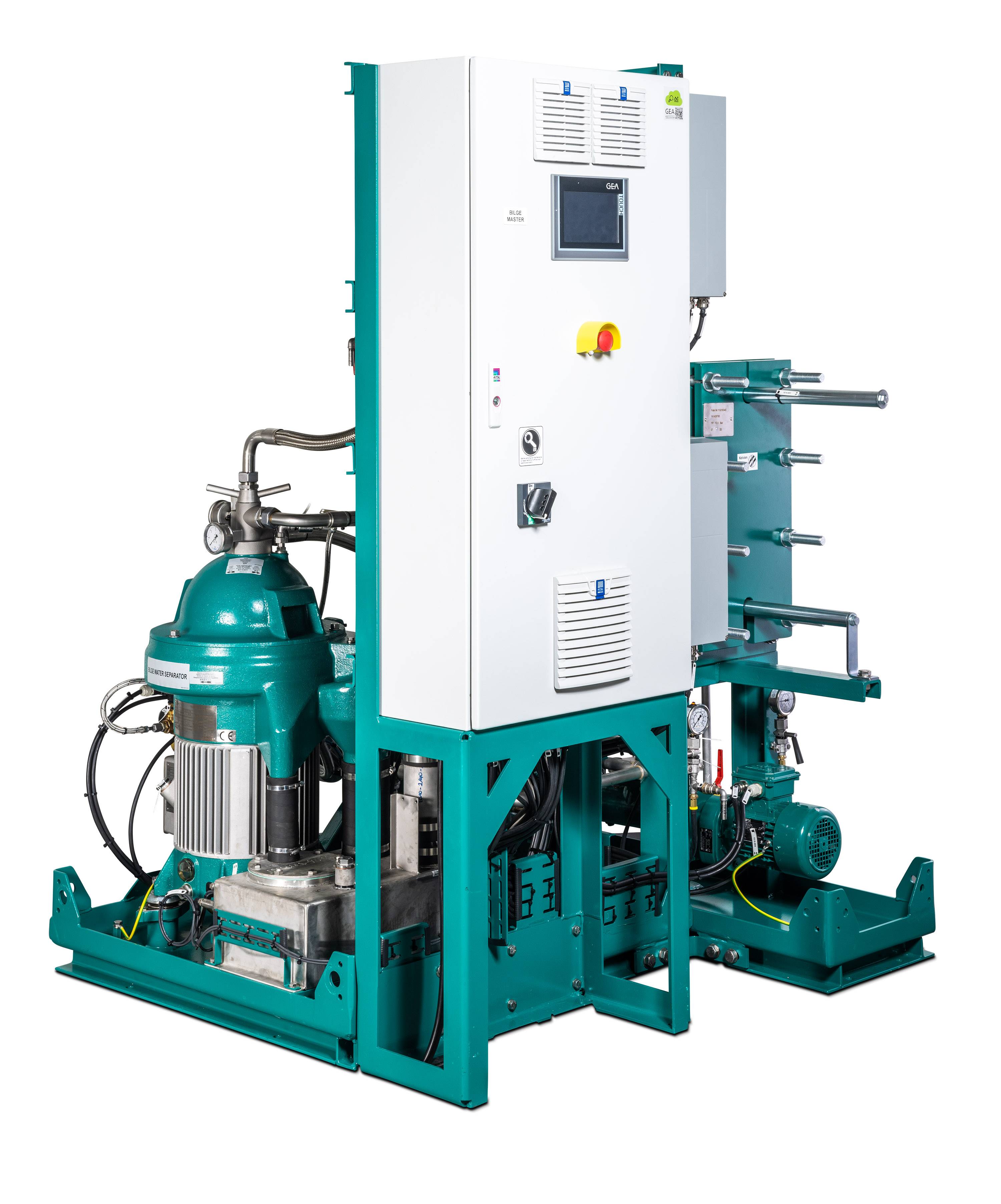
- Area: Sampling point integrity and representativenessCheck: Verify sampling point is in vertical section of effluent piping near OWS outlet, with adequate pressure (≥0.2 bar) and flow rate (≥3 l/min). Check piping is sealed, inspect for tampering or bypass valves. Verify sample line has no isolation points.
- Area: 15ppm bilge alarm accuracy and response timeCheck: Test alarm calibration within ±5 ppm accuracy. Verify response time ≤5 seconds for alarm activation. Test automatic overboard discharge valve closure within ≤20 seconds total. Check alarm has audible/visual indication. Verify alarm stores operational data (date, time, status) for minimum 18 months.
- Area: Coalescer and filter element condition and replacementCheck: Inspect coalescer for blockage, degradation, or sediment accumulation. Check filter elements for fouling or clogging (service life typically 1-2 years). Verify replacement schedule compliance. Inspect internal seals and gaskets for integrity. Check heater elements (if equipped) for corrosion or scaling.
- Area: Oil content monitor (OCM) calibration and functionalityCheck: Verify OCM calibration by manufacturer or authorized agent within 5-year intervals. Test with clean water supply to measuring cell. Confirm sensor precision for oil content regulation. Check OCM display/recording function. Test bypass activation when oil content <threshold. Confirm cell replacement after 5 years of service.
- Area: Separator tank condition, sludge, and sediment accumulationCheck: Inspect separation chambers for cleanliness, oil residue, and water level sensors. Check for sludge or emulsion buildup at tank bottom. Verify automatic sludge/oil discharge valve operation. Test level sensors and transfer solenoid valves. Confirm oil recovery system functioning and recovered oil properly disposed.
Typ-universelle Inspektionspunkte fuer Oily Water Separator (15ppm) (verifiziert, 2026-06).

- Area: Inspection of oil content in discharge (Overboard Monitor): ensure that the 15-ppm limit value is met; calibration and functional test of the ORB (Oil RecoCheck: Inspection of oil content in discharge (Overboard Monitor): ensure that the 15-ppm limit value is met; calibration and functional test of the ORB (Oil Record Book)-relevant oil content monitor according to IMO MEPC 107(49).
- Area: Inspection and cleaning of separator disc stack (Disc Stack / Bowl): check deposits, crusting or corrosion on discs and drum; in self-cleaningCheck: Inspection and cleaning of separator disc stack (Disc Stack / Bowl): check deposits, crusting or corrosion on discs and drum; in self-cleaning designs (self-desludging) check desludging valves and seals.
- Area: Inspection of preheating (Preheater): check temperature control and heating capacity; verify operating temperature at setpoint (typically 60–85 °C), sinceCheck: Inspection of preheating (Preheater): check temperature control and heating capacity; verify operating temperature at setpoint (typically 60–85 °C), since separation performance is temperature-dependent.
- Area: Condition inspection of seals, O-rings and wear parts: particularly drum seals, desludging valve seals and centering seal componentsCheck: Condition inspection of seals, O-rings and wear parts: particularly drum seals, desludging valve seals and centering seal components for wear and leaks; observe manufacturer intervals.
- Area: Functional test of automatic filter (Auto-filter): test backflush filter upstream of separator for blockage and proper backflush function; check filterCheck: Functional test of automatic filter (Auto-filter): test backflush filter upstream of separator for blockage and proper backflush function; check filter screen for damage.
- Area: Inspection of feed pump (Feed Pump): check delivery rate, pressure and leakage; inspect condition of mechanical seal and impeller; note signs of cavitationCheck: Inspection of feed pump (Feed Pump): check delivery rate, pressure and leakage; inspect condition of mechanical seal and impeller; note signs of cavitation.
- Area: Inspection of drive unit (Direct drive / Belt drive): For direct drive: check motor bearings, vibrations and operating temperature. For belt driveCheck: Inspection of drive unit (Direct drive / Belt drive): For direct drive: check motor bearings, vibrations and operating temperature. For belt drive: check belt tension, wear and pulleys.
- Area: Documentation and entry in oil record book (Oil Record Book): ensure that all operating hours, desludging operations, discharges and overboard dischargesCheck: Documentation and entry in the Oil Record Book: Ensure that all operating hours, sludging operations, discharges and overboard drainage are correctly recorded; verify function of the SafetyMaster / Overboard valve and its blocking logic.
Typ-universelle Inspektionspunkte fuer Oily Water Separator (verifiziert, 2026-06).
- Area: Inspection of oil content in discharge (Overboard Monitor): ensure that the 15-ppm limit value is met; calibration and functional test of the ORB (Oil RecoCheck: Inspection of oil content in discharge (Overboard Monitor): ensure that the 15-ppm limit value is met; calibration and functional test of the ORB (Oil Record Book)-relevant oil content monitor according to IMO MEPC 107(49).
- Area: Inspection and cleaning of separator disc stack (Disc Stack / Bowl): check deposits, crusting or corrosion on discs and drum; in self-cleaningCheck: Inspection and cleaning of separator disc stack (Disc Stack / Bowl): check deposits, crusting or corrosion on discs and drum; in self-cleaning designs (self-desludging) check desludging valves and seals.
- Area: Inspection of preheating (Preheater): check temperature control and heating capacity; verify operating temperature at setpoint (typically 60–85 °C), sinceCheck: Inspection of preheating (Preheater): check temperature control and heating capacity; verify operating temperature at setpoint (typically 60–85 °C), since separation performance is temperature-dependent.
- Area: Condition inspection of seals, O-rings and wear parts: particularly drum seals, desludging valve seals and centering seal componentsCheck: Condition inspection of seals, O-rings and wear parts: particularly drum seals, desludging valve seals and centering seal components for wear and leaks; observe manufacturer intervals.
- Area: Functional test of automatic filter (Auto-filter): test backflush filter upstream of separator for blockage and proper backflush function; check filterCheck: Functional test of automatic filter (Auto-filter): test backflush filter upstream of separator for blockage and proper backflush function; check filter screen for damage.
- Area: Inspection of feed pump (Feed Pump): check delivery rate, pressure and leakage; inspect condition of mechanical seal and impeller; note signs of cavitationCheck: Inspection of feed pump (Feed Pump): check delivery rate, pressure and leakage; inspect condition of mechanical seal and impeller; note signs of cavitation.
- Area: Inspection of drive unit (Direct drive / Belt drive): For direct drive: check motor bearings, vibrations and operating temperature. For belt driveCheck: Inspection of drive unit (Direct drive / Belt drive): For direct drive: check motor bearings, vibrations and operating temperature. For belt drive: check belt tension, wear and pulleys.
- Area: Documentation and entry in oil record book (Oil Record Book): ensure that all operating hours, desludging operations, discharges and overboard dischargesCheck: Documentation and entry in the Oil Record Book: Ensure that all operating hours, sludging operations, discharges and overboard drainage are correctly recorded; verify function of the SafetyMaster / Overboard valve and its blocking logic.
Typ-universelle Inspektionspunkte fuer Oily Water Separator (verifiziert, 2026-06).

- Area: Inspection of oil content in discharge (Overboard Monitor): ensure that the 15-ppm limit value is met; calibration and functional test of the ORB (Oil RecoCheck: Inspection of oil content in discharge (Overboard Monitor): ensure that the 15-ppm limit value is met; calibration and functional test of the ORB (Oil Record Book)-relevant oil content monitor according to IMO MEPC 107(49).
- Area: Inspection and cleaning of separator disc stack (Disc Stack / Bowl): check deposits, crusting or corrosion on discs and drum; in self-cleaningCheck: Inspection and cleaning of separator disc stack (Disc Stack / Bowl): check deposits, crusting or corrosion on discs and drum; in self-cleaning designs (self-desludging) check desludging valves and seals.
- Area: Inspection of preheating (Preheater): check temperature control and heating capacity; verify operating temperature at setpoint (typically 60–85 °C), sinceCheck: Inspection of preheating (Preheater): check temperature control and heating capacity; verify operating temperature at setpoint (typically 60–85 °C), since separation performance is temperature-dependent.
- Area: Condition inspection of seals, O-rings and wear parts: particularly drum seals, desludging valve seals and centering seal componentsCheck: Condition inspection of seals, O-rings and wear parts: particularly drum seals, desludging valve seals and centering seal components for wear and leaks; observe manufacturer intervals.
- Area: Functional test of automatic filter (Auto-filter): test backflush filter upstream of separator for blockage and proper backflush function; check filterCheck: Functional test of automatic filter (Auto-filter): test backflush filter upstream of separator for blockage and proper backflush function; check filter screen for damage.
- Area: Inspection of feed pump (Feed Pump): check delivery rate, pressure and leakage; inspect condition of mechanical seal and impeller; note signs of cavitationCheck: Inspection of feed pump (Feed Pump): check delivery rate, pressure and leakage; inspect condition of mechanical seal and impeller; note signs of cavitation.
- Area: Inspection of drive unit (Direct drive / Belt drive): For direct drive: check motor bearings, vibrations and operating temperature. For belt driveCheck: Inspection of drive unit (Direct drive / Belt drive): For direct drive: check motor bearings, vibrations and operating temperature. For belt drive: check belt tension, wear and pulleys.
- Area: Documentation and entry in oil record book (Oil Record Book): ensure that all operating hours, desludging operations, discharges and overboard dischargesCheck: Documentation and entry in the Oil Record Book: Ensure that all operating hours, sludging operations, discharges and overboard drainage are correctly recorded; verify function of the SafetyMaster / Overboard valve and its blocking logic.
Typ-universelle Inspektionspunkte fuer Oily Water Separator (verifiziert, 2026-06).
Wärtsilä
42- Filter, membrane, separator or treatment-stage fouling caused by solids, oil, scale or biological contamination can reduce throughput and increase differential pressure
- Pump or valve faults caused by wear, blockage or actuator problems can cause low flow, unstable pressure or failure to complete an operating sequence
- Sensor or monitor contamination caused by dirty process fluid or poor maintenance can produce implausible readings, alarms or automatic discharge inhibition
- Seal, gasket or piping leakage caused by corrosion, ageing or vibration can lead to visible leakage, air ingress or loss of process pressure
- Control or treatment-component failure caused by electrical faults, lamp or cell deterioration where fitted, or software issues can lead to shutdown or inability to meet the required treatment condition
- Filter, membrane, separator or treatment-stage fouling caused by solids, oil, scale or biological contamination can reduce throughput and increase differential pressure
- Pump or valve faults caused by wear, blockage or actuator problems can cause low flow, unstable pressure or failure to complete an operating sequence
- Sensor or monitor contamination caused by dirty process fluid or poor maintenance can produce implausible readings, alarms or automatic discharge inhibition
- Seal, gasket or piping leakage caused by corrosion, ageing or vibration can lead to visible leakage, air ingress or loss of process pressure
- Control or treatment-component failure caused by electrical faults, lamp or cell deterioration where fitted, or software issues can lead to shutdown or inability to meet the required treatment condition
- Filter, membrane, separator or treatment-stage fouling caused by solids, oil, scale or biological contamination can reduce throughput and increase differential pressure
- Pump or valve faults caused by wear, blockage or actuator problems can cause low flow, unstable pressure or failure to complete an operating sequence
- Sensor or monitor contamination caused by dirty process fluid or poor maintenance can produce implausible readings, alarms or automatic discharge inhibition
- Seal, gasket or piping leakage caused by corrosion, ageing or vibration can lead to visible leakage, air ingress or loss of process pressure
- Control or treatment-component failure caused by electrical faults, lamp or cell deterioration where fitted, or software issues can lead to shutdown or inability to meet the required treatment condition
- Coalescer, filter, or separation-stage fouling from sludge and solids raises pressure drop, reduces throughput, or causes poor separation
- Oil-content monitor contamination, calibration drift, or sampling-line blockage causes unstable readings, alarms, or diversion despite apparently clean water
- Valve, solenoid, or automatic stopping-device faults from sticking, air failure, or electrical problems prevent correct recirculation or overboard control
- Feed-pump wear, air ingress, or suction blockage causes low flow, loss of prime, cavitation, or inability to process the bilge tank
- Excessive emulsified oil, detergents, chemicals, or unsuitable bilge composition overwhelms separation performance and results in persistently high oil-content readings
- Coalescer, filter, or separation-stage fouling from sludge and solids raises pressure drop, reduces throughput, or causes poor separation
- Oil-content monitor contamination, calibration drift, or sampling-line blockage causes unstable readings, alarms, or diversion despite apparently clean water
- Valve, solenoid, or automatic stopping-device faults from sticking, air failure, or electrical problems prevent correct recirculation or overboard control
- Feed-pump wear, air ingress, or suction blockage causes low flow, loss of prime, cavitation, or inability to process the bilge tank
- Excessive emulsified oil, detergents, chemicals, or unsuitable bilge composition overwhelms separation performance and results in persistently high oil-content readings
- Coalescer, filter, or separation-stage fouling from sludge and solids raises pressure drop, reduces throughput, or causes poor separation
- Oil-content monitor contamination, calibration drift, or sampling-line blockage causes unstable readings, alarms, or diversion despite apparently clean water
- Valve, solenoid, or automatic stopping-device faults from sticking, air failure, or electrical problems prevent correct recirculation or overboard control
- Feed-pump wear, air ingress, or suction blockage causes low flow, loss of prime, cavitation, or inability to process the bilge tank
- Excessive emulsified oil, detergents, chemicals, or unsuitable bilge composition overwhelms separation performance and results in persistently high oil-content readings
- Coalescer, filter, or separation-stage fouling from sludge and solids raises pressure drop, reduces throughput, or causes poor separation
- Oil-content monitor contamination, calibration drift, or sampling-line blockage causes unstable readings, alarms, or diversion despite apparently clean water
- Valve, solenoid, or automatic stopping-device faults from sticking, air failure, or electrical problems prevent correct recirculation or overboard control
- Feed-pump wear, air ingress, or suction blockage causes low flow, loss of prime, cavitation, or inability to process the bilge tank
- Excessive emulsified oil, detergents, chemicals, or unsuitable bilge composition overwhelms separation performance and results in persistently high oil-content readings
- Coalescer, filter, or separation-stage fouling from sludge and solids raises pressure drop, reduces throughput, or causes poor separation
- Oil-content monitor contamination, calibration drift, or sampling-line blockage causes unstable readings, alarms, or diversion despite apparently clean water
- Valve, solenoid, or automatic stopping-device faults from sticking, air failure, or electrical problems prevent correct recirculation or overboard control
- Feed-pump wear, air ingress, or suction blockage causes low flow, loss of prime, cavitation, or inability to process the bilge tank
- Excessive emulsified oil, detergents, chemicals, or unsuitable bilge composition overwhelms separation performance and results in persistently high oil-content readings
- Filter, membrane, separator or treatment-stage fouling caused by solids, oil, scale or biological contamination can reduce throughput and increase differential pressure
- Pump or valve faults caused by wear, blockage or actuator problems can cause low flow, unstable pressure or failure to complete an operating sequence
- Sensor or monitor contamination caused by dirty process fluid or poor maintenance can produce implausible readings, alarms or automatic discharge inhibition
- Seal, gasket or piping leakage caused by corrosion, ageing or vibration can lead to visible leakage, air ingress or loss of process pressure
- Control or treatment-component failure caused by electrical faults, lamp or cell deterioration where fitted, or software issues can lead to shutdown or inability to meet the required treatment condition
- Filter, membrane, separator or treatment-stage fouling caused by solids, oil, scale or biological contamination can reduce throughput and increase differential pressure
- Pump or valve faults caused by wear, blockage or actuator problems can cause low flow, unstable pressure or failure to complete an operating sequence
- Sensor or monitor contamination caused by dirty process fluid or poor maintenance can produce implausible readings, alarms or automatic discharge inhibition
- Seal, gasket or piping leakage caused by corrosion, ageing or vibration can lead to visible leakage, air ingress or loss of process pressure
- Control or treatment-component failure caused by electrical faults, lamp or cell deterioration where fitted, or software issues can lead to shutdown or inability to meet the required treatment condition
- Filter, membrane, separator or treatment-stage fouling caused by solids, oil, scale or biological contamination can reduce throughput and increase differential pressure
- Pump or valve faults caused by wear, blockage or actuator problems can cause low flow, unstable pressure or failure to complete an operating sequence
- Sensor or monitor contamination caused by dirty process fluid or poor maintenance can produce implausible readings, alarms or automatic discharge inhibition
- Seal, gasket or piping leakage caused by corrosion, ageing or vibration can lead to visible leakage, air ingress or loss of process pressure
- Control or treatment-component failure caused by electrical faults, lamp or cell deterioration where fitted, or software issues can lead to shutdown or inability to meet the required treatment condition
- Filter, membrane, separator or treatment-stage fouling caused by solids, oil, scale or biological contamination can reduce throughput and increase differential pressure
- Pump or valve faults caused by wear, blockage or actuator problems can cause low flow, unstable pressure or failure to complete an operating sequence
- Sensor or monitor contamination caused by dirty process fluid or poor maintenance can produce implausible readings, alarms or automatic discharge inhibition
- Seal, gasket or piping leakage caused by corrosion, ageing or vibration can lead to visible leakage, air ingress or loss of process pressure
- Control or treatment-component failure caused by electrical faults, lamp or cell deterioration where fitted, or software issues can lead to shutdown or inability to meet the required treatment condition
- Filter, membrane, separator or treatment-stage fouling caused by solids, oil, scale or biological contamination can reduce throughput and increase differential pressure
- Pump or valve faults caused by wear, blockage or actuator problems can cause low flow, unstable pressure or failure to complete an operating sequence
- Sensor or monitor contamination caused by dirty process fluid or poor maintenance can produce implausible readings, alarms or automatic discharge inhibition
- Seal, gasket or piping leakage caused by corrosion, ageing or vibration can lead to visible leakage, air ingress or loss of process pressure
- Control or treatment-component failure caused by electrical faults, lamp or cell deterioration where fitted, or software issues can lead to shutdown or inability to meet the required treatment condition
- Coalescer, filter, or separation-stage fouling from sludge and solids raises pressure drop, reduces throughput, or causes poor separation
- Oil-content monitor contamination, calibration drift, or sampling-line blockage causes unstable readings, alarms, or diversion despite apparently clean water
- Valve, solenoid, or automatic stopping-device faults from sticking, air failure, or electrical problems prevent correct recirculation or overboard control
- Feed-pump wear, air ingress, or suction blockage causes low flow, loss of prime, cavitation, or inability to process the bilge tank
- Excessive emulsified oil, detergents, chemicals, or unsuitable bilge composition overwhelms separation performance and results in persistently high oil-content readings
- Coalescer, filter, or separation-stage fouling from sludge and solids raises pressure drop, reduces throughput, or causes poor separation
- Oil-content monitor contamination, calibration drift, or sampling-line blockage causes unstable readings, alarms, or diversion despite apparently clean water
- Valve, solenoid, or automatic stopping-device faults from sticking, air failure, or electrical problems prevent correct recirculation or overboard control
- Feed-pump wear, air ingress, or suction blockage causes low flow, loss of prime, cavitation, or inability to process the bilge tank
- Excessive emulsified oil, detergents, chemicals, or unsuitable bilge composition overwhelms separation performance and results in persistently high oil-content readings
- Coalescer, filter, or separation-stage fouling from sludge and solids raises pressure drop, reduces throughput, or causes poor separation
- Oil-content monitor contamination, calibration drift, or sampling-line blockage causes unstable readings, alarms, or diversion despite apparently clean water
- Valve, solenoid, or automatic stopping-device faults from sticking, air failure, or electrical problems prevent correct recirculation or overboard control
- Feed-pump wear, air ingress, or suction blockage causes low flow, loss of prime, cavitation, or inability to process the bilge tank
- Excessive emulsified oil, detergents, chemicals, or unsuitable bilge composition overwhelms separation performance and results in persistently high oil-content readings
- Coalescer, filter or separation-stage fouling causes rising oil-content readings or automatic recirculation
- Oil-content monitor contamination or blocked sampling lines cause unstable readings, alarms or discharge shutdown
- Diverting-valve or solenoid faults prevent correct recirculation and cause sequence alarms
- Feed-pump seal wear or suction-side air ingress causes unstable flow or poor separation
- Detergents or stable emulsions overwhelm the process and cause persistent high oil-content readings
- Coalescer, filter or separation-stage fouling causes rising oil-content readings or automatic recirculation
- Oil-content monitor contamination or blocked sampling lines cause unstable readings, alarms or discharge shutdown
- Diverting-valve or solenoid faults prevent correct recirculation and cause sequence alarms
- Feed-pump seal wear or suction-side air ingress causes unstable flow or poor separation
- Detergents or stable emulsions overwhelm the process and cause persistent high oil-content readings
- Coalescer, filter or separation-stage fouling causes rising oil-content readings or automatic recirculation
- Oil-content monitor contamination or blocked sampling lines cause unstable readings, alarms or discharge shutdown
- Diverting-valve or solenoid faults prevent correct recirculation and cause sequence alarms
- Feed-pump seal wear or suction-side air ingress causes unstable flow or poor separation
- Detergents or stable emulsions overwhelm the process and cause persistent high oil-content readings
- Coalescer, filter or separation-stage fouling causes rising oil-content readings or automatic recirculation
- Oil-content monitor contamination or blocked sampling lines cause unstable readings, alarms or discharge shutdown
- Diverting-valve or solenoid faults prevent correct recirculation and cause sequence alarms
- Feed-pump seal wear or suction-side air ingress causes unstable flow or poor separation
- Detergents or stable emulsions overwhelm the process and cause persistent high oil-content readings
- Coalescer, filter or separation-stage fouling causes rising oil-content readings or automatic recirculation
- Oil-content monitor contamination or blocked sampling lines cause unstable readings, alarms or discharge shutdown
- Diverting-valve or solenoid faults prevent correct recirculation and cause sequence alarms
- Feed-pump seal wear or suction-side air ingress causes unstable flow or poor separation
- Detergents or stable emulsions overwhelm the process and cause persistent high oil-content readings
- Coalescer, filter, or separation-stage fouling from sludge and solids raises pressure drop, reduces throughput, or causes poor separation
- Oil-content monitor contamination, calibration drift, or sampling-line blockage causes unstable readings, alarms, or diversion despite apparently clean water
- Valve, solenoid, or automatic stopping-device faults from sticking, air failure, or electrical problems prevent correct recirculation or overboard control
- Feed-pump wear, air ingress, or suction blockage causes low flow, loss of prime, cavitation, or inability to process the bilge tank
- Excessive emulsified oil, detergents, chemicals, or unsuitable bilge composition overwhelms separation performance and results in persistently high oil-content readings
- Coalescer, filter, or separation-stage fouling from sludge and solids raises pressure drop, reduces throughput, or causes poor separation
- Oil-content monitor contamination, calibration drift, or sampling-line blockage causes unstable readings, alarms, or diversion despite apparently clean water
- Valve, solenoid, or automatic stopping-device faults from sticking, air failure, or electrical problems prevent correct recirculation or overboard control
- Feed-pump wear, air ingress, or suction blockage causes low flow, loss of prime, cavitation, or inability to process the bilge tank
- Excessive emulsified oil, detergents, chemicals, or unsuitable bilge composition overwhelms separation performance and results in persistently high oil-content readings
- Coalescer, filter, or separation-stage fouling from sludge and solids raises pressure drop, reduces throughput, or causes poor separation
- Oil-content monitor contamination, calibration drift, or sampling-line blockage causes unstable readings, alarms, or diversion despite apparently clean water
- Valve, solenoid, or automatic stopping-device faults from sticking, air failure, or electrical problems prevent correct recirculation or overboard control
- Feed-pump wear, air ingress, or suction blockage causes low flow, loss of prime, cavitation, or inability to process the bilge tank
- Excessive emulsified oil, detergents, chemicals, or unsuitable bilge composition overwhelms separation performance and results in persistently high oil-content readings
- Coalescer, filter, or separation-stage fouling from sludge and solids raises pressure drop, reduces throughput, or causes poor separation
- Oil-content monitor contamination, calibration drift, or sampling-line blockage causes unstable readings, alarms, or diversion despite apparently clean water
- Valve, solenoid, or automatic stopping-device faults from sticking, air failure, or electrical problems prevent correct recirculation or overboard control
- Feed-pump wear, air ingress, or suction blockage causes low flow, loss of prime, cavitation, or inability to process the bilge tank
- Excessive emulsified oil, detergents, chemicals, or unsuitable bilge composition overwhelms separation performance and results in persistently high oil-content readings
- Coalescer, filter, or separation-stage fouling from sludge and solids raises pressure drop, reduces throughput, or causes poor separation
- Oil-content monitor contamination, calibration drift, or sampling-line blockage causes unstable readings, alarms, or diversion despite apparently clean water
- Valve, solenoid, or automatic stopping-device faults from sticking, air failure, or electrical problems prevent correct recirculation or overboard control
- Feed-pump wear, air ingress, or suction blockage causes low flow, loss of prime, cavitation, or inability to process the bilge tank
- Excessive emulsified oil, detergents, chemicals, or unsuitable bilge composition overwhelms separation performance and results in persistently high oil-content readings
- Separation-element fouling caused by sludge, detergents or excessive oil loading, resulting in poor separation and repeated high-oil-content alarms
- Oil-content monitor contamination or calibration drift caused by dirty sample lines or sensor fouling, resulting in unstable or implausible readings
- Automatic recirculation or discharge-valve failure caused by actuator, solenoid or control faults, resulting in inability to route off-specification water correctly
- Feed-pump or suction problems caused by blockage, air ingress or pump wear, resulting in unstable flow and poor separator performance
- Internal leakage or bypassing caused by damaged seals, incorrect assembly or unauthorized piping changes, resulting in non-compliant operation or abnormal sample results
- Coalescer, filter, or separation-stage fouling from sludge and solids raises pressure drop, reduces throughput, or causes poor separation
- Oil-content monitor contamination, calibration drift, or sampling-line blockage causes unstable readings, alarms, or diversion despite apparently clean water
- Valve, solenoid, or automatic stopping-device faults from sticking, air failure, or electrical problems prevent correct recirculation or overboard control
- Feed-pump wear, air ingress, or suction blockage causes low flow, loss of prime, cavitation, or inability to process the bilge tank
- Excessive emulsified oil, detergents, chemicals, or unsuitable bilge composition overwhelms separation performance and results in persistently high oil-content readings
- Coalescer, filter, or separation-stage fouling from sludge and solids raises pressure drop, reduces throughput, or causes poor separation
- Oil-content monitor contamination, calibration drift, or sampling-line blockage causes unstable readings, alarms, or diversion despite apparently clean water
- Valve, solenoid, or automatic stopping-device faults from sticking, air failure, or electrical problems prevent correct recirculation or overboard control
- Feed-pump wear, air ingress, or suction blockage causes low flow, loss of prime, cavitation, or inability to process the bilge tank
- Excessive emulsified oil, detergents, chemicals, or unsuitable bilge composition overwhelms separation performance and results in persistently high oil-content readings
- Coalescer, filter, or separation-stage fouling from sludge and solids raises pressure drop, reduces throughput, or causes poor separation
- Oil-content monitor contamination, calibration drift, or sampling-line blockage causes unstable readings, alarms, or diversion despite apparently clean water
- Valve, solenoid, or automatic stopping-device faults from sticking, air failure, or electrical problems prevent correct recirculation or overboard control
- Feed-pump wear, air ingress, or suction blockage causes low flow, loss of prime, cavitation, or inability to process the bilge tank
- Excessive emulsified oil, detergents, chemicals, or unsuitable bilge composition overwhelms separation performance and results in persistently high oil-content readings
- Coalescer, filter, or separation-stage fouling from sludge and solids raises pressure drop, reduces throughput, or causes poor separation
- Oil-content monitor contamination, calibration drift, or sampling-line blockage causes unstable readings, alarms, or diversion despite apparently clean water
- Valve, solenoid, or automatic stopping-device faults from sticking, air failure, or electrical problems prevent correct recirculation or overboard control
- Feed-pump wear, air ingress, or suction blockage causes low flow, loss of prime, cavitation, or inability to process the bilge tank
- Excessive emulsified oil, detergents, chemicals, or unsuitable bilge composition overwhelms separation performance and results in persistently high oil-content readings
- Coalescer, filter, or separation-stage fouling from sludge and solids raises pressure drop, reduces throughput, or causes poor separation
- Oil-content monitor contamination, calibration drift, or sampling-line blockage causes unstable readings, alarms, or diversion despite apparently clean water
- Valve, solenoid, or automatic stopping-device faults from sticking, air failure, or electrical problems prevent correct recirculation or overboard control
- Feed-pump wear, air ingress, or suction blockage causes low flow, loss of prime, cavitation, or inability to process the bilge tank
- Excessive emulsified oil, detergents, chemicals, or unsuitable bilge composition overwhelms separation performance and results in persistently high oil-content readings
- Coalescer, filter, or separation-stage fouling from sludge and solids raises pressure drop, reduces throughput, or causes poor separation
- Oil-content monitor contamination, calibration drift, or sampling-line blockage causes unstable readings, alarms, or diversion despite apparently clean water
- Valve, solenoid, or automatic stopping-device faults from sticking, air failure, or electrical problems prevent correct recirculation or overboard control
- Feed-pump wear, air ingress, or suction blockage causes low flow, loss of prime, cavitation, or inability to process the bilge tank
- Excessive emulsified oil, detergents, chemicals, or unsuitable bilge composition overwhelms separation performance and results in persistently high oil-content readings
- Coalescer, filter, or separation-stage fouling from sludge and solids raises pressure drop, reduces throughput, or causes poor separation
- Oil-content monitor contamination, calibration drift, or sampling-line blockage causes unstable readings, alarms, or diversion despite apparently clean water
- Valve, solenoid, or automatic stopping-device faults from sticking, air failure, or electrical problems prevent correct recirculation or overboard control
- Feed-pump wear, air ingress, or suction blockage causes low flow, loss of prime, cavitation, or inability to process the bilge tank
- Excessive emulsified oil, detergents, chemicals, or unsuitable bilge composition overwhelms separation performance and results in persistently high oil-content readings
- Separation-element fouling caused by sludge, detergents or excessive oil loading, resulting in poor separation and repeated high-oil-content alarms
- Oil-content monitor contamination or calibration drift caused by dirty sample lines or sensor fouling, resulting in unstable or implausible readings
- Automatic recirculation or discharge-valve failure caused by actuator, solenoid or control faults, resulting in inability to route off-specification water correctly
- Feed-pump or suction problems caused by blockage, air ingress or pump wear, resulting in unstable flow and poor separator performance
- Internal leakage or bypassing caused by damaged seals, incorrect assembly or unauthorized piping changes, resulting in non-compliant operation or abnormal sample results
- Separation-element fouling caused by sludge, detergents or excessive oil loading, resulting in poor separation and repeated high-oil-content alarms
- Oil-content monitor contamination or calibration drift caused by dirty sample lines or sensor fouling, resulting in unstable or implausible readings
- Automatic recirculation or discharge-valve failure caused by actuator, solenoid or control faults, resulting in inability to route off-specification water correctly
- Feed-pump or suction problems caused by blockage, air ingress or pump wear, resulting in unstable flow and poor separator performance
- Internal leakage or bypassing caused by damaged seals, incorrect assembly or unauthorized piping changes, resulting in non-compliant operation or abnormal sample results
- Separation-element fouling caused by sludge, detergents or excessive oil loading, resulting in poor separation and repeated high-oil-content alarms
- Oil-content monitor contamination or calibration drift caused by dirty sample lines or sensor fouling, resulting in unstable or implausible readings
- Automatic recirculation or discharge-valve failure caused by actuator, solenoid or control faults, resulting in inability to route off-specification water correctly
- Feed-pump or suction problems caused by blockage, air ingress or pump wear, resulting in unstable flow and poor separator performance
- Internal leakage or bypassing caused by damaged seals, incorrect assembly or unauthorized piping changes, resulting in non-compliant operation or abnormal sample results
- Separation-element fouling caused by sludge, detergents or excessive oil loading, resulting in poor separation and repeated high-oil-content alarms
- Oil-content monitor contamination or calibration drift caused by dirty sample lines or sensor fouling, resulting in unstable or implausible readings
- Automatic recirculation or discharge-valve failure caused by actuator, solenoid or control faults, resulting in inability to route off-specification water correctly
- Feed-pump or suction problems caused by blockage, air ingress or pump wear, resulting in unstable flow and poor separator performance
- Internal leakage or bypassing caused by damaged seals, incorrect assembly or unauthorized piping changes, resulting in non-compliant operation or abnormal sample results
- Area: Sampling point integrity and representativenessCheck: Verify sampling point is in vertical section of effluent piping near OWS outlet, with adequate pressure (≥0.2 bar) and flow rate (≥3 l/min). Check piping is sealed, inspect for tampering or bypass valves. Verify sample line has no isolation points.
- Area: 15ppm bilge alarm accuracy and response timeCheck: Test alarm calibration within ±5 ppm accuracy. Verify response time ≤5 seconds for alarm activation. Test automatic overboard discharge valve closure within ≤20 seconds total. Check alarm has audible/visual indication. Verify alarm stores operational data (date, time, status) for minimum 18 months.
- Area: Coalescer and filter element condition and replacementCheck: Inspect coalescer for blockage, degradation, or sediment accumulation. Check filter elements for fouling or clogging (service life typically 1-2 years). Verify replacement schedule compliance. Inspect internal seals and gaskets for integrity. Check heater elements (if equipped) for corrosion or scaling.
- Area: Oil content monitor (OCM) calibration and functionalityCheck: Verify OCM calibration by manufacturer or authorized agent within 5-year intervals. Test with clean water supply to measuring cell. Confirm sensor precision for oil content regulation. Check OCM display/recording function. Test bypass activation when oil content <threshold. Confirm cell replacement after 5 years of service.
- Area: Separator tank condition, sludge, and sediment accumulationCheck: Inspect separation chambers for cleanliness, oil residue, and water level sensors. Check for sludge or emulsion buildup at tank bottom. Verify automatic sludge/oil discharge valve operation. Test level sensors and transfer solenoid valves. Confirm oil recovery system functioning and recovered oil properly disposed.
Typ-universelle Inspektionspunkte fuer Oily Water Separator (15ppm) (verifiziert, 2026-06).
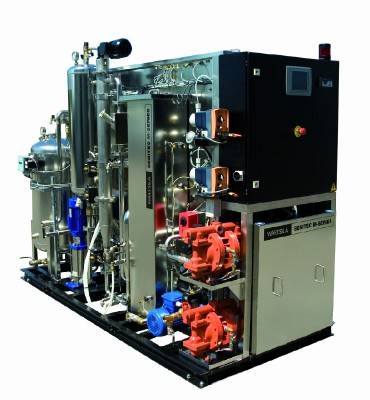
- Area: Sampling point integrity and representativenessCheck: Verify sampling point is in vertical section of effluent piping near OWS outlet, with adequate pressure (≥0.2 bar) and flow rate (≥3 l/min). Check piping is sealed, inspect for tampering or bypass valves. Verify sample line has no isolation points.
- Area: 15ppm bilge alarm accuracy and response timeCheck: Test alarm calibration within ±5 ppm accuracy. Verify response time ≤5 seconds for alarm activation. Test automatic overboard discharge valve closure within ≤20 seconds total. Check alarm has audible/visual indication. Verify alarm stores operational data (date, time, status) for minimum 18 months.
- Area: Coalescer and filter element condition and replacementCheck: Inspect coalescer for blockage, degradation, or sediment accumulation. Check filter elements for fouling or clogging (service life typically 1-2 years). Verify replacement schedule compliance. Inspect internal seals and gaskets for integrity. Check heater elements (if equipped) for corrosion or scaling.
- Area: Oil content monitor (OCM) calibration and functionalityCheck: Verify OCM calibration by manufacturer or authorized agent within 5-year intervals. Test with clean water supply to measuring cell. Confirm sensor precision for oil content regulation. Check OCM display/recording function. Test bypass activation when oil content <threshold. Confirm cell replacement after 5 years of service.
- Area: Separator tank condition, sludge, and sediment accumulationCheck: Inspect separation chambers for cleanliness, oil residue, and water level sensors. Check for sludge or emulsion buildup at tank bottom. Verify automatic sludge/oil discharge valve operation. Test level sensors and transfer solenoid valves. Confirm oil recovery system functioning and recovered oil properly disposed.
Typ-universelle Inspektionspunkte fuer Oily Water Separator (15ppm) (verifiziert, 2026-06).
- Area: Sampling point integrity and representativenessCheck: Verify sampling point is in vertical section of effluent piping near OWS outlet, with adequate pressure (≥0.2 bar) and flow rate (≥3 l/min). Check piping is sealed, inspect for tampering or bypass valves. Verify sample line has no isolation points.
- Area: 15ppm bilge alarm accuracy and response timeCheck: Test alarm calibration within ±5 ppm accuracy. Verify response time ≤5 seconds for alarm activation. Test automatic overboard discharge valve closure within ≤20 seconds total. Check alarm has audible/visual indication. Verify alarm stores operational data (date, time, status) for minimum 18 months.
- Area: Coalescer and filter element condition and replacementCheck: Inspect coalescer for blockage, degradation, or sediment accumulation. Check filter elements for fouling or clogging (service life typically 1-2 years). Verify replacement schedule compliance. Inspect internal seals and gaskets for integrity. Check heater elements (if equipped) for corrosion or scaling.
- Area: Oil content monitor (OCM) calibration and functionalityCheck: Verify OCM calibration by manufacturer or authorized agent within 5-year intervals. Test with clean water supply to measuring cell. Confirm sensor precision for oil content regulation. Check OCM display/recording function. Test bypass activation when oil content <threshold. Confirm cell replacement after 5 years of service.
- Area: Separator tank condition, sludge, and sediment accumulationCheck: Inspect separation chambers for cleanliness, oil residue, and water level sensors. Check for sludge or emulsion buildup at tank bottom. Verify automatic sludge/oil discharge valve operation. Test level sensors and transfer solenoid valves. Confirm oil recovery system functioning and recovered oil properly disposed.
Typ-universelle Inspektionspunkte fuer Oily Water Separator (15ppm) (verifiziert, 2026-06).

- BOSS 0.5
- BOSS 1.0
- BOSS 2.5
- BOSS 5.0
- 0.5
- 5.0
- 1
- 5
- Coalescer cartridge clogging
- OCM fouling
- Pump seal failure
- 3-way valve actuator issues
RWO/Veolia
36- Coalescer, filter or separation-stage fouling reduces separation efficiency and causes rising oil-content readings or automatic recirculation
- Oil-content monitor contamination, blocked sampling lines or calibration drift produces unstable readings, alarms or discharge shutdown
- Diverting-valve, solenoid or actuator faults prevent correct recirculation and cause sequence alarms
- Feed-pump seal wear or suction-side air ingress causes unstable flow, poor treatment performance or visible leakage
- Detergents or stable emulsions in bilge water overload the separation process and cause persistently high oil-content readings
- Coalescer, filter or separation-stage fouling reduces separation efficiency and causes rising oil-content readings or automatic recirculation
- Oil-content monitor contamination, blocked sampling lines or calibration drift produces unstable readings, alarms or discharge shutdown
- Diverting-valve, solenoid or actuator faults prevent correct recirculation and cause sequence alarms
- Feed-pump seal wear or suction-side air ingress causes unstable flow, poor treatment performance or visible leakage
- Detergents or stable emulsions in bilge water overload the separation process and cause persistently high oil-content readings
- Separation-element fouling caused by sludge, detergents or excessive oil loading, resulting in poor separation and repeated high-oil-content alarms
- Oil-content monitor contamination or calibration drift caused by dirty sample lines or sensor fouling, resulting in unstable or implausible readings
- Automatic recirculation or discharge-valve failure caused by actuator, solenoid or control faults, resulting in inability to route off-specification water correctly
- Feed-pump or suction problems caused by blockage, air ingress or pump wear, resulting in unstable flow and poor separator performance
- Internal leakage or bypassing caused by damaged seals, incorrect assembly or unauthorized piping changes, resulting in non-compliant operation or abnormal sample results
- Separation-element fouling caused by sludge, detergents or excessive oil loading, resulting in poor separation and repeated high-oil-content alarms
- Oil-content monitor contamination or calibration drift caused by dirty sample lines or sensor fouling, resulting in unstable or implausible readings
- Automatic recirculation or discharge-valve failure caused by actuator, solenoid or control faults, resulting in inability to route off-specification water correctly
- Feed-pump or suction problems caused by blockage, air ingress or pump wear, resulting in unstable flow and poor separator performance
- Internal leakage or bypassing caused by damaged seals, incorrect assembly or unauthorized piping changes, resulting in non-compliant operation or abnormal sample results
- Separation-element fouling caused by sludge, detergents or excessive oil loading, resulting in poor separation and repeated high-oil-content alarms
- Oil-content monitor contamination or calibration drift caused by dirty sample lines or sensor fouling, resulting in unstable or implausible readings
- Automatic recirculation or discharge-valve failure caused by actuator, solenoid or control faults, resulting in inability to route off-specification water correctly
- Feed-pump or suction problems caused by blockage, air ingress or pump wear, resulting in unstable flow and poor separator performance
- Internal leakage or bypassing caused by damaged seals, incorrect assembly or unauthorized piping changes, resulting in non-compliant operation or abnormal sample results
- Separation-element fouling caused by sludge, detergents or excessive oil loading, resulting in poor separation and repeated high-oil-content alarms
- Oil-content monitor contamination or calibration drift caused by dirty sample lines or sensor fouling, resulting in unstable or implausible readings
- Automatic recirculation or discharge-valve failure caused by actuator, solenoid or control faults, resulting in inability to route off-specification water correctly
- Feed-pump or suction problems caused by blockage, air ingress or pump wear, resulting in unstable flow and poor separator performance
- Internal leakage or bypassing caused by damaged seals, incorrect assembly or unauthorized piping changes, resulting in non-compliant operation or abnormal sample results
- Separation-element fouling caused by sludge, detergents or excessive oil loading, resulting in poor separation and repeated high-oil-content alarms
- Oil-content monitor contamination or calibration drift caused by dirty sample lines or sensor fouling, resulting in unstable or implausible readings
- Automatic recirculation or discharge-valve failure caused by actuator, solenoid or control faults, resulting in inability to route off-specification water correctly
- Feed-pump or suction problems caused by blockage, air ingress or pump wear, resulting in unstable flow and poor separator performance
- Internal leakage or bypassing caused by damaged seals, incorrect assembly or unauthorized piping changes, resulting in non-compliant operation or abnormal sample results
- Separation-element fouling caused by sludge, detergents or excessive oil loading, resulting in poor separation and repeated high-oil-content alarms
- Oil-content monitor contamination or calibration drift caused by dirty sample lines or sensor fouling, resulting in unstable or implausible readings
- Automatic recirculation or discharge-valve failure caused by actuator, solenoid or control faults, resulting in inability to route off-specification water correctly
- Feed-pump or suction problems caused by blockage, air ingress or pump wear, resulting in unstable flow and poor separator performance
- Internal leakage or bypassing caused by damaged seals, incorrect assembly or unauthorized piping changes, resulting in non-compliant operation or abnormal sample results
- Separation-element fouling caused by sludge, detergents or excessive oil loading, resulting in poor separation and repeated high-oil-content alarms
- Oil-content monitor contamination or calibration drift caused by dirty sample lines or sensor fouling, resulting in unstable or implausible readings
- Automatic recirculation or discharge-valve failure caused by actuator, solenoid or control faults, resulting in inability to route off-specification water correctly
- Feed-pump or suction problems caused by blockage, air ingress or pump wear, resulting in unstable flow and poor separator performance
- Internal leakage or bypassing caused by damaged seals, incorrect assembly or unauthorized piping changes, resulting in non-compliant operation or abnormal sample results
- Coalescer, filter or separation-stage fouling reduces separation efficiency and causes rising oil-content readings or automatic recirculation
- Oil-content monitor contamination, blocked sampling lines or calibration drift produces unstable readings, alarms or discharge shutdown
- Diverting-valve, solenoid or actuator faults prevent correct recirculation and cause sequence alarms
- Feed-pump seal wear or suction-side air ingress causes unstable flow, poor treatment performance or visible leakage
- Detergents or stable emulsions in bilge water overload the separation process and cause persistently high oil-content readings
- Coalescer, filter or separation-stage fouling reduces separation efficiency and causes rising oil-content readings or automatic recirculation
- Oil-content monitor contamination, blocked sampling lines or calibration drift produces unstable readings, alarms or discharge shutdown
- Diverting-valve, solenoid or actuator faults prevent correct recirculation and cause sequence alarms
- Feed-pump seal wear or suction-side air ingress causes unstable flow, poor treatment performance or visible leakage
- Detergents or stable emulsions in bilge water overload the separation process and cause persistently high oil-content readings
- Coalescer, filter or separation-stage fouling reduces separation efficiency and causes rising oil-content readings or automatic recirculation
- Oil-content monitor contamination, blocked sampling lines or calibration drift produces unstable readings, alarms or discharge shutdown
- Diverting-valve, solenoid or actuator faults prevent correct recirculation and cause sequence alarms
- Feed-pump seal wear or suction-side air ingress causes unstable flow, poor treatment performance or visible leakage
- Detergents or stable emulsions in bilge water overload the separation process and cause persistently high oil-content readings
- Poor separation caused by excessive oil, detergents or stable emulsions, noticed as high oil-content readings or frequent recirculation
- Coalescer/filter fouling caused by sludge and solids, noticed as high differential pressure and reduced throughput
- Oil-content-monitor drift or contamination caused by dirty sample cell or sensor faults, noticed as implausible readings or failed checks
- Automatic stop/recirculation valve fault caused by actuator or control problems, noticed as incorrect valve position during high-oil alarm
- Feed-pump or suction fault caused by blockage, air ingress or wear, noticed as low or unstable treatment flow
- Unauthorized or incorrect valve lineup caused by human error or tampering, noticed from bypass evidence, broken seals or piping inconsistency
- Poor separation caused by excessive oil, detergents or stable emulsions, noticed as high oil-content readings or frequent recirculation
- Coalescer/filter fouling caused by sludge and solids, noticed as high differential pressure and reduced throughput
- Oil-content-monitor drift or contamination caused by dirty sample cell or sensor faults, noticed as implausible readings or failed checks
- Automatic stop/recirculation valve fault caused by actuator or control problems, noticed as incorrect valve position during high-oil alarm
- Feed-pump or suction fault caused by blockage, air ingress or wear, noticed as low or unstable treatment flow
- Unauthorized or incorrect valve lineup caused by human error or tampering, noticed from bypass evidence, broken seals or piping inconsistency
- Poor separation caused by excessive oil, detergents or stable emulsions, noticed as high oil-content readings or frequent recirculation
- Coalescer/filter fouling caused by sludge and solids, noticed as high differential pressure and reduced throughput
- Oil-content-monitor drift or contamination caused by dirty sample cell or sensor faults, noticed as implausible readings or failed checks
- Automatic stop/recirculation valve fault caused by actuator or control problems, noticed as incorrect valve position during high-oil alarm
- Feed-pump or suction fault caused by blockage, air ingress or wear, noticed as low or unstable treatment flow
- Unauthorized or incorrect valve lineup caused by human error or tampering, noticed from bypass evidence, broken seals or piping inconsistency
- Poor separation caused by excessive oil, detergents or stable emulsions, noticed as high oil-content readings or frequent recirculation
- Coalescer/filter fouling caused by sludge and solids, noticed as high differential pressure and reduced throughput
- Oil-content-monitor drift or contamination caused by dirty sample cell or sensor faults, noticed as implausible readings or failed checks
- Automatic stop/recirculation valve fault caused by actuator or control problems, noticed as incorrect valve position during high-oil alarm
- Feed-pump or suction fault caused by blockage, air ingress or wear, noticed as low or unstable treatment flow
- Unauthorized or incorrect valve lineup caused by human error or tampering, noticed from bypass evidence, broken seals or piping inconsistency
- Poor separation caused by excessive oil, detergents or stable emulsions, noticed as high oil-content readings or frequent recirculation
- Coalescer/filter fouling caused by sludge and solids, noticed as high differential pressure and reduced throughput
- Oil-content-monitor drift or contamination caused by dirty sample cell or sensor faults, noticed as implausible readings or failed checks
- Automatic stop/recirculation valve fault caused by actuator or control problems, noticed as incorrect valve position during high-oil alarm
- Feed-pump or suction fault caused by blockage, air ingress or wear, noticed as low or unstable treatment flow
- Unauthorized or incorrect valve lineup caused by human error or tampering, noticed from bypass evidence, broken seals or piping inconsistency
- Poor separation caused by excessive oil, detergents or stable emulsions, noticed as high oil-content readings or frequent recirculation
- Coalescer/filter fouling caused by sludge and solids, noticed as high differential pressure and reduced throughput
- Oil-content-monitor drift or contamination caused by dirty sample cell or sensor faults, noticed as implausible readings or failed checks
- Automatic stop/recirculation valve fault caused by actuator or control problems, noticed as incorrect valve position during high-oil alarm
- Feed-pump or suction fault caused by blockage, air ingress or wear, noticed as low or unstable treatment flow
- Unauthorized or incorrect valve lineup caused by human error or tampering, noticed from bypass evidence, broken seals or piping inconsistency
- Poor separation caused by excessive oil, detergents or stable emulsions, noticed as high oil-content readings or frequent recirculation
- Coalescer/filter fouling caused by sludge and solids, noticed as high differential pressure and reduced throughput
- Oil-content-monitor drift or contamination caused by dirty sample cell or sensor faults, noticed as implausible readings or failed checks
- Automatic stop/recirculation valve fault caused by actuator or control problems, noticed as incorrect valve position during high-oil alarm
- Feed-pump or suction fault caused by blockage, air ingress or wear, noticed as low or unstable treatment flow
- Unauthorized or incorrect valve lineup caused by human error or tampering, noticed from bypass evidence, broken seals or piping inconsistency
- Poor separation caused by excessive oil, detergents or stable emulsions, noticed as high oil-content readings or frequent recirculation
- Coalescer/filter fouling caused by sludge and solids, noticed as high differential pressure and reduced throughput
- Oil-content-monitor drift or contamination caused by dirty sample cell or sensor faults, noticed as implausible readings or failed checks
- Automatic stop/recirculation valve fault caused by actuator or control problems, noticed as incorrect valve position during high-oil alarm
- Feed-pump or suction fault caused by blockage, air ingress or wear, noticed as low or unstable treatment flow
- Unauthorized or incorrect valve lineup caused by human error or tampering, noticed from bypass evidence, broken seals or piping inconsistency
- Poor separation caused by excessive oil, detergents or stable emulsions, noticed as high oil-content readings or frequent recirculation
- Coalescer/filter fouling caused by sludge and solids, noticed as high differential pressure and reduced throughput
- Oil-content-monitor drift or contamination caused by dirty sample cell or sensor faults, noticed as implausible readings or failed checks
- Automatic stop/recirculation valve fault caused by actuator or control problems, noticed as incorrect valve position during high-oil alarm
- Feed-pump or suction fault caused by blockage, air ingress or wear, noticed as low or unstable treatment flow
- Unauthorized or incorrect valve lineup caused by human error or tampering, noticed from bypass evidence, broken seals or piping inconsistency
- Poor separation caused by excessive oil, detergents or stable emulsions, noticed as high oil-content readings or frequent recirculation
- Coalescer/filter fouling caused by sludge and solids, noticed as high differential pressure and reduced throughput
- Oil-content-monitor drift or contamination caused by dirty sample cell or sensor faults, noticed as implausible readings or failed checks
- Automatic stop/recirculation valve fault caused by actuator or control problems, noticed as incorrect valve position during high-oil alarm
- Feed-pump or suction fault caused by blockage, air ingress or wear, noticed as low or unstable treatment flow
- Unauthorized or incorrect valve lineup caused by human error or tampering, noticed from bypass evidence, broken seals or piping inconsistency
- Poor separation caused by excessive oil, detergents or stable emulsions, noticed as high oil-content readings or frequent recirculation
- Coalescer/filter fouling caused by sludge and solids, noticed as high differential pressure and reduced throughput
- Oil-content-monitor drift or contamination caused by dirty sample cell or sensor faults, noticed as implausible readings or failed checks
- Automatic stop/recirculation valve fault caused by actuator or control problems, noticed as incorrect valve position during high-oil alarm
- Feed-pump or suction fault caused by blockage, air ingress or wear, noticed as low or unstable treatment flow
- Unauthorized or incorrect valve lineup caused by human error or tampering, noticed from bypass evidence, broken seals or piping inconsistency
- Coalescer, filter, or separation-stage fouling from sludge and solids raises pressure drop, reduces throughput, or causes poor separation
- Oil-content monitor contamination, calibration drift, or sampling-line blockage causes unstable readings, alarms, or diversion despite apparently clean water
- Valve, solenoid, or automatic stopping-device faults from sticking, air failure, or electrical problems prevent correct recirculation or overboard control
- Feed-pump wear, air ingress, or suction blockage causes low flow, loss of prime, cavitation, or inability to process the bilge tank
- Excessive emulsified oil, detergents, chemicals, or unsuitable bilge composition overwhelms separation performance and results in persistently high oil-content readings
- Coalescer, filter, or separation-stage fouling from sludge and solids raises pressure drop, reduces throughput, or causes poor separation
- Oil-content monitor contamination, calibration drift, or sampling-line blockage causes unstable readings, alarms, or diversion despite apparently clean water
- Valve, solenoid, or automatic stopping-device faults from sticking, air failure, or electrical problems prevent correct recirculation or overboard control
- Feed-pump wear, air ingress, or suction blockage causes low flow, loss of prime, cavitation, or inability to process the bilge tank
- Excessive emulsified oil, detergents, chemicals, or unsuitable bilge composition overwhelms separation performance and results in persistently high oil-content readings
- Coalescer, filter, or separation-stage fouling from sludge and solids raises pressure drop, reduces throughput, or causes poor separation
- Oil-content monitor contamination, calibration drift, or sampling-line blockage causes unstable readings, alarms, or diversion despite apparently clean water
- Valve, solenoid, or automatic stopping-device faults from sticking, air failure, or electrical problems prevent correct recirculation or overboard control
- Feed-pump wear, air ingress, or suction blockage causes low flow, loss of prime, cavitation, or inability to process the bilge tank
- Excessive emulsified oil, detergents, chemicals, or unsuitable bilge composition overwhelms separation performance and results in persistently high oil-content readings
- Poor separation caused by excessive oil, detergents or stable emulsions, noticed as high oil-content readings or frequent recirculation
- Coalescer/filter fouling caused by sludge and solids, noticed as high differential pressure and reduced throughput
- Oil-content-monitor drift or contamination caused by dirty sample cell or sensor faults, noticed as implausible readings or failed checks
- Automatic stop/recirculation valve fault caused by actuator or control problems, noticed as incorrect valve position during high-oil alarm
- Feed-pump or suction fault caused by blockage, air ingress or wear, noticed as low or unstable treatment flow
- Unauthorized or incorrect valve lineup caused by human error or tampering, noticed from bypass evidence, broken seals or piping inconsistency
- Poor separation caused by excessive oil, detergents or stable emulsions, noticed as high oil-content readings or frequent recirculation
- Coalescer/filter fouling caused by sludge and solids, noticed as high differential pressure and reduced throughput
- Oil-content-monitor drift or contamination caused by dirty sample cell or sensor faults, noticed as implausible readings or failed checks
- Automatic stop/recirculation valve fault caused by actuator or control problems, noticed as incorrect valve position during high-oil alarm
- Feed-pump or suction fault caused by blockage, air ingress or wear, noticed as low or unstable treatment flow
- Unauthorized or incorrect valve lineup caused by human error or tampering, noticed from bypass evidence, broken seals or piping inconsistency
- Poor separation caused by excessive oil, detergents or stable emulsions, noticed as high oil-content readings or frequent recirculation
- Coalescer/filter fouling caused by sludge and solids, noticed as high differential pressure and reduced throughput
- Oil-content-monitor drift or contamination caused by dirty sample cell or sensor faults, noticed as implausible readings or failed checks
- Automatic stop/recirculation valve fault caused by actuator or control problems, noticed as incorrect valve position during high-oil alarm
- Feed-pump or suction fault caused by blockage, air ingress or wear, noticed as low or unstable treatment flow
- Unauthorized or incorrect valve lineup caused by human error or tampering, noticed from bypass evidence, broken seals or piping inconsistency
- Poor separation caused by excessive oil, detergents or stable emulsions, noticed as high oil-content readings or frequent recirculation
- Coalescer/filter fouling caused by sludge and solids, noticed as high differential pressure and reduced throughput
- Oil-content-monitor drift or contamination caused by dirty sample cell or sensor faults, noticed as implausible readings or failed checks
- Automatic stop/recirculation valve fault caused by actuator or control problems, noticed as incorrect valve position during high-oil alarm
- Feed-pump or suction fault caused by blockage, air ingress or wear, noticed as low or unstable treatment flow
- Unauthorized or incorrect valve lineup caused by human error or tampering, noticed from bypass evidence, broken seals or piping inconsistency
- Poor separation caused by excessive oil, detergents or stable emulsions, noticed as high oil-content readings or frequent recirculation
- Coalescer/filter fouling caused by sludge and solids, noticed as high differential pressure and reduced throughput
- Oil-content-monitor drift or contamination caused by dirty sample cell or sensor faults, noticed as implausible readings or failed checks
- Automatic stop/recirculation valve fault caused by actuator or control problems, noticed as incorrect valve position during high-oil alarm
- Feed-pump or suction fault caused by blockage, air ingress or wear, noticed as low or unstable treatment flow
- Unauthorized or incorrect valve lineup caused by human error or tampering, noticed from bypass evidence, broken seals or piping inconsistency
- Poor separation caused by excessive oil, detergents or stable emulsions, noticed as high oil-content readings or frequent recirculation
- Coalescer/filter fouling caused by sludge and solids, noticed as high differential pressure and reduced throughput
- Oil-content-monitor drift or contamination caused by dirty sample cell or sensor faults, noticed as implausible readings or failed checks
- Automatic stop/recirculation valve fault caused by actuator or control problems, noticed as incorrect valve position during high-oil alarm
- Feed-pump or suction fault caused by blockage, air ingress or wear, noticed as low or unstable treatment flow
- Unauthorized or incorrect valve lineup caused by human error or tampering, noticed from bypass evidence, broken seals or piping inconsistency
- Poor separation caused by excessive oil, detergents or stable emulsions, noticed as high oil-content readings or frequent recirculation
- Coalescer/filter fouling caused by sludge and solids, noticed as high differential pressure and reduced throughput
- Oil-content-monitor drift or contamination caused by dirty sample cell or sensor faults, noticed as implausible readings or failed checks
- Automatic stop/recirculation valve fault caused by actuator or control problems, noticed as incorrect valve position during high-oil alarm
- Feed-pump or suction fault caused by blockage, air ingress or wear, noticed as low or unstable treatment flow
- Unauthorized or incorrect valve lineup caused by human error or tampering, noticed from bypass evidence, broken seals or piping inconsistency
- Coalescer, filter, or separation-stage fouling from sludge and solids raises pressure drop, reduces throughput, or causes poor separation
- Oil-content monitor contamination, calibration drift, or sampling-line blockage causes unstable readings, alarms, or diversion despite apparently clean water
- Valve, solenoid, or automatic stopping-device faults from sticking, air failure, or electrical problems prevent correct recirculation or overboard control
- Feed-pump wear, air ingress, or suction blockage causes low flow, loss of prime, cavitation, or inability to process the bilge tank
- Excessive emulsified oil, detergents, chemicals, or unsuitable bilge composition overwhelms separation performance and results in persistently high oil-content readings
- Coalescer, filter, or separation-stage fouling from sludge and solids raises pressure drop, reduces throughput, or causes poor separation
- Oil-content monitor contamination, calibration drift, or sampling-line blockage causes unstable readings, alarms, or diversion despite apparently clean water
- Valve, solenoid, or automatic stopping-device faults from sticking, air failure, or electrical problems prevent correct recirculation or overboard control
- Feed-pump wear, air ingress, or suction blockage causes low flow, loss of prime, cavitation, or inability to process the bilge tank
- Excessive emulsified oil, detergents, chemicals, or unsuitable bilge composition overwhelms separation performance and results in persistently high oil-content readings
- Coalescer, filter, or separation-stage fouling from sludge and solids raises pressure drop, reduces throughput, or causes poor separation
- Oil-content monitor contamination, calibration drift, or sampling-line blockage causes unstable readings, alarms, or diversion despite apparently clean water
- Valve, solenoid, or automatic stopping-device faults from sticking, air failure, or electrical problems prevent correct recirculation or overboard control
- Feed-pump wear, air ingress, or suction blockage causes low flow, loss of prime, cavitation, or inability to process the bilge tank
- Excessive emulsified oil, detergents, chemicals, or unsuitable bilge composition overwhelms separation performance and results in persistently high oil-content readings
Jiujiang Marine
14- Separation-element fouling caused by sludge, detergents or excessive oil loading, resulting in poor separation and repeated high-oil-content alarms
- Oil-content monitor contamination or calibration drift caused by dirty sample lines or sensor fouling, resulting in unstable or implausible readings
- Automatic recirculation or discharge-valve failure caused by actuator, solenoid or control faults, resulting in inability to route off-specification water correctly
- Feed-pump or suction problems caused by blockage, air ingress or pump wear, resulting in unstable flow and poor separator performance
- Internal leakage or bypassing caused by damaged seals, incorrect assembly or unauthorized piping changes, resulting in non-compliant operation or abnormal sample results
- Separation-element fouling caused by sludge, detergents or excessive oil loading, resulting in poor separation and repeated high-oil-content alarms
- Oil-content monitor contamination or calibration drift caused by dirty sample lines or sensor fouling, resulting in unstable or implausible readings
- Automatic recirculation or discharge-valve failure caused by actuator, solenoid or control faults, resulting in inability to route off-specification water correctly
- Feed-pump or suction problems caused by blockage, air ingress or pump wear, resulting in unstable flow and poor separator performance
- Internal leakage or bypassing caused by damaged seals, incorrect assembly or unauthorized piping changes, resulting in non-compliant operation or abnormal sample results
- Separation-element fouling caused by sludge, detergents or excessive oil loading, resulting in poor separation and repeated high-oil-content alarms
- Oil-content monitor contamination or calibration drift caused by dirty sample lines or sensor fouling, resulting in unstable or implausible readings
- Automatic recirculation or discharge-valve failure caused by actuator, solenoid or control faults, resulting in inability to route off-specification water correctly
- Feed-pump or suction problems caused by blockage, air ingress or pump wear, resulting in unstable flow and poor separator performance
- Internal leakage or bypassing caused by damaged seals, incorrect assembly or unauthorized piping changes, resulting in non-compliant operation or abnormal sample results
- Separation-element fouling caused by sludge, detergents or excessive oil loading, resulting in poor separation and repeated high-oil-content alarms
- Oil-content monitor contamination or calibration drift caused by dirty sample lines or sensor fouling, resulting in unstable or implausible readings
- Automatic recirculation or discharge-valve failure caused by actuator, solenoid or control faults, resulting in inability to route off-specification water correctly
- Feed-pump or suction problems caused by blockage, air ingress or pump wear, resulting in unstable flow and poor separator performance
- Internal leakage or bypassing caused by damaged seals, incorrect assembly or unauthorized piping changes, resulting in non-compliant operation or abnormal sample results
- Coalescer, filter or separation-stage fouling causes rising oil-content readings or automatic recirculation
- Oil-content monitor contamination or blocked sampling lines cause unstable readings, alarms or discharge shutdown
- Diverting-valve or solenoid faults prevent correct recirculation and cause sequence alarms
- Feed-pump seal wear or suction-side air ingress causes unstable flow or poor separation
- Detergents or stable emulsions overwhelm the process and cause persistent high oil-content readings
- Coalescer, filter, or separation-stage fouling from sludge and solids raises pressure drop, reduces throughput, or causes poor separation
- Oil-content monitor contamination, calibration drift, or sampling-line blockage causes unstable readings, alarms, or diversion despite apparently clean water
- Valve, solenoid, or automatic stopping-device faults from sticking, air failure, or electrical problems prevent correct recirculation or overboard control
- Feed-pump wear, air ingress, or suction blockage causes low flow, loss of prime, cavitation, or inability to process the bilge tank
- Excessive emulsified oil, detergents, chemicals, or unsuitable bilge composition overwhelms separation performance and results in persistently high oil-content readings
- Coalescer, filter or separation-stage fouling causes rising oil-content readings or automatic recirculation
- Oil-content monitor contamination or blocked sampling lines cause unstable readings, alarms or discharge shutdown
- Diverting-valve or solenoid faults prevent correct recirculation and cause sequence alarms
- Feed-pump seal wear or suction-side air ingress causes unstable flow or poor separation
- Detergents or stable emulsions overwhelm the process and cause persistent high oil-content readings
- Coalescer, filter, or separation-stage fouling from sludge and solids raises pressure drop, reduces throughput, or causes poor separation
- Oil-content monitor contamination, calibration drift, or sampling-line blockage causes unstable readings, alarms, or diversion despite apparently clean water
- Valve, solenoid, or automatic stopping-device faults from sticking, air failure, or electrical problems prevent correct recirculation or overboard control
- Feed-pump wear, air ingress, or suction blockage causes low flow, loss of prime, cavitation, or inability to process the bilge tank
- Excessive emulsified oil, detergents, chemicals, or unsuitable bilge composition overwhelms separation performance and results in persistently high oil-content readings
- Separation-element fouling caused by sludge, detergents or excessive oil loading, resulting in poor separation and repeated high-oil-content alarms
- Oil-content monitor contamination or calibration drift caused by dirty sample lines or sensor fouling, resulting in unstable or implausible readings
- Automatic recirculation or discharge-valve failure caused by actuator, solenoid or control faults, resulting in inability to route off-specification water correctly
- Feed-pump or suction problems caused by blockage, air ingress or pump wear, resulting in unstable flow and poor separator performance
- Internal leakage or bypassing caused by damaged seals, incorrect assembly or unauthorized piping changes, resulting in non-compliant operation or abnormal sample results
- Separation-element fouling caused by sludge, detergents or excessive oil loading, resulting in poor separation and repeated high-oil-content alarms
- Oil-content monitor contamination or calibration drift caused by dirty sample lines or sensor fouling, resulting in unstable or implausible readings
- Automatic recirculation or discharge-valve failure caused by actuator, solenoid or control faults, resulting in inability to route off-specification water correctly
- Feed-pump or suction problems caused by blockage, air ingress or pump wear, resulting in unstable flow and poor separator performance
- Internal leakage or bypassing caused by damaged seals, incorrect assembly or unauthorized piping changes, resulting in non-compliant operation or abnormal sample results
- Coalescer, filter or separation-stage fouling causes rising oil-content readings or automatic recirculation
- Oil-content monitor contamination or blocked sampling lines cause unstable readings, alarms or discharge shutdown
- Diverting-valve or solenoid faults prevent correct recirculation and cause sequence alarms
- Feed-pump seal wear or suction-side air ingress causes unstable flow or poor separation
- Detergents or stable emulsions overwhelm the process and cause persistent high oil-content readings
- Coalescer, filter or separation-stage fouling causes rising oil-content readings or automatic recirculation
- Oil-content monitor contamination or blocked sampling lines cause unstable readings, alarms or discharge shutdown
- Diverting-valve or solenoid faults prevent correct recirculation and cause sequence alarms
- Feed-pump seal wear or suction-side air ingress causes unstable flow or poor separation
- Detergents or stable emulsions overwhelm the process and cause persistent high oil-content readings
- Coalescer, filter or separation-stage fouling causes rising oil-content readings or automatic recirculation
- Oil-content monitor contamination or blocked sampling lines cause unstable readings, alarms or discharge shutdown
- Diverting-valve or solenoid faults prevent correct recirculation and cause sequence alarms
- Feed-pump seal wear or suction-side air ingress causes unstable flow or poor separation
- Detergents or stable emulsions overwhelm the process and cause persistent high oil-content readings
- Coalescer, filter or separation-stage fouling causes rising oil-content readings or automatic recirculation
- Oil-content monitor contamination or blocked sampling lines cause unstable readings, alarms or discharge shutdown
- Diverting-valve or solenoid faults prevent correct recirculation and cause sequence alarms
- Feed-pump seal wear or suction-side air ingress causes unstable flow or poor separation
- Detergents or stable emulsions overwhelm the process and cause persistent high oil-content readings
Shengli Marine
14- Separation-element fouling caused by sludge, detergents or excessive oil loading, resulting in poor separation and repeated high-oil-content alarms
- Oil-content monitor contamination or calibration drift caused by dirty sample lines or sensor fouling, resulting in unstable or implausible readings
- Automatic recirculation or discharge-valve failure caused by actuator, solenoid or control faults, resulting in inability to route off-specification water correctly
- Feed-pump or suction problems caused by blockage, air ingress or pump wear, resulting in unstable flow and poor separator performance
- Internal leakage or bypassing caused by damaged seals, incorrect assembly or unauthorized piping changes, resulting in non-compliant operation or abnormal sample results
- Separation-element fouling caused by sludge, detergents or excessive oil loading, resulting in poor separation and repeated high-oil-content alarms
- Oil-content monitor contamination or calibration drift caused by dirty sample lines or sensor fouling, resulting in unstable or implausible readings
- Automatic recirculation or discharge-valve failure caused by actuator, solenoid or control faults, resulting in inability to route off-specification water correctly
- Feed-pump or suction problems caused by blockage, air ingress or pump wear, resulting in unstable flow and poor separator performance
- Internal leakage or bypassing caused by damaged seals, incorrect assembly or unauthorized piping changes, resulting in non-compliant operation or abnormal sample results
- Separation-element fouling caused by sludge, detergents or excessive oil loading, resulting in poor separation and repeated high-oil-content alarms
- Oil-content monitor contamination or calibration drift caused by dirty sample lines or sensor fouling, resulting in unstable or implausible readings
- Automatic recirculation or discharge-valve failure caused by actuator, solenoid or control faults, resulting in inability to route off-specification water correctly
- Feed-pump or suction problems caused by blockage, air ingress or pump wear, resulting in unstable flow and poor separator performance
- Internal leakage or bypassing caused by damaged seals, incorrect assembly or unauthorized piping changes, resulting in non-compliant operation or abnormal sample results
- Separation-element fouling caused by sludge, detergents or excessive oil loading, resulting in poor separation and repeated high-oil-content alarms
- Oil-content monitor contamination or calibration drift caused by dirty sample lines or sensor fouling, resulting in unstable or implausible readings
- Automatic recirculation or discharge-valve failure caused by actuator, solenoid or control faults, resulting in inability to route off-specification water correctly
- Feed-pump or suction problems caused by blockage, air ingress or pump wear, resulting in unstable flow and poor separator performance
- Internal leakage or bypassing caused by damaged seals, incorrect assembly or unauthorized piping changes, resulting in non-compliant operation or abnormal sample results
- Coalescer, filter or separation-stage fouling reduces separation efficiency and causes rising oil-content readings or automatic recirculation
- Oil-content monitor contamination, blocked sampling lines or calibration drift produces unstable readings, alarms or discharge shutdown
- Diverting-valve, solenoid or actuator faults prevent correct recirculation and cause sequence alarms
- Feed-pump seal wear or suction-side air ingress causes unstable flow, poor treatment performance or visible leakage
- Detergents or stable emulsions in bilge water overload the separation process and cause persistently high oil-content readings
- Coalescer or filter fouling reduces separation efficiency, noticed as rising differential pressure, reduced flow or high oil-content readings
- Oil-content monitor contamination or calibration drift gives unstable or incorrect ppm readings and can prevent discharge
- Incorrect valve position or failed automatic diversion causes recirculation faults or discharge interlock alarms
- Air ingress, poor priming or pump wear reduces throughput and produces unstable flow
- Sludge accumulation or blocked drains degrades separator performance and causes frequent cleaning requirements
- Coalescer or filter fouling reduces separation efficiency, noticed as rising differential pressure, reduced flow or high oil-content readings
- Oil-content monitor contamination or calibration drift gives unstable or incorrect ppm readings and can prevent discharge
- Incorrect valve position or failed automatic diversion causes recirculation faults or discharge interlock alarms
- Air ingress, poor priming or pump wear reduces throughput and produces unstable flow
- Sludge accumulation or blocked drains degrades separator performance and causes frequent cleaning requirements
- Coalescer or filter fouling reduces separation efficiency, noticed as rising differential pressure, reduced flow or high oil-content readings
- Oil-content monitor contamination or calibration drift gives unstable or incorrect ppm readings and can prevent discharge
- Incorrect valve position or failed automatic diversion causes recirculation faults or discharge interlock alarms
- Air ingress, poor priming or pump wear reduces throughput and produces unstable flow
- Sludge accumulation or blocked drains degrades separator performance and causes frequent cleaning requirements
- Coalescer, filter or separation-stage fouling reduces separation efficiency and causes rising oil-content readings or automatic recirculation
- Oil-content monitor contamination, blocked sampling lines or calibration drift produces unstable readings, alarms or discharge shutdown
- Diverting-valve, solenoid or actuator faults prevent correct recirculation and cause sequence alarms
- Feed-pump seal wear or suction-side air ingress causes unstable flow, poor treatment performance or visible leakage
- Detergents or stable emulsions in bilge water overload the separation process and cause persistently high oil-content readings
- Coalescer, filter or separation-stage fouling reduces separation efficiency and causes rising oil-content readings or automatic recirculation
- Oil-content monitor contamination, blocked sampling lines or calibration drift produces unstable readings, alarms or discharge shutdown
- Diverting-valve, solenoid or actuator faults prevent correct recirculation and cause sequence alarms
- Feed-pump seal wear or suction-side air ingress causes unstable flow, poor treatment performance or visible leakage
- Detergents or stable emulsions in bilge water overload the separation process and cause persistently high oil-content readings
- Coalescer or filter fouling reduces separation efficiency, noticed as rising differential pressure, reduced flow or high oil-content readings
- Oil-content monitor contamination or calibration drift gives unstable or incorrect ppm readings and can prevent discharge
- Incorrect valve position or failed automatic diversion causes recirculation faults or discharge interlock alarms
- Air ingress, poor priming or pump wear reduces throughput and produces unstable flow
- Sludge accumulation or blocked drains degrades separator performance and causes frequent cleaning requirements
- Coalescer or filter fouling reduces separation efficiency, noticed as rising differential pressure, reduced flow or high oil-content readings
- Oil-content monitor contamination or calibration drift gives unstable or incorrect ppm readings and can prevent discharge
- Incorrect valve position or failed automatic diversion causes recirculation faults or discharge interlock alarms
- Air ingress, poor priming or pump wear reduces throughput and produces unstable flow
- Sludge accumulation or blocked drains degrades separator performance and causes frequent cleaning requirements
- Coalescer or filter fouling reduces separation efficiency, noticed as rising differential pressure, reduced flow or high oil-content readings
- Oil-content monitor contamination or calibration drift gives unstable or incorrect ppm readings and can prevent discharge
- Incorrect valve position or failed automatic diversion causes recirculation faults or discharge interlock alarms
- Air ingress, poor priming or pump wear reduces throughput and produces unstable flow
- Sludge accumulation or blocked drains degrades separator performance and causes frequent cleaning requirements
- Coalescer or filter fouling reduces separation efficiency, noticed as rising differential pressure, reduced flow or high oil-content readings
- Oil-content monitor contamination or calibration drift gives unstable or incorrect ppm readings and can prevent discharge
- Incorrect valve position or failed automatic diversion causes recirculation faults or discharge interlock alarms
- Air ingress, poor priming or pump wear reduces throughput and produces unstable flow
- Sludge accumulation or blocked drains degrades separator performance and causes frequent cleaning requirements
Aomi Marine
13- Separation-element fouling caused by sludge, detergents or excessive oil loading, resulting in poor separation and repeated high-oil-content alarms
- Oil-content monitor contamination or calibration drift caused by dirty sample lines or sensor fouling, resulting in unstable or implausible readings
- Automatic recirculation or discharge-valve failure caused by actuator, solenoid or control faults, resulting in inability to route off-specification water correctly
- Feed-pump or suction problems caused by blockage, air ingress or pump wear, resulting in unstable flow and poor separator performance
- Internal leakage or bypassing caused by damaged seals, incorrect assembly or unauthorized piping changes, resulting in non-compliant operation or abnormal sample results
- Separation-element fouling caused by sludge, detergents or excessive oil loading, resulting in poor separation and repeated high-oil-content alarms
- Oil-content monitor contamination or calibration drift caused by dirty sample lines or sensor fouling, resulting in unstable or implausible readings
- Automatic recirculation or discharge-valve failure caused by actuator, solenoid or control faults, resulting in inability to route off-specification water correctly
- Feed-pump or suction problems caused by blockage, air ingress or pump wear, resulting in unstable flow and poor separator performance
- Internal leakage or bypassing caused by damaged seals, incorrect assembly or unauthorized piping changes, resulting in non-compliant operation or abnormal sample results
- Separation-element fouling caused by sludge, detergents or excessive oil loading, resulting in poor separation and repeated high-oil-content alarms
- Oil-content monitor contamination or calibration drift caused by dirty sample lines or sensor fouling, resulting in unstable or implausible readings
- Automatic recirculation or discharge-valve failure caused by actuator, solenoid or control faults, resulting in inability to route off-specification water correctly
- Feed-pump or suction problems caused by blockage, air ingress or pump wear, resulting in unstable flow and poor separator performance
- Internal leakage or bypassing caused by damaged seals, incorrect assembly or unauthorized piping changes, resulting in non-compliant operation or abnormal sample results
- Coalescer, filter, or separation-stage fouling from sludge and solids raises pressure drop, reduces throughput, or causes poor separation
- Oil-content monitor contamination, calibration drift, or sampling-line blockage causes unstable readings, alarms, or diversion despite apparently clean water
- Valve, solenoid, or automatic stopping-device faults from sticking, air failure, or electrical problems prevent correct recirculation or overboard control
- Feed-pump wear, air ingress, or suction blockage causes low flow, loss of prime, cavitation, or inability to process the bilge tank
- Excessive emulsified oil, detergents, chemicals, or unsuitable bilge composition overwhelms separation performance and results in persistently high oil-content readings
- Coalescer, filter, or separation-stage fouling from sludge and solids raises pressure drop, reduces throughput, or causes poor separation
- Oil-content monitor contamination, calibration drift, or sampling-line blockage causes unstable readings, alarms, or diversion despite apparently clean water
- Valve, solenoid, or automatic stopping-device faults from sticking, air failure, or electrical problems prevent correct recirculation or overboard control
- Feed-pump wear, air ingress, or suction blockage causes low flow, loss of prime, cavitation, or inability to process the bilge tank
- Excessive emulsified oil, detergents, chemicals, or unsuitable bilge composition overwhelms separation performance and results in persistently high oil-content readings
- Coalescer, filter, or separation-stage fouling from sludge and solids raises pressure drop, reduces throughput, or causes poor separation
- Oil-content monitor contamination, calibration drift, or sampling-line blockage causes unstable readings, alarms, or diversion despite apparently clean water
- Valve, solenoid, or automatic stopping-device faults from sticking, air failure, or electrical problems prevent correct recirculation or overboard control
- Feed-pump wear, air ingress, or suction blockage causes low flow, loss of prime, cavitation, or inability to process the bilge tank
- Excessive emulsified oil, detergents, chemicals, or unsuitable bilge composition overwhelms separation performance and results in persistently high oil-content readings
- Coalescer, filter, or separation-stage fouling from sludge and solids raises pressure drop, reduces throughput, or causes poor separation
- Oil-content monitor contamination, calibration drift, or sampling-line blockage causes unstable readings, alarms, or diversion despite apparently clean water
- Valve, solenoid, or automatic stopping-device faults from sticking, air failure, or electrical problems prevent correct recirculation or overboard control
- Feed-pump wear, air ingress, or suction blockage causes low flow, loss of prime, cavitation, or inability to process the bilge tank
- Excessive emulsified oil, detergents, chemicals, or unsuitable bilge composition overwhelms separation performance and results in persistently high oil-content readings
- Coalescer, filter, or separation-stage fouling from sludge and solids raises pressure drop, reduces throughput, or causes poor separation
- Oil-content monitor contamination, calibration drift, or sampling-line blockage causes unstable readings, alarms, or diversion despite apparently clean water
- Valve, solenoid, or automatic stopping-device faults from sticking, air failure, or electrical problems prevent correct recirculation or overboard control
- Feed-pump wear, air ingress, or suction blockage causes low flow, loss of prime, cavitation, or inability to process the bilge tank
- Excessive emulsified oil, detergents, chemicals, or unsuitable bilge composition overwhelms separation performance and results in persistently high oil-content readings
- Separation-element fouling caused by sludge, detergents or excessive oil loading, resulting in poor separation and repeated high-oil-content alarms
- Oil-content monitor contamination or calibration drift caused by dirty sample lines or sensor fouling, resulting in unstable or implausible readings
- Automatic recirculation or discharge-valve failure caused by actuator, solenoid or control faults, resulting in inability to route off-specification water correctly
- Feed-pump or suction problems caused by blockage, air ingress or pump wear, resulting in unstable flow and poor separator performance
- Internal leakage or bypassing caused by damaged seals, incorrect assembly or unauthorized piping changes, resulting in non-compliant operation or abnormal sample results
- Separation-element fouling caused by sludge, detergents or excessive oil loading, resulting in poor separation and repeated high-oil-content alarms
- Oil-content monitor contamination or calibration drift caused by dirty sample lines or sensor fouling, resulting in unstable or implausible readings
- Automatic recirculation or discharge-valve failure caused by actuator, solenoid or control faults, resulting in inability to route off-specification water correctly
- Feed-pump or suction problems caused by blockage, air ingress or pump wear, resulting in unstable flow and poor separator performance
- Internal leakage or bypassing caused by damaged seals, incorrect assembly or unauthorized piping changes, resulting in non-compliant operation or abnormal sample results
- Separation-element fouling caused by sludge, detergents or excessive oil loading, resulting in poor separation and repeated high-oil-content alarms
- Oil-content monitor contamination or calibration drift caused by dirty sample lines or sensor fouling, resulting in unstable or implausible readings
- Automatic recirculation or discharge-valve failure caused by actuator, solenoid or control faults, resulting in inability to route off-specification water correctly
- Feed-pump or suction problems caused by blockage, air ingress or pump wear, resulting in unstable flow and poor separator performance
- Internal leakage or bypassing caused by damaged seals, incorrect assembly or unauthorized piping changes, resulting in non-compliant operation or abnormal sample results
- Separation-element fouling caused by sludge, detergents or excessive oil loading, resulting in poor separation and repeated high-oil-content alarms
- Oil-content monitor contamination or calibration drift caused by dirty sample lines or sensor fouling, resulting in unstable or implausible readings
- Automatic recirculation or discharge-valve failure caused by actuator, solenoid or control faults, resulting in inability to route off-specification water correctly
- Feed-pump or suction problems caused by blockage, air ingress or pump wear, resulting in unstable flow and poor separator performance
- Internal leakage or bypassing caused by damaged seals, incorrect assembly or unauthorized piping changes, resulting in non-compliant operation or abnormal sample results
- Separation-element fouling caused by sludge, detergents or excessive oil loading, resulting in poor separation and repeated high-oil-content alarms
- Oil-content monitor contamination or calibration drift caused by dirty sample lines or sensor fouling, resulting in unstable or implausible readings
- Automatic recirculation or discharge-valve failure caused by actuator, solenoid or control faults, resulting in inability to route off-specification water correctly
- Feed-pump or suction problems caused by blockage, air ingress or pump wear, resulting in unstable flow and poor separator performance
- Internal leakage or bypassing caused by damaged seals, incorrect assembly or unauthorized piping changes, resulting in non-compliant operation or abnormal sample results
Becker Marine
13- Separation-element fouling caused by sludge, detergents or excessive oil loading, resulting in poor separation and repeated high-oil-content alarms
- Oil-content monitor contamination or calibration drift caused by dirty sample lines or sensor fouling, resulting in unstable or implausible readings
- Automatic recirculation or discharge-valve failure caused by actuator, solenoid or control faults, resulting in inability to route off-specification water correctly
- Feed-pump or suction problems caused by blockage, air ingress or pump wear, resulting in unstable flow and poor separator performance
- Internal leakage or bypassing caused by damaged seals, incorrect assembly or unauthorized piping changes, resulting in non-compliant operation or abnormal sample results
- Separation-element fouling caused by sludge, detergents or excessive oil loading, resulting in poor separation and repeated high-oil-content alarms
- Oil-content monitor contamination or calibration drift caused by dirty sample lines or sensor fouling, resulting in unstable or implausible readings
- Automatic recirculation or discharge-valve failure caused by actuator, solenoid or control faults, resulting in inability to route off-specification water correctly
- Feed-pump or suction problems caused by blockage, air ingress or pump wear, resulting in unstable flow and poor separator performance
- Internal leakage or bypassing caused by damaged seals, incorrect assembly or unauthorized piping changes, resulting in non-compliant operation or abnormal sample results
- Separation-element fouling caused by sludge, detergents or excessive oil loading, resulting in poor separation and repeated high-oil-content alarms
- Oil-content monitor contamination or calibration drift caused by dirty sample lines or sensor fouling, resulting in unstable or implausible readings
- Automatic recirculation or discharge-valve failure caused by actuator, solenoid or control faults, resulting in inability to route off-specification water correctly
- Feed-pump or suction problems caused by blockage, air ingress or pump wear, resulting in unstable flow and poor separator performance
- Internal leakage or bypassing caused by damaged seals, incorrect assembly or unauthorized piping changes, resulting in non-compliant operation or abnormal sample results
- Coalescer, filter or separation-stage fouling reduces separation efficiency and causes rising oil-content readings or automatic recirculation
- Oil-content monitor contamination, blocked sampling lines or calibration drift produces unstable readings, alarms or discharge shutdown
- Diverting-valve, solenoid or actuator faults prevent correct recirculation and cause sequence alarms
- Feed-pump seal wear or suction-side air ingress causes unstable flow, poor treatment performance or visible leakage
- Detergents or stable emulsions in bilge water overload the separation process and cause persistently high oil-content readings
- Coalescer, filter or separation-stage fouling reduces separation efficiency and causes rising oil-content readings or automatic recirculation
- Oil-content monitor contamination, blocked sampling lines or calibration drift produces unstable readings, alarms or discharge shutdown
- Diverting-valve, solenoid or actuator faults prevent correct recirculation and cause sequence alarms
- Feed-pump seal wear or suction-side air ingress causes unstable flow, poor treatment performance or visible leakage
- Detergents or stable emulsions in bilge water overload the separation process and cause persistently high oil-content readings
- Coalescer, filter or separation-stage fouling reduces separation efficiency and causes rising oil-content readings or automatic recirculation
- Oil-content monitor contamination, blocked sampling lines or calibration drift produces unstable readings, alarms or discharge shutdown
- Diverting-valve, solenoid or actuator faults prevent correct recirculation and cause sequence alarms
- Feed-pump seal wear or suction-side air ingress causes unstable flow, poor treatment performance or visible leakage
- Detergents or stable emulsions in bilge water overload the separation process and cause persistently high oil-content readings
- Coalescer, filter or separation-stage fouling reduces separation efficiency and causes rising oil-content readings or automatic recirculation
- Oil-content monitor contamination, blocked sampling lines or calibration drift produces unstable readings, alarms or discharge shutdown
- Diverting-valve, solenoid or actuator faults prevent correct recirculation and cause sequence alarms
- Feed-pump seal wear or suction-side air ingress causes unstable flow, poor treatment performance or visible leakage
- Detergents or stable emulsions in bilge water overload the separation process and cause persistently high oil-content readings
- Coalescer, filter or separation-stage fouling reduces separation efficiency and causes rising oil-content readings or automatic recirculation
- Oil-content monitor contamination, blocked sampling lines or calibration drift produces unstable readings, alarms or discharge shutdown
- Diverting-valve, solenoid or actuator faults prevent correct recirculation and cause sequence alarms
- Feed-pump seal wear or suction-side air ingress causes unstable flow, poor treatment performance or visible leakage
- Detergents or stable emulsions in bilge water overload the separation process and cause persistently high oil-content readings
- Separation-element fouling caused by sludge, detergents or excessive oil loading, resulting in poor separation and repeated high-oil-content alarms
- Oil-content monitor contamination or calibration drift caused by dirty sample lines or sensor fouling, resulting in unstable or implausible readings
- Automatic recirculation or discharge-valve failure caused by actuator, solenoid or control faults, resulting in inability to route off-specification water correctly
- Feed-pump or suction problems caused by blockage, air ingress or pump wear, resulting in unstable flow and poor separator performance
- Internal leakage or bypassing caused by damaged seals, incorrect assembly or unauthorized piping changes, resulting in non-compliant operation or abnormal sample results
- Separation-element fouling caused by sludge, detergents or excessive oil loading, resulting in poor separation and repeated high-oil-content alarms
- Oil-content monitor contamination or calibration drift caused by dirty sample lines or sensor fouling, resulting in unstable or implausible readings
- Automatic recirculation or discharge-valve failure caused by actuator, solenoid or control faults, resulting in inability to route off-specification water correctly
- Feed-pump or suction problems caused by blockage, air ingress or pump wear, resulting in unstable flow and poor separator performance
- Internal leakage or bypassing caused by damaged seals, incorrect assembly or unauthorized piping changes, resulting in non-compliant operation or abnormal sample results
- Separation-element fouling caused by sludge, detergents or excessive oil loading, resulting in poor separation and repeated high-oil-content alarms
- Oil-content monitor contamination or calibration drift caused by dirty sample lines or sensor fouling, resulting in unstable or implausible readings
- Automatic recirculation or discharge-valve failure caused by actuator, solenoid or control faults, resulting in inability to route off-specification water correctly
- Feed-pump or suction problems caused by blockage, air ingress or pump wear, resulting in unstable flow and poor separator performance
- Internal leakage or bypassing caused by damaged seals, incorrect assembly or unauthorized piping changes, resulting in non-compliant operation or abnormal sample results
- Separation-element fouling caused by sludge, detergents or excessive oil loading, resulting in poor separation and repeated high-oil-content alarms
- Oil-content monitor contamination or calibration drift caused by dirty sample lines or sensor fouling, resulting in unstable or implausible readings
- Automatic recirculation or discharge-valve failure caused by actuator, solenoid or control faults, resulting in inability to route off-specification water correctly
- Feed-pump or suction problems caused by blockage, air ingress or pump wear, resulting in unstable flow and poor separator performance
- Internal leakage or bypassing caused by damaged seals, incorrect assembly or unauthorized piping changes, resulting in non-compliant operation or abnormal sample results
- Separation-element fouling caused by sludge, detergents or excessive oil loading, resulting in poor separation and repeated high-oil-content alarms
- Oil-content monitor contamination or calibration drift caused by dirty sample lines or sensor fouling, resulting in unstable or implausible readings
- Automatic recirculation or discharge-valve failure caused by actuator, solenoid or control faults, resulting in inability to route off-specification water correctly
- Feed-pump or suction problems caused by blockage, air ingress or pump wear, resulting in unstable flow and poor separator performance
- Internal leakage or bypassing caused by damaged seals, incorrect assembly or unauthorized piping changes, resulting in non-compliant operation or abnormal sample results
Fuji Filter Marine
13- Coalescer, filter, or separation-stage fouling from sludge and solids raises pressure drop, reduces throughput, or causes poor separation
- Oil-content monitor contamination, calibration drift, or sampling-line blockage causes unstable readings, alarms, or diversion despite apparently clean water
- Valve, solenoid, or automatic stopping-device faults from sticking, air failure, or electrical problems prevent correct recirculation or overboard control
- Feed-pump wear, air ingress, or suction blockage causes low flow, loss of prime, cavitation, or inability to process the bilge tank
- Excessive emulsified oil, detergents, chemicals, or unsuitable bilge composition overwhelms separation performance and results in persistently high oil-content readings
- Coalescer, filter or separation-stage fouling causes rising oil-content readings or automatic recirculation
- Oil-content monitor contamination or blocked sampling lines cause unstable readings, alarms or discharge shutdown
- Diverting-valve or solenoid faults prevent correct recirculation and cause sequence alarms
- Feed-pump seal wear or suction-side air ingress causes unstable flow or poor separation
- Detergents or stable emulsions overwhelm the process and cause persistent high oil-content readings
- Coalescer, filter, or separation-stage fouling from sludge and solids raises pressure drop, reduces throughput, or causes poor separation
- Oil-content monitor contamination, calibration drift, or sampling-line blockage causes unstable readings, alarms, or diversion despite apparently clean water
- Valve, solenoid, or automatic stopping-device faults from sticking, air failure, or electrical problems prevent correct recirculation or overboard control
- Feed-pump wear, air ingress, or suction blockage causes low flow, loss of prime, cavitation, or inability to process the bilge tank
- Excessive emulsified oil, detergents, chemicals, or unsuitable bilge composition overwhelms separation performance and results in persistently high oil-content readings
- Separation-element fouling caused by sludge, detergents or excessive oil loading, resulting in poor separation and repeated high-oil-content alarms
- Oil-content monitor contamination or calibration drift caused by dirty sample lines or sensor fouling, resulting in unstable or implausible readings
- Automatic recirculation or discharge-valve failure caused by actuator, solenoid or control faults, resulting in inability to route off-specification water correctly
- Feed-pump or suction problems caused by blockage, air ingress or pump wear, resulting in unstable flow and poor separator performance
- Internal leakage or bypassing caused by damaged seals, incorrect assembly or unauthorized piping changes, resulting in non-compliant operation or abnormal sample results
- Separation-element fouling caused by sludge, detergents or excessive oil loading, resulting in poor separation and repeated high-oil-content alarms
- Oil-content monitor contamination or calibration drift caused by dirty sample lines or sensor fouling, resulting in unstable or implausible readings
- Automatic recirculation or discharge-valve failure caused by actuator, solenoid or control faults, resulting in inability to route off-specification water correctly
- Feed-pump or suction problems caused by blockage, air ingress or pump wear, resulting in unstable flow and poor separator performance
- Internal leakage or bypassing caused by damaged seals, incorrect assembly or unauthorized piping changes, resulting in non-compliant operation or abnormal sample results
- Separation-element fouling caused by sludge, detergents or excessive oil loading, resulting in poor separation and repeated high-oil-content alarms
- Oil-content monitor contamination or calibration drift caused by dirty sample lines or sensor fouling, resulting in unstable or implausible readings
- Automatic recirculation or discharge-valve failure caused by actuator, solenoid or control faults, resulting in inability to route off-specification water correctly
- Feed-pump or suction problems caused by blockage, air ingress or pump wear, resulting in unstable flow and poor separator performance
- Internal leakage or bypassing caused by damaged seals, incorrect assembly or unauthorized piping changes, resulting in non-compliant operation or abnormal sample results
- Separation-element fouling caused by sludge, detergents or excessive oil loading, resulting in poor separation and repeated high-oil-content alarms
- Oil-content monitor contamination or calibration drift caused by dirty sample lines or sensor fouling, resulting in unstable or implausible readings
- Automatic recirculation or discharge-valve failure caused by actuator, solenoid or control faults, resulting in inability to route off-specification water correctly
- Feed-pump or suction problems caused by blockage, air ingress or pump wear, resulting in unstable flow and poor separator performance
- Internal leakage or bypassing caused by damaged seals, incorrect assembly or unauthorized piping changes, resulting in non-compliant operation or abnormal sample results
- Separation-element fouling caused by sludge, detergents or excessive oil loading, resulting in poor separation and repeated high-oil-content alarms
- Oil-content monitor contamination or calibration drift caused by dirty sample lines or sensor fouling, resulting in unstable or implausible readings
- Automatic recirculation or discharge-valve failure caused by actuator, solenoid or control faults, resulting in inability to route off-specification water correctly
- Feed-pump or suction problems caused by blockage, air ingress or pump wear, resulting in unstable flow and poor separator performance
- Internal leakage or bypassing caused by damaged seals, incorrect assembly or unauthorized piping changes, resulting in non-compliant operation or abnormal sample results
- Coalescer, filter or separation-stage fouling causes rising oil-content readings or automatic recirculation
- Oil-content monitor contamination or blocked sampling lines cause unstable readings, alarms or discharge shutdown
- Diverting-valve or solenoid faults prevent correct recirculation and cause sequence alarms
- Feed-pump seal wear or suction-side air ingress causes unstable flow or poor separation
- Detergents or stable emulsions overwhelm the process and cause persistent high oil-content readings
- Coalescer, filter or separation-stage fouling causes rising oil-content readings or automatic recirculation
- Oil-content monitor contamination or blocked sampling lines cause unstable readings, alarms or discharge shutdown
- Diverting-valve or solenoid faults prevent correct recirculation and cause sequence alarms
- Feed-pump seal wear or suction-side air ingress causes unstable flow or poor separation
- Detergents or stable emulsions overwhelm the process and cause persistent high oil-content readings
- Coalescer, filter or separation-stage fouling causes rising oil-content readings or automatic recirculation
- Oil-content monitor contamination or blocked sampling lines cause unstable readings, alarms or discharge shutdown
- Diverting-valve or solenoid faults prevent correct recirculation and cause sequence alarms
- Feed-pump seal wear or suction-side air ingress causes unstable flow or poor separation
- Detergents or stable emulsions overwhelm the process and cause persistent high oil-content readings
- Coalescer, filter or separation-stage fouling causes rising oil-content readings or automatic recirculation
- Oil-content monitor contamination or blocked sampling lines cause unstable readings, alarms or discharge shutdown
- Diverting-valve or solenoid faults prevent correct recirculation and cause sequence alarms
- Feed-pump seal wear or suction-side air ingress causes unstable flow or poor separation
- Detergents or stable emulsions overwhelm the process and cause persistent high oil-content readings
- Coalescer, filter or separation-stage fouling causes rising oil-content readings or automatic recirculation
- Oil-content monitor contamination or blocked sampling lines cause unstable readings, alarms or discharge shutdown
- Diverting-valve or solenoid faults prevent correct recirculation and cause sequence alarms
- Feed-pump seal wear or suction-side air ingress causes unstable flow or poor separation
- Detergents or stable emulsions overwhelm the process and cause persistent high oil-content readings
Hansun Marine
13- Separation-element fouling caused by sludge, detergents or excessive oil loading, resulting in poor separation and repeated high-oil-content alarms
- Oil-content monitor contamination or calibration drift caused by dirty sample lines or sensor fouling, resulting in unstable or implausible readings
- Automatic recirculation or discharge-valve failure caused by actuator, solenoid or control faults, resulting in inability to route off-specification water correctly
- Feed-pump or suction problems caused by blockage, air ingress or pump wear, resulting in unstable flow and poor separator performance
- Internal leakage or bypassing caused by damaged seals, incorrect assembly or unauthorized piping changes, resulting in non-compliant operation or abnormal sample results
- Separation-element fouling caused by sludge, detergents or excessive oil loading, resulting in poor separation and repeated high-oil-content alarms
- Oil-content monitor contamination or calibration drift caused by dirty sample lines or sensor fouling, resulting in unstable or implausible readings
- Automatic recirculation or discharge-valve failure caused by actuator, solenoid or control faults, resulting in inability to route off-specification water correctly
- Feed-pump or suction problems caused by blockage, air ingress or pump wear, resulting in unstable flow and poor separator performance
- Internal leakage or bypassing caused by damaged seals, incorrect assembly or unauthorized piping changes, resulting in non-compliant operation or abnormal sample results
- Separation-element fouling caused by sludge, detergents or excessive oil loading, resulting in poor separation and repeated high-oil-content alarms
- Oil-content monitor contamination or calibration drift caused by dirty sample lines or sensor fouling, resulting in unstable or implausible readings
- Automatic recirculation or discharge-valve failure caused by actuator, solenoid or control faults, resulting in inability to route off-specification water correctly
- Feed-pump or suction problems caused by blockage, air ingress or pump wear, resulting in unstable flow and poor separator performance
- Internal leakage or bypassing caused by damaged seals, incorrect assembly or unauthorized piping changes, resulting in non-compliant operation or abnormal sample results
- Coalescer, filter or separation-stage fouling reduces separation efficiency and causes rising oil-content readings or automatic recirculation
- Oil-content monitor contamination, blocked sampling lines or calibration drift produces unstable readings, alarms or discharge shutdown
- Diverting-valve, solenoid or actuator faults prevent correct recirculation and cause sequence alarms
- Feed-pump seal wear or suction-side air ingress causes unstable flow, poor treatment performance or visible leakage
- Detergents or stable emulsions in bilge water overload the separation process and cause persistently high oil-content readings
- Coalescer, filter or separation-stage fouling reduces separation efficiency and causes rising oil-content readings or automatic recirculation
- Oil-content monitor contamination, blocked sampling lines or calibration drift produces unstable readings, alarms or discharge shutdown
- Diverting-valve, solenoid or actuator faults prevent correct recirculation and cause sequence alarms
- Feed-pump seal wear or suction-side air ingress causes unstable flow, poor treatment performance or visible leakage
- Detergents or stable emulsions in bilge water overload the separation process and cause persistently high oil-content readings
- Coalescer, filter or separation-stage fouling reduces separation efficiency and causes rising oil-content readings or automatic recirculation
- Oil-content monitor contamination, blocked sampling lines or calibration drift produces unstable readings, alarms or discharge shutdown
- Diverting-valve, solenoid or actuator faults prevent correct recirculation and cause sequence alarms
- Feed-pump seal wear or suction-side air ingress causes unstable flow, poor treatment performance or visible leakage
- Detergents or stable emulsions in bilge water overload the separation process and cause persistently high oil-content readings
- Coalescer, filter or separation-stage fouling reduces separation efficiency and causes rising oil-content readings or automatic recirculation
- Oil-content monitor contamination, blocked sampling lines or calibration drift produces unstable readings, alarms or discharge shutdown
- Diverting-valve, solenoid or actuator faults prevent correct recirculation and cause sequence alarms
- Feed-pump seal wear or suction-side air ingress causes unstable flow, poor treatment performance or visible leakage
- Detergents or stable emulsions in bilge water overload the separation process and cause persistently high oil-content readings
- Coalescer, filter or separation-stage fouling reduces separation efficiency and causes rising oil-content readings or automatic recirculation
- Oil-content monitor contamination, blocked sampling lines or calibration drift produces unstable readings, alarms or discharge shutdown
- Diverting-valve, solenoid or actuator faults prevent correct recirculation and cause sequence alarms
- Feed-pump seal wear or suction-side air ingress causes unstable flow, poor treatment performance or visible leakage
- Detergents or stable emulsions in bilge water overload the separation process and cause persistently high oil-content readings
- Separation-element fouling caused by sludge, detergents or excessive oil loading, resulting in poor separation and repeated high-oil-content alarms
- Oil-content monitor contamination or calibration drift caused by dirty sample lines or sensor fouling, resulting in unstable or implausible readings
- Automatic recirculation or discharge-valve failure caused by actuator, solenoid or control faults, resulting in inability to route off-specification water correctly
- Feed-pump or suction problems caused by blockage, air ingress or pump wear, resulting in unstable flow and poor separator performance
- Internal leakage or bypassing caused by damaged seals, incorrect assembly or unauthorized piping changes, resulting in non-compliant operation or abnormal sample results
- Separation-element fouling caused by sludge, detergents or excessive oil loading, resulting in poor separation and repeated high-oil-content alarms
- Oil-content monitor contamination or calibration drift caused by dirty sample lines or sensor fouling, resulting in unstable or implausible readings
- Automatic recirculation or discharge-valve failure caused by actuator, solenoid or control faults, resulting in inability to route off-specification water correctly
- Feed-pump or suction problems caused by blockage, air ingress or pump wear, resulting in unstable flow and poor separator performance
- Internal leakage or bypassing caused by damaged seals, incorrect assembly or unauthorized piping changes, resulting in non-compliant operation or abnormal sample results
- Separation-element fouling caused by sludge, detergents or excessive oil loading, resulting in poor separation and repeated high-oil-content alarms
- Oil-content monitor contamination or calibration drift caused by dirty sample lines or sensor fouling, resulting in unstable or implausible readings
- Automatic recirculation or discharge-valve failure caused by actuator, solenoid or control faults, resulting in inability to route off-specification water correctly
- Feed-pump or suction problems caused by blockage, air ingress or pump wear, resulting in unstable flow and poor separator performance
- Internal leakage or bypassing caused by damaged seals, incorrect assembly or unauthorized piping changes, resulting in non-compliant operation or abnormal sample results
- Separation-element fouling caused by sludge, detergents or excessive oil loading, resulting in poor separation and repeated high-oil-content alarms
- Oil-content monitor contamination or calibration drift caused by dirty sample lines or sensor fouling, resulting in unstable or implausible readings
- Automatic recirculation or discharge-valve failure caused by actuator, solenoid or control faults, resulting in inability to route off-specification water correctly
- Feed-pump or suction problems caused by blockage, air ingress or pump wear, resulting in unstable flow and poor separator performance
- Internal leakage or bypassing caused by damaged seals, incorrect assembly or unauthorized piping changes, resulting in non-compliant operation or abnormal sample results
- Separation-element fouling caused by sludge, detergents or excessive oil loading, resulting in poor separation and repeated high-oil-content alarms
- Oil-content monitor contamination or calibration drift caused by dirty sample lines or sensor fouling, resulting in unstable or implausible readings
- Automatic recirculation or discharge-valve failure caused by actuator, solenoid or control faults, resulting in inability to route off-specification water correctly
- Feed-pump or suction problems caused by blockage, air ingress or pump wear, resulting in unstable flow and poor separator performance
- Internal leakage or bypassing caused by damaged seals, incorrect assembly or unauthorized piping changes, resulting in non-compliant operation or abnormal sample results
JFE Marine
13- Coalescer or filter fouling reduces separation efficiency, noticed as rising differential pressure, reduced flow or high oil-content readings
- Oil-content monitor contamination or calibration drift gives unstable or incorrect ppm readings and can prevent discharge
- Incorrect valve position or failed automatic diversion causes recirculation faults or discharge interlock alarms
- Air ingress, poor priming or pump wear reduces throughput and produces unstable flow
- Sludge accumulation or blocked drains degrades separator performance and causes frequent cleaning requirements
- Coalescer, filter or separation-stage fouling reduces separation efficiency and causes rising oil-content readings or automatic recirculation
- Oil-content monitor contamination, blocked sampling lines or calibration drift produces unstable readings, alarms or discharge shutdown
- Diverting-valve, solenoid or actuator faults prevent correct recirculation and cause sequence alarms
- Feed-pump seal wear or suction-side air ingress causes unstable flow, poor treatment performance or visible leakage
- Detergents or stable emulsions in bilge water overload the separation process and cause persistently high oil-content readings
- Coalescer or filter fouling reduces separation efficiency, noticed as rising differential pressure, reduced flow or high oil-content readings
- Oil-content monitor contamination or calibration drift gives unstable or incorrect ppm readings and can prevent discharge
- Incorrect valve position or failed automatic diversion causes recirculation faults or discharge interlock alarms
- Air ingress, poor priming or pump wear reduces throughput and produces unstable flow
- Sludge accumulation or blocked drains degrades separator performance and causes frequent cleaning requirements
- Separation-element fouling caused by sludge, detergents or excessive oil loading, resulting in poor separation and repeated high-oil-content alarms
- Oil-content monitor contamination or calibration drift caused by dirty sample lines or sensor fouling, resulting in unstable or implausible readings
- Automatic recirculation or discharge-valve failure caused by actuator, solenoid or control faults, resulting in inability to route off-specification water correctly
- Feed-pump or suction problems caused by blockage, air ingress or pump wear, resulting in unstable flow and poor separator performance
- Internal leakage or bypassing caused by damaged seals, incorrect assembly or unauthorized piping changes, resulting in non-compliant operation or abnormal sample results
- Separation-element fouling caused by sludge, detergents or excessive oil loading, resulting in poor separation and repeated high-oil-content alarms
- Oil-content monitor contamination or calibration drift caused by dirty sample lines or sensor fouling, resulting in unstable or implausible readings
- Automatic recirculation or discharge-valve failure caused by actuator, solenoid or control faults, resulting in inability to route off-specification water correctly
- Feed-pump or suction problems caused by blockage, air ingress or pump wear, resulting in unstable flow and poor separator performance
- Internal leakage or bypassing caused by damaged seals, incorrect assembly or unauthorized piping changes, resulting in non-compliant operation or abnormal sample results
- Separation-element fouling caused by sludge, detergents or excessive oil loading, resulting in poor separation and repeated high-oil-content alarms
- Oil-content monitor contamination or calibration drift caused by dirty sample lines or sensor fouling, resulting in unstable or implausible readings
- Automatic recirculation or discharge-valve failure caused by actuator, solenoid or control faults, resulting in inability to route off-specification water correctly
- Feed-pump or suction problems caused by blockage, air ingress or pump wear, resulting in unstable flow and poor separator performance
- Internal leakage or bypassing caused by damaged seals, incorrect assembly or unauthorized piping changes, resulting in non-compliant operation or abnormal sample results
- Separation-element fouling caused by sludge, detergents or excessive oil loading, resulting in poor separation and repeated high-oil-content alarms
- Oil-content monitor contamination or calibration drift caused by dirty sample lines or sensor fouling, resulting in unstable or implausible readings
- Automatic recirculation or discharge-valve failure caused by actuator, solenoid or control faults, resulting in inability to route off-specification water correctly
- Feed-pump or suction problems caused by blockage, air ingress or pump wear, resulting in unstable flow and poor separator performance
- Internal leakage or bypassing caused by damaged seals, incorrect assembly or unauthorized piping changes, resulting in non-compliant operation or abnormal sample results
- Separation-element fouling caused by sludge, detergents or excessive oil loading, resulting in poor separation and repeated high-oil-content alarms
- Oil-content monitor contamination or calibration drift caused by dirty sample lines or sensor fouling, resulting in unstable or implausible readings
- Automatic recirculation or discharge-valve failure caused by actuator, solenoid or control faults, resulting in inability to route off-specification water correctly
- Feed-pump or suction problems caused by blockage, air ingress or pump wear, resulting in unstable flow and poor separator performance
- Internal leakage or bypassing caused by damaged seals, incorrect assembly or unauthorized piping changes, resulting in non-compliant operation or abnormal sample results
- Coalescer, filter or separation-stage fouling reduces separation efficiency and causes rising oil-content readings or automatic recirculation
- Oil-content monitor contamination, blocked sampling lines or calibration drift produces unstable readings, alarms or discharge shutdown
- Diverting-valve, solenoid or actuator faults prevent correct recirculation and cause sequence alarms
- Feed-pump seal wear or suction-side air ingress causes unstable flow, poor treatment performance or visible leakage
- Detergents or stable emulsions in bilge water overload the separation process and cause persistently high oil-content readings
- Coalescer, filter or separation-stage fouling reduces separation efficiency and causes rising oil-content readings or automatic recirculation
- Oil-content monitor contamination, blocked sampling lines or calibration drift produces unstable readings, alarms or discharge shutdown
- Diverting-valve, solenoid or actuator faults prevent correct recirculation and cause sequence alarms
- Feed-pump seal wear or suction-side air ingress causes unstable flow, poor treatment performance or visible leakage
- Detergents or stable emulsions in bilge water overload the separation process and cause persistently high oil-content readings
- Coalescer, filter or separation-stage fouling reduces separation efficiency and causes rising oil-content readings or automatic recirculation
- Oil-content monitor contamination, blocked sampling lines or calibration drift produces unstable readings, alarms or discharge shutdown
- Diverting-valve, solenoid or actuator faults prevent correct recirculation and cause sequence alarms
- Feed-pump seal wear or suction-side air ingress causes unstable flow, poor treatment performance or visible leakage
- Detergents or stable emulsions in bilge water overload the separation process and cause persistently high oil-content readings
- Coalescer, filter or separation-stage fouling reduces separation efficiency and causes rising oil-content readings or automatic recirculation
- Oil-content monitor contamination, blocked sampling lines or calibration drift produces unstable readings, alarms or discharge shutdown
- Diverting-valve, solenoid or actuator faults prevent correct recirculation and cause sequence alarms
- Feed-pump seal wear or suction-side air ingress causes unstable flow, poor treatment performance or visible leakage
- Detergents or stable emulsions in bilge water overload the separation process and cause persistently high oil-content readings
- Coalescer, filter or separation-stage fouling reduces separation efficiency and causes rising oil-content readings or automatic recirculation
- Oil-content monitor contamination, blocked sampling lines or calibration drift produces unstable readings, alarms or discharge shutdown
- Diverting-valve, solenoid or actuator faults prevent correct recirculation and cause sequence alarms
- Feed-pump seal wear or suction-side air ingress causes unstable flow, poor treatment performance or visible leakage
- Detergents or stable emulsions in bilge water overload the separation process and cause persistently high oil-content readings
Kangrim
13- Coalescer, filter or separation-stage fouling causes rising oil-content readings or automatic recirculation
- Oil-content monitor contamination or blocked sampling lines cause unstable readings, alarms or discharge shutdown
- Diverting-valve or solenoid faults prevent correct recirculation and cause sequence alarms
- Feed-pump seal wear or suction-side air ingress causes unstable flow or poor separation
- Detergents or stable emulsions overwhelm the process and cause persistent high oil-content readings
- Separation-element fouling caused by sludge, detergents or excessive oil loading, resulting in poor separation and repeated high-oil-content alarms
- Oil-content monitor contamination or calibration drift caused by dirty sample lines or sensor fouling, resulting in unstable or implausible readings
- Automatic recirculation or discharge-valve failure caused by actuator, solenoid or control faults, resulting in inability to route off-specification water correctly
- Feed-pump or suction problems caused by blockage, air ingress or pump wear, resulting in unstable flow and poor separator performance
- Internal leakage or bypassing caused by damaged seals, incorrect assembly or unauthorized piping changes, resulting in non-compliant operation or abnormal sample results
- Coalescer, filter or separation-stage fouling causes rising oil-content readings or automatic recirculation
- Oil-content monitor contamination or blocked sampling lines cause unstable readings, alarms or discharge shutdown
- Diverting-valve or solenoid faults prevent correct recirculation and cause sequence alarms
- Feed-pump seal wear or suction-side air ingress causes unstable flow or poor separation
- Detergents or stable emulsions overwhelm the process and cause persistent high oil-content readings
- Coalescer or filter fouling reduces separation efficiency, noticed as rising differential pressure, reduced flow or high oil-content readings
- Oil-content monitor contamination or calibration drift gives unstable or incorrect ppm readings and can prevent discharge
- Incorrect valve position or failed automatic diversion causes recirculation faults or discharge interlock alarms
- Air ingress, poor priming or pump wear reduces throughput and produces unstable flow
- Sludge accumulation or blocked drains degrades separator performance and causes frequent cleaning requirements
- Coalescer or filter fouling reduces separation efficiency, noticed as rising differential pressure, reduced flow or high oil-content readings
- Oil-content monitor contamination or calibration drift gives unstable or incorrect ppm readings and can prevent discharge
- Incorrect valve position or failed automatic diversion causes recirculation faults or discharge interlock alarms
- Air ingress, poor priming or pump wear reduces throughput and produces unstable flow
- Sludge accumulation or blocked drains degrades separator performance and causes frequent cleaning requirements
- Coalescer or filter fouling reduces separation efficiency, noticed as rising differential pressure, reduced flow or high oil-content readings
- Oil-content monitor contamination or calibration drift gives unstable or incorrect ppm readings and can prevent discharge
- Incorrect valve position or failed automatic diversion causes recirculation faults or discharge interlock alarms
- Air ingress, poor priming or pump wear reduces throughput and produces unstable flow
- Sludge accumulation or blocked drains degrades separator performance and causes frequent cleaning requirements
- Coalescer or filter fouling reduces separation efficiency, noticed as rising differential pressure, reduced flow or high oil-content readings
- Oil-content monitor contamination or calibration drift gives unstable or incorrect ppm readings and can prevent discharge
- Incorrect valve position or failed automatic diversion causes recirculation faults or discharge interlock alarms
- Air ingress, poor priming or pump wear reduces throughput and produces unstable flow
- Sludge accumulation or blocked drains degrades separator performance and causes frequent cleaning requirements
- Coalescer or filter fouling reduces separation efficiency, noticed as rising differential pressure, reduced flow or high oil-content readings
- Oil-content monitor contamination or calibration drift gives unstable or incorrect ppm readings and can prevent discharge
- Incorrect valve position or failed automatic diversion causes recirculation faults or discharge interlock alarms
- Air ingress, poor priming or pump wear reduces throughput and produces unstable flow
- Sludge accumulation or blocked drains degrades separator performance and causes frequent cleaning requirements
- Separation-element fouling caused by sludge, detergents or excessive oil loading, resulting in poor separation and repeated high-oil-content alarms
- Oil-content monitor contamination or calibration drift caused by dirty sample lines or sensor fouling, resulting in unstable or implausible readings
- Automatic recirculation or discharge-valve failure caused by actuator, solenoid or control faults, resulting in inability to route off-specification water correctly
- Feed-pump or suction problems caused by blockage, air ingress or pump wear, resulting in unstable flow and poor separator performance
- Internal leakage or bypassing caused by damaged seals, incorrect assembly or unauthorized piping changes, resulting in non-compliant operation or abnormal sample results
- Separation-element fouling caused by sludge, detergents or excessive oil loading, resulting in poor separation and repeated high-oil-content alarms
- Oil-content monitor contamination or calibration drift caused by dirty sample lines or sensor fouling, resulting in unstable or implausible readings
- Automatic recirculation or discharge-valve failure caused by actuator, solenoid or control faults, resulting in inability to route off-specification water correctly
- Feed-pump or suction problems caused by blockage, air ingress or pump wear, resulting in unstable flow and poor separator performance
- Internal leakage or bypassing caused by damaged seals, incorrect assembly or unauthorized piping changes, resulting in non-compliant operation or abnormal sample results
- Separation-element fouling caused by sludge, detergents or excessive oil loading, resulting in poor separation and repeated high-oil-content alarms
- Oil-content monitor contamination or calibration drift caused by dirty sample lines or sensor fouling, resulting in unstable or implausible readings
- Automatic recirculation or discharge-valve failure caused by actuator, solenoid or control faults, resulting in inability to route off-specification water correctly
- Feed-pump or suction problems caused by blockage, air ingress or pump wear, resulting in unstable flow and poor separator performance
- Internal leakage or bypassing caused by damaged seals, incorrect assembly or unauthorized piping changes, resulting in non-compliant operation or abnormal sample results
- Separation-element fouling caused by sludge, detergents or excessive oil loading, resulting in poor separation and repeated high-oil-content alarms
- Oil-content monitor contamination or calibration drift caused by dirty sample lines or sensor fouling, resulting in unstable or implausible readings
- Automatic recirculation or discharge-valve failure caused by actuator, solenoid or control faults, resulting in inability to route off-specification water correctly
- Feed-pump or suction problems caused by blockage, air ingress or pump wear, resulting in unstable flow and poor separator performance
- Internal leakage or bypassing caused by damaged seals, incorrect assembly or unauthorized piping changes, resulting in non-compliant operation or abnormal sample results
- Separation-element fouling caused by sludge, detergents or excessive oil loading, resulting in poor separation and repeated high-oil-content alarms
- Oil-content monitor contamination or calibration drift caused by dirty sample lines or sensor fouling, resulting in unstable or implausible readings
- Automatic recirculation or discharge-valve failure caused by actuator, solenoid or control faults, resulting in inability to route off-specification water correctly
- Feed-pump or suction problems caused by blockage, air ingress or pump wear, resulting in unstable flow and poor separator performance
- Internal leakage or bypassing caused by damaged seals, incorrect assembly or unauthorized piping changes, resulting in non-compliant operation or abnormal sample results
Ocean Clean
13- Separation-element fouling caused by sludge, detergents or excessive oil loading, resulting in poor separation and repeated high-oil-content alarms
- Oil-content monitor contamination or calibration drift caused by dirty sample lines or sensor fouling, resulting in unstable or implausible readings
- Automatic recirculation or discharge-valve failure caused by actuator, solenoid or control faults, resulting in inability to route off-specification water correctly
- Feed-pump or suction problems caused by blockage, air ingress or pump wear, resulting in unstable flow and poor separator performance
- Internal leakage or bypassing caused by damaged seals, incorrect assembly or unauthorized piping changes, resulting in non-compliant operation or abnormal sample results
- Separation-element fouling caused by sludge, detergents or excessive oil loading, resulting in poor separation and repeated high-oil-content alarms
- Oil-content monitor contamination or calibration drift caused by dirty sample lines or sensor fouling, resulting in unstable or implausible readings
- Automatic recirculation or discharge-valve failure caused by actuator, solenoid or control faults, resulting in inability to route off-specification water correctly
- Feed-pump or suction problems caused by blockage, air ingress or pump wear, resulting in unstable flow and poor separator performance
- Internal leakage or bypassing caused by damaged seals, incorrect assembly or unauthorized piping changes, resulting in non-compliant operation or abnormal sample results
- Separation-element fouling caused by sludge, detergents or excessive oil loading, resulting in poor separation and repeated high-oil-content alarms
- Oil-content monitor contamination or calibration drift caused by dirty sample lines or sensor fouling, resulting in unstable or implausible readings
- Automatic recirculation or discharge-valve failure caused by actuator, solenoid or control faults, resulting in inability to route off-specification water correctly
- Feed-pump or suction problems caused by blockage, air ingress or pump wear, resulting in unstable flow and poor separator performance
- Internal leakage or bypassing caused by damaged seals, incorrect assembly or unauthorized piping changes, resulting in non-compliant operation or abnormal sample results
- Coalescer, filter, or separation-stage fouling from sludge and solids raises pressure drop, reduces throughput, or causes poor separation
- Oil-content monitor contamination, calibration drift, or sampling-line blockage causes unstable readings, alarms, or diversion despite apparently clean water
- Valve, solenoid, or automatic stopping-device faults from sticking, air failure, or electrical problems prevent correct recirculation or overboard control
- Feed-pump wear, air ingress, or suction blockage causes low flow, loss of prime, cavitation, or inability to process the bilge tank
- Excessive emulsified oil, detergents, chemicals, or unsuitable bilge composition overwhelms separation performance and results in persistently high oil-content readings
- Coalescer, filter, or separation-stage fouling from sludge and solids raises pressure drop, reduces throughput, or causes poor separation
- Oil-content monitor contamination, calibration drift, or sampling-line blockage causes unstable readings, alarms, or diversion despite apparently clean water
- Valve, solenoid, or automatic stopping-device faults from sticking, air failure, or electrical problems prevent correct recirculation or overboard control
- Feed-pump wear, air ingress, or suction blockage causes low flow, loss of prime, cavitation, or inability to process the bilge tank
- Excessive emulsified oil, detergents, chemicals, or unsuitable bilge composition overwhelms separation performance and results in persistently high oil-content readings
- Coalescer, filter, or separation-stage fouling from sludge and solids raises pressure drop, reduces throughput, or causes poor separation
- Oil-content monitor contamination, calibration drift, or sampling-line blockage causes unstable readings, alarms, or diversion despite apparently clean water
- Valve, solenoid, or automatic stopping-device faults from sticking, air failure, or electrical problems prevent correct recirculation or overboard control
- Feed-pump wear, air ingress, or suction blockage causes low flow, loss of prime, cavitation, or inability to process the bilge tank
- Excessive emulsified oil, detergents, chemicals, or unsuitable bilge composition overwhelms separation performance and results in persistently high oil-content readings
- Coalescer, filter, or separation-stage fouling from sludge and solids raises pressure drop, reduces throughput, or causes poor separation
- Oil-content monitor contamination, calibration drift, or sampling-line blockage causes unstable readings, alarms, or diversion despite apparently clean water
- Valve, solenoid, or automatic stopping-device faults from sticking, air failure, or electrical problems prevent correct recirculation or overboard control
- Feed-pump wear, air ingress, or suction blockage causes low flow, loss of prime, cavitation, or inability to process the bilge tank
- Excessive emulsified oil, detergents, chemicals, or unsuitable bilge composition overwhelms separation performance and results in persistently high oil-content readings
- Coalescer, filter, or separation-stage fouling from sludge and solids raises pressure drop, reduces throughput, or causes poor separation
- Oil-content monitor contamination, calibration drift, or sampling-line blockage causes unstable readings, alarms, or diversion despite apparently clean water
- Valve, solenoid, or automatic stopping-device faults from sticking, air failure, or electrical problems prevent correct recirculation or overboard control
- Feed-pump wear, air ingress, or suction blockage causes low flow, loss of prime, cavitation, or inability to process the bilge tank
- Excessive emulsified oil, detergents, chemicals, or unsuitable bilge composition overwhelms separation performance and results in persistently high oil-content readings
- Separation-element fouling caused by sludge, detergents or excessive oil loading, resulting in poor separation and repeated high-oil-content alarms
- Oil-content monitor contamination or calibration drift caused by dirty sample lines or sensor fouling, resulting in unstable or implausible readings
- Automatic recirculation or discharge-valve failure caused by actuator, solenoid or control faults, resulting in inability to route off-specification water correctly
- Feed-pump or suction problems caused by blockage, air ingress or pump wear, resulting in unstable flow and poor separator performance
- Internal leakage or bypassing caused by damaged seals, incorrect assembly or unauthorized piping changes, resulting in non-compliant operation or abnormal sample results
- Separation-element fouling caused by sludge, detergents or excessive oil loading, resulting in poor separation and repeated high-oil-content alarms
- Oil-content monitor contamination or calibration drift caused by dirty sample lines or sensor fouling, resulting in unstable or implausible readings
- Automatic recirculation or discharge-valve failure caused by actuator, solenoid or control faults, resulting in inability to route off-specification water correctly
- Feed-pump or suction problems caused by blockage, air ingress or pump wear, resulting in unstable flow and poor separator performance
- Internal leakage or bypassing caused by damaged seals, incorrect assembly or unauthorized piping changes, resulting in non-compliant operation or abnormal sample results
- Separation-element fouling caused by sludge, detergents or excessive oil loading, resulting in poor separation and repeated high-oil-content alarms
- Oil-content monitor contamination or calibration drift caused by dirty sample lines or sensor fouling, resulting in unstable or implausible readings
- Automatic recirculation or discharge-valve failure caused by actuator, solenoid or control faults, resulting in inability to route off-specification water correctly
- Feed-pump or suction problems caused by blockage, air ingress or pump wear, resulting in unstable flow and poor separator performance
- Internal leakage or bypassing caused by damaged seals, incorrect assembly or unauthorized piping changes, resulting in non-compliant operation or abnormal sample results
- Separation-element fouling caused by sludge, detergents or excessive oil loading, resulting in poor separation and repeated high-oil-content alarms
- Oil-content monitor contamination or calibration drift caused by dirty sample lines or sensor fouling, resulting in unstable or implausible readings
- Automatic recirculation or discharge-valve failure caused by actuator, solenoid or control faults, resulting in inability to route off-specification water correctly
- Feed-pump or suction problems caused by blockage, air ingress or pump wear, resulting in unstable flow and poor separator performance
- Internal leakage or bypassing caused by damaged seals, incorrect assembly or unauthorized piping changes, resulting in non-compliant operation or abnormal sample results
- Separation-element fouling caused by sludge, detergents or excessive oil loading, resulting in poor separation and repeated high-oil-content alarms
- Oil-content monitor contamination or calibration drift caused by dirty sample lines or sensor fouling, resulting in unstable or implausible readings
- Automatic recirculation or discharge-valve failure caused by actuator, solenoid or control faults, resulting in inability to route off-specification water correctly
- Feed-pump or suction problems caused by blockage, air ingress or pump wear, resulting in unstable flow and poor separator performance
- Internal leakage or bypassing caused by damaged seals, incorrect assembly or unauthorized piping changes, resulting in non-compliant operation or abnormal sample results
RBD Marine
13- Separation-element fouling caused by sludge, detergents or excessive oil loading, resulting in poor separation and repeated high-oil-content alarms
- Oil-content monitor contamination or calibration drift caused by dirty sample lines or sensor fouling, resulting in unstable or implausible readings
- Automatic recirculation or discharge-valve failure caused by actuator, solenoid or control faults, resulting in inability to route off-specification water correctly
- Feed-pump or suction problems caused by blockage, air ingress or pump wear, resulting in unstable flow and poor separator performance
- Internal leakage or bypassing caused by damaged seals, incorrect assembly or unauthorized piping changes, resulting in non-compliant operation or abnormal sample results
- Coalescer, filter, or separation-stage fouling from sludge and solids raises pressure drop, reduces throughput, or causes poor separation
- Oil-content monitor contamination, calibration drift, or sampling-line blockage causes unstable readings, alarms, or diversion despite apparently clean water
- Valve, solenoid, or automatic stopping-device faults from sticking, air failure, or electrical problems prevent correct recirculation or overboard control
- Feed-pump wear, air ingress, or suction blockage causes low flow, loss of prime, cavitation, or inability to process the bilge tank
- Excessive emulsified oil, detergents, chemicals, or unsuitable bilge composition overwhelms separation performance and results in persistently high oil-content readings
- Separation-element fouling caused by sludge, detergents or excessive oil loading, resulting in poor separation and repeated high-oil-content alarms
- Oil-content monitor contamination or calibration drift caused by dirty sample lines or sensor fouling, resulting in unstable or implausible readings
- Automatic recirculation or discharge-valve failure caused by actuator, solenoid or control faults, resulting in inability to route off-specification water correctly
- Feed-pump or suction problems caused by blockage, air ingress or pump wear, resulting in unstable flow and poor separator performance
- Internal leakage or bypassing caused by damaged seals, incorrect assembly or unauthorized piping changes, resulting in non-compliant operation or abnormal sample results
- Coalescer, filter, or separation-stage fouling from sludge and solids raises pressure drop, reduces throughput, or causes poor separation
- Oil-content monitor contamination, calibration drift, or sampling-line blockage causes unstable readings, alarms, or diversion despite apparently clean water
- Valve, solenoid, or automatic stopping-device faults from sticking, air failure, or electrical problems prevent correct recirculation or overboard control
- Feed-pump wear, air ingress, or suction blockage causes low flow, loss of prime, cavitation, or inability to process the bilge tank
- Excessive emulsified oil, detergents, chemicals, or unsuitable bilge composition overwhelms separation performance and results in persistently high oil-content readings
- Coalescer, filter, or separation-stage fouling from sludge and solids raises pressure drop, reduces throughput, or causes poor separation
- Oil-content monitor contamination, calibration drift, or sampling-line blockage causes unstable readings, alarms, or diversion despite apparently clean water
- Valve, solenoid, or automatic stopping-device faults from sticking, air failure, or electrical problems prevent correct recirculation or overboard control
- Feed-pump wear, air ingress, or suction blockage causes low flow, loss of prime, cavitation, or inability to process the bilge tank
- Excessive emulsified oil, detergents, chemicals, or unsuitable bilge composition overwhelms separation performance and results in persistently high oil-content readings
- Coalescer, filter, or separation-stage fouling from sludge and solids raises pressure drop, reduces throughput, or causes poor separation
- Oil-content monitor contamination, calibration drift, or sampling-line blockage causes unstable readings, alarms, or diversion despite apparently clean water
- Valve, solenoid, or automatic stopping-device faults from sticking, air failure, or electrical problems prevent correct recirculation or overboard control
- Feed-pump wear, air ingress, or suction blockage causes low flow, loss of prime, cavitation, or inability to process the bilge tank
- Excessive emulsified oil, detergents, chemicals, or unsuitable bilge composition overwhelms separation performance and results in persistently high oil-content readings
- Coalescer, filter, or separation-stage fouling from sludge and solids raises pressure drop, reduces throughput, or causes poor separation
- Oil-content monitor contamination, calibration drift, or sampling-line blockage causes unstable readings, alarms, or diversion despite apparently clean water
- Valve, solenoid, or automatic stopping-device faults from sticking, air failure, or electrical problems prevent correct recirculation or overboard control
- Feed-pump wear, air ingress, or suction blockage causes low flow, loss of prime, cavitation, or inability to process the bilge tank
- Excessive emulsified oil, detergents, chemicals, or unsuitable bilge composition overwhelms separation performance and results in persistently high oil-content readings
- Coalescer, filter, or separation-stage fouling from sludge and solids raises pressure drop, reduces throughput, or causes poor separation
- Oil-content monitor contamination, calibration drift, or sampling-line blockage causes unstable readings, alarms, or diversion despite apparently clean water
- Valve, solenoid, or automatic stopping-device faults from sticking, air failure, or electrical problems prevent correct recirculation or overboard control
- Feed-pump wear, air ingress, or suction blockage causes low flow, loss of prime, cavitation, or inability to process the bilge tank
- Excessive emulsified oil, detergents, chemicals, or unsuitable bilge composition overwhelms separation performance and results in persistently high oil-content readings
- Coalescer, filter, or separation-stage fouling from sludge and solids raises pressure drop, reduces throughput, or causes poor separation
- Oil-content monitor contamination, calibration drift, or sampling-line blockage causes unstable readings, alarms, or diversion despite apparently clean water
- Valve, solenoid, or automatic stopping-device faults from sticking, air failure, or electrical problems prevent correct recirculation or overboard control
- Feed-pump wear, air ingress, or suction blockage causes low flow, loss of prime, cavitation, or inability to process the bilge tank
- Excessive emulsified oil, detergents, chemicals, or unsuitable bilge composition overwhelms separation performance and results in persistently high oil-content readings
- Coalescer, filter, or separation-stage fouling from sludge and solids raises pressure drop, reduces throughput, or causes poor separation
- Oil-content monitor contamination, calibration drift, or sampling-line blockage causes unstable readings, alarms, or diversion despite apparently clean water
- Valve, solenoid, or automatic stopping-device faults from sticking, air failure, or electrical problems prevent correct recirculation or overboard control
- Feed-pump wear, air ingress, or suction blockage causes low flow, loss of prime, cavitation, or inability to process the bilge tank
- Excessive emulsified oil, detergents, chemicals, or unsuitable bilge composition overwhelms separation performance and results in persistently high oil-content readings
- Coalescer, filter, or separation-stage fouling from sludge and solids raises pressure drop, reduces throughput, or causes poor separation
- Oil-content monitor contamination, calibration drift, or sampling-line blockage causes unstable readings, alarms, or diversion despite apparently clean water
- Valve, solenoid, or automatic stopping-device faults from sticking, air failure, or electrical problems prevent correct recirculation or overboard control
- Feed-pump wear, air ingress, or suction blockage causes low flow, loss of prime, cavitation, or inability to process the bilge tank
- Excessive emulsified oil, detergents, chemicals, or unsuitable bilge composition overwhelms separation performance and results in persistently high oil-content readings
- Coalescer, filter, or separation-stage fouling from sludge and solids raises pressure drop, reduces throughput, or causes poor separation
- Oil-content monitor contamination, calibration drift, or sampling-line blockage causes unstable readings, alarms, or diversion despite apparently clean water
- Valve, solenoid, or automatic stopping-device faults from sticking, air failure, or electrical problems prevent correct recirculation or overboard control
- Feed-pump wear, air ingress, or suction blockage causes low flow, loss of prime, cavitation, or inability to process the bilge tank
- Excessive emulsified oil, detergents, chemicals, or unsuitable bilge composition overwhelms separation performance and results in persistently high oil-content readings
- Coalescer, filter, or separation-stage fouling from sludge and solids raises pressure drop, reduces throughput, or causes poor separation
- Oil-content monitor contamination, calibration drift, or sampling-line blockage causes unstable readings, alarms, or diversion despite apparently clean water
- Valve, solenoid, or automatic stopping-device faults from sticking, air failure, or electrical problems prevent correct recirculation or overboard control
- Feed-pump wear, air ingress, or suction blockage causes low flow, loss of prime, cavitation, or inability to process the bilge tank
- Excessive emulsified oil, detergents, chemicals, or unsuitable bilge composition overwhelms separation performance and results in persistently high oil-content readings
Sumitomo Marine
13- Coalescer, filter, or separation-stage fouling from sludge and solids raises pressure drop, reduces throughput, or causes poor separation
- Oil-content monitor contamination, calibration drift, or sampling-line blockage causes unstable readings, alarms, or diversion despite apparently clean water
- Valve, solenoid, or automatic stopping-device faults from sticking, air failure, or electrical problems prevent correct recirculation or overboard control
- Feed-pump wear, air ingress, or suction blockage causes low flow, loss of prime, cavitation, or inability to process the bilge tank
- Excessive emulsified oil, detergents, chemicals, or unsuitable bilge composition overwhelms separation performance and results in persistently high oil-content readings
- Coalescer, filter or separation-stage fouling causes rising oil-content readings or automatic recirculation
- Oil-content monitor contamination or blocked sampling lines cause unstable readings, alarms or discharge shutdown
- Diverting-valve or solenoid faults prevent correct recirculation and cause sequence alarms
- Feed-pump seal wear or suction-side air ingress causes unstable flow or poor separation
- Detergents or stable emulsions overwhelm the process and cause persistent high oil-content readings
- Coalescer, filter, or separation-stage fouling from sludge and solids raises pressure drop, reduces throughput, or causes poor separation
- Oil-content monitor contamination, calibration drift, or sampling-line blockage causes unstable readings, alarms, or diversion despite apparently clean water
- Valve, solenoid, or automatic stopping-device faults from sticking, air failure, or electrical problems prevent correct recirculation or overboard control
- Feed-pump wear, air ingress, or suction blockage causes low flow, loss of prime, cavitation, or inability to process the bilge tank
- Excessive emulsified oil, detergents, chemicals, or unsuitable bilge composition overwhelms separation performance and results in persistently high oil-content readings
- Separation-element fouling caused by sludge, detergents or excessive oil loading, resulting in poor separation and repeated high-oil-content alarms
- Oil-content monitor contamination or calibration drift caused by dirty sample lines or sensor fouling, resulting in unstable or implausible readings
- Automatic recirculation or discharge-valve failure caused by actuator, solenoid or control faults, resulting in inability to route off-specification water correctly
- Feed-pump or suction problems caused by blockage, air ingress or pump wear, resulting in unstable flow and poor separator performance
- Internal leakage or bypassing caused by damaged seals, incorrect assembly or unauthorized piping changes, resulting in non-compliant operation or abnormal sample results
- Separation-element fouling caused by sludge, detergents or excessive oil loading, resulting in poor separation and repeated high-oil-content alarms
- Oil-content monitor contamination or calibration drift caused by dirty sample lines or sensor fouling, resulting in unstable or implausible readings
- Automatic recirculation or discharge-valve failure caused by actuator, solenoid or control faults, resulting in inability to route off-specification water correctly
- Feed-pump or suction problems caused by blockage, air ingress or pump wear, resulting in unstable flow and poor separator performance
- Internal leakage or bypassing caused by damaged seals, incorrect assembly or unauthorized piping changes, resulting in non-compliant operation or abnormal sample results
- Separation-element fouling caused by sludge, detergents or excessive oil loading, resulting in poor separation and repeated high-oil-content alarms
- Oil-content monitor contamination or calibration drift caused by dirty sample lines or sensor fouling, resulting in unstable or implausible readings
- Automatic recirculation or discharge-valve failure caused by actuator, solenoid or control faults, resulting in inability to route off-specification water correctly
- Feed-pump or suction problems caused by blockage, air ingress or pump wear, resulting in unstable flow and poor separator performance
- Internal leakage or bypassing caused by damaged seals, incorrect assembly or unauthorized piping changes, resulting in non-compliant operation or abnormal sample results
- Separation-element fouling caused by sludge, detergents or excessive oil loading, resulting in poor separation and repeated high-oil-content alarms
- Oil-content monitor contamination or calibration drift caused by dirty sample lines or sensor fouling, resulting in unstable or implausible readings
- Automatic recirculation or discharge-valve failure caused by actuator, solenoid or control faults, resulting in inability to route off-specification water correctly
- Feed-pump or suction problems caused by blockage, air ingress or pump wear, resulting in unstable flow and poor separator performance
- Internal leakage or bypassing caused by damaged seals, incorrect assembly or unauthorized piping changes, resulting in non-compliant operation or abnormal sample results
- Separation-element fouling caused by sludge, detergents or excessive oil loading, resulting in poor separation and repeated high-oil-content alarms
- Oil-content monitor contamination or calibration drift caused by dirty sample lines or sensor fouling, resulting in unstable or implausible readings
- Automatic recirculation or discharge-valve failure caused by actuator, solenoid or control faults, resulting in inability to route off-specification water correctly
- Feed-pump or suction problems caused by blockage, air ingress or pump wear, resulting in unstable flow and poor separator performance
- Internal leakage or bypassing caused by damaged seals, incorrect assembly or unauthorized piping changes, resulting in non-compliant operation or abnormal sample results
- Coalescer, filter or separation-stage fouling causes rising oil-content readings or automatic recirculation
- Oil-content monitor contamination or blocked sampling lines cause unstable readings, alarms or discharge shutdown
- Diverting-valve or solenoid faults prevent correct recirculation and cause sequence alarms
- Feed-pump seal wear or suction-side air ingress causes unstable flow or poor separation
- Detergents or stable emulsions overwhelm the process and cause persistent high oil-content readings
- Coalescer, filter or separation-stage fouling causes rising oil-content readings or automatic recirculation
- Oil-content monitor contamination or blocked sampling lines cause unstable readings, alarms or discharge shutdown
- Diverting-valve or solenoid faults prevent correct recirculation and cause sequence alarms
- Feed-pump seal wear or suction-side air ingress causes unstable flow or poor separation
- Detergents or stable emulsions overwhelm the process and cause persistent high oil-content readings
- Coalescer, filter or separation-stage fouling causes rising oil-content readings or automatic recirculation
- Oil-content monitor contamination or blocked sampling lines cause unstable readings, alarms or discharge shutdown
- Diverting-valve or solenoid faults prevent correct recirculation and cause sequence alarms
- Feed-pump seal wear or suction-side air ingress causes unstable flow or poor separation
- Detergents or stable emulsions overwhelm the process and cause persistent high oil-content readings
- Coalescer, filter or separation-stage fouling causes rising oil-content readings or automatic recirculation
- Oil-content monitor contamination or blocked sampling lines cause unstable readings, alarms or discharge shutdown
- Diverting-valve or solenoid faults prevent correct recirculation and cause sequence alarms
- Feed-pump seal wear or suction-side air ingress causes unstable flow or poor separation
- Detergents or stable emulsions overwhelm the process and cause persistent high oil-content readings
- Coalescer, filter or separation-stage fouling causes rising oil-content readings or automatic recirculation
- Oil-content monitor contamination or blocked sampling lines cause unstable readings, alarms or discharge shutdown
- Diverting-valve or solenoid faults prevent correct recirculation and cause sequence alarms
- Feed-pump seal wear or suction-side air ingress causes unstable flow or poor separation
- Detergents or stable emulsions overwhelm the process and cause persistent high oil-content readings
Wuxi Brightsky
13- Coalescer or filter fouling reduces separation efficiency, noticed as rising differential pressure, reduced flow or high oil-content readings
- Oil-content monitor contamination or calibration drift gives unstable or incorrect ppm readings and can prevent discharge
- Incorrect valve position or failed automatic diversion causes recirculation faults or discharge interlock alarms
- Air ingress, poor priming or pump wear reduces throughput and produces unstable flow
- Sludge accumulation or blocked drains degrades separator performance and causes frequent cleaning requirements
- Coalescer, filter or separation-stage fouling reduces separation efficiency and causes rising oil-content readings or automatic recirculation
- Oil-content monitor contamination, blocked sampling lines or calibration drift produces unstable readings, alarms or discharge shutdown
- Diverting-valve, solenoid or actuator faults prevent correct recirculation and cause sequence alarms
- Feed-pump seal wear or suction-side air ingress causes unstable flow, poor treatment performance or visible leakage
- Detergents or stable emulsions in bilge water overload the separation process and cause persistently high oil-content readings
- Coalescer or filter fouling reduces separation efficiency, noticed as rising differential pressure, reduced flow or high oil-content readings
- Oil-content monitor contamination or calibration drift gives unstable or incorrect ppm readings and can prevent discharge
- Incorrect valve position or failed automatic diversion causes recirculation faults or discharge interlock alarms
- Air ingress, poor priming or pump wear reduces throughput and produces unstable flow
- Sludge accumulation or blocked drains degrades separator performance and causes frequent cleaning requirements
- Separation-element fouling caused by sludge, detergents or excessive oil loading, resulting in poor separation and repeated high-oil-content alarms
- Oil-content monitor contamination or calibration drift caused by dirty sample lines or sensor fouling, resulting in unstable or implausible readings
- Automatic recirculation or discharge-valve failure caused by actuator, solenoid or control faults, resulting in inability to route off-specification water correctly
- Feed-pump or suction problems caused by blockage, air ingress or pump wear, resulting in unstable flow and poor separator performance
- Internal leakage or bypassing caused by damaged seals, incorrect assembly or unauthorized piping changes, resulting in non-compliant operation or abnormal sample results
- Separation-element fouling caused by sludge, detergents or excessive oil loading, resulting in poor separation and repeated high-oil-content alarms
- Oil-content monitor contamination or calibration drift caused by dirty sample lines or sensor fouling, resulting in unstable or implausible readings
- Automatic recirculation or discharge-valve failure caused by actuator, solenoid or control faults, resulting in inability to route off-specification water correctly
- Feed-pump or suction problems caused by blockage, air ingress or pump wear, resulting in unstable flow and poor separator performance
- Internal leakage or bypassing caused by damaged seals, incorrect assembly or unauthorized piping changes, resulting in non-compliant operation or abnormal sample results
- Separation-element fouling caused by sludge, detergents or excessive oil loading, resulting in poor separation and repeated high-oil-content alarms
- Oil-content monitor contamination or calibration drift caused by dirty sample lines or sensor fouling, resulting in unstable or implausible readings
- Automatic recirculation or discharge-valve failure caused by actuator, solenoid or control faults, resulting in inability to route off-specification water correctly
- Feed-pump or suction problems caused by blockage, air ingress or pump wear, resulting in unstable flow and poor separator performance
- Internal leakage or bypassing caused by damaged seals, incorrect assembly or unauthorized piping changes, resulting in non-compliant operation or abnormal sample results
- Separation-element fouling caused by sludge, detergents or excessive oil loading, resulting in poor separation and repeated high-oil-content alarms
- Oil-content monitor contamination or calibration drift caused by dirty sample lines or sensor fouling, resulting in unstable or implausible readings
- Automatic recirculation or discharge-valve failure caused by actuator, solenoid or control faults, resulting in inability to route off-specification water correctly
- Feed-pump or suction problems caused by blockage, air ingress or pump wear, resulting in unstable flow and poor separator performance
- Internal leakage or bypassing caused by damaged seals, incorrect assembly or unauthorized piping changes, resulting in non-compliant operation or abnormal sample results
- Separation-element fouling caused by sludge, detergents or excessive oil loading, resulting in poor separation and repeated high-oil-content alarms
- Oil-content monitor contamination or calibration drift caused by dirty sample lines or sensor fouling, resulting in unstable or implausible readings
- Automatic recirculation or discharge-valve failure caused by actuator, solenoid or control faults, resulting in inability to route off-specification water correctly
- Feed-pump or suction problems caused by blockage, air ingress or pump wear, resulting in unstable flow and poor separator performance
- Internal leakage or bypassing caused by damaged seals, incorrect assembly or unauthorized piping changes, resulting in non-compliant operation or abnormal sample results
- Coalescer, filter or separation-stage fouling reduces separation efficiency and causes rising oil-content readings or automatic recirculation
- Oil-content monitor contamination, blocked sampling lines or calibration drift produces unstable readings, alarms or discharge shutdown
- Diverting-valve, solenoid or actuator faults prevent correct recirculation and cause sequence alarms
- Feed-pump seal wear or suction-side air ingress causes unstable flow, poor treatment performance or visible leakage
- Detergents or stable emulsions in bilge water overload the separation process and cause persistently high oil-content readings
- Coalescer, filter or separation-stage fouling reduces separation efficiency and causes rising oil-content readings or automatic recirculation
- Oil-content monitor contamination, blocked sampling lines or calibration drift produces unstable readings, alarms or discharge shutdown
- Diverting-valve, solenoid or actuator faults prevent correct recirculation and cause sequence alarms
- Feed-pump seal wear or suction-side air ingress causes unstable flow, poor treatment performance or visible leakage
- Detergents or stable emulsions in bilge water overload the separation process and cause persistently high oil-content readings
- Coalescer, filter or separation-stage fouling reduces separation efficiency and causes rising oil-content readings or automatic recirculation
- Oil-content monitor contamination, blocked sampling lines or calibration drift produces unstable readings, alarms or discharge shutdown
- Diverting-valve, solenoid or actuator faults prevent correct recirculation and cause sequence alarms
- Feed-pump seal wear or suction-side air ingress causes unstable flow, poor treatment performance or visible leakage
- Detergents or stable emulsions in bilge water overload the separation process and cause persistently high oil-content readings
- Coalescer, filter or separation-stage fouling reduces separation efficiency and causes rising oil-content readings or automatic recirculation
- Oil-content monitor contamination, blocked sampling lines or calibration drift produces unstable readings, alarms or discharge shutdown
- Diverting-valve, solenoid or actuator faults prevent correct recirculation and cause sequence alarms
- Feed-pump seal wear or suction-side air ingress causes unstable flow, poor treatment performance or visible leakage
- Detergents or stable emulsions in bilge water overload the separation process and cause persistently high oil-content readings
- Coalescer, filter or separation-stage fouling reduces separation efficiency and causes rising oil-content readings or automatic recirculation
- Oil-content monitor contamination, blocked sampling lines or calibration drift produces unstable readings, alarms or discharge shutdown
- Diverting-valve, solenoid or actuator faults prevent correct recirculation and cause sequence alarms
- Feed-pump seal wear or suction-side air ingress causes unstable flow, poor treatment performance or visible leakage
- Detergents or stable emulsions in bilge water overload the separation process and cause persistently high oil-content readings
PureSep Marine
12- Separation-element fouling caused by sludge, detergents or excessive oil loading, resulting in poor separation and repeated high-oil-content alarms
- Oil-content monitor contamination or calibration drift caused by dirty sample lines or sensor fouling, resulting in unstable or implausible readings
- Automatic recirculation or discharge-valve failure caused by actuator, solenoid or control faults, resulting in inability to route off-specification water correctly
- Feed-pump or suction problems caused by blockage, air ingress or pump wear, resulting in unstable flow and poor separator performance
- Internal leakage or bypassing caused by damaged seals, incorrect assembly or unauthorized piping changes, resulting in non-compliant operation or abnormal sample results
- Separation-element fouling caused by sludge, detergents or excessive oil loading, resulting in poor separation and repeated high-oil-content alarms
- Oil-content monitor contamination or calibration drift caused by dirty sample lines or sensor fouling, resulting in unstable or implausible readings
- Automatic recirculation or discharge-valve failure caused by actuator, solenoid or control faults, resulting in inability to route off-specification water correctly
- Feed-pump or suction problems caused by blockage, air ingress or pump wear, resulting in unstable flow and poor separator performance
- Internal leakage or bypassing caused by damaged seals, incorrect assembly or unauthorized piping changes, resulting in non-compliant operation or abnormal sample results
- Separation-element fouling caused by sludge, detergents or excessive oil loading, resulting in poor separation and repeated high-oil-content alarms
- Oil-content monitor contamination or calibration drift caused by dirty sample lines or sensor fouling, resulting in unstable or implausible readings
- Automatic recirculation or discharge-valve failure caused by actuator, solenoid or control faults, resulting in inability to route off-specification water correctly
- Feed-pump or suction problems caused by blockage, air ingress or pump wear, resulting in unstable flow and poor separator performance
- Internal leakage or bypassing caused by damaged seals, incorrect assembly or unauthorized piping changes, resulting in non-compliant operation or abnormal sample results
- Separation-element fouling caused by sludge, detergents or excessive oil loading, resulting in poor separation and repeated high-oil-content alarms
- Oil-content monitor contamination or calibration drift caused by dirty sample lines or sensor fouling, resulting in unstable or implausible readings
- Automatic recirculation or discharge-valve failure caused by actuator, solenoid or control faults, resulting in inability to route off-specification water correctly
- Feed-pump or suction problems caused by blockage, air ingress or pump wear, resulting in unstable flow and poor separator performance
- Internal leakage or bypassing caused by damaged seals, incorrect assembly or unauthorized piping changes, resulting in non-compliant operation or abnormal sample results
- Separation-element fouling caused by sludge, detergents or excessive oil loading, resulting in poor separation and repeated high-oil-content alarms
- Oil-content monitor contamination or calibration drift caused by dirty sample lines or sensor fouling, resulting in unstable or implausible readings
- Automatic recirculation or discharge-valve failure caused by actuator, solenoid or control faults, resulting in inability to route off-specification water correctly
- Feed-pump or suction problems caused by blockage, air ingress or pump wear, resulting in unstable flow and poor separator performance
- Internal leakage or bypassing caused by damaged seals, incorrect assembly or unauthorized piping changes, resulting in non-compliant operation or abnormal sample results
- Separation-element fouling caused by sludge, detergents or excessive oil loading, resulting in poor separation and repeated high-oil-content alarms
- Oil-content monitor contamination or calibration drift caused by dirty sample lines or sensor fouling, resulting in unstable or implausible readings
- Automatic recirculation or discharge-valve failure caused by actuator, solenoid or control faults, resulting in inability to route off-specification water correctly
- Feed-pump or suction problems caused by blockage, air ingress or pump wear, resulting in unstable flow and poor separator performance
- Internal leakage or bypassing caused by damaged seals, incorrect assembly or unauthorized piping changes, resulting in non-compliant operation or abnormal sample results
- Separation-element fouling caused by sludge, detergents or excessive oil loading, resulting in poor separation and repeated high-oil-content alarms
- Oil-content monitor contamination or calibration drift caused by dirty sample lines or sensor fouling, resulting in unstable or implausible readings
- Automatic recirculation or discharge-valve failure caused by actuator, solenoid or control faults, resulting in inability to route off-specification water correctly
- Feed-pump or suction problems caused by blockage, air ingress or pump wear, resulting in unstable flow and poor separator performance
- Internal leakage or bypassing caused by damaged seals, incorrect assembly or unauthorized piping changes, resulting in non-compliant operation or abnormal sample results
- Separation-element fouling caused by sludge, detergents or excessive oil loading, resulting in poor separation and repeated high-oil-content alarms
- Oil-content monitor contamination or calibration drift caused by dirty sample lines or sensor fouling, resulting in unstable or implausible readings
- Automatic recirculation or discharge-valve failure caused by actuator, solenoid or control faults, resulting in inability to route off-specification water correctly
- Feed-pump or suction problems caused by blockage, air ingress or pump wear, resulting in unstable flow and poor separator performance
- Internal leakage or bypassing caused by damaged seals, incorrect assembly or unauthorized piping changes, resulting in non-compliant operation or abnormal sample results
- Separation-element fouling caused by sludge, detergents or excessive oil loading, resulting in poor separation and repeated high-oil-content alarms
- Oil-content monitor contamination or calibration drift caused by dirty sample lines or sensor fouling, resulting in unstable or implausible readings
- Automatic recirculation or discharge-valve failure caused by actuator, solenoid or control faults, resulting in inability to route off-specification water correctly
- Feed-pump or suction problems caused by blockage, air ingress or pump wear, resulting in unstable flow and poor separator performance
- Internal leakage or bypassing caused by damaged seals, incorrect assembly or unauthorized piping changes, resulting in non-compliant operation or abnormal sample results
- Coalescer, filter or separation-stage fouling reduces separation efficiency and causes rising oil-content readings or automatic recirculation
- Oil-content monitor contamination, blocked sampling lines or calibration drift produces unstable readings, alarms or discharge shutdown
- Diverting-valve, solenoid or actuator faults prevent correct recirculation and cause sequence alarms
- Feed-pump seal wear or suction-side air ingress causes unstable flow, poor treatment performance or visible leakage
- Detergents or stable emulsions in bilge water overload the separation process and cause persistently high oil-content readings
- Coalescer, filter or separation-stage fouling reduces separation efficiency and causes rising oil-content readings or automatic recirculation
- Oil-content monitor contamination, blocked sampling lines or calibration drift produces unstable readings, alarms or discharge shutdown
- Diverting-valve, solenoid or actuator faults prevent correct recirculation and cause sequence alarms
- Feed-pump seal wear or suction-side air ingress causes unstable flow, poor treatment performance or visible leakage
- Detergents or stable emulsions in bilge water overload the separation process and cause persistently high oil-content readings
- Coalescer, filter or separation-stage fouling reduces separation efficiency and causes rising oil-content readings or automatic recirculation
- Oil-content monitor contamination, blocked sampling lines or calibration drift produces unstable readings, alarms or discharge shutdown
- Diverting-valve, solenoid or actuator faults prevent correct recirculation and cause sequence alarms
- Feed-pump seal wear or suction-side air ingress causes unstable flow, poor treatment performance or visible leakage
- Detergents or stable emulsions in bilge water overload the separation process and cause persistently high oil-content readings
Compass Water Solutions
10- Filter, membrane, separator or treatment-stage fouling caused by solids, oil, scale or biological contamination can reduce throughput and increase differential pressure
- Pump or valve faults caused by wear, blockage or actuator problems can cause low flow, unstable pressure or failure to complete an operating sequence
- Sensor or monitor contamination caused by dirty process fluid or poor maintenance can produce implausible readings, alarms or automatic discharge inhibition
- Seal, gasket or piping leakage caused by corrosion, ageing or vibration can lead to visible leakage, air ingress or loss of process pressure
- Control or treatment-component failure caused by electrical faults, lamp or cell deterioration where fitted, or software issues can lead to shutdown or inability to meet the required treatment condition
- Filter, membrane, separator or treatment-stage fouling caused by solids, oil, scale or biological contamination can reduce throughput and increase differential pressure
- Pump or valve faults caused by wear, blockage or actuator problems can cause low flow, unstable pressure or failure to complete an operating sequence
- Sensor or monitor contamination caused by dirty process fluid or poor maintenance can produce implausible readings, alarms or automatic discharge inhibition
- Seal, gasket or piping leakage caused by corrosion, ageing or vibration can lead to visible leakage, air ingress or loss of process pressure
- Control or treatment-component failure caused by electrical faults, lamp or cell deterioration where fitted, or software issues can lead to shutdown or inability to meet the required treatment condition
- Filter, membrane, separator or treatment-stage fouling caused by solids, oil, scale or biological contamination can reduce throughput and increase differential pressure
- Pump or valve faults caused by wear, blockage or actuator problems can cause low flow, unstable pressure or failure to complete an operating sequence
- Sensor or monitor contamination caused by dirty process fluid or poor maintenance can produce implausible readings, alarms or automatic discharge inhibition
- Seal, gasket or piping leakage caused by corrosion, ageing or vibration can lead to visible leakage, air ingress or loss of process pressure
- Control or treatment-component failure caused by electrical faults, lamp or cell deterioration where fitted, or software issues can lead to shutdown or inability to meet the required treatment condition
- Filter, membrane, separator or treatment-stage fouling caused by solids, oil, scale or biological contamination can reduce throughput and increase differential pressure
- Pump or valve faults caused by wear, blockage or actuator problems can cause low flow, unstable pressure or failure to complete an operating sequence
- Sensor or monitor contamination caused by dirty process fluid or poor maintenance can produce implausible readings, alarms or automatic discharge inhibition
- Seal, gasket or piping leakage caused by corrosion, ageing or vibration can lead to visible leakage, air ingress or loss of process pressure
- Control or treatment-component failure caused by electrical faults, lamp or cell deterioration where fitted, or software issues can lead to shutdown or inability to meet the required treatment condition
- Filter, membrane, separator or treatment-stage fouling caused by solids, oil, scale or biological contamination can reduce throughput and increase differential pressure
- Pump or valve faults caused by wear, blockage or actuator problems can cause low flow, unstable pressure or failure to complete an operating sequence
- Sensor or monitor contamination caused by dirty process fluid or poor maintenance can produce implausible readings, alarms or automatic discharge inhibition
- Seal, gasket or piping leakage caused by corrosion, ageing or vibration can lead to visible leakage, air ingress or loss of process pressure
- Control or treatment-component failure caused by electrical faults, lamp or cell deterioration where fitted, or software issues can lead to shutdown or inability to meet the required treatment condition
- Filter, membrane, separator or treatment-stage fouling caused by solids, oil, scale or biological contamination can reduce throughput and increase differential pressure
- Pump or valve faults caused by wear, blockage or actuator problems can cause low flow, unstable pressure or failure to complete an operating sequence
- Sensor or monitor contamination caused by dirty process fluid or poor maintenance can produce implausible readings, alarms or automatic discharge inhibition
- Seal, gasket or piping leakage caused by corrosion, ageing or vibration can lead to visible leakage, air ingress or loss of process pressure
- Control or treatment-component failure caused by electrical faults, lamp or cell deterioration where fitted, or software issues can lead to shutdown or inability to meet the required treatment condition
- Filter, membrane, separator or treatment-stage fouling caused by solids, oil, scale or biological contamination can reduce throughput and increase differential pressure
- Pump or valve faults caused by wear, blockage or actuator problems can cause low flow, unstable pressure or failure to complete an operating sequence
- Sensor or monitor contamination caused by dirty process fluid or poor maintenance can produce implausible readings, alarms or automatic discharge inhibition
- Seal, gasket or piping leakage caused by corrosion, ageing or vibration can lead to visible leakage, air ingress or loss of process pressure
- Control or treatment-component failure caused by electrical faults, lamp or cell deterioration where fitted, or software issues can lead to shutdown or inability to meet the required treatment condition
- Separation-stage, bowl, coalescer or filter fouling reduces treatment efficiency and causes poor outlet quality or alarms
- Monitor, sensor or sampling-line contamination causes unstable readings or unnecessary recirculation and trips
- Seal, gasket or bowl-sealing faults cause leakage or loss of correct separation conditions
- Feed-pump, drive or bearing faults cause unstable flow, vibration, abnormal noise or shutdown
- Incorrect temperature, flow, interface or chemical condition causes poor separation despite apparently normal machinery
- Separation-stage, bowl, coalescer or filter fouling reduces treatment efficiency and causes poor outlet quality or alarms
- Monitor, sensor or sampling-line contamination causes unstable readings or unnecessary recirculation and trips
- Seal, gasket or bowl-sealing faults cause leakage or loss of correct separation conditions
- Feed-pump, drive or bearing faults cause unstable flow, vibration, abnormal noise or shutdown
- Incorrect temperature, flow, interface or chemical condition causes poor separation despite apparently normal machinery
- Separation-stage, bowl, coalescer or filter fouling reduces treatment efficiency and causes poor outlet quality or alarms
- Monitor, sensor or sampling-line contamination causes unstable readings or unnecessary recirculation and trips
- Seal, gasket or bowl-sealing faults cause leakage or loss of correct separation conditions
- Feed-pump, drive or bearing faults cause unstable flow, vibration, abnormal noise or shutdown
- Incorrect temperature, flow, interface or chemical condition causes poor separation despite apparently normal machinery
Damen Marine
9- Separation-element fouling caused by sludge, detergents or excessive oil loading, resulting in poor separation and repeated high-oil-content alarms
- Oil-content monitor contamination or calibration drift caused by dirty sample lines or sensor fouling, resulting in unstable or implausible readings
- Automatic recirculation or discharge-valve failure caused by actuator, solenoid or control faults, resulting in inability to route off-specification water correctly
- Feed-pump or suction problems caused by blockage, air ingress or pump wear, resulting in unstable flow and poor separator performance
- Internal leakage or bypassing caused by damaged seals, incorrect assembly or unauthorized piping changes, resulting in non-compliant operation or abnormal sample results
- Coalescer or filter fouling reduces separation efficiency, noticed as rising differential pressure, reduced flow or high oil-content readings
- Oil-content monitor contamination or calibration drift gives unstable or incorrect ppm readings and can prevent discharge
- Incorrect valve position or failed automatic diversion causes recirculation faults or discharge interlock alarms
- Air ingress, poor priming or pump wear reduces throughput and produces unstable flow
- Sludge accumulation or blocked drains degrades separator performance and causes frequent cleaning requirements
- Coalescer, filter or separation-stage fouling reduces separation efficiency and causes rising oil-content readings or automatic recirculation
- Oil-content monitor contamination, blocked sampling lines or calibration drift produces unstable readings, alarms or discharge shutdown
- Diverting-valve, solenoid or actuator faults prevent correct recirculation and cause sequence alarms
- Feed-pump seal wear or suction-side air ingress causes unstable flow, poor treatment performance or visible leakage
- Detergents or stable emulsions in bilge water overload the separation process and cause persistently high oil-content readings
- Coalescer, filter or separation-stage fouling reduces separation efficiency and causes rising oil-content readings or automatic recirculation
- Oil-content monitor contamination, blocked sampling lines or calibration drift produces unstable readings, alarms or discharge shutdown
- Diverting-valve, solenoid or actuator faults prevent correct recirculation and cause sequence alarms
- Feed-pump seal wear or suction-side air ingress causes unstable flow, poor treatment performance or visible leakage
- Detergents or stable emulsions in bilge water overload the separation process and cause persistently high oil-content readings
- Coalescer, filter or separation-stage fouling reduces separation efficiency and causes rising oil-content readings or automatic recirculation
- Oil-content monitor contamination, blocked sampling lines or calibration drift produces unstable readings, alarms or discharge shutdown
- Diverting-valve, solenoid or actuator faults prevent correct recirculation and cause sequence alarms
- Feed-pump seal wear or suction-side air ingress causes unstable flow, poor treatment performance or visible leakage
- Detergents or stable emulsions in bilge water overload the separation process and cause persistently high oil-content readings
- Coalescer, filter or separation-stage fouling reduces separation efficiency and causes rising oil-content readings or automatic recirculation
- Oil-content monitor contamination, blocked sampling lines or calibration drift produces unstable readings, alarms or discharge shutdown
- Diverting-valve, solenoid or actuator faults prevent correct recirculation and cause sequence alarms
- Feed-pump seal wear or suction-side air ingress causes unstable flow, poor treatment performance or visible leakage
- Detergents or stable emulsions in bilge water overload the separation process and cause persistently high oil-content readings
- Coalescer, filter or separation-stage fouling reduces separation efficiency and causes rising oil-content readings or automatic recirculation
- Oil-content monitor contamination, blocked sampling lines or calibration drift produces unstable readings, alarms or discharge shutdown
- Diverting-valve, solenoid or actuator faults prevent correct recirculation and cause sequence alarms
- Feed-pump seal wear or suction-side air ingress causes unstable flow, poor treatment performance or visible leakage
- Detergents or stable emulsions in bilge water overload the separation process and cause persistently high oil-content readings
- Coalescer or filter fouling reduces separation efficiency, noticed as rising differential pressure, reduced flow or high oil-content readings
- Oil-content monitor contamination or calibration drift gives unstable or incorrect ppm readings and can prevent discharge
- Incorrect valve position or failed automatic diversion causes recirculation faults or discharge interlock alarms
- Air ingress, poor priming or pump wear reduces throughput and produces unstable flow
- Sludge accumulation or blocked drains degrades separator performance and causes frequent cleaning requirements
- Coalescer or filter fouling reduces separation efficiency, noticed as rising differential pressure, reduced flow or high oil-content readings
- Oil-content monitor contamination or calibration drift gives unstable or incorrect ppm readings and can prevent discharge
- Incorrect valve position or failed automatic diversion causes recirculation faults or discharge interlock alarms
- Air ingress, poor priming or pump wear reduces throughput and produces unstable flow
- Sludge accumulation or blocked drains degrades separator performance and causes frequent cleaning requirements
DVZ Marine
9- Separation-element fouling caused by sludge, detergents or excessive oil loading, resulting in poor separation and repeated high-oil-content alarms
- Oil-content monitor contamination or calibration drift caused by dirty sample lines or sensor fouling, resulting in unstable or implausible readings
- Automatic recirculation or discharge-valve failure caused by actuator, solenoid or control faults, resulting in inability to route off-specification water correctly
- Feed-pump or suction problems caused by blockage, air ingress or pump wear, resulting in unstable flow and poor separator performance
- Internal leakage or bypassing caused by damaged seals, incorrect assembly or unauthorized piping changes, resulting in non-compliant operation or abnormal sample results
- Coalescer, filter, or separation-stage fouling from sludge and solids raises pressure drop, reduces throughput, or causes poor separation
- Oil-content monitor contamination, calibration drift, or sampling-line blockage causes unstable readings, alarms, or diversion despite apparently clean water
- Valve, solenoid, or automatic stopping-device faults from sticking, air failure, or electrical problems prevent correct recirculation or overboard control
- Feed-pump wear, air ingress, or suction blockage causes low flow, loss of prime, cavitation, or inability to process the bilge tank
- Excessive emulsified oil, detergents, chemicals, or unsuitable bilge composition overwhelms separation performance and results in persistently high oil-content readings
- Coalescer, filter, or separation-stage fouling from sludge and solids raises pressure drop, reduces throughput, or causes poor separation
- Oil-content monitor contamination, calibration drift, or sampling-line blockage causes unstable readings, alarms, or diversion despite apparently clean water
- Valve, solenoid, or automatic stopping-device faults from sticking, air failure, or electrical problems prevent correct recirculation or overboard control
- Feed-pump wear, air ingress, or suction blockage causes low flow, loss of prime, cavitation, or inability to process the bilge tank
- Excessive emulsified oil, detergents, chemicals, or unsuitable bilge composition overwhelms separation performance and results in persistently high oil-content readings
- Coalescer, filter, or separation-stage fouling from sludge and solids raises pressure drop, reduces throughput, or causes poor separation
- Oil-content monitor contamination, calibration drift, or sampling-line blockage causes unstable readings, alarms, or diversion despite apparently clean water
- Valve, solenoid, or automatic stopping-device faults from sticking, air failure, or electrical problems prevent correct recirculation or overboard control
- Feed-pump wear, air ingress, or suction blockage causes low flow, loss of prime, cavitation, or inability to process the bilge tank
- Excessive emulsified oil, detergents, chemicals, or unsuitable bilge composition overwhelms separation performance and results in persistently high oil-content readings
- Coalescer, filter, or separation-stage fouling from sludge and solids raises pressure drop, reduces throughput, or causes poor separation
- Oil-content monitor contamination, calibration drift, or sampling-line blockage causes unstable readings, alarms, or diversion despite apparently clean water
- Valve, solenoid, or automatic stopping-device faults from sticking, air failure, or electrical problems prevent correct recirculation or overboard control
- Feed-pump wear, air ingress, or suction blockage causes low flow, loss of prime, cavitation, or inability to process the bilge tank
- Excessive emulsified oil, detergents, chemicals, or unsuitable bilge composition overwhelms separation performance and results in persistently high oil-content readings
- Coalescer, filter, or separation-stage fouling from sludge and solids raises pressure drop, reduces throughput, or causes poor separation
- Oil-content monitor contamination, calibration drift, or sampling-line blockage causes unstable readings, alarms, or diversion despite apparently clean water
- Valve, solenoid, or automatic stopping-device faults from sticking, air failure, or electrical problems prevent correct recirculation or overboard control
- Feed-pump wear, air ingress, or suction blockage causes low flow, loss of prime, cavitation, or inability to process the bilge tank
- Excessive emulsified oil, detergents, chemicals, or unsuitable bilge composition overwhelms separation performance and results in persistently high oil-content readings
- Coalescer, filter, or separation-stage fouling from sludge and solids raises pressure drop, reduces throughput, or causes poor separation
- Oil-content monitor contamination, calibration drift, or sampling-line blockage causes unstable readings, alarms, or diversion despite apparently clean water
- Valve, solenoid, or automatic stopping-device faults from sticking, air failure, or electrical problems prevent correct recirculation or overboard control
- Feed-pump wear, air ingress, or suction blockage causes low flow, loss of prime, cavitation, or inability to process the bilge tank
- Excessive emulsified oil, detergents, chemicals, or unsuitable bilge composition overwhelms separation performance and results in persistently high oil-content readings
- Coalescer, filter, or separation-stage fouling from sludge and solids raises pressure drop, reduces throughput, or causes poor separation
- Oil-content monitor contamination, calibration drift, or sampling-line blockage causes unstable readings, alarms, or diversion despite apparently clean water
- Valve, solenoid, or automatic stopping-device faults from sticking, air failure, or electrical problems prevent correct recirculation or overboard control
- Feed-pump wear, air ingress, or suction blockage causes low flow, loss of prime, cavitation, or inability to process the bilge tank
- Excessive emulsified oil, detergents, chemicals, or unsuitable bilge composition overwhelms separation performance and results in persistently high oil-content readings
- Coalescer, filter, or separation-stage fouling from sludge and solids raises pressure drop, reduces throughput, or causes poor separation
- Oil-content monitor contamination, calibration drift, or sampling-line blockage causes unstable readings, alarms, or diversion despite apparently clean water
- Valve, solenoid, or automatic stopping-device faults from sticking, air failure, or electrical problems prevent correct recirculation or overboard control
- Feed-pump wear, air ingress, or suction blockage causes low flow, loss of prime, cavitation, or inability to process the bilge tank
- Excessive emulsified oil, detergents, chemicals, or unsuitable bilge composition overwhelms separation performance and results in persistently high oil-content readings
Facet
9- Filter, membrane, separator or treatment-stage fouling caused by solids, oil, scale or biological contamination can reduce throughput and increase differential pressure
- Pump or valve faults caused by wear, blockage or actuator problems can cause low flow, unstable pressure or failure to complete an operating sequence
- Sensor or monitor contamination caused by dirty process fluid or poor maintenance can produce implausible readings, alarms or automatic discharge inhibition
- Seal, gasket or piping leakage caused by corrosion, ageing or vibration can lead to visible leakage, air ingress or loss of process pressure
- Control or treatment-component failure caused by electrical faults, lamp or cell deterioration where fitted, or software issues can lead to shutdown or inability to meet the required treatment condition
- Coalescer, filter, or separation-stage fouling from sludge and solids raises pressure drop, reduces throughput, or causes poor separation
- Oil-content monitor contamination, calibration drift, or sampling-line blockage causes unstable readings, alarms, or diversion despite apparently clean water
- Valve, solenoid, or automatic stopping-device faults from sticking, air failure, or electrical problems prevent correct recirculation or overboard control
- Feed-pump wear, air ingress, or suction blockage causes low flow, loss of prime, cavitation, or inability to process the bilge tank
- Excessive emulsified oil, detergents, chemicals, or unsuitable bilge composition overwhelms separation performance and results in persistently high oil-content readings
- Coalescer, filter, or separation-stage fouling from sludge and solids raises pressure drop, reduces throughput, or causes poor separation
- Oil-content monitor contamination, calibration drift, or sampling-line blockage causes unstable readings, alarms, or diversion despite apparently clean water
- Valve, solenoid, or automatic stopping-device faults from sticking, air failure, or electrical problems prevent correct recirculation or overboard control
- Feed-pump wear, air ingress, or suction blockage causes low flow, loss of prime, cavitation, or inability to process the bilge tank
- Excessive emulsified oil, detergents, chemicals, or unsuitable bilge composition overwhelms separation performance and results in persistently high oil-content readings
- Coalescer, filter, or separation-stage fouling from sludge and solids raises pressure drop, reduces throughput, or causes poor separation
- Oil-content monitor contamination, calibration drift, or sampling-line blockage causes unstable readings, alarms, or diversion despite apparently clean water
- Valve, solenoid, or automatic stopping-device faults from sticking, air failure, or electrical problems prevent correct recirculation or overboard control
- Feed-pump wear, air ingress, or suction blockage causes low flow, loss of prime, cavitation, or inability to process the bilge tank
- Excessive emulsified oil, detergents, chemicals, or unsuitable bilge composition overwhelms separation performance and results in persistently high oil-content readings
- Coalescer, filter, or separation-stage fouling from sludge and solids raises pressure drop, reduces throughput, or causes poor separation
- Oil-content monitor contamination, calibration drift, or sampling-line blockage causes unstable readings, alarms, or diversion despite apparently clean water
- Valve, solenoid, or automatic stopping-device faults from sticking, air failure, or electrical problems prevent correct recirculation or overboard control
- Feed-pump wear, air ingress, or suction blockage causes low flow, loss of prime, cavitation, or inability to process the bilge tank
- Excessive emulsified oil, detergents, chemicals, or unsuitable bilge composition overwhelms separation performance and results in persistently high oil-content readings
- Coalescer, filter, or separation-stage fouling from sludge and solids raises pressure drop, reduces throughput, or causes poor separation
- Oil-content monitor contamination, calibration drift, or sampling-line blockage causes unstable readings, alarms, or diversion despite apparently clean water
- Valve, solenoid, or automatic stopping-device faults from sticking, air failure, or electrical problems prevent correct recirculation or overboard control
- Feed-pump wear, air ingress, or suction blockage causes low flow, loss of prime, cavitation, or inability to process the bilge tank
- Excessive emulsified oil, detergents, chemicals, or unsuitable bilge composition overwhelms separation performance and results in persistently high oil-content readings
- Coalescer, filter, or separation-stage fouling from sludge and solids raises pressure drop, reduces throughput, or causes poor separation
- Oil-content monitor contamination, calibration drift, or sampling-line blockage causes unstable readings, alarms, or diversion despite apparently clean water
- Valve, solenoid, or automatic stopping-device faults from sticking, air failure, or electrical problems prevent correct recirculation or overboard control
- Feed-pump wear, air ingress, or suction blockage causes low flow, loss of prime, cavitation, or inability to process the bilge tank
- Excessive emulsified oil, detergents, chemicals, or unsuitable bilge composition overwhelms separation performance and results in persistently high oil-content readings
- Coalescer, filter, or separation-stage fouling from sludge and solids raises pressure drop, reduces throughput, or causes poor separation
- Oil-content monitor contamination, calibration drift, or sampling-line blockage causes unstable readings, alarms, or diversion despite apparently clean water
- Valve, solenoid, or automatic stopping-device faults from sticking, air failure, or electrical problems prevent correct recirculation or overboard control
- Feed-pump wear, air ingress, or suction blockage causes low flow, loss of prime, cavitation, or inability to process the bilge tank
- Excessive emulsified oil, detergents, chemicals, or unsuitable bilge composition overwhelms separation performance and results in persistently high oil-content readings
- Coalescer, filter, or separation-stage fouling from sludge and solids raises pressure drop, reduces throughput, or causes poor separation
- Oil-content monitor contamination, calibration drift, or sampling-line blockage causes unstable readings, alarms, or diversion despite apparently clean water
- Valve, solenoid, or automatic stopping-device faults from sticking, air failure, or electrical problems prevent correct recirculation or overboard control
- Feed-pump wear, air ingress, or suction blockage causes low flow, loss of prime, cavitation, or inability to process the bilge tank
- Excessive emulsified oil, detergents, chemicals, or unsuitable bilge composition overwhelms separation performance and results in persistently high oil-content readings
GEORIM
9- Coalescer, filter, or separation-stage fouling from sludge and solids raises pressure drop, reduces throughput, or causes poor separation
- Oil-content monitor contamination, calibration drift, or sampling-line blockage causes unstable readings, alarms, or diversion despite apparently clean water
- Valve, solenoid, or automatic stopping-device faults from sticking, air failure, or electrical problems prevent correct recirculation or overboard control
- Feed-pump wear, air ingress, or suction blockage causes low flow, loss of prime, cavitation, or inability to process the bilge tank
- Excessive emulsified oil, detergents, chemicals, or unsuitable bilge composition overwhelms separation performance and results in persistently high oil-content readings
- Coalescer, filter, or separation-stage fouling from sludge and solids raises pressure drop, reduces throughput, or causes poor separation
- Oil-content monitor contamination, calibration drift, or sampling-line blockage causes unstable readings, alarms, or diversion despite apparently clean water
- Valve, solenoid, or automatic stopping-device faults from sticking, air failure, or electrical problems prevent correct recirculation or overboard control
- Feed-pump wear, air ingress, or suction blockage causes low flow, loss of prime, cavitation, or inability to process the bilge tank
- Excessive emulsified oil, detergents, chemicals, or unsuitable bilge composition overwhelms separation performance and results in persistently high oil-content readings
- Poor separation caused by excessive oil, detergents or stable emulsions, noticed as high oil-content readings or frequent recirculation
- Coalescer/filter fouling caused by sludge and solids, noticed as high differential pressure and reduced throughput
- Oil-content-monitor drift or contamination caused by dirty sample cell or sensor faults, noticed as implausible readings or failed checks
- Automatic stop/recirculation valve fault caused by actuator or control problems, noticed as incorrect valve position during high-oil alarm
- Feed-pump or suction fault caused by blockage, air ingress or wear, noticed as low or unstable treatment flow
- Unauthorized or incorrect valve lineup caused by human error or tampering, noticed from bypass evidence, broken seals or piping inconsistency
- Poor separation caused by excessive oil, detergents or stable emulsions, noticed as high oil-content readings or frequent recirculation
- Coalescer/filter fouling caused by sludge and solids, noticed as high differential pressure and reduced throughput
- Oil-content-monitor drift or contamination caused by dirty sample cell or sensor faults, noticed as implausible readings or failed checks
- Automatic stop/recirculation valve fault caused by actuator or control problems, noticed as incorrect valve position during high-oil alarm
- Feed-pump or suction fault caused by blockage, air ingress or wear, noticed as low or unstable treatment flow
- Unauthorized or incorrect valve lineup caused by human error or tampering, noticed from bypass evidence, broken seals or piping inconsistency
- Poor separation caused by excessive oil, detergents or stable emulsions, noticed as high oil-content readings or frequent recirculation
- Coalescer/filter fouling caused by sludge and solids, noticed as high differential pressure and reduced throughput
- Oil-content-monitor drift or contamination caused by dirty sample cell or sensor faults, noticed as implausible readings or failed checks
- Automatic stop/recirculation valve fault caused by actuator or control problems, noticed as incorrect valve position during high-oil alarm
- Feed-pump or suction fault caused by blockage, air ingress or wear, noticed as low or unstable treatment flow
- Unauthorized or incorrect valve lineup caused by human error or tampering, noticed from bypass evidence, broken seals or piping inconsistency
- Poor separation caused by excessive oil, detergents or stable emulsions, noticed as high oil-content readings or frequent recirculation
- Coalescer/filter fouling caused by sludge and solids, noticed as high differential pressure and reduced throughput
- Oil-content-monitor drift or contamination caused by dirty sample cell or sensor faults, noticed as implausible readings or failed checks
- Automatic stop/recirculation valve fault caused by actuator or control problems, noticed as incorrect valve position during high-oil alarm
- Feed-pump or suction fault caused by blockage, air ingress or wear, noticed as low or unstable treatment flow
- Unauthorized or incorrect valve lineup caused by human error or tampering, noticed from bypass evidence, broken seals or piping inconsistency
- Poor separation caused by excessive oil, detergents or stable emulsions, noticed as high oil-content readings or frequent recirculation
- Coalescer/filter fouling caused by sludge and solids, noticed as high differential pressure and reduced throughput
- Oil-content-monitor drift or contamination caused by dirty sample cell or sensor faults, noticed as implausible readings or failed checks
- Automatic stop/recirculation valve fault caused by actuator or control problems, noticed as incorrect valve position during high-oil alarm
- Feed-pump or suction fault caused by blockage, air ingress or wear, noticed as low or unstable treatment flow
- Unauthorized or incorrect valve lineup caused by human error or tampering, noticed from bypass evidence, broken seals or piping inconsistency
- Coalescer, filter, or separation-stage fouling from sludge and solids raises pressure drop, reduces throughput, or causes poor separation
- Oil-content monitor contamination, calibration drift, or sampling-line blockage causes unstable readings, alarms, or diversion despite apparently clean water
- Valve, solenoid, or automatic stopping-device faults from sticking, air failure, or electrical problems prevent correct recirculation or overboard control
- Feed-pump wear, air ingress, or suction blockage causes low flow, loss of prime, cavitation, or inability to process the bilge tank
- Excessive emulsified oil, detergents, chemicals, or unsuitable bilge composition overwhelms separation performance and results in persistently high oil-content readings
- Coalescer, filter, or separation-stage fouling from sludge and solids raises pressure drop, reduces throughput, or causes poor separation
- Oil-content monitor contamination, calibration drift, or sampling-line blockage causes unstable readings, alarms, or diversion despite apparently clean water
- Valve, solenoid, or automatic stopping-device faults from sticking, air failure, or electrical problems prevent correct recirculation or overboard control
- Feed-pump wear, air ingress, or suction blockage causes low flow, loss of prime, cavitation, or inability to process the bilge tank
- Excessive emulsified oil, detergents, chemicals, or unsuitable bilge composition overwhelms separation performance and results in persistently high oil-content readings
HSN-Kikai
9- Coalescer, filter, or separation-stage fouling from sludge and solids raises pressure drop, reduces throughput, or causes poor separation
- Oil-content monitor contamination, calibration drift, or sampling-line blockage causes unstable readings, alarms, or diversion despite apparently clean water
- Valve, solenoid, or automatic stopping-device faults from sticking, air failure, or electrical problems prevent correct recirculation or overboard control
- Feed-pump wear, air ingress, or suction blockage causes low flow, loss of prime, cavitation, or inability to process the bilge tank
- Excessive emulsified oil, detergents, chemicals, or unsuitable bilge composition overwhelms separation performance and results in persistently high oil-content readings
- Coalescer, filter, or separation-stage fouling from sludge and solids raises pressure drop, reduces throughput, or causes poor separation
- Oil-content monitor contamination, calibration drift, or sampling-line blockage causes unstable readings, alarms, or diversion despite apparently clean water
- Valve, solenoid, or automatic stopping-device faults from sticking, air failure, or electrical problems prevent correct recirculation or overboard control
- Feed-pump wear, air ingress, or suction blockage causes low flow, loss of prime, cavitation, or inability to process the bilge tank
- Excessive emulsified oil, detergents, chemicals, or unsuitable bilge composition overwhelms separation performance and results in persistently high oil-content readings
- Poor separation caused by excessive oil, detergents or stable emulsions, noticed as high oil-content readings or frequent recirculation
- Coalescer/filter fouling caused by sludge and solids, noticed as high differential pressure and reduced throughput
- Oil-content-monitor drift or contamination caused by dirty sample cell or sensor faults, noticed as implausible readings or failed checks
- Automatic stop/recirculation valve fault caused by actuator or control problems, noticed as incorrect valve position during high-oil alarm
- Feed-pump or suction fault caused by blockage, air ingress or wear, noticed as low or unstable treatment flow
- Unauthorized or incorrect valve lineup caused by human error or tampering, noticed from bypass evidence, broken seals or piping inconsistency
- Poor separation caused by excessive oil, detergents or stable emulsions, noticed as high oil-content readings or frequent recirculation
- Coalescer/filter fouling caused by sludge and solids, noticed as high differential pressure and reduced throughput
- Oil-content-monitor drift or contamination caused by dirty sample cell or sensor faults, noticed as implausible readings or failed checks
- Automatic stop/recirculation valve fault caused by actuator or control problems, noticed as incorrect valve position during high-oil alarm
- Feed-pump or suction fault caused by blockage, air ingress or wear, noticed as low or unstable treatment flow
- Unauthorized or incorrect valve lineup caused by human error or tampering, noticed from bypass evidence, broken seals or piping inconsistency
- Poor separation caused by excessive oil, detergents or stable emulsions, noticed as high oil-content readings or frequent recirculation
- Coalescer/filter fouling caused by sludge and solids, noticed as high differential pressure and reduced throughput
- Oil-content-monitor drift or contamination caused by dirty sample cell or sensor faults, noticed as implausible readings or failed checks
- Automatic stop/recirculation valve fault caused by actuator or control problems, noticed as incorrect valve position during high-oil alarm
- Feed-pump or suction fault caused by blockage, air ingress or wear, noticed as low or unstable treatment flow
- Unauthorized or incorrect valve lineup caused by human error or tampering, noticed from bypass evidence, broken seals or piping inconsistency
- Poor separation caused by excessive oil, detergents or stable emulsions, noticed as high oil-content readings or frequent recirculation
- Coalescer/filter fouling caused by sludge and solids, noticed as high differential pressure and reduced throughput
- Oil-content-monitor drift or contamination caused by dirty sample cell or sensor faults, noticed as implausible readings or failed checks
- Automatic stop/recirculation valve fault caused by actuator or control problems, noticed as incorrect valve position during high-oil alarm
- Feed-pump or suction fault caused by blockage, air ingress or wear, noticed as low or unstable treatment flow
- Unauthorized or incorrect valve lineup caused by human error or tampering, noticed from bypass evidence, broken seals or piping inconsistency
- Poor separation caused by excessive oil, detergents or stable emulsions, noticed as high oil-content readings or frequent recirculation
- Coalescer/filter fouling caused by sludge and solids, noticed as high differential pressure and reduced throughput
- Oil-content-monitor drift or contamination caused by dirty sample cell or sensor faults, noticed as implausible readings or failed checks
- Automatic stop/recirculation valve fault caused by actuator or control problems, noticed as incorrect valve position during high-oil alarm
- Feed-pump or suction fault caused by blockage, air ingress or wear, noticed as low or unstable treatment flow
- Unauthorized or incorrect valve lineup caused by human error or tampering, noticed from bypass evidence, broken seals or piping inconsistency
- Coalescer, filter, or separation-stage fouling from sludge and solids raises pressure drop, reduces throughput, or causes poor separation
- Oil-content monitor contamination, calibration drift, or sampling-line blockage causes unstable readings, alarms, or diversion despite apparently clean water
- Valve, solenoid, or automatic stopping-device faults from sticking, air failure, or electrical problems prevent correct recirculation or overboard control
- Feed-pump wear, air ingress, or suction blockage causes low flow, loss of prime, cavitation, or inability to process the bilge tank
- Excessive emulsified oil, detergents, chemicals, or unsuitable bilge composition overwhelms separation performance and results in persistently high oil-content readings
- Coalescer, filter, or separation-stage fouling from sludge and solids raises pressure drop, reduces throughput, or causes poor separation
- Oil-content monitor contamination, calibration drift, or sampling-line blockage causes unstable readings, alarms, or diversion despite apparently clean water
- Valve, solenoid, or automatic stopping-device faults from sticking, air failure, or electrical problems prevent correct recirculation or overboard control
- Feed-pump wear, air ingress, or suction blockage causes low flow, loss of prime, cavitation, or inability to process the bilge tank
- Excessive emulsified oil, detergents, chemicals, or unsuitable bilge composition overwhelms separation performance and results in persistently high oil-content readings
Miura
9- Coalescer, filter, or separation-stage fouling from sludge and solids raises pressure drop, reduces throughput, or causes poor separation
- Oil-content monitor contamination, calibration drift, or sampling-line blockage causes unstable readings, alarms, or diversion despite apparently clean water
- Valve, solenoid, or automatic stopping-device faults from sticking, air failure, or electrical problems prevent correct recirculation or overboard control
- Feed-pump wear, air ingress, or suction blockage causes low flow, loss of prime, cavitation, or inability to process the bilge tank
- Excessive emulsified oil, detergents, chemicals, or unsuitable bilge composition overwhelms separation performance and results in persistently high oil-content readings
- Coalescer, filter, or separation-stage fouling from sludge and solids raises pressure drop, reduces throughput, or causes poor separation
- Oil-content monitor contamination, calibration drift, or sampling-line blockage causes unstable readings, alarms, or diversion despite apparently clean water
- Valve, solenoid, or automatic stopping-device faults from sticking, air failure, or electrical problems prevent correct recirculation or overboard control
- Feed-pump wear, air ingress, or suction blockage causes low flow, loss of prime, cavitation, or inability to process the bilge tank
- Excessive emulsified oil, detergents, chemicals, or unsuitable bilge composition overwhelms separation performance and results in persistently high oil-content readings
- Poor separation caused by excessive oil, detergents or stable emulsions, noticed as high oil-content readings or frequent recirculation
- Coalescer/filter fouling caused by sludge and solids, noticed as high differential pressure and reduced throughput
- Oil-content-monitor drift or contamination caused by dirty sample cell or sensor faults, noticed as implausible readings or failed checks
- Automatic stop/recirculation valve fault caused by actuator or control problems, noticed as incorrect valve position during high-oil alarm
- Feed-pump or suction fault caused by blockage, air ingress or wear, noticed as low or unstable treatment flow
- Unauthorized or incorrect valve lineup caused by human error or tampering, noticed from bypass evidence, broken seals or piping inconsistency
- Poor separation caused by excessive oil, detergents or stable emulsions, noticed as high oil-content readings or frequent recirculation
- Coalescer/filter fouling caused by sludge and solids, noticed as high differential pressure and reduced throughput
- Oil-content-monitor drift or contamination caused by dirty sample cell or sensor faults, noticed as implausible readings or failed checks
- Automatic stop/recirculation valve fault caused by actuator or control problems, noticed as incorrect valve position during high-oil alarm
- Feed-pump or suction fault caused by blockage, air ingress or wear, noticed as low or unstable treatment flow
- Unauthorized or incorrect valve lineup caused by human error or tampering, noticed from bypass evidence, broken seals or piping inconsistency
- Poor separation caused by excessive oil, detergents or stable emulsions, noticed as high oil-content readings or frequent recirculation
- Coalescer/filter fouling caused by sludge and solids, noticed as high differential pressure and reduced throughput
- Oil-content-monitor drift or contamination caused by dirty sample cell or sensor faults, noticed as implausible readings or failed checks
- Automatic stop/recirculation valve fault caused by actuator or control problems, noticed as incorrect valve position during high-oil alarm
- Feed-pump or suction fault caused by blockage, air ingress or wear, noticed as low or unstable treatment flow
- Unauthorized or incorrect valve lineup caused by human error or tampering, noticed from bypass evidence, broken seals or piping inconsistency
- Poor separation caused by excessive oil, detergents or stable emulsions, noticed as high oil-content readings or frequent recirculation
- Coalescer/filter fouling caused by sludge and solids, noticed as high differential pressure and reduced throughput
- Oil-content-monitor drift or contamination caused by dirty sample cell or sensor faults, noticed as implausible readings or failed checks
- Automatic stop/recirculation valve fault caused by actuator or control problems, noticed as incorrect valve position during high-oil alarm
- Feed-pump or suction fault caused by blockage, air ingress or wear, noticed as low or unstable treatment flow
- Unauthorized or incorrect valve lineup caused by human error or tampering, noticed from bypass evidence, broken seals or piping inconsistency
- Poor separation caused by excessive oil, detergents or stable emulsions, noticed as high oil-content readings or frequent recirculation
- Coalescer/filter fouling caused by sludge and solids, noticed as high differential pressure and reduced throughput
- Oil-content-monitor drift or contamination caused by dirty sample cell or sensor faults, noticed as implausible readings or failed checks
- Automatic stop/recirculation valve fault caused by actuator or control problems, noticed as incorrect valve position during high-oil alarm
- Feed-pump or suction fault caused by blockage, air ingress or wear, noticed as low or unstable treatment flow
- Unauthorized or incorrect valve lineup caused by human error or tampering, noticed from bypass evidence, broken seals or piping inconsistency
- Coalescer, filter, or separation-stage fouling from sludge and solids raises pressure drop, reduces throughput, or causes poor separation
- Oil-content monitor contamination, calibration drift, or sampling-line blockage causes unstable readings, alarms, or diversion despite apparently clean water
- Valve, solenoid, or automatic stopping-device faults from sticking, air failure, or electrical problems prevent correct recirculation or overboard control
- Feed-pump wear, air ingress, or suction blockage causes low flow, loss of prime, cavitation, or inability to process the bilge tank
- Excessive emulsified oil, detergents, chemicals, or unsuitable bilge composition overwhelms separation performance and results in persistently high oil-content readings
- Coalescer, filter, or separation-stage fouling from sludge and solids raises pressure drop, reduces throughput, or causes poor separation
- Oil-content monitor contamination, calibration drift, or sampling-line blockage causes unstable readings, alarms, or diversion despite apparently clean water
- Valve, solenoid, or automatic stopping-device faults from sticking, air failure, or electrical problems prevent correct recirculation or overboard control
- Feed-pump wear, air ingress, or suction blockage causes low flow, loss of prime, cavitation, or inability to process the bilge tank
- Excessive emulsified oil, detergents, chemicals, or unsuitable bilge composition overwhelms separation performance and results in persistently high oil-content readings
Oleology
9- Coalescer, filter, or separation-stage fouling from sludge and solids raises pressure drop, reduces throughput, or causes poor separation
- Oil-content monitor contamination, calibration drift, or sampling-line blockage causes unstable readings, alarms, or diversion despite apparently clean water
- Valve, solenoid, or automatic stopping-device faults from sticking, air failure, or electrical problems prevent correct recirculation or overboard control
- Feed-pump wear, air ingress, or suction blockage causes low flow, loss of prime, cavitation, or inability to process the bilge tank
- Excessive emulsified oil, detergents, chemicals, or unsuitable bilge composition overwhelms separation performance and results in persistently high oil-content readings
- Coalescer, filter, or separation-stage fouling from sludge and solids raises pressure drop, reduces throughput, or causes poor separation
- Oil-content monitor contamination, calibration drift, or sampling-line blockage causes unstable readings, alarms, or diversion despite apparently clean water
- Valve, solenoid, or automatic stopping-device faults from sticking, air failure, or electrical problems prevent correct recirculation or overboard control
- Feed-pump wear, air ingress, or suction blockage causes low flow, loss of prime, cavitation, or inability to process the bilge tank
- Excessive emulsified oil, detergents, chemicals, or unsuitable bilge composition overwhelms separation performance and results in persistently high oil-content readings
- Poor separation caused by excessive oil, detergents or stable emulsions, noticed as high oil-content readings or frequent recirculation
- Coalescer/filter fouling caused by sludge and solids, noticed as high differential pressure and reduced throughput
- Oil-content-monitor drift or contamination caused by dirty sample cell or sensor faults, noticed as implausible readings or failed checks
- Automatic stop/recirculation valve fault caused by actuator or control problems, noticed as incorrect valve position during high-oil alarm
- Feed-pump or suction fault caused by blockage, air ingress or wear, noticed as low or unstable treatment flow
- Unauthorized or incorrect valve lineup caused by human error or tampering, noticed from bypass evidence, broken seals or piping inconsistency
- Poor separation caused by excessive oil, detergents or stable emulsions, noticed as high oil-content readings or frequent recirculation
- Coalescer/filter fouling caused by sludge and solids, noticed as high differential pressure and reduced throughput
- Oil-content-monitor drift or contamination caused by dirty sample cell or sensor faults, noticed as implausible readings or failed checks
- Automatic stop/recirculation valve fault caused by actuator or control problems, noticed as incorrect valve position during high-oil alarm
- Feed-pump or suction fault caused by blockage, air ingress or wear, noticed as low or unstable treatment flow
- Unauthorized or incorrect valve lineup caused by human error or tampering, noticed from bypass evidence, broken seals or piping inconsistency
- Poor separation caused by excessive oil, detergents or stable emulsions, noticed as high oil-content readings or frequent recirculation
- Coalescer/filter fouling caused by sludge and solids, noticed as high differential pressure and reduced throughput
- Oil-content-monitor drift or contamination caused by dirty sample cell or sensor faults, noticed as implausible readings or failed checks
- Automatic stop/recirculation valve fault caused by actuator or control problems, noticed as incorrect valve position during high-oil alarm
- Feed-pump or suction fault caused by blockage, air ingress or wear, noticed as low or unstable treatment flow
- Unauthorized or incorrect valve lineup caused by human error or tampering, noticed from bypass evidence, broken seals or piping inconsistency
- Poor separation caused by excessive oil, detergents or stable emulsions, noticed as high oil-content readings or frequent recirculation
- Coalescer/filter fouling caused by sludge and solids, noticed as high differential pressure and reduced throughput
- Oil-content-monitor drift or contamination caused by dirty sample cell or sensor faults, noticed as implausible readings or failed checks
- Automatic stop/recirculation valve fault caused by actuator or control problems, noticed as incorrect valve position during high-oil alarm
- Feed-pump or suction fault caused by blockage, air ingress or wear, noticed as low or unstable treatment flow
- Unauthorized or incorrect valve lineup caused by human error or tampering, noticed from bypass evidence, broken seals or piping inconsistency
- Poor separation caused by excessive oil, detergents or stable emulsions, noticed as high oil-content readings or frequent recirculation
- Coalescer/filter fouling caused by sludge and solids, noticed as high differential pressure and reduced throughput
- Oil-content-monitor drift or contamination caused by dirty sample cell or sensor faults, noticed as implausible readings or failed checks
- Automatic stop/recirculation valve fault caused by actuator or control problems, noticed as incorrect valve position during high-oil alarm
- Feed-pump or suction fault caused by blockage, air ingress or wear, noticed as low or unstable treatment flow
- Unauthorized or incorrect valve lineup caused by human error or tampering, noticed from bypass evidence, broken seals or piping inconsistency
- Coalescer, filter, or separation-stage fouling from sludge and solids raises pressure drop, reduces throughput, or causes poor separation
- Oil-content monitor contamination, calibration drift, or sampling-line blockage causes unstable readings, alarms, or diversion despite apparently clean water
- Valve, solenoid, or automatic stopping-device faults from sticking, air failure, or electrical problems prevent correct recirculation or overboard control
- Feed-pump wear, air ingress, or suction blockage causes low flow, loss of prime, cavitation, or inability to process the bilge tank
- Excessive emulsified oil, detergents, chemicals, or unsuitable bilge composition overwhelms separation performance and results in persistently high oil-content readings
- Coalescer, filter, or separation-stage fouling from sludge and solids raises pressure drop, reduces throughput, or causes poor separation
- Oil-content monitor contamination, calibration drift, or sampling-line blockage causes unstable readings, alarms, or diversion despite apparently clean water
- Valve, solenoid, or automatic stopping-device faults from sticking, air failure, or electrical problems prevent correct recirculation or overboard control
- Feed-pump wear, air ingress, or suction blockage causes low flow, loss of prime, cavitation, or inability to process the bilge tank
- Excessive emulsified oil, detergents, chemicals, or unsuitable bilge composition overwhelms separation performance and results in persistently high oil-content readings
Parker Hannifin
9- Filter, membrane, separator or treatment-stage fouling caused by solids, oil, scale or biological contamination can reduce throughput and increase differential pressure
- Pump or valve faults caused by wear, blockage or actuator problems can cause low flow, unstable pressure or failure to complete an operating sequence
- Sensor or monitor contamination caused by dirty process fluid or poor maintenance can produce implausible readings, alarms or automatic discharge inhibition
- Seal, gasket or piping leakage caused by corrosion, ageing or vibration can lead to visible leakage, air ingress or loss of process pressure
- Control or treatment-component failure caused by electrical faults, lamp or cell deterioration where fitted, or software issues can lead to shutdown or inability to meet the required treatment condition
- Filter, membrane, separator or treatment-stage fouling caused by solids, oil, scale or biological contamination can reduce throughput and increase differential pressure
- Pump or valve faults caused by wear, blockage or actuator problems can cause low flow, unstable pressure or failure to complete an operating sequence
- Sensor or monitor contamination caused by dirty process fluid or poor maintenance can produce implausible readings, alarms or automatic discharge inhibition
- Seal, gasket or piping leakage caused by corrosion, ageing or vibration can lead to visible leakage, air ingress or loss of process pressure
- Control or treatment-component failure caused by electrical faults, lamp or cell deterioration where fitted, or software issues can lead to shutdown or inability to meet the required treatment condition
- Filter, membrane, separator or treatment-stage fouling caused by solids, oil, scale or biological contamination can reduce throughput and increase differential pressure
- Pump or valve faults caused by wear, blockage or actuator problems can cause low flow, unstable pressure or failure to complete an operating sequence
- Sensor or monitor contamination caused by dirty process fluid or poor maintenance can produce implausible readings, alarms or automatic discharge inhibition
- Seal, gasket or piping leakage caused by corrosion, ageing or vibration can lead to visible leakage, air ingress or loss of process pressure
- Control or treatment-component failure caused by electrical faults, lamp or cell deterioration where fitted, or software issues can lead to shutdown or inability to meet the required treatment condition
- Filter, membrane, separator or treatment-stage fouling caused by solids, oil, scale or biological contamination can reduce throughput and increase differential pressure
- Pump or valve faults caused by wear, blockage or actuator problems can cause low flow, unstable pressure or failure to complete an operating sequence
- Sensor or monitor contamination caused by dirty process fluid or poor maintenance can produce implausible readings, alarms or automatic discharge inhibition
- Seal, gasket or piping leakage caused by corrosion, ageing or vibration can lead to visible leakage, air ingress or loss of process pressure
- Control or treatment-component failure caused by electrical faults, lamp or cell deterioration where fitted, or software issues can lead to shutdown or inability to meet the required treatment condition
- Filter, membrane, separator or treatment-stage fouling caused by solids, oil, scale or biological contamination can reduce throughput and increase differential pressure
- Pump or valve faults caused by wear, blockage or actuator problems can cause low flow, unstable pressure or failure to complete an operating sequence
- Sensor or monitor contamination caused by dirty process fluid or poor maintenance can produce implausible readings, alarms or automatic discharge inhibition
- Seal, gasket or piping leakage caused by corrosion, ageing or vibration can lead to visible leakage, air ingress or loss of process pressure
- Control or treatment-component failure caused by electrical faults, lamp or cell deterioration where fitted, or software issues can lead to shutdown or inability to meet the required treatment condition
- Filter, membrane, separator or treatment-stage fouling caused by solids, oil, scale or biological contamination can reduce throughput and increase differential pressure
- Pump or valve faults caused by wear, blockage or actuator problems can cause low flow, unstable pressure or failure to complete an operating sequence
- Sensor or monitor contamination caused by dirty process fluid or poor maintenance can produce implausible readings, alarms or automatic discharge inhibition
- Seal, gasket or piping leakage caused by corrosion, ageing or vibration can lead to visible leakage, air ingress or loss of process pressure
- Control or treatment-component failure caused by electrical faults, lamp or cell deterioration where fitted, or software issues can lead to shutdown or inability to meet the required treatment condition
- Filter, membrane, separator or treatment-stage fouling caused by solids, oil, scale or biological contamination can reduce throughput and increase differential pressure
- Pump or valve faults caused by wear, blockage or actuator problems can cause low flow, unstable pressure or failure to complete an operating sequence
- Sensor or monitor contamination caused by dirty process fluid or poor maintenance can produce implausible readings, alarms or automatic discharge inhibition
- Seal, gasket or piping leakage caused by corrosion, ageing or vibration can lead to visible leakage, air ingress or loss of process pressure
- Control or treatment-component failure caused by electrical faults, lamp or cell deterioration where fitted, or software issues can lead to shutdown or inability to meet the required treatment condition
- Separation-stage, bowl, coalescer or filter fouling reduces treatment efficiency and causes poor outlet quality or alarms
- Monitor, sensor or sampling-line contamination causes unstable readings or unnecessary recirculation and trips
- Seal, gasket or bowl-sealing faults cause leakage or loss of correct separation conditions
- Feed-pump, drive or bearing faults cause unstable flow, vibration, abnormal noise or shutdown
- Incorrect temperature, flow, interface or chemical condition causes poor separation despite apparently normal machinery
- Separation-stage, bowl, coalescer or filter fouling reduces treatment efficiency and causes poor outlet quality or alarms
- Monitor, sensor or sampling-line contamination causes unstable readings or unnecessary recirculation and trips
- Seal, gasket or bowl-sealing faults cause leakage or loss of correct separation conditions
- Feed-pump, drive or bearing faults cause unstable flow, vibration, abnormal noise or shutdown
- Incorrect temperature, flow, interface or chemical condition causes poor separation despite apparently normal machinery
Recovered Energy
9- Separation-element fouling caused by sludge, detergents or excessive oil loading, resulting in poor separation and repeated high-oil-content alarms
- Oil-content monitor contamination or calibration drift caused by dirty sample lines or sensor fouling, resulting in unstable or implausible readings
- Automatic recirculation or discharge-valve failure caused by actuator, solenoid or control faults, resulting in inability to route off-specification water correctly
- Feed-pump or suction problems caused by blockage, air ingress or pump wear, resulting in unstable flow and poor separator performance
- Internal leakage or bypassing caused by damaged seals, incorrect assembly or unauthorized piping changes, resulting in non-compliant operation or abnormal sample results
- Separation-element fouling caused by sludge, detergents or excessive oil loading, resulting in poor separation and repeated high-oil-content alarms
- Oil-content monitor contamination or calibration drift caused by dirty sample lines or sensor fouling, resulting in unstable or implausible readings
- Automatic recirculation or discharge-valve failure caused by actuator, solenoid or control faults, resulting in inability to route off-specification water correctly
- Feed-pump or suction problems caused by blockage, air ingress or pump wear, resulting in unstable flow and poor separator performance
- Internal leakage or bypassing caused by damaged seals, incorrect assembly or unauthorized piping changes, resulting in non-compliant operation or abnormal sample results
- Coalescer, filter or separation-stage fouling reduces separation efficiency and causes rising oil-content readings or automatic recirculation
- Oil-content monitor contamination, blocked sampling lines or calibration drift produces unstable readings, alarms or discharge shutdown
- Diverting-valve, solenoid or actuator faults prevent correct recirculation and cause sequence alarms
- Feed-pump seal wear or suction-side air ingress causes unstable flow, poor treatment performance or visible leakage
- Detergents or stable emulsions in bilge water overload the separation process and cause persistently high oil-content readings
- Coalescer, filter or separation-stage fouling reduces separation efficiency and causes rising oil-content readings or automatic recirculation
- Oil-content monitor contamination, blocked sampling lines or calibration drift produces unstable readings, alarms or discharge shutdown
- Diverting-valve, solenoid or actuator faults prevent correct recirculation and cause sequence alarms
- Feed-pump seal wear or suction-side air ingress causes unstable flow, poor treatment performance or visible leakage
- Detergents or stable emulsions in bilge water overload the separation process and cause persistently high oil-content readings
- Coalescer, filter or separation-stage fouling reduces separation efficiency and causes rising oil-content readings or automatic recirculation
- Oil-content monitor contamination, blocked sampling lines or calibration drift produces unstable readings, alarms or discharge shutdown
- Diverting-valve, solenoid or actuator faults prevent correct recirculation and cause sequence alarms
- Feed-pump seal wear or suction-side air ingress causes unstable flow, poor treatment performance or visible leakage
- Detergents or stable emulsions in bilge water overload the separation process and cause persistently high oil-content readings
- Coalescer, filter or separation-stage fouling reduces separation efficiency and causes rising oil-content readings or automatic recirculation
- Oil-content monitor contamination, blocked sampling lines or calibration drift produces unstable readings, alarms or discharge shutdown
- Diverting-valve, solenoid or actuator faults prevent correct recirculation and cause sequence alarms
- Feed-pump seal wear or suction-side air ingress causes unstable flow, poor treatment performance or visible leakage
- Detergents or stable emulsions in bilge water overload the separation process and cause persistently high oil-content readings
- Coalescer, filter or separation-stage fouling reduces separation efficiency and causes rising oil-content readings or automatic recirculation
- Oil-content monitor contamination, blocked sampling lines or calibration drift produces unstable readings, alarms or discharge shutdown
- Diverting-valve, solenoid or actuator faults prevent correct recirculation and cause sequence alarms
- Feed-pump seal wear or suction-side air ingress causes unstable flow, poor treatment performance or visible leakage
- Detergents or stable emulsions in bilge water overload the separation process and cause persistently high oil-content readings
- Separation-element fouling caused by sludge, detergents or excessive oil loading, resulting in poor separation and repeated high-oil-content alarms
- Oil-content monitor contamination or calibration drift caused by dirty sample lines or sensor fouling, resulting in unstable or implausible readings
- Automatic recirculation or discharge-valve failure caused by actuator, solenoid or control faults, resulting in inability to route off-specification water correctly
- Feed-pump or suction problems caused by blockage, air ingress or pump wear, resulting in unstable flow and poor separator performance
- Internal leakage or bypassing caused by damaged seals, incorrect assembly or unauthorized piping changes, resulting in non-compliant operation or abnormal sample results
- Separation-element fouling caused by sludge, detergents or excessive oil loading, resulting in poor separation and repeated high-oil-content alarms
- Oil-content monitor contamination or calibration drift caused by dirty sample lines or sensor fouling, resulting in unstable or implausible readings
- Automatic recirculation or discharge-valve failure caused by actuator, solenoid or control faults, resulting in inability to route off-specification water correctly
- Feed-pump or suction problems caused by blockage, air ingress or pump wear, resulting in unstable flow and poor separator performance
- Internal leakage or bypassing caused by damaged seals, incorrect assembly or unauthorized piping changes, resulting in non-compliant operation or abnormal sample results
SCITEX Marine
7- Coalescer, filter or separation-stage fouling reduces separation efficiency and causes rising oil-content readings or automatic recirculation
- Oil-content monitor contamination, blocked sampling lines or calibration drift produces unstable readings, alarms or discharge shutdown
- Diverting-valve, solenoid or actuator faults prevent correct recirculation and cause sequence alarms
- Feed-pump seal wear or suction-side air ingress causes unstable flow, poor treatment performance or visible leakage
- Detergents or stable emulsions in bilge water overload the separation process and cause persistently high oil-content readings
- Coalescer, filter or separation-stage fouling reduces separation efficiency and causes rising oil-content readings or automatic recirculation
- Oil-content monitor contamination, blocked sampling lines or calibration drift produces unstable readings, alarms or discharge shutdown
- Diverting-valve, solenoid or actuator faults prevent correct recirculation and cause sequence alarms
- Feed-pump seal wear or suction-side air ingress causes unstable flow, poor treatment performance or visible leakage
- Detergents or stable emulsions in bilge water overload the separation process and cause persistently high oil-content readings
- Coalescer, filter or separation-stage fouling reduces separation efficiency and causes rising oil-content readings or automatic recirculation
- Oil-content monitor contamination, blocked sampling lines or calibration drift produces unstable readings, alarms or discharge shutdown
- Diverting-valve, solenoid or actuator faults prevent correct recirculation and cause sequence alarms
- Feed-pump seal wear or suction-side air ingress causes unstable flow, poor treatment performance or visible leakage
- Detergents or stable emulsions in bilge water overload the separation process and cause persistently high oil-content readings
- Coalescer, filter or separation-stage fouling reduces separation efficiency and causes rising oil-content readings or automatic recirculation
- Oil-content monitor contamination, blocked sampling lines or calibration drift produces unstable readings, alarms or discharge shutdown
- Diverting-valve, solenoid or actuator faults prevent correct recirculation and cause sequence alarms
- Feed-pump seal wear or suction-side air ingress causes unstable flow, poor treatment performance or visible leakage
- Detergents or stable emulsions in bilge water overload the separation process and cause persistently high oil-content readings
- Coalescer, filter or separation-stage fouling reduces separation efficiency and causes rising oil-content readings or automatic recirculation
- Oil-content monitor contamination, blocked sampling lines or calibration drift produces unstable readings, alarms or discharge shutdown
- Diverting-valve, solenoid or actuator faults prevent correct recirculation and cause sequence alarms
- Feed-pump seal wear or suction-side air ingress causes unstable flow, poor treatment performance or visible leakage
- Detergents or stable emulsions in bilge water overload the separation process and cause persistently high oil-content readings
- Coalescer, filter or separation-stage fouling reduces separation efficiency and causes rising oil-content readings or automatic recirculation
- Oil-content monitor contamination, blocked sampling lines or calibration drift produces unstable readings, alarms or discharge shutdown
- Diverting-valve, solenoid or actuator faults prevent correct recirculation and cause sequence alarms
- Feed-pump seal wear or suction-side air ingress causes unstable flow, poor treatment performance or visible leakage
- Detergents or stable emulsions in bilge water overload the separation process and cause persistently high oil-content readings
- Separation-element fouling caused by sludge, detergents or excessive oil loading, resulting in poor separation and repeated high-oil-content alarms
- Oil-content monitor contamination or calibration drift caused by dirty sample lines or sensor fouling, resulting in unstable or implausible readings
- Automatic recirculation or discharge-valve failure caused by actuator, solenoid or control faults, resulting in inability to route off-specification water correctly
- Feed-pump or suction problems caused by blockage, air ingress or pump wear, resulting in unstable flow and poor separator performance
- Internal leakage or bypassing caused by damaged seals, incorrect assembly or unauthorized piping changes, resulting in non-compliant operation or abnormal sample results
A.S.T.R.A. REFRIGERANTI S.r.l. - AIR COM Plant
1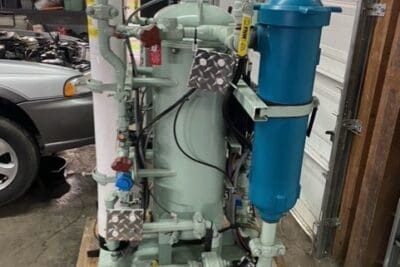
ACIR Marine
1- Area: Sampling point integrity and representativenessCheck: Verify sampling point is in vertical section of effluent piping near OWS outlet, with adequate pressure (≥0.2 bar) and flow rate (≥3 l/min). Check piping is sealed, inspect for tampering or bypass valves. Verify sample line has no isolation points.
- Area: 15ppm bilge alarm accuracy and response timeCheck: Test alarm calibration within ±5 ppm accuracy. Verify response time ≤5 seconds for alarm activation. Test automatic overboard discharge valve closure within ≤20 seconds total. Check alarm has audible/visual indication. Verify alarm stores operational data (date, time, status) for minimum 18 months.
- Area: Coalescer and filter element condition and replacementCheck: Inspect coalescer for blockage, degradation, or sediment accumulation. Check filter elements for fouling or clogging (service life typically 1-2 years). Verify replacement schedule compliance. Inspect internal seals and gaskets for integrity. Check heater elements (if equipped) for corrosion or scaling.
- Area: Oil content monitor (OCM) calibration and functionalityCheck: Verify OCM calibration by manufacturer or authorized agent within 5-year intervals. Test with clean water supply to measuring cell. Confirm sensor precision for oil content regulation. Check OCM display/recording function. Test bypass activation when oil content <threshold. Confirm cell replacement after 5 years of service.
- Area: Separator tank condition, sludge, and sediment accumulationCheck: Inspect separation chambers for cleanliness, oil residue, and water level sensors. Check for sludge or emulsion buildup at tank bottom. Verify automatic sludge/oil discharge valve operation. Test level sensors and transfer solenoid valves. Confirm oil recovery system functioning and recovered oil properly disposed.
Typ-universelle Inspektionspunkte fuer Oily Water Separator (15ppm) (verifiziert, 2026-06).
BITZER Kühlmaschinenbau
1
Chongqing Gohi Marine Equipment
1- Area: Sampling point integrity and representativenessCheck: Verify sampling point is in vertical section of effluent piping near OWS outlet, with adequate pressure (≥0.2 bar) and flow rate (≥3 l/min). Check piping is sealed, inspect for tampering or bypass valves. Verify sample line has no isolation points.
- Area: 15ppm bilge alarm accuracy and response timeCheck: Test alarm calibration within ±5 ppm accuracy. Verify response time ≤5 seconds for alarm activation. Test automatic overboard discharge valve closure within ≤20 seconds total. Check alarm has audible/visual indication. Verify alarm stores operational data (date, time, status) for minimum 18 months.
- Area: Coalescer and filter element condition and replacementCheck: Inspect coalescer for blockage, degradation, or sediment accumulation. Check filter elements for fouling or clogging (service life typically 1-2 years). Verify replacement schedule compliance. Inspect internal seals and gaskets for integrity. Check heater elements (if equipped) for corrosion or scaling.
- Area: Oil content monitor (OCM) calibration and functionalityCheck: Verify OCM calibration by manufacturer or authorized agent within 5-year intervals. Test with clean water supply to measuring cell. Confirm sensor precision for oil content regulation. Check OCM display/recording function. Test bypass activation when oil content <threshold. Confirm cell replacement after 5 years of service.
- Area: Separator tank condition, sludge, and sediment accumulationCheck: Inspect separation chambers for cleanliness, oil residue, and water level sensors. Check for sludge or emulsion buildup at tank bottom. Verify automatic sludge/oil discharge valve operation. Test level sensors and transfer solenoid valves. Confirm oil recovery system functioning and recovered oil properly disposed.
Typ-universelle Inspektionspunkte fuer Oily Water Separator (15ppm) (verifiziert, 2026-06).
Compass Water Solutions (formerly Oil Pollution Control) (USA)
1- CWS-250
- CWS-500
- CWS-1000
- CWS-2500
- 0.25
- 5.0
- 1
- 4
- Absorption polisher exhaustion — replacement required
- OCM calibration issues
- Pump cavitation from debris
Deckma Hamburg (Germany)
1
- OMD-24
- OMD-24ex
- 0.05
- 0.1
- IR window fouling from oil buildup
- Calibration drift
- Sample pump failure
- Electronics sensitivity to humidity
Detegasa (Spain)
1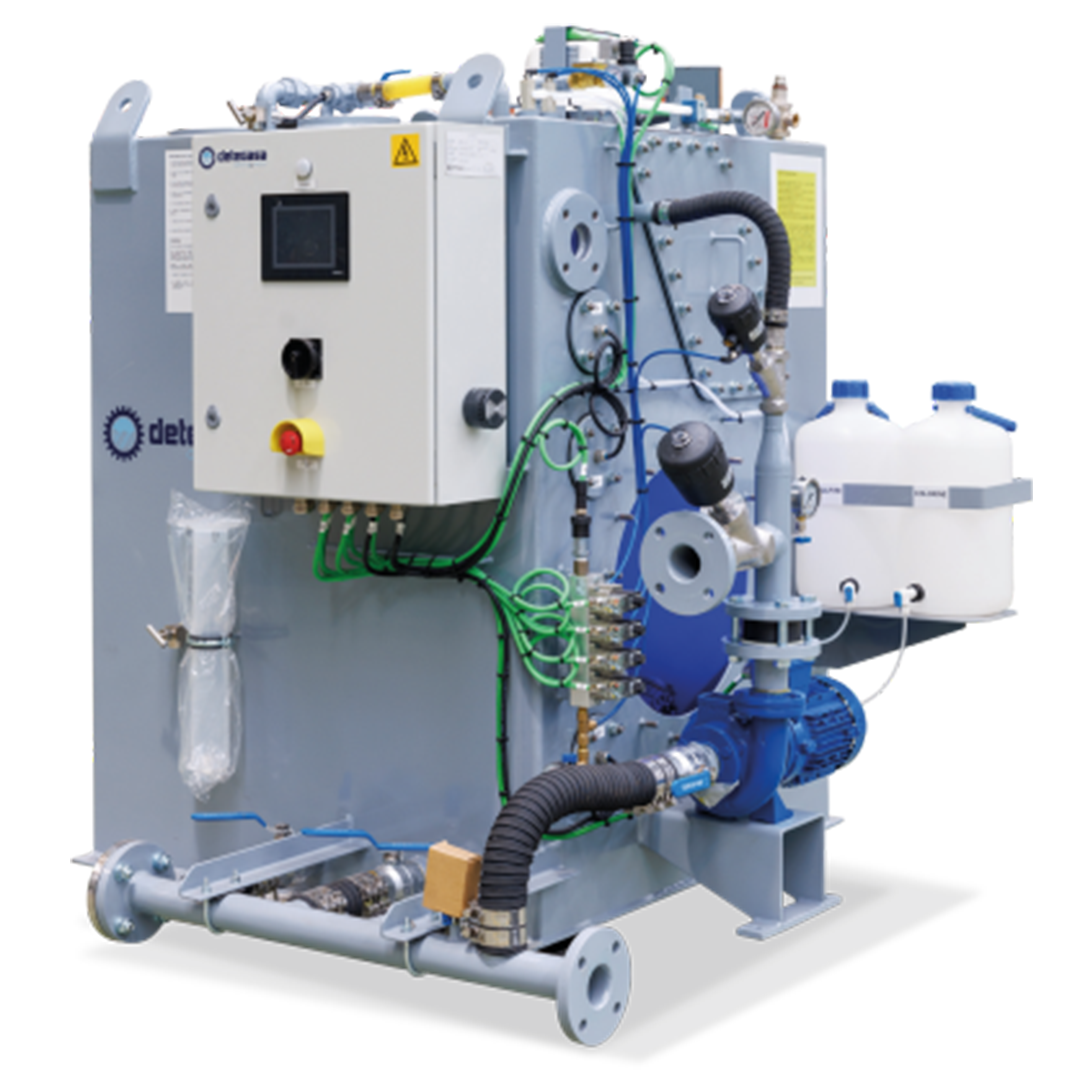
- DWF-250
- DWF-500
- DWF-1000
- DWF-2500
- 0.25
- 5.0
- 2
- 6
- Membrane fouling requiring chemical cleaning or replacement
- High-pressure pump failure on membrane stage
- OCM calibration drift
Deyuan Marine
1- Area: Sampling point integrity and representativenessCheck: Verify sampling point is in vertical section of effluent piping near OWS outlet, with adequate pressure (≥0.2 bar) and flow rate (≥3 l/min). Check piping is sealed, inspect for tampering or bypass valves. Verify sample line has no isolation points.
- Area: 15ppm bilge alarm accuracy and response timeCheck: Test alarm calibration within ±5 ppm accuracy. Verify response time ≤5 seconds for alarm activation. Test automatic overboard discharge valve closure within ≤20 seconds total. Check alarm has audible/visual indication. Verify alarm stores operational data (date, time, status) for minimum 18 months.
- Area: Coalescer and filter element condition and replacementCheck: Inspect coalescer for blockage, degradation, or sediment accumulation. Check filter elements for fouling or clogging (service life typically 1-2 years). Verify replacement schedule compliance. Inspect internal seals and gaskets for integrity. Check heater elements (if equipped) for corrosion or scaling.
- Area: Oil content monitor (OCM) calibration and functionalityCheck: Verify OCM calibration by manufacturer or authorized agent within 5-year intervals. Test with clean water supply to measuring cell. Confirm sensor precision for oil content regulation. Check OCM display/recording function. Test bypass activation when oil content <threshold. Confirm cell replacement after 5 years of service.
- Area: Separator tank condition, sludge, and sediment accumulationCheck: Inspect separation chambers for cleanliness, oil residue, and water level sensors. Check for sludge or emulsion buildup at tank bottom. Verify automatic sludge/oil discharge valve operation. Test level sensors and transfer solenoid valves. Confirm oil recovery system functioning and recovered oil properly disposed.
Typ-universelle Inspektionspunkte fuer Oily Water Separator (15ppm) (verifiziert, 2026-06).
DVZ
1
- Separation-stage, bowl, coalescer or filter fouling reduces treatment efficiency and causes poor outlet quality or alarms
- Monitor, sensor or sampling-line contamination causes unstable readings or unnecessary recirculation and trips
- Seal, gasket or bowl-sealing faults cause leakage or loss of correct separation conditions
- Feed-pump, drive or bearing faults cause unstable flow, vibration, abnormal noise or shutdown
- Incorrect temperature, flow, interface or chemical condition causes poor separation despite apparently normal machinery
- No external power required for separation – operates on gravity
- Compact footprint; fits limited engine‑room spaces
- Straight‑forward routine maintenance (filter change and valve inspection)
- Adequate for low to moderate flow rates typical of small ships
- Built‑in oil content monitor for automatic compliance reporting
- Limited throughput compared with centrifuge or high‑capacity OWS units
- Filter media must be replaced regularly; exhaustion leads to loss of efficiency
- Oil monitor sensor can become fouled, requiring periodic cleaning
- Three‑way valve may stick if not lubricated and inspected
- Not ideal for vessels with large bilge water volumes or high discharge rates
DVZ-Services
1- Area: Sampling point integrity and representativenessCheck: Verify sampling point is in vertical section of effluent piping near OWS outlet, with adequate pressure (≥0.2 bar) and flow rate (≥3 l/min). Check piping is sealed, inspect for tampering or bypass valves. Verify sample line has no isolation points.
- Area: 15ppm bilge alarm accuracy and response timeCheck: Test alarm calibration within ±5 ppm accuracy. Verify response time ≤5 seconds for alarm activation. Test automatic overboard discharge valve closure within ≤20 seconds total. Check alarm has audible/visual indication. Verify alarm stores operational data (date, time, status) for minimum 18 months.
- Area: Coalescer and filter element condition and replacementCheck: Inspect coalescer for blockage, degradation, or sediment accumulation. Check filter elements for fouling or clogging (service life typically 1-2 years). Verify replacement schedule compliance. Inspect internal seals and gaskets for integrity. Check heater elements (if equipped) for corrosion or scaling.
- Area: Oil content monitor (OCM) calibration and functionalityCheck: Verify OCM calibration by manufacturer or authorized agent within 5-year intervals. Test with clean water supply to measuring cell. Confirm sensor precision for oil content regulation. Check OCM display/recording function. Test bypass activation when oil content <threshold. Confirm cell replacement after 5 years of service.
- Area: Separator tank condition, sludge, and sediment accumulationCheck: Inspect separation chambers for cleanliness, oil residue, and water level sensors. Check for sludge or emulsion buildup at tank bottom. Verify automatic sludge/oil discharge valve operation. Test level sensors and transfer solenoid valves. Confirm oil recovery system functioning and recovered oil properly disposed.
Typ-universelle Inspektionspunkte fuer Oily Water Separator (15ppm) (verifiziert, 2026-06).
DVZ-Services (Netherlands)
1- IC-05
- IC-10
- IC-25
- IC-50
- 0.5
- 5.0
- 1
- 4
- Coalescer plate fouling from detergent contamination
- OCM calibration drift
- Discharge valve actuator failure
Eferest
1Facet Filtration
1- Area: Sampling point integrity and representativenessCheck: Verify sampling point is in vertical section of effluent piping near OWS outlet, with adequate pressure (≥0.2 bar) and flow rate (≥3 l/min). Check piping is sealed, inspect for tampering or bypass valves. Verify sample line has no isolation points.
- Area: 15ppm bilge alarm accuracy and response timeCheck: Test alarm calibration within ±5 ppm accuracy. Verify response time ≤5 seconds for alarm activation. Test automatic overboard discharge valve closure within ≤20 seconds total. Check alarm has audible/visual indication. Verify alarm stores operational data (date, time, status) for minimum 18 months.
- Area: Coalescer and filter element condition and replacementCheck: Inspect coalescer for blockage, degradation, or sediment accumulation. Check filter elements for fouling or clogging (service life typically 1-2 years). Verify replacement schedule compliance. Inspect internal seals and gaskets for integrity. Check heater elements (if equipped) for corrosion or scaling.
- Area: Oil content monitor (OCM) calibration and functionalityCheck: Verify OCM calibration by manufacturer or authorized agent within 5-year intervals. Test with clean water supply to measuring cell. Confirm sensor precision for oil content regulation. Check OCM display/recording function. Test bypass activation when oil content <threshold. Confirm cell replacement after 5 years of service.
- Area: Separator tank condition, sludge, and sediment accumulationCheck: Inspect separation chambers for cleanliness, oil residue, and water level sensors. Check for sludge or emulsion buildup at tank bottom. Verify automatic sludge/oil discharge valve operation. Test level sensors and transfer solenoid valves. Confirm oil recovery system functioning and recovered oil properly disposed.
Typ-universelle Inspektionspunkte fuer Oily Water Separator (15ppm) (verifiziert, 2026-06).
Facet International / Parker Hannifin (USA)
1- CLS-25
- CLS-50
- CLS-100
- CLS-200
- 0.5
- 10.0
- 1
- 5
- Coalescing cartridge plugging from heavy contamination
- Separation efficiency drop with emulsified oils
- OCM sensor drift
Hanyoung Engineering
1- Area: Sampling point integrity and representativenessCheck: Verify sampling point is in vertical section of effluent piping near OWS outlet, with adequate pressure (≥0.2 bar) and flow rate (≥3 l/min). Check piping is sealed, inspect for tampering or bypass valves. Verify sample line has no isolation points.
- Area: 15ppm bilge alarm accuracy and response timeCheck: Test alarm calibration within ±5 ppm accuracy. Verify response time ≤5 seconds for alarm activation. Test automatic overboard discharge valve closure within ≤20 seconds total. Check alarm has audible/visual indication. Verify alarm stores operational data (date, time, status) for minimum 18 months.
- Area: Coalescer and filter element condition and replacementCheck: Inspect coalescer for blockage, degradation, or sediment accumulation. Check filter elements for fouling or clogging (service life typically 1-2 years). Verify replacement schedule compliance. Inspect internal seals and gaskets for integrity. Check heater elements (if equipped) for corrosion or scaling.
- Area: Oil content monitor (OCM) calibration and functionalityCheck: Verify OCM calibration by manufacturer or authorized agent within 5-year intervals. Test with clean water supply to measuring cell. Confirm sensor precision for oil content regulation. Check OCM display/recording function. Test bypass activation when oil content <threshold. Confirm cell replacement after 5 years of service.
- Area: Separator tank condition, sludge, and sediment accumulationCheck: Inspect separation chambers for cleanliness, oil residue, and water level sensors. Check for sludge or emulsion buildup at tank bottom. Verify automatic sludge/oil discharge valve operation. Test level sensors and transfer solenoid valves. Confirm oil recovery system functioning and recovered oil properly disposed.
Typ-universelle Inspektionspunkte fuer Oily Water Separator (15ppm) (verifiziert, 2026-06).
Heckmann Maschinenbau und Verfahrenstechnik
1Hi-Sea Marine
1- Area: Sampling point integrity and representativenessCheck: Verify sampling point is in vertical section of effluent piping near OWS outlet, with adequate pressure (≥0.2 bar) and flow rate (≥3 l/min). Check piping is sealed, inspect for tampering or bypass valves. Verify sample line has no isolation points.
- Area: 15ppm bilge alarm accuracy and response timeCheck: Test alarm calibration within ±5 ppm accuracy. Verify response time ≤5 seconds for alarm activation. Test automatic overboard discharge valve closure within ≤20 seconds total. Check alarm has audible/visual indication. Verify alarm stores operational data (date, time, status) for minimum 18 months.
- Area: Coalescer and filter element condition and replacementCheck: Inspect coalescer for blockage, degradation, or sediment accumulation. Check filter elements for fouling or clogging (service life typically 1-2 years). Verify replacement schedule compliance. Inspect internal seals and gaskets for integrity. Check heater elements (if equipped) for corrosion or scaling.
- Area: Oil content monitor (OCM) calibration and functionalityCheck: Verify OCM calibration by manufacturer or authorized agent within 5-year intervals. Test with clean water supply to measuring cell. Confirm sensor precision for oil content regulation. Check OCM display/recording function. Test bypass activation when oil content <threshold. Confirm cell replacement after 5 years of service.
- Area: Separator tank condition, sludge, and sediment accumulationCheck: Inspect separation chambers for cleanliness, oil residue, and water level sensors. Check for sludge or emulsion buildup at tank bottom. Verify automatic sludge/oil discharge valve operation. Test level sensors and transfer solenoid valves. Confirm oil recovery system functioning and recovered oil properly disposed.
Typ-universelle Inspektionspunkte fuer Oily Water Separator (15ppm) (verifiziert, 2026-06).
Imarinex
1- Area: Sampling point integrity and representativenessCheck: Verify sampling point is in vertical section of effluent piping near OWS outlet, with adequate pressure (≥0.2 bar) and flow rate (≥3 l/min). Check piping is sealed, inspect for tampering or bypass valves. Verify sample line has no isolation points.
- Area: 15ppm bilge alarm accuracy and response timeCheck: Test alarm calibration within ±5 ppm accuracy. Verify response time ≤5 seconds for alarm activation. Test automatic overboard discharge valve closure within ≤20 seconds total. Check alarm has audible/visual indication. Verify alarm stores operational data (date, time, status) for minimum 18 months.
- Area: Coalescer and filter element condition and replacementCheck: Inspect coalescer for blockage, degradation, or sediment accumulation. Check filter elements for fouling or clogging (service life typically 1-2 years). Verify replacement schedule compliance. Inspect internal seals and gaskets for integrity. Check heater elements (if equipped) for corrosion or scaling.
- Area: Oil content monitor (OCM) calibration and functionalityCheck: Verify OCM calibration by manufacturer or authorized agent within 5-year intervals. Test with clean water supply to measuring cell. Confirm sensor precision for oil content regulation. Check OCM display/recording function. Test bypass activation when oil content <threshold. Confirm cell replacement after 5 years of service.
- Area: Separator tank condition, sludge, and sediment accumulationCheck: Inspect separation chambers for cleanliness, oil residue, and water level sensors. Check for sludge or emulsion buildup at tank bottom. Verify automatic sludge/oil discharge valve operation. Test level sensors and transfer solenoid valves. Confirm oil recovery system functioning and recovered oil properly disposed.
Typ-universelle Inspektionspunkte fuer Oily Water Separator (15ppm) (verifiziert, 2026-06).
Jowa (Sweden)
1- Jowa OWS 0.5
- Jowa OWS 1.0
- Jowa OWS 2.5
- Jowa OWS 5.0
- 0.5
- 5.0
- 1
- 5
- OCM window fouling causing false readings
- Coalescer element degradation
- Bilge pump air lock from empty bilge well
- Solenoid valve failure on 3-way valve
Llalco
1- Area: Sampling point integrity and representativenessCheck: Verify sampling point is in vertical section of effluent piping near OWS outlet, with adequate pressure (≥0.2 bar) and flow rate (≥3 l/min). Check piping is sealed, inspect for tampering or bypass valves. Verify sample line has no isolation points.
- Area: 15ppm bilge alarm accuracy and response timeCheck: Test alarm calibration within ±5 ppm accuracy. Verify response time ≤5 seconds for alarm activation. Test automatic overboard discharge valve closure within ≤20 seconds total. Check alarm has audible/visual indication. Verify alarm stores operational data (date, time, status) for minimum 18 months.
- Area: Coalescer and filter element condition and replacementCheck: Inspect coalescer for blockage, degradation, or sediment accumulation. Check filter elements for fouling or clogging (service life typically 1-2 years). Verify replacement schedule compliance. Inspect internal seals and gaskets for integrity. Check heater elements (if equipped) for corrosion or scaling.
- Area: Oil content monitor (OCM) calibration and functionalityCheck: Verify OCM calibration by manufacturer or authorized agent within 5-year intervals. Test with clean water supply to measuring cell. Confirm sensor precision for oil content regulation. Check OCM display/recording function. Test bypass activation when oil content <threshold. Confirm cell replacement after 5 years of service.
- Area: Separator tank condition, sludge, and sediment accumulationCheck: Inspect separation chambers for cleanliness, oil residue, and water level sensors. Check for sludge or emulsion buildup at tank bottom. Verify automatic sludge/oil discharge valve operation. Test level sensors and transfer solenoid valves. Confirm oil recovery system functioning and recovered oil properly disposed.
Typ-universelle Inspektionspunkte fuer Oily Water Separator (15ppm) (verifiziert, 2026-06).
Marine Technical Engineering (MTE)
1- Area: Sampling point integrity and representativenessCheck: Verify sampling point is in vertical section of effluent piping near OWS outlet, with adequate pressure (≥0.2 bar) and flow rate (≥3 l/min). Check piping is sealed, inspect for tampering or bypass valves. Verify sample line has no isolation points.
- Area: 15ppm bilge alarm accuracy and response timeCheck: Test alarm calibration within ±5 ppm accuracy. Verify response time ≤5 seconds for alarm activation. Test automatic overboard discharge valve closure within ≤20 seconds total. Check alarm has audible/visual indication. Verify alarm stores operational data (date, time, status) for minimum 18 months.
- Area: Coalescer and filter element condition and replacementCheck: Inspect coalescer for blockage, degradation, or sediment accumulation. Check filter elements for fouling or clogging (service life typically 1-2 years). Verify replacement schedule compliance. Inspect internal seals and gaskets for integrity. Check heater elements (if equipped) for corrosion or scaling.
- Area: Oil content monitor (OCM) calibration and functionalityCheck: Verify OCM calibration by manufacturer or authorized agent within 5-year intervals. Test with clean water supply to measuring cell. Confirm sensor precision for oil content regulation. Check OCM display/recording function. Test bypass activation when oil content <threshold. Confirm cell replacement after 5 years of service.
- Area: Separator tank condition, sludge, and sediment accumulationCheck: Inspect separation chambers for cleanliness, oil residue, and water level sensors. Check for sludge or emulsion buildup at tank bottom. Verify automatic sludge/oil discharge valve operation. Test level sensors and transfer solenoid valves. Confirm oil recovery system functioning and recovered oil properly disposed.
Typ-universelle Inspektionspunkte fuer Oily Water Separator (15ppm) (verifiziert, 2026-06).
Marinfloc (Sweden)
1
- MF 0.5
- MF 1.0
- MF 2.5
- MF 5.0
- 0.5
- 5.0
- 2
- 6
- Chemical dosing pump failure or misdosing
- Flocculation chemical supply exhaustion — requires regular replenishment
- Flotation tank foam overflow
- OCM calibration drift
Rivertrace (UK)
1- Smart OCM
- Smart OWS 0.5
- Smart OWS 1.0
- Smart OWS 2.5
- 0.5
- 5.0
- 1
- 5
- Fluorescence sensor window fouling
- Calibration drift — requires regular zero-water check
- Flow cell blockage
RWO
1- Separation-stage, bowl, coalescer or filter fouling reduces treatment efficiency and causes poor outlet quality or alarms
- Monitor, sensor or sampling-line contamination causes unstable readings or unnecessary recirculation and trips
- Seal, gasket or bowl-sealing faults cause leakage or loss of correct separation conditions
- Feed-pump, drive or bearing faults cause unstable flow, vibration, abnormal noise or shutdown
- Incorrect temperature, flow, interface or chemical condition causes poor separation despite apparently normal machinery
- Small physical size – fits vessels with limited engine‑room space
- Meets full MEPC 2005/16 (15 ppm) discharge requirement despite reduced capacity
- Lower initial purchase and installation cost compared with larger RWO models
- Simplified integration for retrofits on existing ships
- On‑board 15 ppm monitor prone to calibration drift, requiring frequent checks
- Coalescer media reaches saturation faster due to reduced capacity
- Reported auto‑stop valve failures can interrupt discharge cycles
- Limited maximum flow rate – unsuitable for high‑throughput tankers
RWO / Veolia (Germany/France)
1
- SKIT/S 0.25
- SKIT/S 0.50
- SKIT/S 1.0
- SKIT/S 2.5
- SKIT/S 5.0
- 0.25
- 5.0
- 1
- 5
- Coalescer plate fouling from detergent-contaminated bilge water
- OCM sensor drift — regular calibration mandatory
- Bilge pump cavitation from debris blockage
- 3-way recirculation valve failure
RØRTEK
1SES International
1SKF / Blohm+Voss (Germany/Sweden)
1
- OCM-15
- OCM-15E
- 0.05
- 0.1
- Optical window fouling from oil film buildup — most common issue
- Calibration drift requiring monthly recalibration
- Flow cell blockage from debris
- Electronics board failure from humidity/vibration
Victor Marine (UK)
1
- VMS 0.25
- VMS 0.50
- VMS 1.0
- VMS 2.5
- VMS 5.0
- 0.25
- 5.0
- 1
- 4
- Coalescer cartridge clogging from detergent contamination
- OCM sensor fouling
- Bilge pump suction strainer clogging
- 3-way valve actuator failure
Zava Marine
1- Area: Sampling point integrity and representativenessCheck: Verify sampling point is in vertical section of effluent piping near OWS outlet, with adequate pressure (≥0.2 bar) and flow rate (≥3 l/min). Check piping is sealed, inspect for tampering or bypass valves. Verify sample line has no isolation points.
- Area: 15ppm bilge alarm accuracy and response timeCheck: Test alarm calibration within ±5 ppm accuracy. Verify response time ≤5 seconds for alarm activation. Test automatic overboard discharge valve closure within ≤20 seconds total. Check alarm has audible/visual indication. Verify alarm stores operational data (date, time, status) for minimum 18 months.
- Area: Coalescer and filter element condition and replacementCheck: Inspect coalescer for blockage, degradation, or sediment accumulation. Check filter elements for fouling or clogging (service life typically 1-2 years). Verify replacement schedule compliance. Inspect internal seals and gaskets for integrity. Check heater elements (if equipped) for corrosion or scaling.
- Area: Oil content monitor (OCM) calibration and functionalityCheck: Verify OCM calibration by manufacturer or authorized agent within 5-year intervals. Test with clean water supply to measuring cell. Confirm sensor precision for oil content regulation. Check OCM display/recording function. Test bypass activation when oil content <threshold. Confirm cell replacement after 5 years of service.
- Area: Separator tank condition, sludge, and sediment accumulationCheck: Inspect separation chambers for cleanliness, oil residue, and water level sensors. Check for sludge or emulsion buildup at tank bottom. Verify automatic sludge/oil discharge valve operation. Test level sensors and transfer solenoid valves. Confirm oil recovery system functioning and recovered oil properly disposed.
Typ-universelle Inspektionspunkte fuer Oily Water Separator (15ppm) (verifiziert, 2026-06).