Submersible Pump
A submersible pump has its motor sealed inside the same housing as the impeller and runs fully immersed in the liquid it moves, avoiding the shaft seal a dry-mounted pump depends on, but making the motor itself the point that fails if the seal lets water in.
What to check on a Submersible Pump.
1 models from Sulzer in Submersible Pump. Below: the full model list.
What defines this type
A submersible pump combines the motor and the pump end in one sealed unit designed to operate fully underwater, unlike a conventional dry-mounted centrifugal pump that sits above or beside the liquid with a shaft seal or gland keeping the liquid out of a dry motor. Because the motor itself is submerged, the design eliminates the mechanical seal as the usual failure point but shifts the risk to the motor's own watertight enclosure and cable gland. On ships this makes submersible pumps the natural choice for bilge wells, ballast tank stripping, and cargo hold or void space drainage, anywhere a dry-mounted pump would need long suction lines and priming.
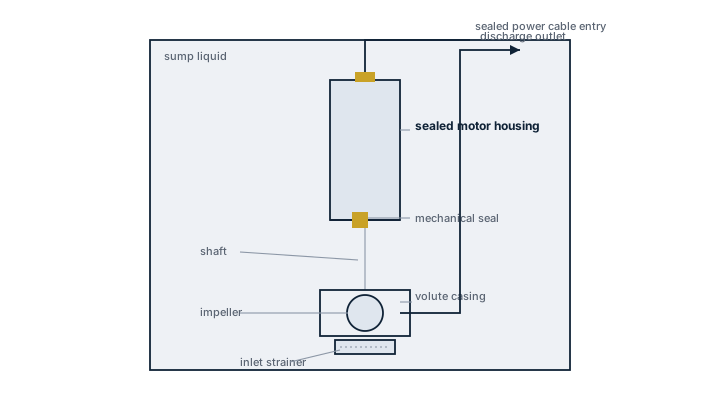
Legend
- Sealed cable entry
- Discharge
- Sealed motor housing
- Sump liquid
- Mechanical seal
- Shaft
- Impeller
- Volute casing
- Inlet strainer
Main components
- Sealed motor housing with a double mechanical seal arrangement between the motor cavity and the pumped liquid, often with an oil-filled barrier chamber and a moisture sensor
- Impeller and volute at the base of the unit, in vortex, semi-open or channel design depending on how much solids the liquid carries
- Cable entry gland, one of the most common failure points, sealing the power cable where it enters the motor housing
- Float switch or level sensor for automatic start/stop, common on bilge and drainage duty
- Guide rail or portable base, letting the pump be lowered into or lifted out of a well without disturbing the discharge piping on fixed installations
Selection and sizing
- Duty point: flow rate and total head including static lift out of the well or tank
- Solids-handling capability if the liquid carries debris, sludge or fibrous material, which calls for a vortex or channel impeller rather than a closed impeller
- Motor insulation class and moisture-sensor protection appropriate to continuous submerged duty, not intermittent dry-well use
- Materials of construction against the liquid's corrosivity, particularly for bilge water carrying oil residue or ballast water with high chloride content
- Portable versus fixed installation, since a fixed unit on guide rails needs matched coupling hardware in the well
Regulations and class
Bilge pumping arrangements, including submersible bilge pumps, fall under SOLAS Chapter II-1 requirements for bilge pumping systems and the number and capacity of pumps required by ship size and type. MARPOL Annex I governs the discharge of bilge water, requiring oil content monitoring before any overboard discharge regardless of which pump moved it. Class societies survey the pump as part of the bilge and drainage system, checking capacity against the required rules calculation and confirming remote start arrangements where fitted for unmanned machinery space operation.
Typical faults
| Fault | Cause | Consequence |
|---|---|---|
| Motor failure from water ingress | Cable gland seal degraded or mechanical seal worn | Complete pump loss, often with no warning if the moisture sensor is not monitored |
| Impeller clogged or worn | Debris, rag or solids beyond the impeller's rated clearance | Reduced flow, and on vortex designs increased vibration from imbalance |
| Float switch stuck | Debris or oil residue fouling the float mechanism in a bilge well | Pump fails to start on rising level, or runs dry after the level drops |
| Bearing failure | Running dry for extended periods, or age | Increased noise and vibration, eventually seizure |
What to look for in a supplier
- Moisture sensor and double mechanical seal as standard, not an optional extra, for any well the pump cannot be easily lifted from
- Impeller type matched to the actual solids content of the duty, not a generic clear-water rating
- Guide rail and coupling hardware compatible with the existing well if replacing rather than a new installation
- Spare parts kit availability for the seal and cable gland specifically, since those are the components that actually wear
A moisture sensor alarm on a submersible pump is an early warning, not a nuisance trip, so pulling the pump for a seal check at that point is far cheaper than replacing a flooded motor.
Read the full guide

Models in this type.
The best-documented model of each manufacturer first, then the next — 1 of 1 models in Submersible Pump. Every row links to full specifications, documents and service notes.
Manufacturers.
All 14 manufacturers with models of Submersible Pump. Names with a manufacturer page open it; the others open a search across the full library.
All manufacturers in the libraryAlso in Pumps.
The other equipment types in this category.
Write to us about this model — the answer comes by e-mail.
Name the make and the model and what the job is: a spare, a service call, a second opinion on a data sheet. We answer by e-mail.
No details at hand? A photo of the rating plate or the part is enough — simply attach it to the request.
Questions that come up with this equipment.
Is Submersible Pump data free?
Yes. Every model page, every guide and every datasheet for this type is readable without an account. An account adds saved searches and requests, nothing is taken away.
My model is missing — what now?
Send us the nameplate. We identify it by hand, add it to the library, and if you need a part or a service, the request is already on our desk.
Can you source a Submersible Pump part?
Yes. Tell us the manufacturer, the model and what you need — a person reads every request and replies by e-mail.