What to check on a HT/LT Cooling Water Pump.
The high-temperature (HT) circuit carries fresh water through the cylinder jackets and cylinder head cooling spaces of the main and auxiliary engines, running at 70-90°C on most medium and slow-speed diesels, and rejects its heat to the LT circuit or directly to the fresh water generator. The low-temperature (LT) circuit runs cooler, typically 30-40°C after seawater cooling, and serves the charge air cooler, lube oil cooler and sometimes the HT circuit's own heat exchanger. Both are centrifugal pumps running on closed, treated fresh water rather than raw seawater, which is…
What sets HT/LT pumps apart from other engine room pumps
The high-temperature (HT) circuit carries fresh water through the cylinder jackets and cylinder head cooling spaces of the main and auxiliary engines, running at 70-90°C on most medium and slow-speed diesels, and rejects its heat to the LT circuit or directly to the fresh water generator. The low-temperature (LT) circuit runs cooler, typically 30-40°C after seawater cooling, and serves the charge air cooler, lube oil cooler and sometimes the HT circuit's own heat exchanger. Both are centrifugal pumps running on closed, treated fresh water rather than raw seawater, which is what separates them from the seawater cooling pumps upstream - closed circuit water is chemically dosed against corrosion and scale, so these pumps see a far more benign fluid than a seawater pump does, but the consequence of a leak is loss of treated inventory rather than just lost suction.
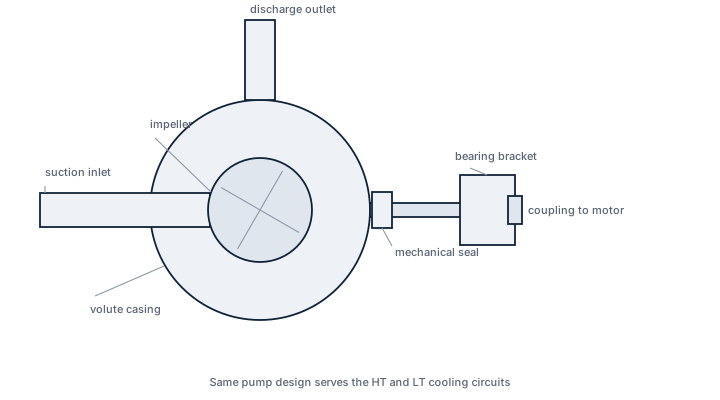
Main components
- Pump casing and impeller - centrifugal, single or multi-stage depending on required head, usually bronze or cast iron wetted parts since the fluid is non-corrosive fresh water.
- Mechanical seal or gland packing - the most common source of visible leakage, particularly on older packed-gland designs.
- Electric motor drive - most HT/LT pumps are motor-driven rather than engine-driven, allowing independent operation and standby duty.
- Non-return and isolating valves - allow a standby pump to be brought online without draining the circuit.
- Expansion tank connection - each circuit has a header/expansion tank that accommodates thermal expansion and provides the static head the pump suction needs.
Selection / Sizing
Pump capacity is set by the engine manufacturer's specified cooling water flow rate at rated output, expressed in m³/h, with head determined by the circuit's total resistance including the heat exchangers, engine water jackets and piping runs. HT and LT pumps are normally sized identically to their duty pump as a 100% standby, arranged so either pump can be started manually or automatically on a pressure-drop signal. Motor rating follows directly from the flow/head duty point on the pump curve; oversizing wastes electrical power continuously since these pumps run for the entire time the engine runs.
Regulations / Class
Class rules require engine cooling water systems to include standby pumping capacity capable of maintaining cooling if the duty pump fails, consistent with SOLAS Ch. II-1 requirements for essential machinery redundancy. Automatic standby pump start on low pressure is commonly a class notation requirement for unmanned machinery space (UMS) operation. There is no dedicated international convention specific to HT/LT pumps beyond these general machinery redundancy and periodic survey requirements.
Typical faults
| Fault | Consequence |
|---|---|
| Mechanical seal wear or gland packing leakage | Gradual loss of circuit water, falling expansion tank level, air ingress |
| Impeller wear or erosion | Falling flow and pressure, engine temperatures creeping up under load |
| Bearing failure from inadequate lubrication or misalignment | Vibration, noise, eventual seizure and unplanned pump stoppage |
| Air lock in the circuit after maintenance | Pump loses prime or cavitates, poor circulation despite pump running |
| Standby pump not tested regularly | Fails to start automatically when needed, defeating the redundancy it exists for |
What to look for in a supplier
- Pump curves matched precisely to the engine maker's specified duty point, not a generic nearest-fit selection.
- Seal type compatible with the treated water chemistry already in use on board.
- Spare parts commonality with other cooling pumps already carried, to reduce the spare parts inventory.
- Documented bearing life and lubrication interval so maintenance planning can be scheduled realistically.
A slowly falling expansion tank level with no visible leak is almost always a gland or mechanical seal weeping into the bilge - trace it before it becomes a running loss that masks a real cooling water shortage under load.