"> Stern Tube LO Pump - Equipment Database

Stern Tube LO Pump

high 3 models total

The stern tube lubricating oil pump keeps a continuous film of oil between the propeller shaft and its aft bearing, and losing that flow for even a short time can score the shaft where no in-water repair is possible.

Read more — Stern Tube LO Pump explained

What makes this type

This pump circulates lubricating oil through the stern tube bearing that supports the propeller shaft where it passes out through the hull. Unlike most lubricating oil pumps on a ship, which serve an engine that can simply be stopped if oil pressure is lost, the stern tube bearing supports a shaft that is often still turning under way, driven by the propeller's momentum even after the pump stops. That makes redundancy and reliable low-flow alarms more important here than in most other lubrication circuits.
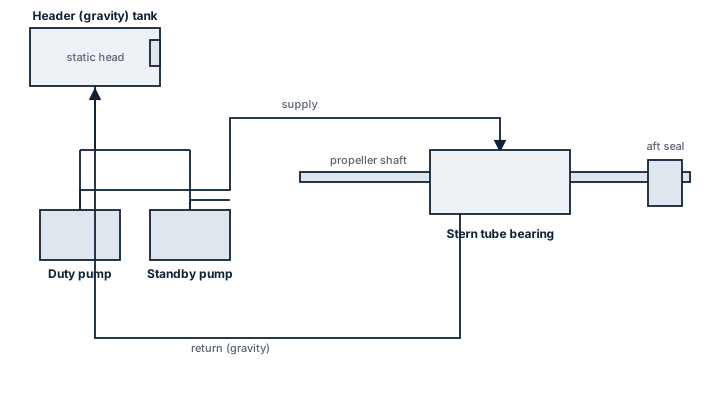
Stern tube lubricating oil pump circuit
Gravity-fed lubrication circuit for a propeller shaft stern tube bearing, showing the header tank, duty and standby pumps, supply line to the bearing and gravity return to the tank.

Main components

Pump unit

Usually a small positive displacement or centrifugal pump, often supplied in a duplicate arrangement with a standby unit on automatic changeover.

Header tank

A gravity tank mounted above the waterline that maintains a positive pressure at the stern tube seal, preventing seawater ingress even if the pump stops, on oil-lubricated stern tube arrangements.

Cooler

A small heat exchanger, often seawater-cooled, keeping oil temperature within the bearing's design range under continuous circulation.

Filters

Fine filtration protecting the bearing surface from any debris in the oil circuit, usually duplex to allow cleaning without stopping flow.

Seal arrangement

Forward and aft seals at the stern tube, whose condition depends directly on the pump maintaining correct oil pressure relative to sea pressure outside the seal.

Selection / sizing

  • Bearing type: oil-lubricated white metal bearings need continuous forced circulation; water-lubricated arrangements do not use this pump at all, which is the main dividing line in this category.
  • Required flow rate against shaft speed and bearing length, set by the bearing manufacturer.
  • Header tank height above the waterline, fixed by the need to keep seal pressure positive relative to sea pressure at the draft the ship normally operates at.
  • Standby pump arrangement and automatic changeover logic.

Regulations / Class

Class rules require duplication or an equivalent standby means of lubrication for the stern tube bearing on most vessels, along with a low-pressure or low-flow alarm at a manned station. MARPOL Annex I governs stern tube lubricants where an oil-to-sea interface exists, and many owners now fit environmentally acceptable lubricants in the stern tube specifically to reduce pollution risk from that interface, which class societies recognise with dedicated notations in some cases.

Typical faults

FaultCauseConsequence
Loss of pump flowElectrical fault, blocked suction, standby pump not started in timeBearing runs dry under load, rapid wear or scoring of the shaft liner
Header tank low levelSlow oil loss through the aft seal not topped upSeal pressure falls below sea pressure, risk of water ingress
Cooler foulingSeawater side scaling or biofoulingRising oil temperature, reduced film strength at the bearing
Water in oilSeal wear allowing seawater past the aft sealEmulsified oil loses lubricating properties, accelerates bearing wear

What to look for in a supplier

  • Pump duty point matched precisely to the bearing manufacturer's flow requirement, not an oversized generic unit.
  • Reliable automatic changeover logic between duty and standby pump, tested during commissioning.
  • Compatibility with environmentally acceptable lubricants if the vessel is fitted or being retrofitted with them, since viscosity and seal material compatibility differ from mineral oil.

Check header tank level and pump changeover alarm function at every engine room round. This is one circuit where the consequence of a missed low-level alarm is a shaft that has to come out for repair, not a part that can be swapped at sea.

4000h
Service Interval
20 yr
Typical Lifetime

Typical Manufacturers

IMO Naniwa Shinko

3 manufacturers · 3 models

IMO

1
IMO ACE 025K3 ST
ACE 025K3 ST
3 m3/h · 1.1 kW · Lube Oil · Oil-lubricated screw compressor
Common Failures & Inspection Points
  • Low flow alarm
  • Seal leakage
  • Filter differential pressure high
Service: Small screw pump; monitor stern tube oil level and temperature.
Spare Parts: IMO: Ersatzteile per Hersteller-Ersatzteilliste. Mechanische Dichtungen und Laufräder an Bord vorhalten. Lead time: 2-6 Wochen je nach Hersteller.
Strengths
  • Compact design for space-constrained vessels
  • Low maintenance requirements due to simple design
  • Effective in maintaining optimal stern tube oil levels
Weaknesses
  • Potential for seal leakage if not properly maintained
  • May require frequent filter replacements
  • Limited flow rate compared to larger pumps
Typical Vessels: General cargo shipsBulk carriersTankers
Certifications: IMO D-2DNV GL Type Approval
Decision Guide: Choose if: You need a compact, low-maintenance pump for stern tube oil circulation. Avoid if: You require high flow rates or are concerned about seal leakage.
Use Cases: Typically deployed on vessels with limited space and moderate propeller shaft loads, such as general cargo ships and bulk carriers.

Naniwa

1
Naniwa FG-100 ST
FG-100 ST
2.5 m3/h · 0.75 kW · Lube Oil · gear pump
Common Failures & Inspection Points
  • Gear wear
  • Oil contamination with seawater
  • Pressure fluctuation
Service: Gear pump; check stern tube oil for seawater contamination weekly.
Spare Parts: Naniwa: Ersatzteile per Hersteller-Ersatzteilliste. Mechanische Dichtungen und Laufräder an Bord vorhalten. Lead time: 2-6 Wochen je nach Hersteller.
Strengths
  • Robust cast‑iron/bronze construction suitable for harsh marine environments
  • Compact footprint fits typical engine room layouts
  • High pressure capability (up to ~30 bar) ensures reliable bearing oil flow
  • Simple mechanical drive – easy to install and service
Weaknesses
  • Gear wear can increase maintenance intervals if oil quality is poor
  • Sensitive to seawater ingress; contamination leads to rapid degradation
  • Limited flow‑rate adjustability compared with variable‑speed screw pumps
  • Noise and vibration at full load may require additional isolation
Typical Vessels: TankerBulk carrierContainer shipGeneral cargo vesselOffshore supply vessel
Certifications: IMO D‑2
Decision Guide: Choose if: you need a proven, low‑cost gear pump for stern‑tube lubrication on vessels where space is limited and the operating profile is steady. Avoid if: you require highly variable flow rates, ultra‑quiet operation, or have a history of oil contamination that would accelerate gear wear.
Use Cases: The FG‑100 ST is typically installed in the engine room of medium‑size merchant ships to feed oil from the central lube‑oil system into the stern tube bearing housings, ensuring continuous lubrication during all speed regimes and while at anchor.

Shinko

1
GVK 100 ST
2 m3/h · 0.75 kW · Lube Oil · positive displacement gear pump
Common Failures & Inspection Points
  • Rotor clearance increase
  • Seal degradation
  • Low pressure alarm
Service: Positive displacement; critical to monitor for seawater ingress.
Spare Parts: Shinko: Ersatzteile per Hersteller-Ersatzteilliste. Mechanische Dichtungen und Laufräder an Bord vorhalten. Lead time: 2-6 Wochen je nach Hersteller.
Strengths
  • Compact, lightweight design suited for tight engine room spaces
  • High volumetric efficiency with consistent flow at low speeds
  • Robust cast‑iron housing provides good resistance to marine corrosion
  • Easy access for routine inspection and seal replacement
  • Integrated pressure monitoring compatible with standard low‑pressure alarms
Weaknesses
  • Rotor clearance can increase with wear, leading to reduced pressure output
  • Mechanical seals have a limited service life and require regular inspection
  • Low maximum discharge pressure compared with some high‑pressure piston pumps
  • Sensitive to oil contamination; requires diligent oil analysis and filtration
Typical Vessels: TankerBulk CarrierContainer ShipGeneral Cargo VesselCruise Ship
Certifications: DNV GL Type Approval
Decision Guide: Choose if: you need a reliable, compact LO pump for standard stern‑tube bearing lubrication on medium to large commercial vessels and value ease of maintenance. Avoid if: the installation demands very high discharge pressures or you prefer a pump with longer seal intervals and lower wear sensitivity.
Use Cases: The GVK 100 ST is typically installed in the oil‑lubrication loop of a vessel’s stern tube bearing system, feeding pressurised lubricating oil from the main LO tank through filters to the journal bearings. It is common on vessels where space constraints and straightforward maintenance are priorities.