What to check on a Auxiliary Cooling SW Pump.
The auxiliary cooling seawater pump supplies raw seawater to the coolers serving generator engines, air conditioning and refrigeration plant, and other machinery that does not draw on the main engine's dedicated seawater circuit. It is distinct from the main engine seawater pump mainly in duty: lower head and flow, continuous running at sea and in port whenever any auxiliary machinery is in use, and typically installed with a standby unit so a single pump failure does not shut down electrical generation.
What defines an auxiliary cooling SW pump
The auxiliary cooling seawater pump supplies raw seawater to the coolers serving generator engines, air conditioning and refrigeration plant, and other machinery that does not draw on the main engine's dedicated seawater circuit. It is distinct from the main engine seawater pump mainly in duty: lower head and flow, continuous running at sea and in port whenever any auxiliary machinery is in use, and typically installed with a standby unit so a single pump failure does not shut down electrical generation.
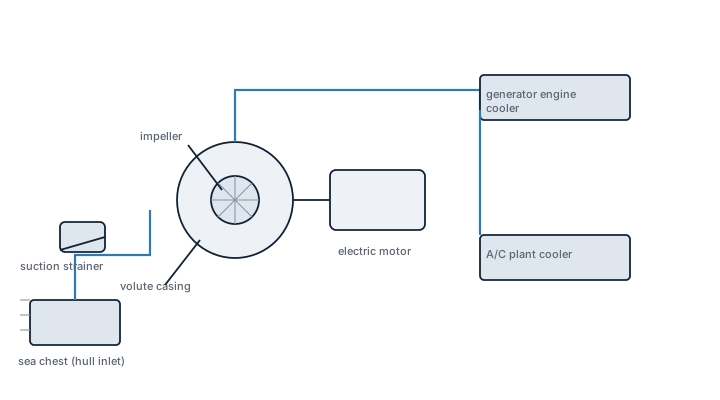
Main components
Pump casing and impeller
Almost all auxiliary cooling seawater pumps are single-stage centrifugal units with a bronze or duplex stainless steel impeller and casing, chosen for corrosion resistance against raw seawater rather than for high pressure duty.
Shaft seal
Mechanical seals have largely replaced packed glands on newer installations because they need less routine attention, though packed glands remain common on older ships and are simpler to repair without a spare seal kit on board.
Drive motor and coupling
A flexible coupling connects the pump to an electric motor sized for the design flow and head with margin for fouled coolers. Motor protection includes thermal overload and, on larger units, current monitoring that can flag impeller wear or a partially blocked strainer before the motor trips.
Suction strainer and sea chest arrangement
A duplex sea chest with high and low suction, each behind its own strainer, lets the crew switch suction without stopping the pump when marine growth or ice blocks one chest.
Selection and sizing
Capacity is set by adding the seawater-side heat rejection of every cooler on the circuit, generator jacket water coolers, lube oil coolers, air conditioning condensers, with a margin for fouling. Head is usually modest, often under 3 bar, since the pump only needs to overcome piping resistance and cooler pressure drop rather than lift against static height. Material selection matters more than for most pump types: bronze, duplex or super-duplex stainless steel resist seawater corrosion and cavitation erosion far better than cast iron, which is unsuitable for this duty.
Regulations and class
Class rules require at least two independent means of seawater cooling for essential auxiliary machinery, which is why these pumps are almost always installed as duty and standby pairs with automatic changeover on low discharge pressure. Sea chest and overboard valve arrangements fall under the ship's structural and piping survey rather than a boiler or pressure vessel regime, but the automatic standby start function is tested at each periodic survey.
Typical faults
- Impeller erosion from cavitation, caused by a partially blocked suction strainer, leading to falling flow and rising cooling water temperatures
- Mechanical seal leakage from dry running after a strainer blockage, resulting in bilge alarms and eventual seal replacement
- Bearing failure from misalignment after coupling wear, showing up first as vibration and noise before the pump seizes
- Marine growth inside the casing on ships with long idle periods, reducing flow until the pump is opened up and cleaned
- Standby pump failing to start on demand because it was never rotated or test-run, only discovered when the duty pump trips
What to look for in a supplier
- Material certificates confirming impeller and casing alloy match the specified seawater service, not a generic substitute
- Documented NPSH curve so the pump can be checked against the ship's actual suction lift and sea chest arrangement
- Availability of shaft seal spares and wear ring kits as standard stock items
- Motor frame and terminal box rated for the engine room's ambient temperature and humidity
Rotate the standby pump on a fixed schedule and log the start; a pump that has sat idle for months is the one that fails to prime the day the duty unit trips.