What to check on a Bilge Pump (Main + Emergency).
Every ship has some capacity to pump out bilges as part of routine housekeeping, but the SOLAS bilge pumping system is a specific, sized arrangement meant to keep a flooding compartment from sinking the ship, not just to clear condensate and leakage. It has two distinct layers: the main bilge system, usually served by pumps also used for general service or ballast duty, and a separate emergency bilge pump that must be able to draw from the machinery space bilges even if that space itself floods and takes out the…
What sets the main/emergency bilge arrangement apart from general dewatering
Every ship has some capacity to pump out bilges as part of routine housekeeping, but the SOLAS bilge pumping system is a specific, sized arrangement meant to keep a flooding compartment from sinking the ship, not just to clear condensate and leakage. It has two distinct layers: the main bilge system, usually served by pumps also used for general service or ballast duty, and a separate emergency bilge pump that must be able to draw from the machinery space bilges even if that space itself floods and takes out the main system. The emergency pump is deliberately independent — different power source, different location, or a direct sea suction — because the failure mode it is designed for is the main system going down with the compartment it was meant to save.
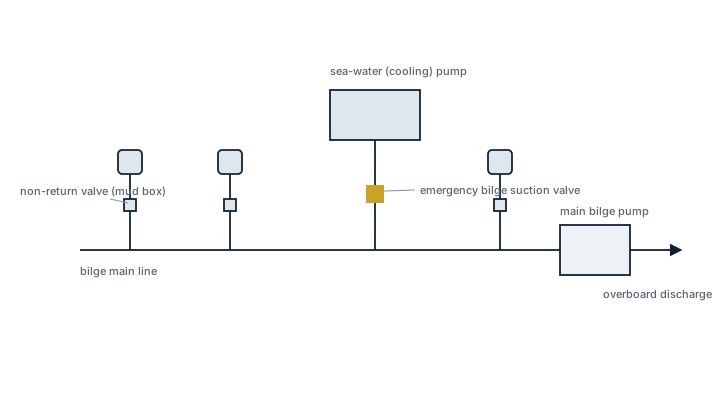
Main components
Bilge main and branches
Piping running the length of the machinery space and into other watertight compartments, with a suction valve in each space feeding back to the bilge main.
Bilge pumps
Often the ballast or general service pumps cross-connected to the bilge main rather than dedicated units, sized so that at least the required number can be run on the bilge duty simultaneously.
Non-return and screw-down non-return valves
Fitted at each bilge suction to stop water flowing back into an already-flooded or damaged compartment from the bilge main.
Emergency bilge pump / suction
An independently powered pump, or a direct emergency suction on the main circulating pump, positioned and powered so it survives the same flooding scenario that could disable the primary bilge pumps.
Sizing and selection
- Required bilge pump capacity, calculated from the ship's dimensions under the applicable SOLAS formula, not an arbitrary flow rate.
- Number of independently powered pumps required, which scales with ship size and passenger or cargo ship category.
- Suction pipe diameter, set by rule to a minimum bore so it cannot be undersized to save cost.
- Emergency pump location, chosen specifically to remain accessible and operable in a flooding casualty in the machinery space.
Regulations and class
SOLAS Chapter II-1 sets the required number of power bilge pumps, minimum bilge main and branch pipe diameters by formula, and the requirement for an independently driven emergency bilge pump able to take suction directly from the machinery space. Class societies verify pump capacity against the formula at newbuilding, and survey bilge valves, non-return valves and pipe condition periodically, since corroded or seized bilge suction valves are a recurring finding that directly undermines the ship's flooding response.
Typical faults
| Fault | Consequence |
|---|---|
| Bilge suction valve seized shut with rust or paint | Compartment cannot be pumped out in a flooding event even though the pump itself works |
| Non-return valve stuck open | Water can flow backward into an intact compartment from a flooded one via the bilge main |
| Emergency pump never run under load, only started dry | Pump fails to actually deliver rated capacity when tested against real suction lift and head |
| Bilge strum boxes clogged with debris | Pump loses suction or runs dry, and can be damaged before the crew realises the bilge is not actually being cleared |
What to look for in a supplier
- Certified pump capacity against the applicable SOLAS formula for the ship's dimensions, with test data, not a nameplate figure alone.
- Materials suited to bilge water service, including entrained oil and solids, not clean seawater duty pumps repurposed for bilge use.
- Independent power source arrangement for the emergency pump that genuinely survives a main machinery space casualty.
- Non-return and screw-down valve quality at each suction point, since these are cheap to under-specify and expensive to have fail.
Test the emergency bilge suction against an actual load during drills, not just a dry start-up — a pump that spins freely on the bench can still fail to lift water once real suction lift and pipe friction are in the circuit.