What to check on a LO Standby/Priming Pump.
This pump exists for the moments the main lubricating oil pump cannot cover: before the main engine starts, when the shaft-driven or electric main LO pump has not yet built pressure, and as an automatic backup if the main pump trips while the engine is running. It does not run continuously alongside the main pump under normal load — it is either idle, priming the system before start, or picking up the full duty automatically the instant low LO pressure is detected.
What sets the LO standby/priming pump apart
This pump exists for the moments the main lubricating oil pump cannot cover: before the main engine starts, when the shaft-driven or electric main LO pump has not yet built pressure, and as an automatic backup if the main pump trips while the engine is running. It does not run continuously alongside the main pump under normal load — it is either idle, priming the system before start, or picking up the full duty automatically the instant low LO pressure is detected.
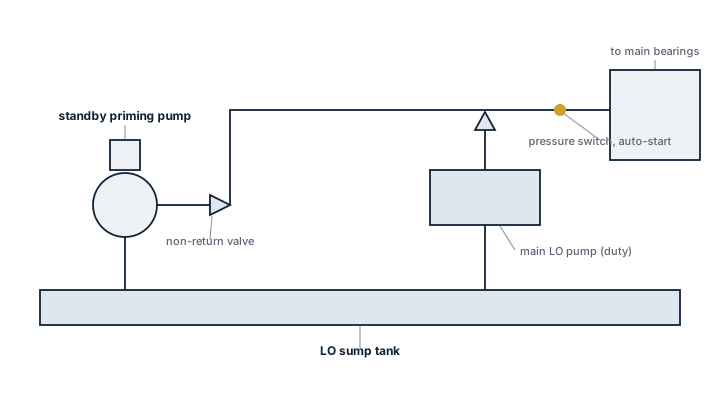
Main components
Pump and motor
Usually a smaller electric centrifugal or screw pump than the main LO pump, sized to deliver enough pressure and flow to protect bearings, not to match full running capacity — many are rated to sustain the engine at reduced load or dead slow only.
Automatic start relay
A pressure switch on the main LO line triggers the standby pump to start within a set delay, commonly a few seconds, if main LO pressure drops below the alarm setpoint. This automatic changeover is the core safety function of the whole unit.
Non-return valve
Prevents the main pump, once it recovers or restarts, from driving oil backward through the idle standby pump and its motor.
Suction strainer
A dedicated strainer, often finer than the main pump's, since a standby pump that starts automatically after months of idle standby is exactly the pump most likely to pick up settled sludge from the bottom of the sump.
Selection and sizing
- Flow and pressure sufficient to maintain minimum bearing protection at the load the engine is permitted to run at on standby pump alone
- Automatic start delay short enough to avoid bearing damage but long enough to ignore momentary pressure dips from rolling or manoeuvring
- Motor supplied from the emergency switchboard or a source independent of the main pump's supply, so a single electrical fault cannot take out both pumps
- Compatibility confirmed with priming duty — some standby pumps double as the priming pump used before every cold start, which adds self-priming capability to the specification
Regulations and class
Class rules for main propulsion machinery require a standby means of lubrication such that loss of the main LO pump does not immediately endanger the engine, and for unmanned machinery space notation the automatic changeover and its alarm must function without manual intervention. Surveyors test the automatic start function directly, simulating a main pump trip and timing the standby pump's pickup and the resulting pressure recovery.
Typical faults
- Automatic start relay never tested in service — fails to trigger on the one occasion the main pump actually trips
- Standby pump seized or seal-bound from long idle periods without a periodic run — discovered only during the automatic changeover test, or worse, during a real trip
- Suction strainer clogged with settled sludge — pump starts but cannot draw sufficient flow, so LO pressure keeps falling despite the changeover
- Priming function left disabled after a control system update — engine start attempted on an unprimed system, risking a dry start on the bearings
What to look for in a supplier
- Documented automatic start and changeover time tested at the factory, not just claimed in a data sheet
- Self-priming capability confirmed if the pump is also intended for pre-start priming duty
- Motor and control gear compatible with the vessel's emergency power arrangement
- Seal design suited to long idle periods without weeping or seizing, since this pump spends most of its life stationary
Run the standby LO pump on load, not just on a no-flow test bench check, at least once a month — a pump that starts on command but cannot deliver pressure against the real system resistance gives a false sense of security until the day the main pump actually fails.