Fuel Oil Supply/Booster Pump
A fuel oil supply/booster pump raises fuel from the settling or service tank to the pressure the main or auxiliary engine's injection system needs, and on heavy fuel installations does so against a viscosity and temperature the pump was specifically sized for.
What to check on a Fuel Oil Supply/Booster Pump.
13 models from KRAL in Fuel Oil Supply/Booster Pump. Below: the full model list.
What Sets Supply/Booster Pumps Apart
A supply pump moves fuel at modest, near-atmospheric pressure from tank to the day tank or mixing unit; a booster pump raises that fuel further, to the pressure the injection pumps or common-rail system actually require, often 4-10 bar for conventional injection and considerably higher for common-rail engines. On a heavy fuel oil (HFO) installation, the booster stage works in series with a heater and viscosity control loop, because HFO must reach injection viscosity, not just injection pressure, or atomization at the nozzle fails. Distillate fuel (MGO/MDO) installations skip the heating stage but still need the booster pump sized for the engine's rail pressure and flow.
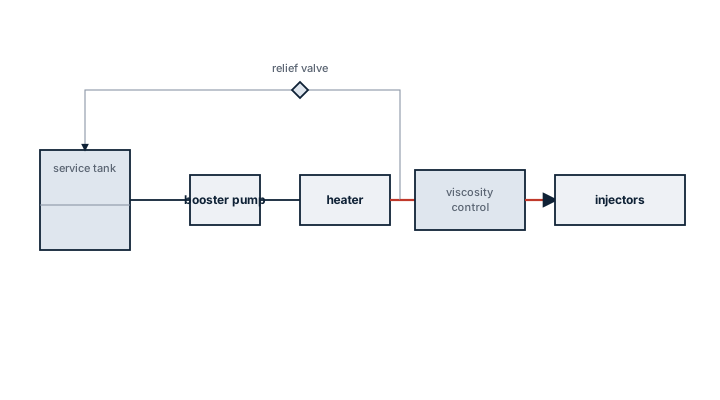
Legend
- relief valve
- service tank
- booster pump
- heater
- viscosity control
- injectors
Main Components
Pump Element
Almost always a positive displacement type, typically a screw or gear pump, chosen because fuel oil viscosity varies too widely for a centrifugal pump to hold a stable delivery pressure across the operating range.
Relief Valve
Protects the pump and downstream piping against dead-heading if a valve is shut with the pump running; set to open just above normal working pressure.
Read the full guide
Duplex Filter
Fitted upstream to protect the close-tolerance pump elements and injection equipment from abrasive particles; changeable on load without stopping flow.
Mechanical Seal or Packing
Seals the shaft against the pumped fuel; mechanical seals dominate on modern installations for lower leakage and less maintenance than packed glands.
Selection and Sizing
- Delivery pressure and flow matched to the specific engine's injection or common-rail system, not a generic figure
- Viscosity range the pump element can handle, since HFO service means a far wider range than MGO-only service
- Material selection for the pump casing and internals against the fuel's sulfur and corrosivity
- Standby capacity: class requires a duplicate pump able to take over without manual reconfiguration under way
Regulations and Class
Class rules require duplicated fuel oil supply and booster pumps for the main propulsion engine, arranged so that failure of one does not stop propulsion, with standby start typically automatic or from the engine control room. MARPOL Annex VI governs the fuel's sulfur content the pump ultimately delivers to the engine, which matters for material compatibility when a vessel switches between HFO and low-sulfur fuels for emission control area transits.
Typical Faults
| Fault | Consequence |
|---|---|
| Mechanical seal wear from running dry during tank changeover | Fuel leakage into the bilge or pump room, a fire and pollution risk |
| Relief valve set point drifted low | Chronic loss of delivery pressure at the injectors, poor combustion |
| Duplex filter not switched over before it clogs | Pump cavitation and reduced flow, worst case an unplanned changeover under load |
| Standby pump left in manual isolation after maintenance | No automatic backup if the running pump fails, a single point of failure that class assumed was covered |
What to Look for in a Supplier
- Pump curve data matched against the specific engine maker's fuel system requirement, not a catalog match by flow alone
- Material certificates for wetted parts appropriate to the fuel sulfur range the ship will actually burn
- Spare rotor/seal kits available for the exact model, since fuel pumps are wear items in continuous service
After every fuel switchover between HFO and low-sulfur distillate, confirm the standby pump is back in automatic - it is routinely left in manual during the changeover and forgotten.
Models in this type.
The best-documented model of each manufacturer first, then the next — 13 of 13 models in Fuel Oil Supply/Booster Pump. Every row links to full specifications, documents and service notes.
Manufacturers.
All 9 manufacturers with models of Fuel Oil Supply/Booster Pump. Names with a manufacturer page open it; the others open a search across the full library.
All manufacturers in the libraryAlso in Pumps.
The other equipment types in this category.
Write to us about this model — the answer comes by e-mail.
Name the make and the model and what the job is: a spare, a service call, a second opinion on a data sheet. We answer by e-mail.
No details at hand? A photo of the rating plate or the part is enough — simply attach it to the request.
Questions that come up with this equipment.
Is Fuel Oil Supply/Booster Pump data free?
Yes. Every model page, every guide and every datasheet for this type is readable without an account. An account adds saved searches and requests, nothing is taken away.
My model is missing — what now?
Send us the nameplate. We identify it by hand, add it to the library, and if you need a part or a service, the request is already on our desk.
Can you source a Fuel Oil Supply/Booster Pump part?
Yes. Tell us the manufacturer, the model and what you need — a person reads every request and replies by e-mail.