Fuel Oil Transfer Pump
A fuel oil transfer pump moves fuel between storage, settling and service tanks and has to keep working on heavy fuel oil at viscosities that would stall a centrifugal design, which is why positive displacement types dominate this duty.
What to check on a Fuel Oil Transfer Pump.
18 models from KRAL in Fuel Oil Transfer Pump. Below: the full model list.
What defines this type
A fuel oil transfer pump moves fuel between storage, settling and service tanks at low to moderate pressure and modest flow — its job is inventory management within the tank system, not feeding fuel to an engine under injection pressure. That distinguishes it from fuel injection or booster pumps further down the fuel line: a transfer pump has to handle heavy fuel oil at viscosities that would stall a centrifugal design, so positive displacement types dominate this duty.
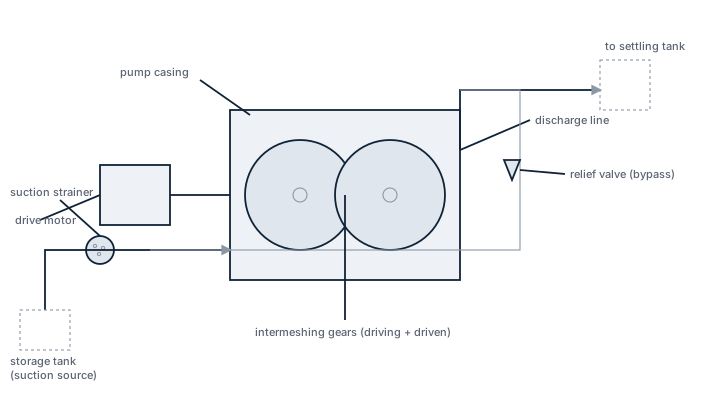
Main components
Pump element
Almost always a rotary positive displacement type — external gear or screw pump — chosen because it maintains flow at the high viscosities heavy fuel oil reaches when cold, which a centrifugal pump cannot do without losing efficiency and priming reliably.
Relief valve
A positive displacement pump generates rising pressure against any closed or blocked downstream valve, so an internal or external relief valve set to bypass back to suction is fitted as standard, not an optional safety add-on.
Read the full guide
Suction strainer
A duplex or single basket strainer ahead of the pump protects the close internal clearances of the gear or screw elements from tank sludge, sediment and welding debris that heavy fuel tanks accumulate over years of service.
Heating arrangement
Many transfer pumps handling heavy fuel oil carry a steam or thermal-oil heating jacket on the pump casing itself, keeping the fuel inside the pump above its pour point during standstill so the unit does not have to break loose a solidified plug on start-up.
Selection / Sizing
| Parameter | Why it matters |
|---|---|
| Capacity (m3/h) | Set by required tank transfer time, not engine consumption rate |
| Viscosity range | Must cover cold HFO at standstill through to pre-heated transfer temperature |
| Discharge pressure | Set by pipe run length and any settling tank elevation |
| NPSH available | Low suction head from tank bottom suctions limits pump speed selection |
| Seal type | Mechanical seal material must suit fuel type and temperature |
Sizing is normally set to complete a full tank-to-tank transfer within a watch period rather than continuously, so capacity is chosen against operational routine, and viscosity range is checked against the coldest fuel the pump will ever see, including a cold-ship start after a long lay-up.
Regulations / Class
MARPOL Annex I governs oil transfer procedures and requires a documented shipboard oil transfer procedure covering the equipment used, including transfer pumps, with remote emergency stops reachable from outside the pump space required by class rules so a spill can be stopped without entering a compartment that may already be contaminated. Class societies typically require duplicate transfer pump capacity, or a demonstrated alternative means of transfer, so a single pump failure cannot strand fuel in a tank the engine needs to draw from. High level alarms on receiving tanks are a standard companion requirement, not a feature of the pump itself, and are cross-checked at survey against the transfer procedure documentation.
Typical faults
- Air lock on suction — a partially empty suction line or a leaking suction joint lets a positive displacement pump lose prime; unlike a centrifugal pump it will not usually re-prime itself against any real suction lift.
- Strainer clogging — sludge from tank bottoms builds differential pressure across the strainer, starving the pump and showing up first as reduced transfer rate rather than an outright stoppage.
- Seal wear — abrasive catalytic fines in heavy fuel oil wear mechanical seal faces faster than the fuel's own lubricating properties would suggest, and slow seepage often goes unnoticed until a drip tray alarm trips.
- Gear or rotor wear from cold starts — starting a positive displacement pump against unheated, highly viscous fuel accelerates internal clearance wear and can overload the drive motor.
- Relief valve stuck closed — a seized relief valve turns a blocked downstream line into an overpressure event on the pump casing or piping instead of a harmless bypass.
What to look for in a supplier
- A stated viscosity operating range that actually spans the ship's coldest expected fuel temperature, not just a typical mid-range figure.
- Mechanical seal material compatible with both distillate and heavy fuel oil if the vessel switches fuel grades for emission control area entry.
- ATEX or equivalent explosion-protected motor rating where the pump sits in a classified hazardous area.
- Spares availability for wear parts — gears, seals, strainer baskets — rather than only complete pump replacement.
Never throttle a positive displacement transfer pump by closing a discharge valve to control flow — use the relief valve bypass or a variable speed drive, because a blocked discharge on this pump type builds pressure until something gives, not until the flow simply stops.
Models in this type.
The best-documented model of each manufacturer first, then the next — 18 of 18 models in Fuel Oil Transfer Pump. Every row links to full specifications, documents and service notes.
Manufacturers.
All 27 manufacturers with models of Fuel Oil Transfer Pump. Names with a manufacturer page open it; the others open a search across the full library.
All manufacturersAlso in Pumps.
The other equipment types in this category.
One request. A person reads it and replies by e-mail.
Tell us the manufacturer, the model and what you need — a part, a service call, a second opinion. A person reads every request and replies by e-mail.
No details at hand? A photo of the rating plate or the part is enough — simply attach it to the request.
Three things people ask first.
Is Fuel Oil Transfer Pump data free?
Yes. Every model page, every guide and every datasheet for this type is readable without an account. An account adds saved searches and requests, nothing is taken away.
My model is missing — what now?
Send us the nameplate. We identify it by hand, add it to the library, and if you need a part or a service, the request is already on our desk.
Can you source a Fuel Oil Transfer Pump part?
Yes. Tell us the manufacturer, the model and what you need — a person reads every request and replies by e-mail.