Provision Crane
A provision crane is a light-duty deck crane rated to lift stores, spare parts and provision pallets rather than cargo, typically under 3 tonnes SWL and mounted where the boom can reach both the quay or supply boat and a stores hatch or hold.
What to check on a Provision Crane.
44 models from Liebherr Maritime in Provision Crane. Below: the full model list.
What sets this type apart
A provision crane is built for occasional, light lifting rather than the sustained duty cycle of a cargo crane. Its structure, wire rope and hydraulic or electric power pack are sized around stores drums, pallets, spare parts crates and the occasional engine component, not repeated cargo hold cycles through a working day. On many ships it is the only crane fitted, since deck cargo is handled by shore cranes or the ship carries no cargo cranes at all, which makes its availability for provisioning and ship's spares handling more important than its lifting capacity.
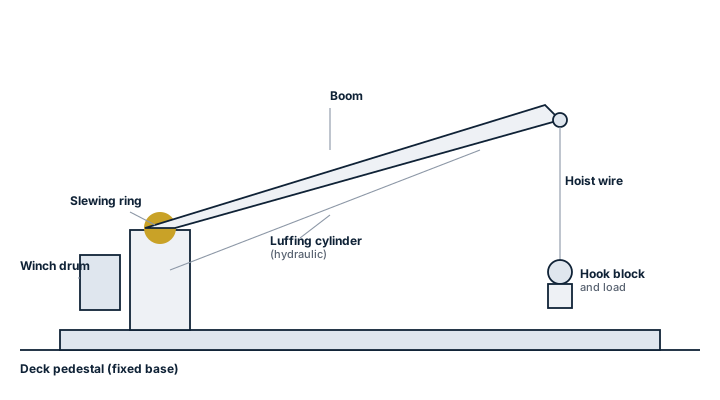
Legend
- Hoist wire
- Hook block and load
- Boom
- Luffing cylinder (hydraulic)
- Slewing ring
- Winch drum
- Deck pedestal (fixed base)
Main components
Boom and slewing structure
A single hydraulic luffing boom, often telescopic, reaches from a fixed pedestal out over the ship's side or down into a stores hold. Slewing is powered, usually hydraulically, through a limited arc rather than a full 360 degrees on many installations.
Wire rope and hook block
A single-fall wire rope runs from the winch drum through the boom head sheave to a hook block; the SWL marked on the crane assumes the rope and sheaves are in the condition recorded at last inspection, not as-new.
Read the full guide
Hydraulic power pack and winch
An electrically driven hydraulic pump supplies the luffing, slewing and hoisting cylinders and motors; a local control station and often a remote pendant let the operator work from a position with a clear view of the load.
Limit switches and overload protection
Slew limit, luffing limit and hoist upper-limit switches prevent the boom driving into the ship's structure or two-blocking the hook against the boom head; an overload cut-out stops hoisting or luffing before the rated SWL is exceeded.
Selection and sizing
| Parameter | Typical value |
|---|---|
| SWL | 0.5-3 tonnes |
| Outreach | set by ship's beam and stores hatch location |
| Duty cycle | intermittent, not continuous cargo duty |
Sizing follows the heaviest single item routinely handled, such as a full drum of lubricating oil, a spare turbocharger cartridge, or a loaded pallet, plus margin, rather than an average provisioning load.
Regulations and class
Lifting appliances including provision cranes fall under class and flag lifting gear survey requirements, with annual thorough examination and periodic proof-load testing at a multiple of SWL, carried out by an approved surveyor. The crane's test certificate and load chart must be kept on board and available for port state control inspection, and a crane operated past its due proof-load date is a common detention item.
Typical faults
- Wire rope corrosion from weather exposure - reduced breaking strength not visible without close inspection, especially at the socket and drum anchorage.
- Hydraulic seal leakage - slow load drift or loss of luffing hold, often first noticed as the boom creeping down under a static load.
- Limit switch drift or failure - boom driven into structure, or hook two-blocked against the head sheave.
- Corroded pedestal bolting - a structural item easy to miss under paint, checked at survey but worth a visual check before use in exposed locations.
- Overload cut-out bypass or failure - loss of the one safeguard against exceeding SWL, usually found only when tested.
What to look for in a supplier
- Spare hydraulic seals, limit switches and wire rope matched to the specific crane model rather than generic equivalents.
- Willingness to support the proof-load test and thorough examination cycle rather than only selling parts.
- Clear load charts covering the full outreach range the crane is actually used across on board.
Check the proof-load test date on the crane's certificate before every provisioning operation that involves a heavier-than-usual item - a crane rated for stores duty has little reserve capacity if pushed toward its SWL with an aged wire rope.
Models in this type.
The best-documented model of each manufacturer first, then the next — 44 of 44 models in Provision Crane. Every row links to full specifications, documents and service notes.
Manufacturers.
All 14 manufacturers with models of Provision Crane. Names with a manufacturer page open it; the others open a search across the full library.
All manufacturers in the libraryAlso in Deck Cranes.
The other equipment types in this category.
Write to us about this model — the answer comes by e-mail.
Name the make and the model and what the job is: a spare, a service call, a second opinion on a data sheet. We answer by e-mail.
No details at hand? A photo of the rating plate or the part is enough — simply attach it to the request.
Questions that come up with this equipment.
Is Provision Crane data free?
Yes. Every model page, every guide and every datasheet for this type is readable without an account. An account adds saved searches and requests, nothing is taken away.
My model is missing — what now?
Send us the nameplate. We identify it by hand, add it to the library, and if you need a part or a service, the request is already on our desk.
Can you source a Provision Crane part?
Yes. Tell us the manufacturer, the model and what you need — a person reads every request and replies by e-mail.