What to check on a Deck Crane.
A deck crane is a self-contained, slewing lifting appliance permanently fitted to the ship, distinct from derrick-and-boom cargo gear or gantry systems that move on rails. It combines its own power source (electro-hydraulic on the great majority of newbuildings, older units still found with electric or steam drive), a slewing platform, a luffing or fixed jib, and its own control station, so it can work independently of shore cranes at any berth or anchorage. On general cargo ships the deck crane may handle the entire cargo operation; on tankers and…
What makes a deck crane different from cargo gear in general
A deck crane is a self-contained, slewing lifting appliance permanently fitted to the ship, distinct from derrick-and-boom cargo gear or gantry systems that move on rails. It combines its own power source (electro-hydraulic on the great majority of newbuildings, older units still found with electric or steam drive), a slewing platform, a luffing or fixed jib, and its own control station, so it can work independently of shore cranes at any berth or anchorage. On general cargo ships the deck crane may handle the entire cargo operation; on tankers and bulk carriers it more often serves stores, spares, hose handling and maintenance lifts, but the safety case is the same regardless of how often it is used.
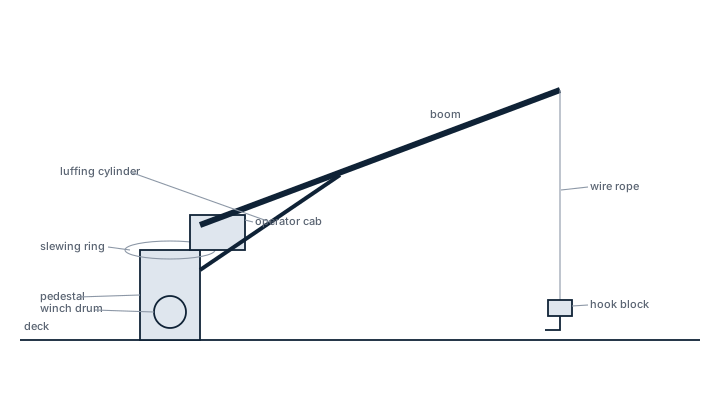
Main components
Hydraulic power pack and drive
An electric motor drives a hydraulic pump feeding the slew, luff and hoist motors; this gives smooth, controllable lifting speed and allows the crane to be started and stopped locally without warming up a large prime mover.
Jib and luffing system
The jib is either fixed-length with a luffing cylinder to change radius, or telescopic to extend reach without increasing height. Luffing cylinders and their locking devices carry the full overturning moment of the load and are a primary inspection point.
Slewing ring and bearing
A large-diameter bearing carries the whole crane structure and lets it rotate on the pedestal; it takes both the vertical load and the tipping moment from an offset load, and its condition determines the crane's remaining working life more than almost any other single part.
Hoist winch and wire rope
The hoist drum and wire rope lift the load; rope diameter, construction and discard criteria are set against the crane's rated load and the wire rope's design factor, not chosen for convenience.
Overload and limit protection
A load moment indicator or equivalent safe load indicator monitors load against radius in real time and cuts hoist and luff functions before the rated capacity at that radius is exceeded.
Selection and sizing
- Safe working load at the radius actually needed on deck, read from the crane's load chart, not the single maximum SWL figure
- Outreach required to clear hatch coamings, deck cargo or the ship's side when working stores or spares
- Hoisting speed and duty cycle appropriate to the cargo handled — general cargo work needs faster cycling than occasional stores lifts
- Deck space and structural strengthening available at the pedestal foundation
Regulations and class
Deck cranes are lifting appliances subject to class society rules for cargo gear, which require a proof load test and thorough examination before entry into service and at periodic intervals thereafter, commonly annual thorough examination with a proof load test at longer, class-defined intervals. Wire ropes, hooks and other loose lifting gear associated with the crane carry their own certification and discard criteria. Where the crane is used for lifting persons in a work basket, additional class and flag requirements apply and are not automatically covered by the crane's cargo lifting certificate.
Typical faults
| Fault | Cause | Consequence |
|---|---|---|
| Slewing ring bearing wear | Inadequate lubrication or long-term overload at maximum radius | Play in the crane structure, uneven slewing, eventual bearing failure |
| Hydraulic cylinder seal leakage | Seal wear or contaminated hydraulic oil | Loss of luffing control, jib creep under load |
| Wire rope degradation | Corrosion, fatigue from repeated bending over the drum and sheaves, poor lubrication | Broken wires reaching discard criteria, risk of rope failure under load |
| Load moment indicator drift | Sensor calibration lost over time, or damage during maintenance | Crane allows lifts beyond the true safe working load at a given radius |
What to look for in a supplier
- Load charts and safe working load documentation matched to the exact crane model and jib configuration fitted
- Genuine or approved-equivalent hydraulic and electrical spares, given how model-specific crane control systems tend to be
- Service history and proof load test records available with the crane if purchased second-hand or transferred between vessels
- Local service support in the trading area, since a crane failure often means cargo operations stop entirely
The load chart, not the SWL plate, is what governs a lift — a crane rated for twenty tonnes close in may be good for a fraction of that at full outreach, and more than one deck incident has started with someone reading the wrong number.