"> Engine Room Crane - Equipment Database

Engine Room Crane

medium 4 models total

An engine room crane is a fixed overhead or jib lifting arrangement sized for machinery component handling inside the confines of the engine room, not for cargo, and its capacity and reach are set by what has to come out of the main engine rather than by any deck cargo figure.

Read more — Engine Room Crane explained

What sets this type apart

Deck cranes work outdoors across a wide reach and load range for cargo, stores and equipment; an engine room crane works in a fixed, confined indoor space and is sized around one job in particular - pulling heavy machinery components such as cylinder heads, pistons, liners or turbocharger rotors for overhaul without needing to send them ashore or up on deck. Its travel is usually limited to a monorail or a short jib arc positioned directly over the main engine and auxiliary machinery, rather than the full-reach slewing motion of a deck crane.
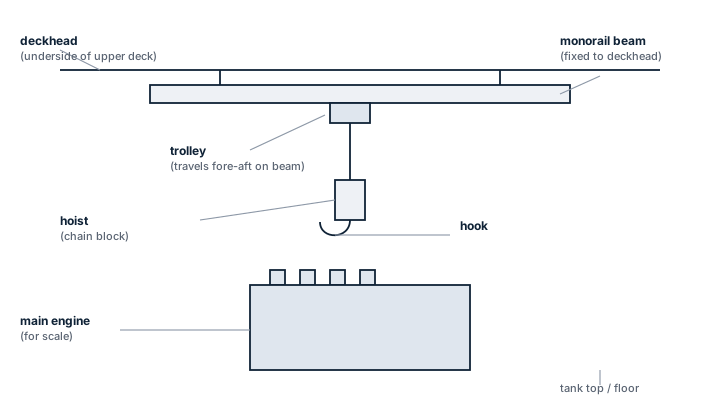
Engine room crane arrangement
Cross-section of an engine room showing the monorail beam fixed to the deckhead, the travelling trolley, the chain hoist and hook, and the main engine below for scale.

Main components

  • Monorail beam or jib arm - fixed structural steel run positioned over the engine top platform, sized to the heaviest single component expected to be lifted.
  • Hoist trolley - travels along the monorail, carrying the lifting mechanism and allowing positioning along the beam's length.
  • Chain or wire rope hoist - electric hoists are common on larger installations; manual chain blocks remain in use on smaller engine rooms or as a secondary means where power is not available during maintenance.
  • Hook block and lifting gear - the interface to slings, shackles and dedicated lifting tools for specific engine components such as piston lifting eyes.
  • Control pendant or radio control - lets the operator position the load while standing clear, important given the tight clearances typical of engine room overhauls.

Selection and sizing

Safe working load is set by the single heaviest component the crane will realistically need to lift - typically a cylinder head, piston assembly or turbocharger cartridge for the specific main engine model fitted - with margin for the lifting tackle itself. Headroom and beam travel are dictated by the physical layout of the engine room rather than chosen freely: the crane has to clear the component from its seated position and travel it far enough to set it down on a maintenance platform or lower it toward a hatch for removal.

Regulations and class

Engine room lifting appliances fall under the same class lifting gear survey regime as deck cranes: periodic load testing and thorough examination at intervals set by class, with load test certificates and a lifting gear register kept on board. Because engine room cranes are used less frequently than deck cranes but for critical overhaul work, class surveyors pay particular attention to whether load tests have actually been carried out on schedule rather than only paperwork being current.

Typical faults

  • Hoist brake slipping under sustained load - a partially raised heavy component creeps down, a serious hazard in the confined space of an engine room during overhaul.
  • Trolley wheels or rail corroded from the humid, oily engine room atmosphere - increases rolling resistance and can bind under load.
  • Control pendant cable damaged by heat or oil exposure - intermittent control loss while a load is suspended.
  • Wrong lifting gear substituted for the job (standard sling instead of the engine maker's dedicated lifting tool) - unbalanced or overstressed lift of an awkwardly shaped component.

What to look for in a supplier

  • Load test certification matching the actual installed capacity, not just a generic hoist rating.
  • Component compatible with the engine room's headroom and beam travel as installed, confirmed against ship drawings rather than assumed.
  • Suitability for the ambient conditions - heat, oil mist, vibration - typical of a machinery space rather than a general industrial hoist rated for clean environments.
  • Availability of the engine maker's dedicated lifting attachments alongside the crane itself, since generic slings are often unsuited to specific components.

Confirm the crane's safe working load against the actual heaviest component of the current main engine model, not the figure from a previous ship - engines change between newbuildings and retrofits, the crane rating sometimes does not.

2000h
Service Interval

Typical Manufacturers

Konecranes TTS

3 manufacturers · 4 models

Liebherr Maritime

2
Liebherr LEC 100
1.0t SWL
Model Family
LEC
Crane type
stiff_boom
Application
engine_room
Drive Type
electric
Safe working load tonnes
1.0
Technical Specifications
Traglastbereich (CBG Serie)
CBG 300: 25 t (Hook), CBG 350: 35 t Grab / 45 t Hook, CBG 500E: bis 90 t Grab
Traglastbereich (RL Serie)
RL 650: bis 30 t, RL 1500: bis 40 t, RL 2650: bis 60 t, RL 4200: bis 100 t
Traglastbereich (MTC Serie)
MTC 1900: bis 75 t, MTC 3100: bis 100 t, MTC 6000: bis 150 t, MTC 78000: bis 300 t
Traglastbereich (BOS Serie)
BOS 2600: bis 100 t, BOS 4200: bis 140 t, BOS 14000: bis 600 t
Traglastbereich (LS-C Serie)
LS-C 60: 60 t / 32m Auslegerlänge, LS-C 80: 80 t / 38m, LS-C 100: 100 t / 43m
Antrieb / Steuerung
Diesel-hydraulic or Electro-hydraulic, Litronic control system, hydraulic hoses with chromium-nickel plating
Drehkranz
Large-diameter roller bearing slewing rings (e.g. ~9 m diameter, ~70 t in BOS series), lubrication and sealing systems
Inspektionsintervalle
After ~20,000 operating hours or per statutory requirement (DGUV, ISO 4309); daily visual inspection, annual expert inspection
Product Lines
  • CBG (Floating Cargo Cranes)
  • CBW (Cylinder Luffing Ship Cranes)
  • RL (Ram Luffing Cranes)
  • RL-K (Ram Luffing Knuckle Boom Cranes)
  • MTC (Mast Type Cranes)
  • BOS (Board Offshore Cranes)
  • LS-C (Cylinder Luffing Ship Cranes)
Common Failures & Inspection Points
  • Area: Wire rope wear: diameter reduction >10% (natural fibre core) or >5% (steel core), wire breaks in groups, kinks, waves, twists, corrosion, pitting
    Check: Visual daily inspection per ISO 4309:2017; caliper for diameter; magnetic inductive inspection (MRI) for suspected internal damage; inspection points: drum anchorage, loading, deflection over sheaves, loaded rope sections
  • Area: Slewing ring: sealing system worn (leaks, contaminated lubrication), tooth wear (check engagement), bearing clearance, vibrations, temperature increase
    Check: Visual inspection for lubricant leakage; check seals for wear and contamination; vibration and temperature monitoring; overhaul by qualified Liebherr service with specialized equipment if needed
  • Area: Hydraulic system: pressure loss, leaks at cylinders/pipes, hydraulic fluid contaminated or oxidized, valve and control function impaired
    Check: Drucktest (Pressure Test) gegen spezifizierte Solldrücke; Sichtprüfung auf Flüssigkeitsverluste; Ölprobenanalyse (Condition Monitoring); Funktionsprüfung aller Hubfunktionen (Heben, Schwenken, Luffing)
  • Area: Hook/Hook-block: cracks, plastic deformation, wear on running surfaces, notches or scratches, damage to load deflection surfaces
    Check: Visual surface inspection for surface cracks and deformation; NDT inspection (X-ray/MRI) at critical hooks for internal damage; load test: ~25% above rated load capacity; inspection of hook locking and wear marks
  • Area: Steel structure / boom / jib: corrosion, surface cracks (especially at welds and load introduction points), plastic deformation, welded repairs
    Check: Surface rust and corrosion by visual inspection; NDT inspection (ultrasonic, X-ray) at critical welds; dimensional check of geometric tolerances; overhaul by Service Centre Steel with welding/structural analysis if required
  • Area: Electrical / control (Litronic system): cable insulation faults, connectors/contacts oxidized or corroded, malfunction of control systems, overload/underload
    Check: Visual inspection of all electrical connections for corrosion in saltwater environment; functional test of overload protection and indicators; continuity test of critical circuits; lithium battery/accumulator condition check on electro-hydraulic systems

Type-universal inspection/service points for Deck Cranes (Liebherr Maritime, Mega-Schwarm 2026-06). Per-model specs not auto-filled.

Engine room crane
Liebherr LEC 120
1.2t SWL
Model Family
LEC
Crane type
stiff_boom
Application
engine_room
Drive Type
electric
Safe working load tonnes
1.2
Technical Specifications
Traglastbereich (CBG Serie)
CBG 300: 25 t (Hook), CBG 350: 35 t Grab / 45 t Hook, CBG 500E: bis 90 t Grab
Traglastbereich (RL Serie)
RL 650: bis 30 t, RL 1500: bis 40 t, RL 2650: bis 60 t, RL 4200: bis 100 t
Traglastbereich (MTC Serie)
MTC 1900: bis 75 t, MTC 3100: bis 100 t, MTC 6000: bis 150 t, MTC 78000: bis 300 t
Traglastbereich (BOS Serie)
BOS 2600: bis 100 t, BOS 4200: bis 140 t, BOS 14000: bis 600 t
Traglastbereich (LS-C Serie)
LS-C 60: 60 t / 32m Auslegerlänge, LS-C 80: 80 t / 38m, LS-C 100: 100 t / 43m
Antrieb / Steuerung
Diesel-hydraulic or Electro-hydraulic, Litronic control system, hydraulic hoses with chromium-nickel plating
Drehkranz
Large-diameter roller bearing slewing rings (e.g. ~9 m diameter, ~70 t in BOS series), lubrication and sealing systems
Inspektionsintervalle
After ~20,000 operating hours or per statutory requirement (DGUV, ISO 4309); daily visual inspection, annual expert inspection
Product Lines
  • CBG (Floating Cargo Cranes)
  • CBW (Cylinder Luffing Ship Cranes)
  • RL (Ram Luffing Cranes)
  • RL-K (Ram Luffing Knuckle Boom Cranes)
  • MTC (Mast Type Cranes)
  • BOS (Board Offshore Cranes)
  • LS-C (Cylinder Luffing Ship Cranes)
Common Failures & Inspection Points
  • Area: Wire rope wear: diameter reduction >10% (natural fibre core) or >5% (steel core), wire breaks in groups, kinks, waves, twists, corrosion, pitting
    Check: Visual daily inspection per ISO 4309:2017; caliper for diameter; magnetic inductive inspection (MRI) for suspected internal damage; inspection points: drum anchorage, loading, deflection over sheaves, loaded rope sections
  • Area: Slewing ring: sealing system worn (leaks, contaminated lubrication), tooth wear (check engagement), bearing clearance, vibrations, temperature increase
    Check: Visual inspection for lubricant leakage; check seals for wear and contamination; vibration and temperature monitoring; overhaul by qualified Liebherr service with specialized equipment if needed
  • Area: Hydraulic system: pressure loss, leaks at cylinders/pipes, hydraulic fluid contaminated or oxidized, valve and control function impaired
    Check: Drucktest (Pressure Test) gegen spezifizierte Solldrücke; Sichtprüfung auf Flüssigkeitsverluste; Ölprobenanalyse (Condition Monitoring); Funktionsprüfung aller Hubfunktionen (Heben, Schwenken, Luffing)
  • Area: Hook/Hook-block: cracks, plastic deformation, wear on running surfaces, notches or scratches, damage to load deflection surfaces
    Check: Visual surface inspection for surface cracks and deformation; NDT inspection (X-ray/MRI) at critical hooks for internal damage; load test: ~25% above rated load capacity; inspection of hook locking and wear marks
  • Area: Steel structure / boom / jib: corrosion, surface cracks (especially at welds and load introduction points), plastic deformation, welded repairs
    Check: Surface rust and corrosion by visual inspection; NDT inspection (ultrasonic, X-ray) at critical welds; dimensional check of geometric tolerances; overhaul by Service Centre Steel with welding/structural analysis if required
  • Area: Electrical / control (Litronic system): cable insulation faults, connectors/contacts oxidized or corroded, malfunction of control systems, overload/underload
    Check: Visual inspection of all electrical connections for corrosion in saltwater environment; functional test of overload protection and indicators; continuity test of critical circuits; lithium battery/accumulator condition check on electro-hydraulic systems

Type-universal inspection/service points for Deck Cranes (Liebherr Maritime, Mega-Schwarm 2026-06). Per-model specs not auto-filled.

Engine room crane

Konecranes Marine

1
Konecranes CXT Engine Room Overhead Crane
CXT Engine Room Overhead Crane
10 t SWL · Cargo / Equipment · electric engine‑room crane
Common Failures & Inspection Points
  • Wire-rope, chain or reeving wear causes broken wires, poor spooling, vibration or uneven movement
  • Hydraulic leakage, pump wear or electric-drive faults cause slow operation, drift or inability to complete a motion
  • Brake, holding-valve or locking deterioration causes load creep or poor holding
  • Pins, bearings, sheaves or structural joints develop play and are noticed as noise or abnormal movement
  • Limit-switch, overload, interlock or control faults cause alarms, blocked motions or unreliable protection
Service: Inspect ropes or chains, sheaves, hooks, brakes, hydraulic or electric drive, structure, bearings, pins, limit switches and safety devices. Review certification, load-test and service records where applicable. Check for corrosion, cracking and emergency-control function. Refer to manufacturer, class and statutory documentation for the exact figure for load, rope and wear criteria.
Spare Parts: Carry hydraulic seals and hoses, brake and valve parts, limit switches, control relays, lubrication items and approved rope or termination service parts.
Strengths
  • Compact, low‑profile design fits tight engine‑room spaces
  • Integrated pendant control with optional remote operation
  • Corrosion‑resistant coating suitable for marine environments
  • Modular construction simplifies installation and future upgrades
  • Proven reliability on a wide range of merchant vessels
Weaknesses
  • Requires regular hoist brake adjustment to maintain performance
  • Trolley wheel wear can lead to flat spots if not inspected frequently
  • Pendant control cable is prone to damage in harsh vibration zones
  • Limited travel length compared with larger deck‑crane families
  • Fully electric – no manual backup for power loss situations
Typical Vessels: TankerBulk CarrierContainer ShipOffshore Supply VesselGeneral Cargo Ship
Decision Guide: Choose if you need a reliable, space‑saving overhead crane for routine engine‑room handling of pumps, generators and pipe spools on medium‑size merchant vessels. Avoid if the vessel requires very high lift speeds, extremely long travel runs, or a manual‑backup hoist system.
Use Cases: Cargo, stores, machinery, offshore and survival-craft lifting duties.

TTS Marine

1
TTS TTS-ER Jib Crane
TTS-ER Jib Crane
5 t SWL at 4 m · Cargo / Equipment · slew‑ring jib crane
Common Failures & Inspection Points
  • Wire-rope, chain or reeving wear causes broken wires, poor spooling, vibration or uneven movement
  • Hydraulic leakage, pump wear or electric-drive faults cause slow operation, drift or inability to complete a motion
  • Brake, holding-valve or locking deterioration causes load creep or poor holding
  • Pins, bearings, sheaves or structural joints develop play and are noticed as noise or abnormal movement
  • Limit-switch, overload, interlock or control faults cause alarms, blocked motions or unreliable protection
Service: Inspect ropes or chains, sheaves, hooks, brakes, hydraulic or electric drive, structure, bearings, pins, limit switches and safety devices. Review certification, load-test and service records where applicable. Check for corrosion, cracking and emergency-control function. Refer to manufacturer, class and statutory documentation for the exact figure for load, rope and wear criteria.
Spare Parts: Carry hydraulic seals and hoses, brake and valve parts, limit switches, control relays, lubrication items and approved rope or termination service parts.
Strengths
  • Compact footprint fits tight engine‑room layouts
  • Integrated slewing ring provides smooth 360° rotation
  • High load capacity relative to size, suitable for engines and generators
  • Standardised bolt‑torque inspection interval (every 500 hrs) simplifies maintenance planning
  • Monthly wire‑rope lubrication schedule is straightforward
Weaknesses
  • Limited outreach compared with larger deck cranes
  • Hoist motor prone to overheating under continuous heavy use
  • Slew ring bolts can loosen if torque checks are missed
  • Limit switch misalignment may cause positioning errors
  • Requires regular manual inspections; limited remote diagnostics
Typical Vessels: TankerBulk CarrierContainer ShipOffshore Supply VesselCruise Ship
Decision Guide: Choose if: you need a high‑capacity lift in a confined engine‑room space, value easy manual maintenance and have scheduled inspection intervals. Avoid if: the operation demands long outreach, continuous heavy lifting that may overheat the hoist motor, or you require advanced remote monitoring.
Use Cases: Cargo, stores, machinery, offshore and survival-craft lifting duties.