What to check on a Cargo Crane.
A cargo crane is a deck-mounted, slewing crane dedicated to loading and discharging cargo, distinct from a provisions crane sized only for stores and spares, and from a knuckle-boom crane used mainly for hose handling on tankers. On a general cargo ship or multipurpose vessel, cargo cranes can lift the full range of the ship's cargo, including break bulk, containers, and heavy lifts, without depending on shore cranes being available at every port, which matters on routes calling at ports with limited or no shore lifting equipment.
What defines a cargo crane
A cargo crane is a deck-mounted, slewing crane dedicated to loading and discharging cargo, distinct from a provisions crane sized only for stores and spares, and from a knuckle-boom crane used mainly for hose handling on tankers. On a general cargo ship or multipurpose vessel, cargo cranes can lift the full range of the ship's cargo, including break bulk, containers, and heavy lifts, without depending on shore cranes being available at every port, which matters on routes calling at ports with limited or no shore lifting equipment.
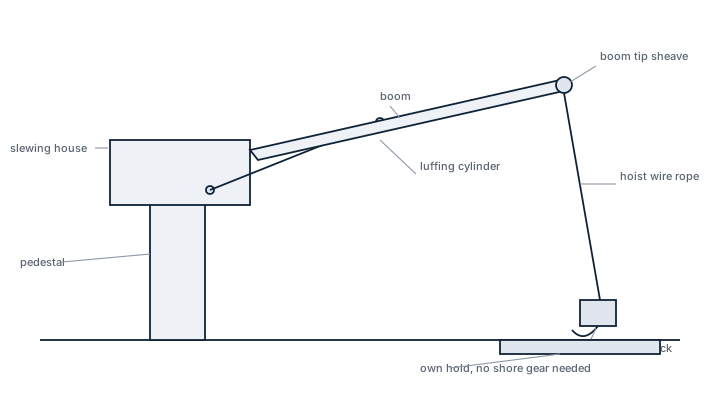
Main components
Pedestal and slewing ring
The crane sits on a welded steel pedestal through the deck, transferring load into the ship's structure below, with a slewing bearing allowing the upper works to rotate through the required slew angle, often a full 360 degrees or limited to clear deckhouses and rigging.
Boom and luffing system
The boom carries the load block out from the pedestal; luffing is done by a hydraulic cylinder on smaller cranes or by a luffing wire and winch on larger, wire-luffed designs. Boom length and permissible luffing angle set the crane's outreach and lifting radius.
Hoist winch and wire rope
The hoist winch pays out and takes in the main lifting wire, typically through a hydraulic motor and planetary gearbox, with a multi-layer drum and a load brake that holds the load if hydraulic pressure is lost.
Power pack and controls
Most modern cargo cranes are hydraulically driven from an electric-motor-driven power pack in the pedestal base, with proportional controls in the operator's cab giving smooth start and stop on hoist, luff, and slew to avoid load swing.
Load block and safety devices
The load block carries the cargo hook; overload protection and limit switches on hoist, luff, and slew, together with an anti-two-block device on many cranes, stop the crane before mechanical damage occurs.
Selection and sizing
| Parameter | Why it matters |
|---|---|
| Safe Working Load | Sets the cargo the crane can lift at a given radius; a larger SWL usually reduces outreach at maximum load. |
| Outreach / radius | Determines how far over the quay or an adjacent hold the crane can work. |
| Duty cycle | Continuous cargo operation needs higher-rated components than occasional-use cranes. |
| Power source | Hydraulic, electric-hydraulic, or fully electric affects response, maintenance, and generator load. |
| Cab position and visibility | Operator sightlines into the hold and over the quay affect safe, efficient working. |
Regulations and class
Cargo cranes are lifting appliances and fall under class society rules for cargo gear, including periodic thorough examination and proof load testing, commonly around every four to five years for proof load and annually for thorough examination. SOLAS Ch. II-1 and, where the flag applies it, ILO Convention 152 address safe working practices for lifting appliances; a register of lifting appliances and loose gear is kept on board and produced at survey.
Typical faults
- Wire rope wear or broken wires beyond discard criteria: reduced breaking strength, risk of load drop under working load.
- Hydraulic cylinder seal leakage on the luffing cylinder: loss of boom position control, drift under load.
- Slewing ring wear or contamination: rough, jerky slewing and eventually excessive bearing play.
- Load brake slippage: load creeps down when hoist control is centred, a serious safety issue.
- Limit switch failure: loses automatic protection against over-hoisting or over-luffing, increasing reliance on operator judgement alone.
What to look for in a supplier
- Proof load test certificate and thorough examination records supplied with the crane, not only a general conformity statement.
- Spare parts commonality with cranes the operator already runs, to simplify the ship's spares inventory.
- Documented SWL and radius curve for the full range, not just the maximum SWL figure.
- Local service support in the trading area, given that hydraulic cargo cranes need periodic hands-on maintenance.
- Cab ergonomics and visibility suited to the vessel's actual cargo operations, not a generic layout.
Check that the load brake holds with the hoist control centred and no hydraulic pressure applied before every cargo operation: a brake that slips under load is the fault most likely to end in an accident, not a paperwork finding.