What to check on a Offshore Crane.
A general cargo crane lifts and lowers a load on a stationary or slowly rolling ship, with the operator judging timing against the ship's own motion. An offshore crane routinely has to land a load on, or lift it from, a structure that is not moving with the ship at all: a fixed platform, another vessel, or the seabed. Vessel heave, roll and pitch mean the crane tip is constantly changing position relative to the load's destination. Offshore cranes handle this with active or passive heave compensation, letting the winch…
What sets an offshore crane apart
A general cargo crane lifts and lowers a load on a stationary or slowly rolling ship, with the operator judging timing against the ship's own motion. An offshore crane routinely has to land a load on, or lift it from, a structure that is not moving with the ship at all: a fixed platform, another vessel, or the seabed. Vessel heave, roll and pitch mean the crane tip is constantly changing position relative to the load's destination. Offshore cranes handle this with active or passive heave compensation, letting the winch pay out or take in wire to hold the load at a near-constant position, or under near-constant tension, regardless of the vessel's motion.
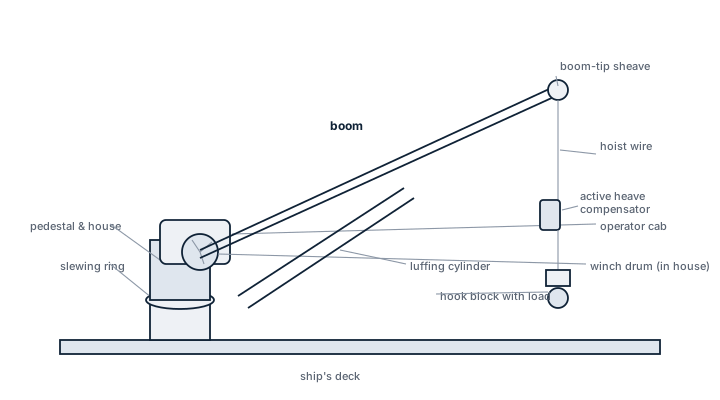
Main components
Pedestal and slew system
Fixed base and slewing ring carrying the full crane, with hydraulic or electric slew drives; on larger offshore cranes the pedestal is a significant structural item engineered into the ship's hull.
Boom and luffing system
Knuckle-boom or lattice-boom designs are both used; knuckle booms fold compactly for stowage and give better reach control close to the vessel, lattice booms give greater reach and capacity at longer radius.
Main and auxiliary winch
The main winch carries the working load; the heave compensation system, whether active and constantly driven by the control system, or passive and reacting to line tension, sits in or alongside this winch.
Motion reference unit
Feeds real-time vessel motion data to the crane's control system on active heave-compensated cranes, so the winch can counteract heave in near real time rather than reacting after the fact.
Selection and sizing
- Safe working load at the required radius, read from the crane's full load chart, not a single headline lifting capacity figure.
- Heave compensation performance: stroke length and response time against the sea states the vessel is expected to operate in.
- Duty class and design factor appropriate to the lift type: cargo transfer, subsea, or personnel transfer, which carry different safety factors.
- Deck footprint, pedestal strength requirement and reach against the vessel's actual operating envelope.
Regulations and class
Class societies certify offshore cranes against their own lifting appliance rules, which set design factors, proof-load and periodic test requirements distinct from cargo gear rules. Cranes used for personnel transfer carry additional certification and are subject to stricter design factors and independent wire rope condition monitoring. Periodic thorough examination and load testing intervals are set by class and enforced through the vessel's safety management system.
Typical faults
| Fault | Cause | Consequence |
|---|---|---|
| Heave compensation lag | Motion reference unit miscalibrated or control tuning not matched to the actual sea state | Load impact or snatch loading at the point of transfer |
| Wire rope degradation | Repeated snatch loading and fleet angle issues on the compensated winch | Accelerated fatigue, risk of rope failure under load |
| Slew or luff drift under load | Hydraulic system leakage or wear in holding valves | Uncontrolled load movement, particularly hazardous during personnel transfer |
| Overload trip in a following sea | Load chart used without correcting for dynamic amplification from vessel motion | Emergency stop mid-lift, or exceeding the crane's rated capacity |
What to look for in a supplier
- Class type approval for the specific crane model and, separately, for its heave compensation system.
- Documented compensation performance tested against real sea-state data, not simulation alone.
- Track record with the specific transfer type intended, since certification and safety case differ between cargo, subsea and personnel transfer.
- Remote diagnostics and a service network reachable at the vessel's actual operating area.
Treat the crane's load chart as a starting point, not the answer, in any real sea state; dynamic amplification from vessel motion can exceed the static safe working load well before the operator sees a warning.