What to check on a Ship Crane (General).
A general-purpose deck crane is built to handle a range of duties rather than one dedicated cargo, from loading break-bulk or containers on a general cargo ship to hoisting stores, spare parts, hoses and maintenance equipment on a tanker or bulk carrier where cargo handling itself is shore-side. This flexibility is its defining feature and its limitation: it will not match a dedicated container gantry's speed or a heavy-lift crane's capacity, but it covers everything a crew needs day to day without relying on port equipment being available or compatible…
What sets a general-purpose ship crane apart
A general-purpose deck crane is built to handle a range of duties rather than one dedicated cargo, from loading break-bulk or containers on a general cargo ship to hoisting stores, spare parts, hoses and maintenance equipment on a tanker or bulk carrier where cargo handling itself is shore-side. This flexibility is its defining feature and its limitation: it will not match a dedicated container gantry's speed or a heavy-lift crane's capacity, but it covers everything a crew needs day to day without relying on port equipment being available or compatible with the vessel.
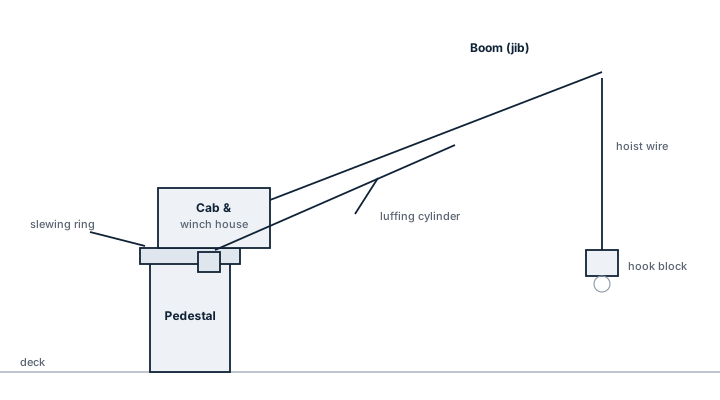
Main components
Pedestal
Fixed base welded into the deck structure, transferring all crane loads into the hull.
Slewing ring and drive
Allows the crane to rotate through its working arc, or a full 360 degrees on many general-purpose designs.
Jib or boom
The load-carrying arm, luffing to change radius and reach; may be a fixed-length boom or a telescopic design for variable reach.
Hoist winch and wire
Raises and lowers the load; larger cranes carry a separate whip hoist for light, fast lifts alongside the main hoist for heavy loads.
Power pack
Hydraulic or electric drive for slew, luff and hoist functions, with local and remote control stations.
Load moment limiter
Monitors load against radius and automatically prevents operation beyond the crane's rated capacity curve.
Selection and sizing
- Safe working load required at maximum radius, since capacity falls as reach increases and the full rated load is usually only available close to the pedestal.
- Outreach needed to clear the ship's side and reach the quay or an adjacent barge.
- Duty cycle — occasional stores handling versus frequent cargo operation changes wear rate and drives different component selection.
- Power source available on board, hydraulic or electric, matching existing deck machinery infrastructure.
Regulations and class requirements
Ship cranes are certified as lifting appliances under class society rules for cargo gear, with proof load testing before entry into service and periodic thorough examination thereafter, generally annual visual inspection with a more extensive load test at longer intervals. Flag state cargo gear certification requirements apply in parallel, and the crane's rated capacity chart must be posted at the control station and kept current with any modification to the rigging or hoist arrangement.
Typical faults
| Fault | Consequence |
|---|---|
| Wire rope wear or broken strands | Reduced safe working load margin, requires replacement before the next lift rather than after a failure. |
| Load moment limiter miscalibration | Crane may allow operation beyond safe radius-load combinations without the intended automatic cutout. |
| Slew bearing wear | Play or roughness in rotation, increasing wear on the drive and risk of jerky, uncontrolled movement under load. |
| Hydraulic hose or seal leakage | Loss of lifting or lowering control mid-operation, a hazard with a suspended load. |
What to look for in a supplier
- Capacity chart matched to the vessel's actual outreach and lift requirements, not a nominal maximum figure alone.
- Load moment limiter and control system compatible with the vessel's existing power supply and control philosophy.
- Cargo gear certification documentation ready for the flag state and class society before delivery.
- Spares availability for hoist wire, hydraulic components and slew bearing at the vessel's normal trading ports.
Read the capacity chart at the radius actually being used, not the crane's headline maximum — the same crane that lifts twenty tonnes close in may be rated for a fraction of that once the jib is luffed out to reach a barge alongside.