Main Engine 4-Stroke
A four-stroke main engine completes intake, compression, power and exhaust in four piston strokes per cycle, turns far faster than a slow-speed two-stroke of comparable power, and needs a reduction gearbox to bring propeller shaft speed down to something a propeller can use.
What to check on a Main Engine 4-Stroke.
131 models from Hanshin in Main Engine 4-Stroke. Below: the full model list.
What sets four-stroke main engines apart
A four-stroke main engine fires once every two crankshaft revolutions, cycling through intake, compression, power and exhaust, compared with the once-per-revolution cycle of a slow-speed two-stroke. That extra mechanical step is what a camshaft and valve train are for, and it is the defining difference from the crosshead two-stroke engines used as direct-drive propulsion on large tankers and container ships. Running at medium speed, typically from a few hundred up to just over a thousand RPM depending on bore size, a four-stroke main engine turns far faster than a propeller wants to go, so it drives the shaft through a reduction gearbox rather than directly. This is also what lets several engines share one gearbox and one propeller shaft, a configuration common on ferries and offshore vessels that two-stroke propulsion cannot offer.
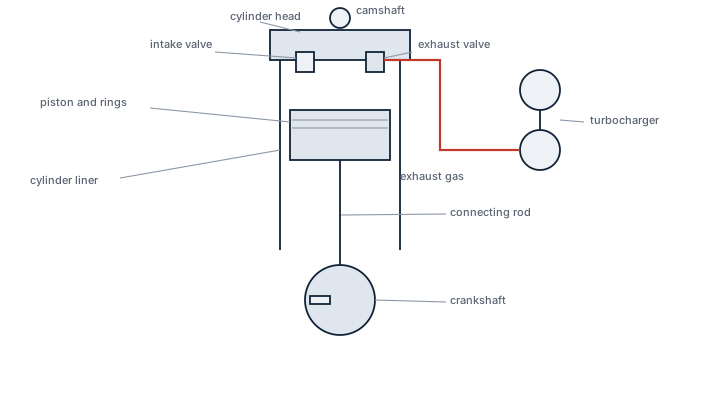
Legend
- Camshaft
- Cylinder head
- Intake valve
- Exhaust valve
- Piston and rings
- Exhaust gas to turbine
- Turbocharger
- Cylinder liner
- Connecting rod
- Crankshaft
Main components
Cylinder block and trunk piston
Unlike a two-stroke's crosshead design, a four-stroke uses a trunk piston that takes side thrust directly from the connecting rod, which keeps the engine shorter and lighter for its power but puts more load on the piston skirt and cylinder liner.
Camshaft and valve train
Gear- or chain-driven camshafts operate intake and exhaust valves in the cylinder head, timed to the four-stroke cycle. This valve train is a maintenance item in its own right, since clearance checks, valve seat wear and camshaft bearing condition all need periodic attention that a two-stroke's simpler port arrangement does not.
Read the full guide
Turbocharger and charge air system
Exhaust-driven turbochargers, usually one or two per engine depending on cylinder count, force air into the cylinders to make up for the shorter, faster cycle producing less natural aspiration than a large slow-speed engine.
Fuel injection
Modern medium-speed engines increasingly use common-rail injection, which allows injection timing and pressure to be controlled independently of engine speed; older and simpler designs still use jerk-pump systems driven mechanically off the camshaft.
Reduction gearbox
Brings engine output speed down to propeller shaft speed, and on multi-engine installations combines the output of two or more engines onto a single shaft, often with clutches so individual engines can be taken offline.
Selection and sizing
Power output, cylinder count and configuration, inline or V, are set by the required propulsion power and the space available in the engine room, since a V-configuration packs more cylinders into a shorter engine room at the cost of width. Speed rating interacts directly with gearbox ratio selection, and fuel flexibility, whether marine diesel oil only or dual-fuel gas capability, is decided at the ordering stage because it changes the whole fuel system, not just the engine.
- Rated power and speed at the propeller design point, not just the engine's maximum continuous rating
- Number of engines per gearbox and the redundancy that gives against a single engine failure
- Fuel flexibility, whether single fuel, dual fuel, or ready for a future retrofit
- Space and weight against the engine room layout, particularly for multi-engine diesel-electric arrangements
Regulations and class
Main engines are surveyed under the class society's periodic survey scheme, with continuous machinery survey as an option on many vessels. Emissions are governed by MARPOL Annex VI, which sets NOx limits by engine build date and operating area, with tighter Tier III limits inside Emission Control Areas that most modern medium-speed engines meet through selective catalytic reduction or exhaust gas recirculation rather than engine design alone. Fuel sulphur limits under the same annex apply regardless of engine type.
Typical faults
| Cause | Consequence |
|---|---|
| Valve clearance drift or valve seat wear | Loss of compression, rough running, burnt valves if left unchecked |
| Turbocharger fouling or bearing wear | Falling charge air pressure, black smoke, reduced power |
| Injector wear or common-rail leakage | Poor combustion, cylinder-to-cylinder imbalance, increased fuel consumption |
| Trunk piston skirt or liner wear | Increased blow-by, rising lube oil consumption, eventual liner replacement |
What to look for in a supplier
- Global service network, since medium-speed engines are worked hard on tight schedules and need parts and technicians available where the ship trades
- Confirmed emission compliance for the intended trading area, not just the engine's country of build
- Spare parts commonality across a fleet if the operator runs several sister ships
- Documented condition monitoring support, since vibration and performance trending catch turbocharger and bearing problems before they become failures
Track charge air pressure and exhaust temperature spread across cylinders on every watch - a single cylinder drifting away from its sisters is usually the first sign of an injector or valve problem, long before it shows up as lost power.
Models in this type.
The best-documented model of each manufacturer first, then the next — 100 of 131 models in Main Engine 4-Stroke. Every row links to full specifications, documents and service notes.
Manufacturers.
All 121 manufacturers with models of Main Engine 4-Stroke. Names with a manufacturer page open it; the others open a search across the full library.
All manufacturersShow all 121 manufacturers
- A/S Grenaa Motorfabrik1
- Aabenraa Motorfabrik, Heinrich Callesen1
- AGCO Power Inc.2
- Akasaka Diesel2
- Alaska diesel electric5
- Anqing CSSC Diesel Engine Co., Ltd.5
- Bergen Engines19
- Beta Marine6
- BUKH1
- C.M.D. COSTRUZIONI mOTORI dIESEL8
- Caterpillar Motoren GmbH & Co. KG11
- Chongqing Cummins Engine Co. Ltd.1
- Cox Powertrain1
- CSSC / Hudong Heavy4
- CSSC Marine Power Zhenjiang Co., Ltd.4
- CSSC/Hudong10
- Cummins Mercruiser diesel9
- DAIHATSU INFINEARTH MFG. CO., LTD.3
- Detroit Diesel9
- engine.od / MAN Service Letters3
- Fairbanks Morse Engine4
- FPT - iveco motors4
- Frydenbø Industri AS1
- FRYDENBØ SABB MOTOR AS3
- ge Rail2
- Gravois Aluminum Boats, dba Metal Shark1
- Guascor (Siemens Energy)10
- HD Hyundai Heavy Ind. Co., Ltd. Engine & Machinery Division7
- HD Hyundai Heavy Industries Co., Ltd1
- HD Hyundai Infracore8
- Henan Diesel Engine Industry Co., Ltd.3
- Hyundai17
- IHI Agri-Tech10
- IHI Power Systems8
- IHI shibaura mAchinery1
- Ishikawajima-shibaura Machinery1
- isotta fraschini motori S.P.A1
- Isuzu MOTORS18
- IVECO17
- IVECO/FPT18
- Japan Engine9
- John Deere3
- Kawasaki7
- Kawasaki Heavy Industries, Ltd. Kobe Works1
- Kirloskar Oil Engines Ltd.1
- Kubota1
- MAN11
- MAN Diesel & Turbo, Filial of MAN Diesel & Turbo SE, Tyskland1
- MAN Nutzfahrzeuge1
- Marine Diesel Engineering1
- Marinediesel Sweden4
- Mercury Marine8
- Mitsubishi Heavy Industries20
- Mitsubishi Heavy Industries Engine & Turbocharger6
- Mitsubishi Turbocharger and Engine Europe15
- MITSUI E&S1
- mNB1
- MTU Friedrichshafen GmbH1
- Oceanair environmental4
- OXE Marine AB1
- Progress Rail Locomotive, Inc.6
- Rolls-Royce Bergen -Engines1
- Rolls-Royce Solutions America3
- Rolls-Royce Solutions GmbH11
- Sandfirden Technics7
- SEMCO1
- Shanghai Cummins Trade Co., Ltd.1
- SKL Motor5
- SOLE S.A.4
- speccodexjacobsen6
- Stamford/Cummins1
- Steyr Motors7
- Sword marine technology1
- Tognum America5
- Transportation systems business operations of general electric28
- Twin Disc1
- US EPA1
- Vetus18
- VETUS Mitsubishi4
- Vm Motori10
- Volkswagen7
- Wabtec Transportation Systems, LLC6
- Westerbeke12
- Yanmar Power Solutions Co., Ltd.3
- ZF Marine1
Also in Main Engines (4-Stroke).
The other equipment types in this category.
One request. A person reads it and replies by e-mail.
Tell us the manufacturer, the model and what you need — a part, a service call, a second opinion. A person reads every request and replies by e-mail.
No details at hand? A photo of the rating plate or the part is enough — simply attach it to the request.
Three things people ask first.
Is Main Engine 4-Stroke data free?
Yes. Every model page, every guide and every datasheet for this type is readable without an account. An account adds saved searches and requests, nothing is taken away.
My model is missing — what now?
Send us the nameplate. We identify it by hand, add it to the library, and if you need a part or a service, the request is already on our desk.
Can you source a Main Engine 4-Stroke part?
Yes. Tell us the manufacturer, the model and what you need — a person reads every request and replies by e-mail.