What to check on a Main Engine (4-Stroke Trunk Piston).
A medium-speed four-stroke trunk-piston engine completes its combustion cycle in four piston strokes (intake, compression, power, exhaust) per two crankshaft revolutions, typically running at 400 to 1000 rpm depending on size. Because a propeller needs to turn far slower than that for efficiency, these engines always drive through a reduction gearbox, and often a controllable-pitch propeller to allow full engine power to be used across a range of ship speeds without stalling the engine. This is the fundamental split from slow-speed two-stroke crosshead engines, which turn at propeller speed directly…
What makes this type
A medium-speed four-stroke trunk-piston engine completes its combustion cycle in four piston strokes (intake, compression, power, exhaust) per two crankshaft revolutions, typically running at 400 to 1000 rpm depending on size. Because a propeller needs to turn far slower than that for efficiency, these engines always drive through a reduction gearbox, and often a controllable-pitch propeller to allow full engine power to be used across a range of ship speeds without stalling the engine. This is the fundamental split from slow-speed two-stroke crosshead engines, which turn at propeller speed directly with no gearbox and no piston skirt contact with the cylinder wall. Trunk-piston engines are the standard choice for ferries, offshore vessels, cruise ships, and increasingly diesel-electric plants, where several medium-speed sets driving generators (rather than a shaft directly) give redundancy and flexible loading that a single large two-stroke cannot.
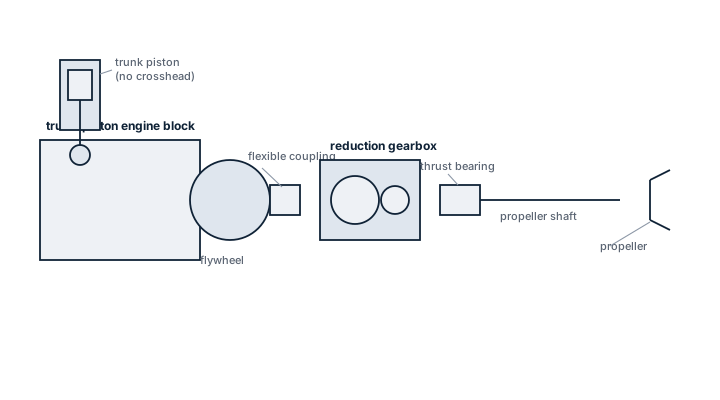
Main components
Cylinder block and trunk pistons
Unlike a crosshead engine, the piston itself takes the side thrust from the connecting rod (hence "trunk" piston, with an extended skirt to handle that side load), which is why cylinder lubrication and piston ring design differ substantially from a two-stroke crosshead design.
Camshaft and valve gear
Gear- or chain-driven camshaft operates intake and exhaust valves and, on mechanically injected engines, the fuel pumps; many modern units use common-rail electronic injection instead.
Turbocharger and charge air system
Essential for the power density these engines achieve; charge air coolers control intake temperature, which directly affects both power output and NOx formation.
Reduction gearbox
Steps engine speed down to propeller speed, and on multi-engine plants combines the output of two or more engines onto a single shaft, with clutches allowing individual engines to be declutched for maintenance while the ship remains under power from the others.
Selection / Sizing
Power is selected against the ship's required speed and the propeller curve, but the practical decision is usually single large engine versus multiple smaller engines in parallel through a combining gearbox — the latter costs more in gearbox complexity but gives redundancy (losing one of four engines still leaves propulsion) and better part-load efficiency, since unneeded engines can be shut down rather than all units running lightly loaded. Fuel type (MDO, HFO with the right auxiliary systems, or dual-fuel gas-capable variants) is a major selection axis that affects injection system, cylinder lubrication regime, and exhaust aftertreatment needs.
Regulations / Class
MARPOL Annex VI Tier II or Tier III NOx limits apply according to keel-laying date and the ship's Emission Control Area trading pattern, with Tier III typically met through exhaust gas recirculation or selective catalytic reduction rather than in-cylinder measures alone at this engine class. EIAPP certification is required per engine. Class rules require torsional vibration analysis of the full shaft line including gearbox and, for multi-engine combining gearboxes, specific approval of the clutch and combining arrangement. SOLAS redundancy requirements for certain ship types (e.g., some offshore and passenger vessels) directly favour the multi-engine trunk-piston arrangement over a single engine.
Typical faults
- Cylinder liner wear from lubrication mismatch — using the wrong cylinder oil alkalinity for the fuel sulphur content accelerates liner and ring wear.
- Turbocharger fouling — reduced boost pressure, rising exhaust temperatures, and falling power output, usually from inadequate compressor-side cleaning intervals.
- Gearbox clutch wear on combining gearboxes — slippage during engine engagement/disengagement, often first noticed as unusual vibration during load transfer between engines.
- Injector fouling on HFO-burning units — uneven cylinder loads and rising smoke, traceable to fuel quality or injector maintenance interval slippage.
- Torsional vibration issues after gearbox or coupling repair — if alignment or coupling stiffness changes without re-checking the torsional analysis, resonance can appear at operating speeds that were previously clear.
What to look for in a supplier
- NOx compliance path (Tier II or Tier III with the aftertreatment it requires) matched to the ship's actual trading area, not the minimum for delivery.
- Combining gearbox and clutch design proven in the specific multi-engine configuration intended, since this is where redundancy either works or does not.
- Cylinder lubrication and fuel-flexibility documentation if the ship may switch between MDO and HFO or run dual-fuel.
- Service network coverage for the trading pattern — medium-speed engines see more frequent overhaul intervals than slow-speed two-strokes and downtime cost adds up fast without local support.
Match cylinder oil alkalinity to actual fuel sulphur content, not the figure printed on the bunker delivery note from six months ago — fuel quality drifts between bunkerings and the liners pay for it quietly until a survey finds the wear.