Self-Priming Pump
A self-priming pump can evacuate air from its own suction line and start moving liquid without a foot valve or separate priming system, which is exactly why it is the standard choice for bilge, stripping, and dirty water duties where the suction line cannot stay flooded.
What to check on a Self-Priming Pump.
27 models from Uflex in Self-Priming Pump. Below: the full model list.
What makes a self-priming pump different
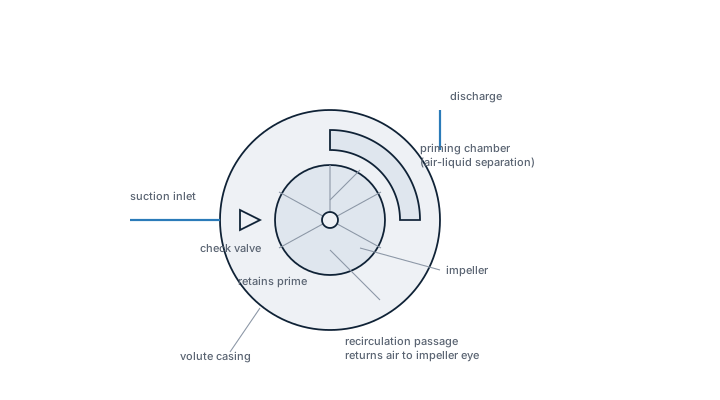
Most centrifugal pumps lose prime and stop pumping the moment air enters the casing, because a centrifugal impeller cannot compress air the way it compresses liquid. A self-priming pump gets around this by retaining a volume of liquid in the casing between duty cycles and recirculating it internally to entrain and expel the air in the suction line before true pumping begins. This is what lets it start dry, evacuate an empty suction line by itself, and recover prime after running dry momentarily, none of which a standard centrifugal pump can do without a separate priming device such as a liquid ring vacuum pump or ejector.
Main components
Casing with reserve liquid chamber
The casing is shaped to trap a volume of liquid after shutdown, usually a litre or more depending on pump size, so the next start has something to recirculate.
Impeller
Semi-open or fully open impellers are common on dirty-water self-priming pumps because they pass solids and fibrous debris without clogging the way a closed impeller with tight wear rings would.
Read the full guide
Recirculation port/separation chamber
An internal passage returns air-laden liquid from the discharge side back to the eye of the impeller, where the air separates out and vents through the discharge while liquid recirculates, repeating until the suction line is fully evacuated.
Mechanical seal or packing gland
Bilge and stripping duty means intermittent dry running and abrasive solids, so seal choice has a direct effect on service life; many bilge pumps still use packing specifically because it tolerates a dry-running restart better than some mechanical seal faces.
Selection and sizing
Key figures: rated capacity in cubic metres per hour at the duty head, self-priming lift (the vertical suction lift the pump can re-establish from dry, typically a few metres), maximum solids size passed through the impeller, and NPSH required at the duty point. Bilge and stripping service also calls for a wide operating range rather than a single best-efficiency point, since the pump must handle nearly empty tanks (mostly air) down to the last few centimetres of liquid.
Regulations and class
- SOLAS Ch. II-1 sets minimum bilge pumping arrangements and capacity requirements depending on ship type and size.
- Class rules require at least one independently powered bilge pump available with the engine room flooded, which shapes where self-priming units are fitted versus emergency bilge pumps driven off the main engine.
- Stripping pump performance for cargo tanks on tankers is checked against the applicable MARPOL Annex I stripping quantity requirements during survey.
Typical faults
| Fault | Consequence |
|---|---|
| Reserve liquid chamber lost through a leaking casing gasket or drained down over a long idle period | Pump cannot self-prime on next start and runs dry, risking seal or wear-ring damage |
| Impeller clearance opened up by abrasive wear from bilge solids | Priming time lengthens and rated capacity falls even though the pump still runs |
| Suction strainer partially blocked | Pump struggles to reach rated flow and can cavitate intermittently, sounding like a healthy pump under partial load |
| Air leak at a suction line joint | Pump repeatedly loses prime mid-cycle even though it primed successfully at start-up |
What to look for in a supplier
- Confirmed self-priming lift figure tested at the actual suction line length and lift the installation requires, not just a catalogue number.
- Materials suited to bilge water chemistry: bronze or stainless impellers and wear rings resist the abrasive, sometimes corrosive mix found in engine room bilges.
- Spare parts kits sized to the maintenance interval class expects, particularly seals and wear rings.
- Reference installations on similar ship types where duty cycle (frequent start/stop versus continuous run) matches the intended service.
A self-priming pump that takes noticeably longer to prime than it did new is telling you the reserve chamber seal or the impeller clearance has opened up; do not wait for it to fail to prime altogether before opening it up for inspection.
Models in this type.
The best-documented model of each manufacturer first, then the next — 27 of 27 models in Self-Priming Pump. Every row links to full specifications, documents and service notes.
Manufacturers.
All 27 manufacturers with models of Self-Priming Pump. Names with a manufacturer page open it; the others open a search across the full library.
All manufacturersAlso in Pumps.
The other equipment types in this category.
One request. A person reads it and replies by e-mail.
Tell us the manufacturer, the model and what you need — a part, a service call, a second opinion. A person reads every request and replies by e-mail.
No details at hand? A photo of the rating plate or the part is enough — simply attach it to the request.
Three things people ask first.
Is Self-Priming Pump data free?
Yes. Every model page, every guide and every datasheet for this type is readable without an account. An account adds saved searches and requests, nothing is taken away.
My model is missing — what now?
Send us the nameplate. We identify it by hand, add it to the library, and if you need a part or a service, the request is already on our desk.
Can you source a Self-Priming Pump part?
Yes. Tell us the manufacturer, the model and what you need — a person reads every request and replies by e-mail.