Panama Chock
A Panama chock is a closed, oversized fairlead let into the bulwark specifically to take the canal's own towing lines during a Panama Canal transit, sized and positioned to a fixed specification the canal authority checks rather than to the ship's own mooring plan.
What to check on a Panama Chock.
47 models from Smith Berger in Panama Chock. Below: the full model list.
What sets a Panama chock apart from other mooring fairleads
Most fairleads and chocks on deck are sized and positioned around the ship's own mooring lines and winches, to suit its normal berthing pattern. A Panama chock is different: its opening size, wall thickness and deck position are set to a specification the Panama Canal Authority applies to transiting ships, because the chock has to take the canal's own centreline towing lines run out to the electric mules that hold the ship in the lock chambers, not the ship's own mooring wires. A ship without correctly positioned and sized Panama chocks can be delayed or refused transit until temporary fittings are arranged.
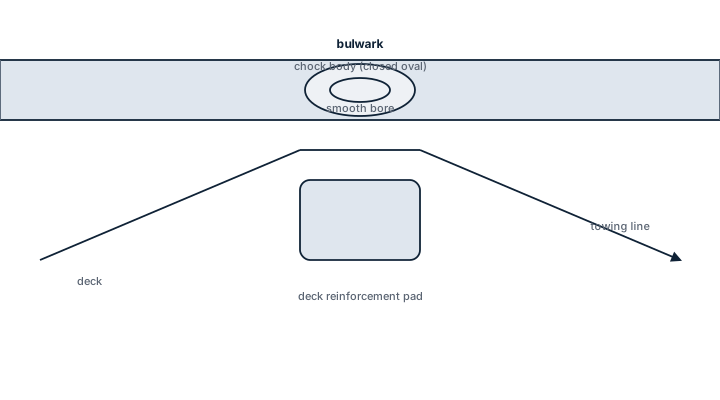
Legend
- bulwark
- chock body (closed oval)
- smooth bore
- towing line
- deck
- deck reinforcement pad
Main components
Chock body
A closed oval casting or fabrication recessed into or mounted on the bulwark, with rounded, smooth-radius bearing surfaces to avoid chafing the canal's towing lines as the ship works through a lock.
Base and bulwark reinforcement
Doubling plates and internal stiffening around the chock to carry the towing loads transmitted through it, since the loads involved in canal transit can be higher than the ship's own mooring operations generate at that fairlead.
Read the full guide
Bulwark opening
Positioned at defined intervals along each side to match the canal's standard line-handling arrangement, so mule operators can run lines to a predictable point on any ship passing through.
Selection and sizing
Because the specification comes from the canal authority rather than from the ship's own mooring design, selection is a matter of building to that specification rather than optimising for the ship's normal trade:
- Minimum number of chocks per side required for the ship's length and tonnage category
- Opening dimensions and bearing surface radius set by the current Panama Canal specification
- Deck-edge spacing and position relative to the ship's fairleads and bitts, so canal lines and the ship's own mooring gear do not foul each other
- Structural reinforcement adequate for the towing loads the canal's mules can apply
Regulations and class
Fitting is driven by the Panama Canal Authority's own vessel requirements rather than by SOLAS or IMO instruments, though the chock and its bulwark reinforcement still fall under the ship's class rules for hull outfitting and deck equipment strength. Ships intending to transit are checked against the canal's published requirements at the admeasurement stage, and non-compliant fittings are one of the items that can hold up a transit.
Typical faults
| Fault | Consequence |
|---|---|
| Chock opening undersized or wrongly positioned for the current canal specification | Delay or refusal of transit until temporary chocks are rigged |
| Corrosion or wear on the bearing surface | Chafing damage to the canal's towing lines, a chargeable incident |
| Bulwark reinforcement inadequate or corroded | Local structural damage under the towing load during a lock transit |
| Chock painted over repeatedly until the radius is lost | Sharp edges that cut into lines under load |
What to look for in a supplier
- Fabrication built to the current published Panama Canal chock specification, not an older or generic pattern
- Documented structural calculation for the bulwark reinforcement under towing load
- Smooth, correctly radiused bearing surfaces without casting defects that could chafe a line
- Experience fitting chocks that have actually passed canal admeasurement on comparable ships
Check the chocks against the current canal specification before a scheduled transit, not after arrival at the pilot station — the specification has been revised over the years and an older ship can fall out of compliance without anything having changed on board.
Models in this type.
The best-documented model of each manufacturer first, then the next — 47 of 47 models in Panama Chock. Every row links to full specifications, documents and service notes.
Manufacturers.
All 13 manufacturers with models of Panama Chock. Names with a manufacturer page open it; the others open a search across the full library.
All manufacturers in the libraryAlso in Anchor & Mooring Equipment.
The other equipment types in this category.
Write to us about this model — the answer comes by e-mail.
Name the make and the model and what the job is: a spare, a service call, a second opinion on a data sheet. We answer by e-mail.
No details at hand? A photo of the rating plate or the part is enough — simply attach it to the request.
Questions that come up with this equipment.
Is Panama Chock data free?
Yes. Every model page, every guide and every datasheet for this type is readable without an account. An account adds saved searches and requests, nothing is taken away.
My model is missing — what now?
Send us the nameplate. We identify it by hand, add it to the library, and if you need a part or a service, the request is already on our desk.
Can you source a Panama Chock part?
Yes. Tell us the manufacturer, the model and what you need — a person reads every request and replies by e-mail.