What to check on a Combined Windlass/Mooring.
A combined unit puts the anchor cable lifter (the wildcat) and one or two mooring warping drums on the same shaft line, driven through a common gearbox from a single hydraulic motor or electric motor. This differs from a split arrangement of a dedicated anchor windlass forward and separate mooring winches along the deck: the combined design saves deck space and installed power on smaller vessels where anchor handling and mooring are never required at the same instant, but it means the mooring drum cannot be run at full rated…
What defines a combined windlass/mooring winch
A combined unit puts the anchor cable lifter (the wildcat) and one or two mooring warping drums on the same shaft line, driven through a common gearbox from a single hydraulic motor or electric motor. This differs from a split arrangement of a dedicated anchor windlass forward and separate mooring winches along the deck: the combined design saves deck space and installed power on smaller vessels where anchor handling and mooring are never required at the same instant, but it means the mooring drum cannot be run at full rated pull while the wildcat is also working the cable, because both draw on the same drive train and brake system.
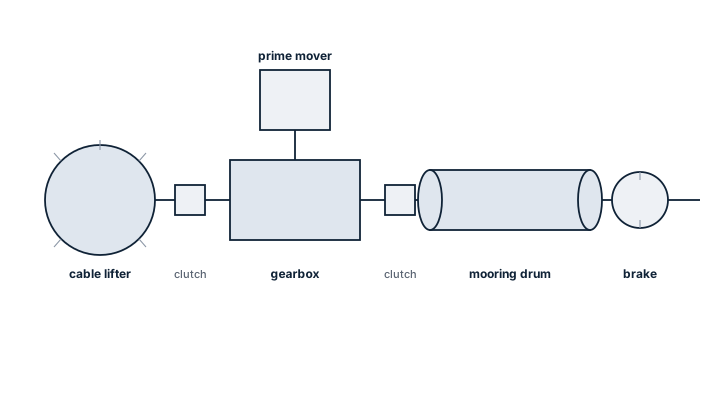
Main components
Wildcat (cable lifter)
A grooved wheel matched to the chain size that engages the links and pays cable in or out; declutchable from the main shaft so the chain can be walked back or veered under brake control alone.
Warping/mooring drum
One or two smooth drums for mooring line, mounted on the same shaft, also declutchable so the drum can be used independently of the wildcat.
Band brake
A mechanical brake on the wildcat shaft that holds the anchor cable under load with the clutch disengaged and the drive shut down; its holding capacity, not the motor, is what actually secures the anchor at rest.
Prime mover and gearbox
Typically a hydraulic motor fed from a dedicated power pack, or an electric motor through a reduction gearbox; sized for anchor hoisting speed and mooring line pull rather than the other way round, since anchor recovery is usually the higher power demand of the two duties.
Selection and sizing
Anchor-side sizing follows class rules for equipment number, which set minimum chain size, wildcat pull and hoisting speed for the vessel's dimensions. Mooring-side sizing follows the required line pull and speed for the vessel's mooring arrangement, expressed as rated pull at first layer and brake holding load, typically well above the rated pull. Where both duties share one drive, the manufacturer's rating has to be checked for whichever duty is more demanding, and the deck arrangement has to allow the mooring drum to be used without fouling the anchor cable led over the same shaft.
| Parameter | Governs |
|---|---|
| Equipment number (class rule) | Minimum chain size, wildcat pull, hoisting speed |
| Rated line pull | Mooring drum sizing at first layer |
| Brake holding load | Safety margin over rated pull, both duties |
| Prime mover power | Sized on the more demanding of anchor or mooring duty |
Regulations and class
Class rules derive an equipment number from the vessel's length, breadth and freeboard, which in turn sets minimum anchor mass, chain size and windlass performance; this applies equally to a combined unit. Brake holding capacity, wildcat pull and hoisting speed are all verified at builder's trials. Mooring line pull and drum brake holding are checked against the ship's mooring arrangement plan, and for many vessel types against IACS recommendations on mooring equipment covering safe working load and line angles. Periodic survey includes load testing of the anchor windlass brake and inspection of the wildcat and drum for wear.
Typical faults
- Band brake lining wear — reduced holding torque lets the anchor cable render under load, the most safety-critical failure mode of the whole unit.
- Wildcat pocket wear — a worn wildcat no longer grips the chain links positively, causing slip and accelerating further wear on both wildcat and chain.
- Clutch slippage — a worn dog clutch between drum and shaft fails to fully engage, giving reduced mooring pull that is easy to mistake for a hydraulic power problem.
- Hydraulic power pack contamination — on hydraulic-drive units, water or particulate contamination in the hydraulic oil scores the motor and control valves, showing up first as erratic speed control.
What to look for in a supplier
- Class-approved rating certificate covering both the anchor duty and the mooring duty at the power actually installed.
- Brake holding capacity documented as a multiple of rated pull, not just stated as class compliant.
- Availability of wildcat and drum liner spares sized to the specific chain and rope in use onboard.
- Local service support for hydraulic power pack maintenance if the unit is hydraulically driven, since this is the more failure-prone half of the system.
Never rely on the clutch or the motor to hold an anchor at stay — set the band brake and disengage the clutch, because the brake is the only element in the chain rated and tested to hold the load with the drive shut down.