What to check on a Mooring Roller.
A fixed fairlead simply redirects a mooring line over a smooth, non-moving surface, relying on the surface finish and radius alone to limit chafe. A mooring roller replaces that fixed surface with one or more rotating drums, so the line rolls rather than slides as it changes direction under load, which cuts friction and line wear substantially, especially where the line angle changes frequently during a mooring operation such as at a Panama-type chock. The trade-off is mechanical complexity: bearings, seals and a rotating assembly that itself needs maintenance and…
What distinguishes a mooring roller from a fixed fairlead
A fixed fairlead simply redirects a mooring line over a smooth, non-moving surface, relying on the surface finish and radius alone to limit chafe. A mooring roller replaces that fixed surface with one or more rotating drums, so the line rolls rather than slides as it changes direction under load, which cuts friction and line wear substantially, especially where the line angle changes frequently during a mooring operation such as at a Panama-type chock. The trade-off is mechanical complexity: bearings, seals and a rotating assembly that itself needs maintenance and can seize.
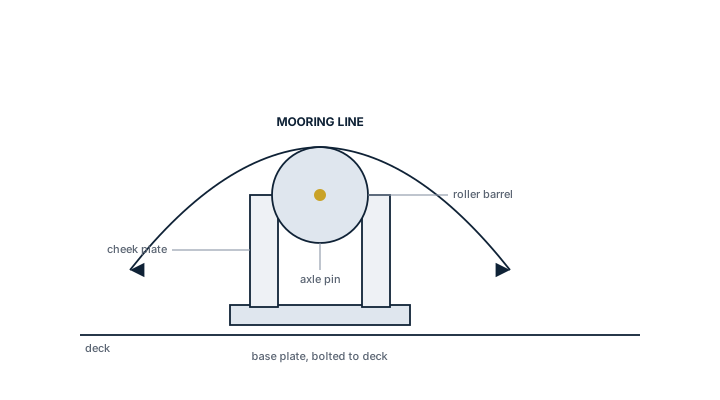
Main components
Roller drum
The rotating body the line runs over, usually a steel or composite cylinder sized to the expected rope or wire diameter and bend radius requirement.
Bearings and shaft
Support the drum and allow it to rotate freely under mooring load; plain bushings are common and simpler, while roller or ball bearings reduce friction further but need more careful lubrication and sealing against salt water.
Housing / chock body
The fixed structure bolted or welded to deck that carries the shaft and defines the line's lead angle and the vertical and horizontal limits of travel.
Selection and sizing
- Safe working load matched to the mooring line's breaking strength and the vessel's mooring arrangement, not just the deck fitting's nominal rating.
- Roller diameter large enough to keep the line's minimum bend radius within its rated limit, since a roller that is too small still causes line damage despite rotating.
- Bearing type suited to the maintenance regime realistically available - sealed-for-life bearings reduce upkeep but cannot be inspected internally.
- Corrosion protection appropriate to the exposure, since mooring rollers sit in one of the wettest, most salt-exposed positions on deck.
Regulations and class
Mooring equipment is sized against the vessel's Equipment Number under the classification society's mooring and anchoring rules, which set minimum line breaking strength and, indirectly, the loads the fairleads and rollers must handle. Class surveys check mooring fittings for wear, deformation and secure attachment to deck at the periodic hull survey, and any fitting showing cracking or significant wear against its original dimensions is renewed rather than repaired.
Typical faults
| Fault | Cause | Consequence |
|---|---|---|
| Roller will not turn, line drags across it | Seized bearing from lack of lubrication or salt water ingress | Roller acts as a fixed fairlead again, line chafes and wears fast |
| Grooving or flat spots on the drum surface | Line running repeatedly under high load at the same point | Rope or wire chafes against the damaged surface, accelerating rope wear |
| Excessive play in the shaft | Worn bushing or bearing, corrosion of the shaft | Line can jump the roller under sudden load, increasing snap-back risk |
| Cracked housing or deck attachment | Fatigue from repeated mooring loads, corrosion at the weld | Fitting can fail suddenly under load - a mooring line under tension that lets go is a serious injury risk |
What to look for in a supplier
- Safe working load certificate matched to the vessel's actual mooring line strength, not a generic deck fitting rating.
- Material and coating specification suited to the vessel's trading area and exposure.
- Bearing type and lubrication interval clearly stated, so it matches what the crew can realistically maintain.
- Dimensional drawing confirming fit to the existing deck footprint and bolt pattern before ordering.
A roller that has seized solid is more dangerous than no roller at all, because the crew still trusts it to turn - check rollers turn freely by hand at every mooring station inspection, not just that they are physically present.