What to check on a Capstan.
A capstan is a powered rotating drum on a vertical shaft, used to haul in mooring lines, warp the ship alongside a berth, or recover a line under tension that a crew could not handle by hand. The defining difference from a windlass is the axis: a windlass drum turns horizontally and is built around a chain wildcat to raise and lower the anchor, while a capstan has no wildcat and does not touch chain at all. Where deck arrangement allows a horizontal winch, yards usually fit a combined windlass…
What sets a capstan apart
A capstan is a powered rotating drum on a vertical shaft, used to haul in mooring lines, warp the ship alongside a berth, or recover a line under tension that a crew could not handle by hand. The defining difference from a windlass is the axis: a windlass drum turns horizontally and is built around a chain wildcat to raise and lower the anchor, while a capstan has no wildcat and does not touch chain at all. Where deck arrangement allows a horizontal winch, yards usually fit a combined windlass; a standalone capstan appears where deck space around the winch is too narrow for a horizontal barrel, on poop decks, at midship mooring stations, or wherever a second independent pulling point is needed without running hydraulic or electric supply all the way from the forecastle.
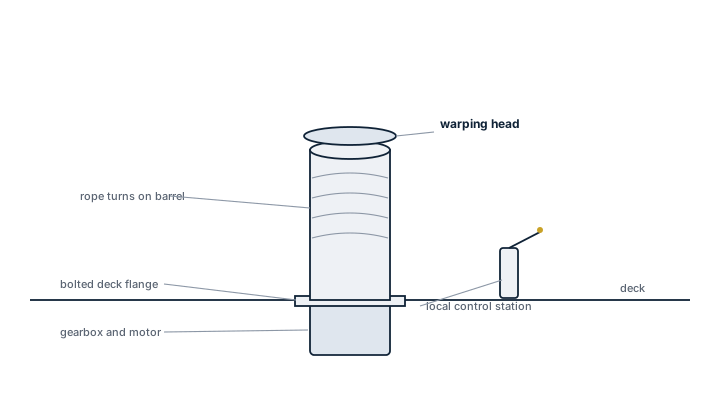
Because the drum sits vertical, a line can be walked around it from almost any direction and tended by one or two crew standing at the barrel, paying out or taking in by hand while the machine supplies the pulling force. That geometry is why capstans remain common at mooring stations even on ships that also carry full windlass-winch combination units forward.
Main components
Drive unit
Electric motor or hydraulic motor mounted below deck, driving the barrel through a gear reducer. Hydraulic drive dominates on larger units because torque control at low, near-stall speed is easier to manage than with an electric motor alone.
Warping drum / barrel
The vertical drum the line is walked around, usually with a slightly conical or waisted profile (whelped) so turns of rope do not ride up or jam. Barrel diameter and the number of turns taken determine how much load the friction of the rope against the drum can hold.
Brake
A band or disc brake on the drive shaft that holds a line under load without power to the motor, needed whenever the crew must let go the barrel to tend the line by hand.
Base and foundation
Capstans are through-bolted to a reinforced deck insert; the foundation, not the machine housing, carries the mooring load into the ship's structure, so foundation condition matters as much as the capstan itself.
Selection and sizing
Sizing turns on line pull, not drum diameter alone.
| Parameter | Typical range |
|---|---|
| Rated line pull | 30 - 150 kN depending on vessel size |
| Warping speed | 15 - 20 m/min at rated load |
| Rope diameter handled | usually matched to the ship's mooring line schedule, commonly 40 - 64 mm |
| Drive type | hydraulic for continuous duty stations, electric for lighter, occasional use |
Deck planners also check swept radius of the barrel against adjacent bulwarks, fairleads and bollards, and whether the motor and reducer fit below deck without fouling tanks or piping.
Regulations and class
Mooring equipment including capstans falls under the ship's approved mooring arrangement, reviewed by class against the equipment number calculated from the ship's dimensions, windage and displacement. Class rules require the safe working load to be marked at the machine and require periodic function testing and load-holding checks of the brake as part of the mooring equipment survey. There is no separate IMO convention specific to capstans; they are assessed as part of the anchoring and mooring system under the classification society's own rules.
Typical faults
- Brake slip under load - worn linings or contaminated brake surfaces let the drum creep, and a slipping brake under a loaded mooring line is a direct injury risk to anyone standing in the line's bight.
- Whelp and barrel wear - grooving from years of rope friction reduces grip, so the same number of turns holds less load than it used to.
- Gear reducer oil leakage - seal wear lets lubricant escape, and a reducer run low on oil overheats and can seize under sustained warping load.
- Hydraulic motor loss of torque - internal wear or a failing relief valve setting shows up as a capstan that stalls well below its rated pull.
What to look for in a supplier
- Documented rated line pull and warping speed backed by a test certificate, not just a nameplate figure.
- Brake design that holds rated load with the drive disengaged, verifiable at commissioning.
- Spares availability for the specific gear reducer and hydraulic motor model, since these are often proprietary to the winch maker.
- Deck foundation drawing compatible with the ship's existing bolting pattern where the unit replaces an older capstan.
Never stand in the bight of a line being taken in on a capstan - a slipping brake or a jammed turn on the barrel can put full mooring load through that loop in an instant.