What to check on a Mooring Tail.
Steel wire mooring lines are strong but stretch very little, so surge, wash from passing traffic, and tidal movement at the berth translate almost directly into peak loads on the wire, the winch, and the fittings it runs through. A mooring tail is a length of synthetic rope, usually nylon for its high elasticity or polyester for a more moderate stretch, spliced onto the end of the wire so that the line as a whole absorbs shock loading through the tail's stretch before it reaches the wire and the ship's…
What a mooring tail does
Steel wire mooring lines are strong but stretch very little, so surge, wash from passing traffic, and tidal movement at the berth translate almost directly into peak loads on the wire, the winch, and the fittings it runs through. A mooring tail is a length of synthetic rope, usually nylon for its high elasticity or polyester for a more moderate stretch, spliced onto the end of the wire so that the line as a whole absorbs shock loading through the tail's stretch before it reaches the wire and the ship's mooring equipment.
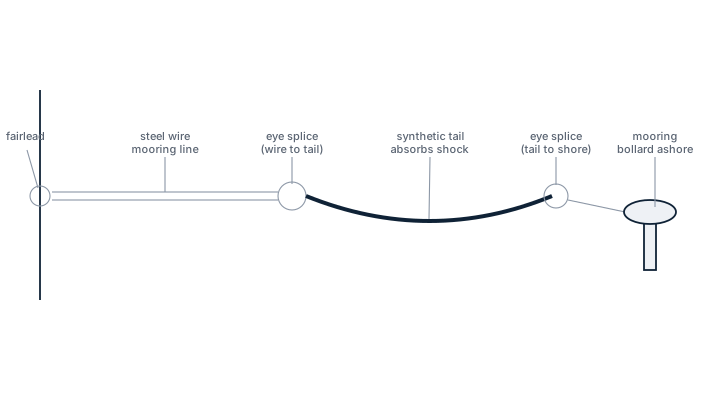
Construction and main components
- Rope material — nylon for maximum elongation and shock absorption, polyester where controlled stretch with less energy storage is preferred; polypropylene is generally avoided for tails because of its lower strength retention.
- Eye splice to the wire — a mechanical or hand splice joining the tail to the wire's own eye, sized so the joint itself does not become the weak point of the assembly.
- Chafe protection — a leather, canvas, or synthetic sleeve fitted where the tail runs through the fairlead or over the ship's side, since this is where abrasion damage concentrates.
- Length — typically in the region of 11 metres, though this varies with the mooring arrangement and is set to keep the elastic working length long enough to matter without over-lengthening the assembly.
Selection and sizing
Tail diameter and construction are matched to the breaking strength of the wire it is spliced to, following the mooring line manufacturer's compatibility tables rather than a generic strength match, since a tail that is too strong relative to the wire defeats the purpose of shock absorption and one that is too weak becomes the failure point. Ship type matters too: vessels on berths exposed to swell or heavy passing-vessel wash get more benefit from a longer, more elastic nylon tail than ships on sheltered, still-water berths.
Regulations and class
Mooring equipment falls under class society mooring and anchoring notations, with minimum breaking loads for mooring lines set against the ship's equipment number. Industry guidance from bodies such as OCIMF, particularly for tankers, sets recommended practice for tail material, length, and inspection intervals, and terminals increasingly expect documented compliance with this guidance before they will accept a ship alongside.
Typical faults
| Fault | Consequence |
|---|---|
| UV degradation of nylon or polyester fibres | Reduced breaking strength that is not visible from the outside of the rope. |
| Chafe damage at the fairlead left unprotected | Localised fibre damage concentrates at exactly the point of highest load. |
| Eye splice worked loose or improperly made | Joint fails under sudden load, parting the tail from the wire entirely. |
| Tail not rotated or retired on a schedule | Fatigue accumulates unevenly across the mooring line inventory, with the weakest tail unknown until it fails. |
What to look for in a supplier
- Breaking strength matched to this ship's specific wire, with the compatibility calculation shown, not just a rope of similar-sounding diameter.
- Splicing done to a documented standard, ideally with a certificate stating the tested strength of the finished eye, not just the rope stock.
- Chafe protection included as standard, not sold separately as an afterthought.
- Clear guidance on inspection and retirement criteria so the crew has an objective standard rather than a visual guess.
Retire a mooring tail on a schedule based on hours in use and visible chafe, not on whether it has actually broken yet — by the time a tail parts on the berth, it has usually been giving warning signs for weeks.