What to check on a Quick Release Hook.
Most mooring gear — bollards, bitts, fairleads — assumes the crew has time to ease a line under control. A quick release hook is built for the opposite case: a line that has to come off now, at full tension, because the ship must cast off in an emergency or because a mooring line has gone dangerously overloaded. The hook carries a pivoting cam or jaw that holds the eye of the line under load, and a separate trigger mechanism — mechanical, hydraulic or pneumatic — that releases the cam…
What sets a quick release hook apart
Most mooring gear — bollards, bitts, fairleads — assumes the crew has time to ease a line under control. A quick release hook is built for the opposite case: a line that has to come off now, at full tension, because the ship must cast off in an emergency or because a mooring line has gone dangerously overloaded. The hook carries a pivoting cam or jaw that holds the eye of the line under load, and a separate trigger mechanism — mechanical, hydraulic or pneumatic — that releases the cam independently of that load. Pulling the trigger does not require first taking the strain off the line, which is what makes the hook different from a bollard or a set of bitts.
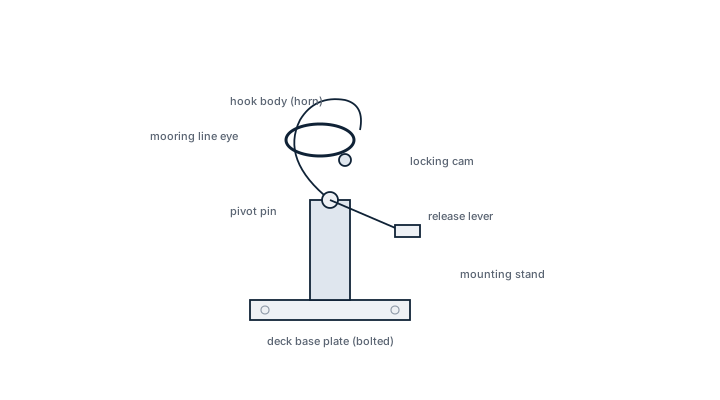
Main components
Hook body and cam
A forged or cast hook with a spring-loaded or counterweighted cam that closes over the eye of the mooring line and locks against a stop. The cam geometry is designed so line tension keeps it shut rather than forcing it open.
Release trigger
A manual lever with a mechanical linkage on the simplest designs; a hydraulic ram or pneumatic actuator on remote-release versions used on tanker manifolds and SPM terminals. The trigger disengages the cam latch, letting the line run free.
Load pin / load cell
Fitted on many terminal-facing hooks to give a continuous tension reading, feeding a mooring line monitoring system so the duty officer can see when a line approaches its safe working load before it needs to be released at all.
Base and swivel
The hook sits on a swivelling base bolted to deck, allowing it to align with the lead of the line and avoid side-loading the cam mechanism, which is the single biggest cause of a hook that will not release cleanly.
Selection criteria
- Safe working load (SWL) matched to the mooring line's minimum breaking load with the correct design factor, not just the line diameter.
- Single or double hook body, depending on whether one or two lines share the same fairlead.
- Local, remote or dual release — remote pneumatic or hydraulic release is standard at SPM and CALM buoy moorings where the terminal, not the ship, may need to trigger release.
- Material and coating for the trade: hot-dip galvanized steel is common, stainless or duplex components where the hook sits in permanent spray.
Regulations and class
There is no SOLAS chapter dedicated to quick release hooks, but OCIMF's Mooring Equipment Guidelines (MEG4) set the working practice most tanker operators and terminals now hold ships to, including proof load testing and inspection intervals for hooks and their load pins. Class societies require the hook and its foundation to be included in the ship's mooring equipment arrangement plan and to pass a proof load test — typically 1.5 times SWL — before entry into service and again at intervals set by the class rules, with the certificate kept on board.
Typical faults
| Fault | Consequence |
|---|---|
| Corrosion or paint buildup jamming the cam pivot | Hook will not release on demand — the exact failure mode it exists to prevent |
| Load pin sensor drift or cable damage | Console shows false tension, line held past safe working load without warning |
| Trigger linkage misaligned after deck maintenance | Premature or uncommanded release under load, a serious injury hazard to nearby crew |
| Base bolts loosened by vibration | Hook shifts under side load, cam binds, release force rises sharply |
What to look for in a supplier
- A proof load test certificate traceable to the individual hook, not just the model type.
- Documented compatibility with the mooring line construction actually carried on board — HMPE lines behave differently in the jaw than wire or polyester.
- Spare cams, pins and trigger seals held as standard stock, since a hook out of service removes a mooring station.
- Clear servicing instructions for the release mechanism, since this is the one piece of deck gear where a stiff, badly greased trigger defeats the entire purpose.
Test the trigger under no load every time the hook is inspected, not just at survey — a cam that looks free by hand can still bind once a real load is pulling it shut.