What to check on a Chain Stopper.
The windlass brake is designed to control chain paying out and to hold moderate loads, but it is not meant to carry the anchor's full working load for long periods, and the gypsy and brake band would wear quickly if asked to. Once the anchor is on the bottom with enough chain out, the crew disengages the windlass from the chain and transfers the load onto a chain stopper, a fixed deck fitting that grips the chain directly, usually between two links, and holds it against the ship's structure rather…
What a chain stopper is for
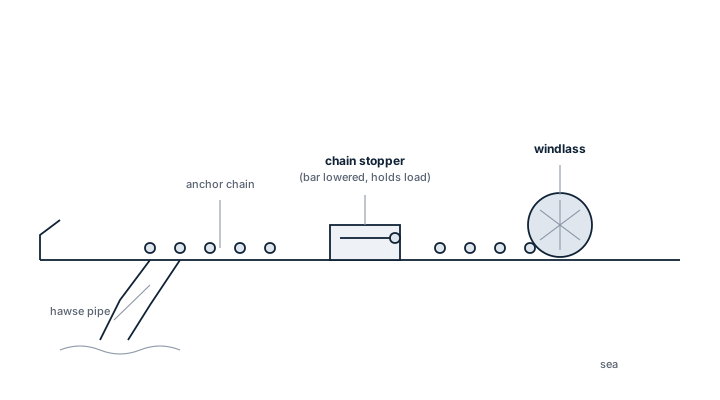
The windlass brake is designed to control chain paying out and to hold moderate loads, but it is not meant to carry the anchor's full working load for long periods, and the gypsy and brake band would wear quickly if asked to. Once the anchor is on the bottom with enough chain out, the crew disengages the windlass from the chain and transfers the load onto a chain stopper, a fixed deck fitting that grips the chain directly, usually between two links, and holds it against the ship's structure rather than against the windlass gearing.
Main components
Bar or guillotine
A pivoting bar drops across the chain, resting in the gap between two links so the load bears directly on the bar and its pin, not on friction; some designs use a sliding guillotine plate instead of a pivoting bar.
Base and securing pin
The stopper body is through-bolted or welded to reinforced deck plating directly in line with the hawse pipe, so the load path runs straight into the ship's structure rather than sideways through the deck.
Tensioning screw or turnbuckle (some designs)
On stoppers used also to take up slack for sea stowing, a screw mechanism lets the crew snug the chain up tight against the hawse pipe once the anchor is fully housed, reducing chain movement and noise in a seaway.
Selection and sizing
A chain stopper must be rated to at least the breaking load of the chain it holds, not simply matched to chain diameter by eye:
- Chain grade and diameter, since stopper bar dimensions and the link gap they engage are specific to a given chain size.
- Safe working load rating relative to the chain's certified breaking strength, with margin for shock loading in a seaway.
- Deck arrangement and hawse pipe alignment, since the stopper must sit in a straight line between hawse pipe and windlass gypsy.
- Material and corrosion protection suited to constant spray exposure at the anchor deck.
Regulations and class
Class societies size anchoring equipment, including chain stoppers, as part of the ship's Equipment Number calculation, which sets anchor mass, chain diameter and length based on the vessel's hull dimensions and windage. The stopper itself is assessed against the certified breaking load of the chain grade fitted, and class surveys check its condition, security of fastening and freedom from cracking at each periodic anchor equipment inspection, alongside the windlass brake test.
Typical faults
| Fault | Consequence |
|---|---|
| Worn or deformed bar/guillotine seating | Chain can jump the stopper under shock load, transferring full load back onto the windlass brake |
| Cracked weld or loosened bolts at the base | Load path into the deck structure is compromised, risking a sudden failure under strain |
| Corroded pivot pin, stopper will not drop or lift freely | Crew cannot engage or release the stopper quickly, delaying anchoring or weighing operations |
| Misalignment with hawse pipe and gypsy | Chain runs at an angle through the stopper, causing uneven wear and jamming risk |
What to look for in a supplier
- Rating certificate matched to the ship's actual chain grade and diameter, not a generic capacity claim.
- Material traceability and mill certificates for the bar and body, since this is a safety-critical casting or forging.
- Correct dimensions for the existing deck footprint and hawse pipe alignment, to avoid re-engineering the deck fitting.
- Willingness to supply load test documentation if the class society requires proof testing after installation or repair.
Check the bar-to-link seating by eye every time the stopper is engaged, not just at survey; a bar that has started to ride up on a worn link edge instead of seating flush is the first visible sign it is about to let the chain slip.