Cargo Tank Coating
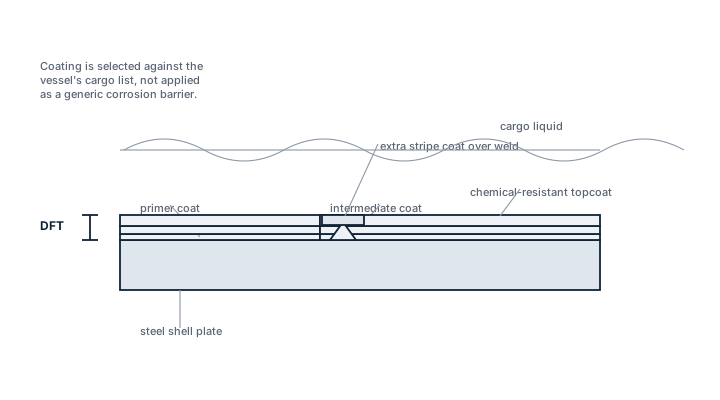
Cargo tank coating on a chemical or product tanker is chosen against the specific cargo list the vessel intends to carry, not applied as a generic corrosion barrier, because chemical resistance and cargo compatibility rule out most coating systems that would otherwise be adequate anti-corrosive paint.
What to check on a Cargo Tank Coating.
46 models from Jotun in Cargo Tank Coating. Below: the full model list.
What sets cargo tank coating apart
Deck and ballast tank coatings mainly resist corrosion from seawater and atmosphere. Cargo tank coating on a chemical or product tanker has a second, often harder job: it must resist chemical attack from whatever the charterer loads next, and it must not contaminate that cargo with taste, odour or dissolved coating material. A tanker's Certificate of Fitness lists an approved cargo list matched to its coating type; carrying a cargo not on that list, or one the coating is not proven against, can mean cargo rejection at the discharge port even if the ship itself is undamaged.
Main coating types
Epoxy-phenolic
The most widely used cargo tank coating on product and chemical tankers; good general chemical resistance and a long track record, but it can be attacked by strong acids and some solvents, and its cargo list must be checked cargo by cargo.
Zinc silicate
Very hard and abrasion-resistant, common for clean petroleum products, but unsuitable for many chemical cargoes and sensitive to cargoes that react with zinc.
Read the full guide
Stainless steel, uncoated
Not a coating at all but the alternative to one: tanks built in stainless steel avoid the cargo-list restriction entirely at the cost of much higher newbuild price, and are standard on dedicated chemical carriers trading a wide cargo range.
Surface preparation
Coating performance depends as much on the steel surface profile achieved before application, through blast cleaning to a specified roughness and cleanliness grade, as on the coating chemistry itself; a correctly specified coating over poor surface preparation fails early regardless.
Selection
- Intended cargo list: the coating manufacturer's cargo resistance list must cover every cargo the charter party or trading pattern expects, checked at the specified concentration and temperature.
- Number of coats and total dry film thickness, since chemical resistance depends on achieving full, pinhole-free coverage at the specified thickness.
- Cargo temperature range: heated cargoes push some coating systems outside their proven resistance envelope even for a cargo they otherwise tolerate.
- Cure time and conditions before first cargo loading; a coating loaded before full cure gives up its chemical resistance early.
Regulations and class
IMO's IBC Code governs which cargoes a chemical tanker may carry and drives the coating or material requirement recorded on the Certificate of Fitness. The coating manufacturer's recognised cargo resistance list is cross-checked against the ship's intended trade at newbuilding and whenever a new cargo is proposed. Class and flag surveys include periodic tank coating condition surveys, with breakdown coverage thresholds that can trigger a Condition of Class if exceeded.
Typical faults
| Fault | Cause | Consequence |
|---|---|---|
| Blistering | Solvent or moisture trapped under the coating during application or early cargo exposure | Coating breakdown, exposed steel, potential cargo contamination |
| Cargo staining or off-spec cargo | Coating not resistant to the actual cargo loaded, or loaded before full cure | Cargo rejection or downgrade at discharge, commercial claim against the ship |
| Localised breakdown at welds and edges | Insufficient stripe coating on edges and welds during application | Early corrosion starting at high-stress points, spreading under the coating |
| Coating loss from mechanical cleaning | Repeated aggressive tank cleaning such as high-pressure hotwash | Progressive thinning, reduced remaining chemical resistance life |
What to look for in a supplier
- A current, IMO-recognised cargo resistance list covering the specific cargoes the ship intends to trade.
- Documented surface preparation standard and application procedure, with a qualified applicator and independent film-thickness inspection during application.
- Batch traceability for the coating used, since cargo claims can require proof of which product and batch was applied.
- Track record on comparable tonnage in the same trade, since chemical tanker coatings are judged over years of cargo exposure.
Never treat "epoxy coated" as a single specification; the same generic coating family covers products with very different cargo lists, and the document that matters names the exact product and its approved cargoes.
Models in this type.
The best-documented model of each manufacturer first, then the next — 46 of 46 models in Cargo Tank Coating. Every row links to full specifications, documents and service notes.
Manufacturers.
All 15 manufacturers with models of Cargo Tank Coating. Names with a manufacturer page open it; the others open a search across the full library.
All manufacturersAlso in Paint & Coating Systems.
The other equipment types in this category.
One request. A person reads it and replies by e-mail.
Tell us the manufacturer, the model and what you need — a part, a service call, a second opinion. A person reads every request and replies by e-mail.
No details at hand? A photo of the rating plate or the part is enough — simply attach it to the request.
Three things people ask first.
Is Cargo Tank Coating data free?
Yes. Every model page, every guide and every datasheet for this type is readable without an account. An account adds saved searches and requests, nothing is taken away.
My model is missing — what now?
Send us the nameplate. We identify it by hand, add it to the library, and if you need a part or a service, the request is already on our desk.
Can you source a Cargo Tank Coating part?
Yes. Tell us the manufacturer, the model and what you need — a person reads every request and replies by e-mail.