What to check on a Boot Topping Paint.
Boot topping is not a performance coating in the sense that antifouling is -- it does not release biocide and does not need hydrodynamic smoothness. Its job is narrower: survive the waterline strip that alternates between full seawater immersion and air exposure as the vessel moves between loaded and ballast draft, several times a voyage on a bulker or tanker. That cycling causes blistering and adhesion failure in coatings not designed for it, which is why boot topping is a distinct product line rather than an extension of either the…
What Makes Boot Topping Different
Boot topping is not a performance coating in the sense that antifouling is -- it does not release biocide and does not need hydrodynamic smoothness. Its job is narrower: survive the waterline strip that alternates between full seawater immersion and air exposure as the vessel moves between loaded and ballast draft, several times a voyage on a bulker or tanker. That cycling causes blistering and adhesion failure in coatings not designed for it, which is why boot topping is a distinct product line rather than an extension of either the antifouling or the topside system it sits between.
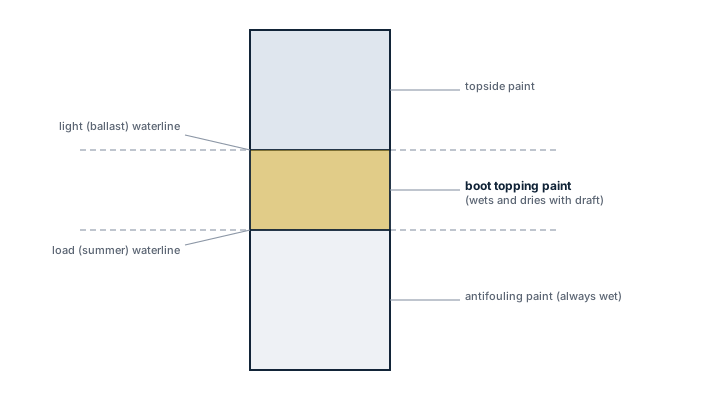
It differs from antifouling in one direction (no biocide, tolerates drying out) and from topside enamel in the other (tolerates continuous or repeated immersion, resists osmotic blistering).
Composition and Types
Vinyl Tar and Bituminous Systems
Older and lower-cost boot topping is based on chlorinated rubber or vinyl tar, offering reasonable water resistance at low material cost but requiring more frequent recoating and generally being phased out under solvent emission restrictions in many ports.
Epoxy-Based Systems
Modern boot topping is typically a two-component epoxy, sometimes epoxy-mastic for tolerance of marginal surface preparation, giving stronger adhesion and better resistance to the wet/dry cycling than tar-based products.
Colour and Pigmentation
Boot topping is conventionally supplied in dark red, black or grey to visually mark the design waterline and to hide the staining that inevitably occurs at that band; the colour also gives crew and port state control an easy visual check on the vessel's draft against its marks.
Selection Considerations
Choice depends less on sizing calculations than on compatibility with the coatings above and below it. Boot topping must be applied over a compatible primer and must not react with the antifouling tie-coat below or the topside primer above -- an incompatible interface is the single most common cause of early failure. Trading pattern matters too: a vessel that spends long periods in ballast with the boot topping band permanently dry needs less immersion resistance than one that runs consistently near full draft.
Regulations and Class
Boot topping is not separately regulated by IMO instruments, but the coating system as a whole falls under class society requirements for hull coating specification, and where anti-corrosive primers below the boot topping are concerned, must meet the Performance Standard for Protective Coatings (PSPC) requirements that apply to ballast tanks and, on newer tonnage, to void spaces -- the external boot topping band itself sits outside PSPC's scope but is recorded in the ship's coating technical file.
Typical Faults
| Fault | Cause | Consequence |
|---|---|---|
| Blistering along the waterline | Osmotic pressure from moisture trapped under the film, often from inadequate surface preparation | Local coating breakdown and accelerated corrosion |
| Peeling at the antifouling interface | Chemical incompatibility between boot topping and the antifouling tie-coat | Early exposure of bare steel, need for premature drydock touch-up |
| Chalking and fading | UV exposure combined with continuous wet/dry cycling | Cosmetic loss of waterline definition, not usually structural |
| Rapid wear at the forward shoulder | Wave slap and ice or debris abrasion concentrated at the bow waterline | Localised recoating needed between drydocks |
What to Look for in a Supplier
- Written confirmation of compatibility with the specific antifouling and primer already specified for the rest of the hull system.
- Technical data sheet stating recoat intervals and minimum/maximum overcoating windows during the drydock schedule.
- Reference projects on similar trading patterns, since ballast-heavy trades cycle the boot topping band harder than fully laden trades.
- Supply consistency across drydock ports, since touch-up mid-contract with a different manufacturer's product is a frequent source of the incompatibility faults above.
Check the boot topping band at every port call, not just in drydock -- it is the first place hull damage shows and the cheapest place to catch a coating failure before it reaches the steel.