Deck Paint (Anti-Slip)
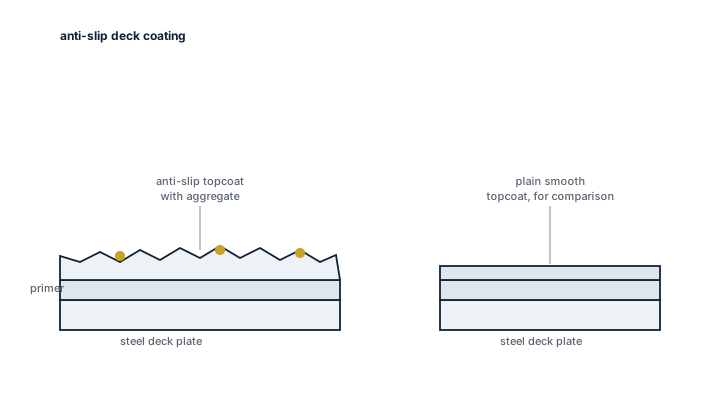
Anti-slip deck paint replaces the smooth, high-build finish used elsewhere on the hull with a textured film loaded with aggregate, because on walkways, stair treads and working decks the operational risk is a crew member's boot losing grip, not steel loss over years.
Read more — Deck Paint (Anti-Slip) explained ▾
What sets anti-slip deck paint apart from general deck coatings
General deck paint is chosen mainly for corrosion resistance and ease of cleaning; anti-slip paint accepts a rougher, harder-to-clean surface in exchange for measurable underfoot grip. It is applied where people walk in wet, oily or icy conditions with a load in their hands: gangways, stair treads, engine room floor plates, helicopter decks and open working decks forward and aft. The coating is not a separate chemistry so much as a standard epoxy or polyurethane system with a coarse aggregate broadcast or mixed into the top coat before it cures, so the film keeps the same corrosion protection as the layers beneath it while gaining texture on the surface.
Main components
Primer and intermediate coats
Beneath the textured top coat sits the same zinc-rich or epoxy primer and epoxy intermediate build used on any steel deck area, sized for the expected exposure. The anti-slip property does nothing for the steel if this substructure is thin or poorly prepared, so surface preparation standards do not relax just because the final coat is textured.
Textured top coat
The top coat carries the aggregate, either pre-mixed into the paint or broadcast by hand into the wet film and then sealed with a thin top-seal coat. Pre-mixed systems give a more even texture and are faster to apply; broadcast systems give a coarser, longer-lasting grip and are preferred on high-traffic stair treads and gangways.
Aggregate
Aluminium oxide, silica sand or crushed quartz are the common aggregates, graded by particle size. Coarser grades give more grip but wear boot soles and deck-cleaning brushes faster and are harder to keep clean of oil; finer grades are easier to maintain but lose grip sooner under traffic.
Selection and sizing
| Variable | Why it matters |
|---|---|
| Aggregate grit size | Coarser grit for stairs and gangways, finer for large open deck areas that need regular cleaning |
| Dry film thickness | Anti-slip systems typically run thicker than smooth deck paint because the aggregate sits within the film, not on top of a thin layer |
| Colour | Safety colours (yellow, red) are used on hazard edges and escape routes independent of the base coating colour |
| Chemical exposure | Engine room floor plates need oil and fuel resistance; open deck areas need UV and salt resistance |
Regulations and class
There is no dedicated SOLAS chapter for deck paint, but anti-slip surfaces on escape routes, stairways and muster station approaches fall under the general SOLAS Ch. II-2 requirement that means of escape remain usable in an emergency, and class societies check this during structural and safety surveys rather than as a coating-specific item. Helicopter decks carry their own friction requirements under the applicable helideck design guidance, tested periodically with a slip-resistance measurement rather than a visual check.
Typical faults
- Aggregate polished smooth by foot traffic before the underlying film is worn - grip is lost while the coating still looks intact, so visual inspection alone misses the failure.
- Top coat applied too thin over the aggregate, leaving sharp particles exposed - accelerates boot sole wear and gives a false sense of security since the surface still looks anti-slip.
- Oil and grease trapped in the textured surface on engine room plates - the aggregate that should improve grip becomes a slip hazard once contaminated, and is harder to clean than a smooth floor.
- Full recoat applied without removing the old aggregate layer - builds an uneven, spongy film that debonds under foot traffic within months.
What to look for in a supplier
- Published slip-resistance test data (pendulum test values) for the specific product, not just a generic "anti-slip" label
- A defined aggregate grade and application method matched to the deck area, not a one-size-fits-all system
- Compatibility confirmed with the existing coating system if this is a partial recoat rather than a full strip
- Chemical resistance data if the area sees fuel, oil or cleaning chemicals routinely
Test grip with a wet boot, not a dry hand - an anti-slip deck that feels rough to the touch in dry dock can still be dangerously smooth once it has a film of sea spray and diesel on it.
2 manufacturers · 2 models
AkzoNobel / International Paint
1- • High corrosion resistance on steel substrates
- • Allows thick dry film (≈150 µm) for robust protection
- • Excellent adhesion to most polyurethane or alkyd deck topcoats when overcoated within the specified window
- • Proven durability in harsh marine environments
- • Designed to work with International's own anti‑slip deck systems
- • Requires meticulous surface preparation; flash rust can develop on inadequately cleaned steel
- • Low viscosity may cause sagging on vertical areas if applied too thickly
- • Not compatible with certain epoxy or high‑solvent topcoats
- • Longer curing time compared with fast‑dry primers
- • Must be overcoated within a limited window (typically 6–12 h) to achieve optimal performance
- Flash rusting on steel substrate
- Sagging on vertical areas
- Incompatible topcoating
- High corrosion resistance on steel substrates
- Allows thick dry film (≈150 µm) for robust protection
- Excellent adhesion to most polyurethane or alkyd deck topcoats when overcoated within the specified window
- Proven durability in harsh marine environments
- Designed to work with International's own anti‑slip deck systems
- Requires meticulous surface preparation; flash rust can develop on inadequately cleaned steel
- Low viscosity may cause sagging on vertical areas if applied too thickly
- Not compatible with certain epoxy or high‑solvent topcoats
- Longer curing time compared with fast‑dry primers
- Must be overcoated within a limited window (typically 6–12 h) to achieve optimal performance
Jotun
1- Jotamastic 90 DFT
- 100 µm (Trockenfilm-Dicke)
- Marathon IQ2 Maximum DFT
- bis 500 µm, solidentfrei (98% Volumen)
- Penguard Primer DFT
- 60–120 µm typisch
- SeaQuantum Ultra VOC-Gehalt
- Niedrig (<340 g/l); IMO AFS/CONF/26 konform
- Haftungs-anforderung
- ≥5 MPa; ASTM D3359 Level 0–1
- Salzsprühwiderstand (ASTM B117)
- >1,000 hours typical; Marine Heavy-Duty 500–2,000 h
- Jotamastic 90/87/80 (Epoxy Mastic Primer)
- Marathon IQ2 (solventfrei Epoxy Topcoat)
- Penguard Primer/HB/Universal (High-MW Epoxy Primer)
- SeaQuantum Ultra III/S/SP (Antifouling Silyl-Acrylat)
- SeaForce Shield/Active/Active Plus (Biozidbasierte Antifouling)
- • Provides strong slip resistance with a dry film thickness of up to 150 µm
- • High adhesion (≥5 MPa) meeting ASTM D3359 Level 0–1 requirements
- • Excellent salt‑spray durability (>1000 h typical, suitable for heavy‑duty marine service)
- • Compatible with Jotun primer systems such as Jotamastic 90 and Penguard primers
- • Low VOC formulation helps meet IMO environmental guidelines
- • Requires strict surface preparation (ISO 8501‑1 Sa 2½ or White‑Metal) to achieve adhesion
- • Curing time can extend several days before full hardness is reached
- • Thickness control is critical; under‑application compromises corrosion protection
- • Limited colour palette compared with some competing deck paints
- • Re‑application needed when slip resistance degrades, adding maintenance cycles
- Area: Unzureichende Schichtdicke (DFT) = Keine Korrosionsschutz-GarantieCheck: Measure with coating thickness gauge (gage) per SSPC-PA2. Example: Jotamastic 90 shall be 100 µm = passed; <75 µm = rework required. Statistical sampling: minimum 20 points/m².
- Area: Schlechte Haftung (Adhesion-Versagen) = Abblätterung/DelaminierungCheck: Cross-Hatch-Adhäsionstest (ASTM D3359) durchführen: 6mm Rasterabstände, Klebeband aufreißen. Bewertung: Level 0 = beste Haftung (0% Verlust). Level ≥3 = Schicht-Versagen → Nacharbeiten. Alternativ: Pull-off Test >5 MPa.
- Area: Unvollständige Aushärtung = Weiche/klebrige Oberfläche, reduzierte HärteCheck: Pencil hardness test (ASTM D3363) perform: guide pencil at 45° angle with pressure over surface. Expected for epoxy after 7 days: ≥H (hard). Observe test duration per TDS (typically 24–48h hard-dry, 7 days full cure).
- Area: Surface preparation non-conforming (too rough/too smooth surface) = adhesion defectCheck: Surface roughness inspect: ISO 8501-1 grade Sa 2½ (medium roughness) or white-metal. Surface roughness: 30–85 µm (ISO 8503-2, fine–medium). Visual + surface roughness gauge (profile gauge) use.
- Area: Holiday/Pinhole-Defekte = lokale Korrosion trotz BeschichtungCheck: Holiday detector (spark tester for >250 µm; low-volt sponge for <500 µm) guide over entire area systematically. Defects localize and mark with red marking → must be repaired before operation.
- Area: PSPC/IMO non-conformity = tanks fail classification (ballast/cargo)Check: IMO PSPC certificate of coating system inspect (ballast tank coatings, COT = cargo oil tank). Salt spray test references (ASTM B117) ≥500 hours for ballast, ≥1000–2000h for heavy marine applications inspect. Certificates: ClassNK, Lloyd's Register.
Type-universal inspection/maintenance points for paint & coating systems (Jotun, Mega-Schwarm 2026-06). Per-model specs not auto-filled.
- Provides strong slip resistance with a dry film thickness of up to 150 µm
- High adhesion (≥5 MPa) meeting ASTM D3359 Level 0–1 requirements
- Excellent salt‑spray durability (>1000 h typical, suitable for heavy‑duty marine service)
- Compatible with Jotun primer systems such as Jotamastic 90 and Penguard primers
- Low VOC formulation helps meet IMO environmental guidelines
- Requires strict surface preparation (ISO 8501‑1 Sa 2½ or White‑Metal) to achieve adhesion
- Curing time can extend several days before full hardness is reached
- Thickness control is critical; under‑application compromises corrosion protection
- Limited colour palette compared with some competing deck paints
- Re‑application needed when slip resistance degrades, adding maintenance cycles