Galley Cooking Equipment
Marine galley ranges and ovens are built around fiddle rails, gimbals and automatic flame-failure cutoffs, because the rolling motion a shore kitchen never sees is a daily condition at sea for hot oil and open flame alike.
Was man an einem Galley Cooking Equipment prüft.
10 Modelle von Metos Marine in Galley Cooking Equipment. Darunter die vollständige Modellliste.
What sets marine galley equipment apart
A shore kitchen never has to worry about a fryer of hot oil sliding off its base in a beam sea. Marine galley cooking equipment is built around that one difference: everything above waist height is secured, fitted with fiddle rails, or gimballed, and every open flame or heating element has an automatic cutoff if the flame fails or the appliance tips beyond a set angle. The rest of the specification, output, capacity, hygiene standards, largely follows commercial catering practice ashore.
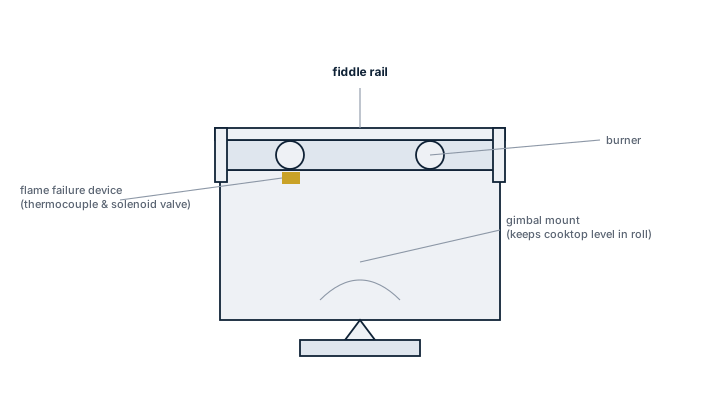
Legend
- fiddle rail
- burner
- flame failure device (thermocouple & solenoid valve)
- gimbal mount (keeps cooktop level in roll)
Main components
Ranges and ovens
Combined range-oven units are common on smaller ships to save galley footprint; larger vessels split them into separate ranges, convection ovens and combi-steamers. Electric induction ranges are increasingly specified over gas or diesel-fired ranges because they remove an open flame and a fuel line from the galley altogether.
Deep fat fryers
Fitted with a high-temperature cutout independent of the normal thermostat, and increasingly with a lid or splash guard that can be closed quickly, since a spilled fryer is one of the more common sources of galley fire and burn injury aboard.
Ganzen Leitfaden lesen
Fiddle rails, gimbals and securing points
Pots and pans need fiddle rails on the range top to stop them sliding in a seaway. Larger vessels sometimes gimbal an entire stove so the cooking surface stays closer to level regardless of roll; smaller ships more often just rely on rails, non-slip surfaces and disciplined stowage.
Selection considerations
| Factor | Why it matters |
|---|---|
| Crew or passenger headcount | Sets required oven and range capacity, and mess room turnover |
| Available power supply (voltage, phase) | Electric galleys need enough generator capacity margin, especially with induction ranges |
| Ventilation and extraction capacity | Grease-laden exhaust must be ducted and filtered per fire safety requirements |
| Space for gimballing or fiddle rails | Retrofitting gimbals into an existing galley footprint is rarely simple |
Regulations and class
SOLAS Chapter II-2 fire safety provisions apply to galley installations, covering grease filter and duct fire protection, automatic extinguishing over deep fat fryers on larger passenger and cargo ships, and insulation of hot surfaces adjacent to accommodation bulkheads. Flag and class rules on food hygiene generally track ashore commercial kitchen practice for materials and surface finishes, stainless steel work surfaces, rounded internal corners, equipment that can be fully broken down for cleaning.
Typical faults
| Fault | Consequence |
|---|---|
| Grease buildup in the extraction duct | Major fire risk, a leading cause of galley fires aboard ship |
| Flame failure device disabled or bypassed on a gas range | Unburnt gas accumulates in the galley if the flame goes out unnoticed |
| Fiddle rails removed or left off after cleaning | Pans slide in a seaway, scalding injuries and spilled meals |
| Gimbal mechanism seized from lack of lubrication | Stove no longer levels correctly, defeating its purpose in a seaway |
What to look for in a supplier
- Marine type approval for the specific model, not a shore commercial unit adapted after the fact
- Documented flame-failure and tilt-cutoff performance for gas-fired appliances
- Stainless steel grades and surface finishes that hold up to salt air, not just standard catering-grade steel
- Spare parts and service support reachable at the ports the ship actually calls at
Grease duct cleaning gets deferred more often than any other galley maintenance item because it is dirty and inconvenient; treat the interval as a fire safety task, not a housekeeping one.
Modelle in diesem Typ.
Zuerst das am besten belegte Modell jedes Herstellers, dann das nächste — 10 von 10 Modellen in Galley Cooking Equipment. Jede Zeile führt zu Daten, Dokumenten und Servicehinweisen.
Hersteller.
Alle 10 Hersteller mit Modellen von Galley Cooking Equipment. Namen mit Herstellerseite öffnen diese; die übrigen öffnen eine Suche über die ganze Bibliothek.
Alle Hersteller der BibliothekAuch in Kombüse & Hauswirtschaft.
Die übrigen Gerätetypen dieser Kategorie.
Inspektionsbefunde zu dieser Ausrüstung
Aus öffentlichen Aufzeichnungen der Hafenstaatkontrolle und der US Coast Guard; die Zuordnung zu diesem Gerätetyp nimmt OceanSphere anhand der Bezeichnungen vor.
Untersuchungsberichte
- 2002-07-20 · MAIB (UK) · Fire caused by gas-fired barbecue in galley of passenger river cruiser Pride of Bath
- 1998-08-21 · MAIB (UK) · Fire in main galley of passenger cruise ship Edinburgh Castle
Schreiben Sie uns zu Ihrer Maschine — die Antwort kommt per E-Mail.
Nennen Sie Hersteller und Modell und worum es geht: ein Ersatzteil, einen Serviceeinsatz, eine zweite Meinung zu einem Datenblatt. Wir antworten per E-Mail.
Kein Typenschild zur Hand? Ein Foto vom Typenschild oder vom Teil genügt — einfach an die Anfrage anhängen.
Fragen, die bei dieser Ausrüstung aufkommen.
Sind die Daten zu Galley Cooking Equipment kostenfrei?
Ja. Jede Modellseite, jeder Leitfaden und jedes Datenblatt zu diesem Typ ist ohne Konto lesbar. Ein Konto bringt gespeicherte Suchen und Anfragen dazu, es nimmt nichts weg.
Mein Modell fehlt — was nun?
Schicken Sie uns das Typenschild. Wir bestimmen es von Hand, nehmen es in die Bibliothek auf — und wenn Sie ein Teil oder einen Service brauchen, liegt die Anfrage schon bei uns.
Können Sie ein Teil für Galley Cooking Equipment beschaffen?
Ja. Nennen Sie uns Hersteller, Modell und Bedarf — ein Mensch liest jede Anfrage und antwortet per E-Mail.