What to check on a Deep Fryer.
A marine deep fryer does the same job as any commercial fryer ashore - holding oil at a controlled frying temperature for consistent results - but it is built around the fact that the ship moves. The tank sits low and is baffled or shaped to resist oil surging out during roll, the unit is through-bolted to the deck rather than simply standing on rubber feet, and the whole appliance is smaller in footprint than its shoreside equivalent because galley space is tight. Heat source is either electric elements immersed…
What makes this type distinct
A marine deep fryer does the same job as any commercial fryer ashore - holding oil at a controlled frying temperature for consistent results - but it is built around the fact that the ship moves. The tank sits low and is baffled or shaped to resist oil surging out during roll, the unit is through-bolted to the deck rather than simply standing on rubber feet, and the whole appliance is smaller in footprint than its shoreside equivalent because galley space is tight. Heat source is either electric elements immersed in or beneath the oil, or gas burners under the tank on vessels running LPG or natural gas galleys, with electric dominating on most merchant ships because of the fire risk and bunkering complexity of gas at sea.
Main components
Frying tank
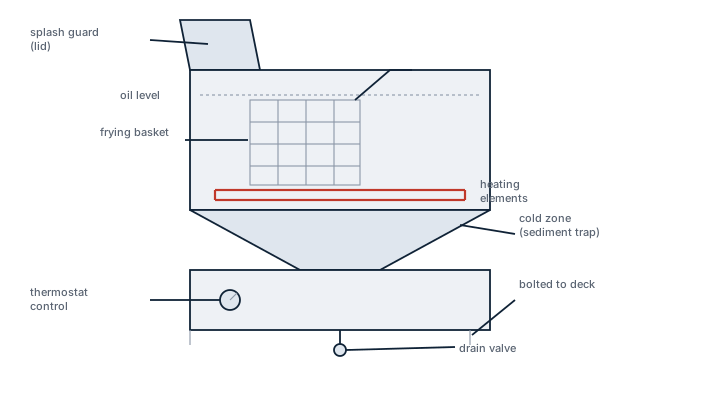
Stainless steel tank, often with a cooler zone below the heating elements where crumbs and debris settle away from the hottest oil, extending oil life between changes.
Heating elements or burners
Electric immersion or under-tank elements with a thermostat, or gas burners with a pilot or electronic ignition and a flame failure device that cuts gas supply if the flame goes out.
Basket and lift mechanism
One or more frying baskets, sometimes with an automatic lift that raises the basket out of the oil at the set time, useful in a rolling galley where a crew member cannot always watch the timer.
High-limit and lid/splash guard
Independent high-limit thermostat that cuts power if the main control fails, plus a splash guard or lid arrangement to contain oil movement during heavy rolling.
Filtration
Built-in or portable oil filtration on larger units, extending oil life and reducing the volume of used cooking oil generated, which otherwise has to be stored and landed ashore as waste.
Selection and sizing
Tank capacity and heating output are sized to crew or passenger numbers and expected meal service pattern, balanced against galley space and the vessel's electrical or gas supply capacity. Recovery time - how fast the oil returns to set temperature after a batch of frozen food goes in - matters more at sea than raw wattage, since a slow-recovering fryer produces greasy, oil-soaked food. Bolted footprint and low centre of gravity should be checked against the vessel's stated roll angle in the galley equipment specification, not assumed from a shoreside catalogue rating.
- Tank capacity in litres of oil against expected batch sizes
- Heating output and recovery time after a cold food load
- Electric supply voltage and phase, or gas type and burner rating
- Bolting arrangement and low-profile design suited to the vessel's motion
- Availability of oil filtration to reduce waste oil volume
Regulations and class
Galley cooking equipment falls under SOLAS Ch. II-2 fire safety provisions for galleys, including required fixed fire extinguishing arrangements over cooking appliances and automatic shut-off of fuel or power on fire detection at the range. Flag and port state food hygiene rules apply to the equipment's cleanability and the handling of cooking oil, and used cooking oil is subject to MARPOL Annex V garbage management requirements once it becomes waste for disposal ashore. Class does not typically survey the fryer itself beyond electrical installation checks, but the fixed fire suppression over the galley range is surveyed.
Typical faults
| Fault | Consequence |
|---|---|
| High-limit thermostat bypassed or failed | Oil overheats towards its flash point, serious fire risk |
| Bolting to deck loosened over time | Fryer shifts in heavy rolling, hot oil spill risk |
| Flame failure device disabled on gas units | Unburned gas accumulates in the galley if the flame goes out |
| Oil not filtered or changed on schedule | Degraded oil smokes at lower temperature and affects food quality |
| Splash guard missing or left open | Oil surges onto the deck or crew during rolling |
What to look for in a supplier
- Bolt-down base and tank shape specifically rated for marine motion, not a shoreside model with feet swapped for holes
- Independent high-limit protection as standard, separate from the operating thermostat
- Compatibility of the fixed fire suppression nozzle layout with the galley range design
- Electrical certification matching the ship's supply voltage and frequency without a step-down transformer as a workaround
- Spare heating elements and thermostats held or quickly sourceable in the ship's trading area
Check the deck bolts on the fryer at the same interval as the range hood fire suppression inspection - a fryer that has walked half an inch on its mounts is the first sign the bolts need re-torquing before someone gets burned in a roll.
